For the downtown evaluation I include 15th St as the western edge, I-235 as the north, and MLK as the southern edge. Between MLK and the river is a former brownfield that is slowly being redeveloped as mixed-use fabric. This should be nice when it is finished but is still long way to go before its a cohesive neighborhood and partially removed from the rest of Downtown.
Downtown Des Moines like most American cities is the place where Des Moines was founded starting with the establishment of Fort Des Moines in 1843. The area served as a military outpost designed to control conflicts between Native Americans and settlers. By 1851, it was incorporated as a city and quickly grew thanks to its strategic location at the confluence of the Des Moines and Raccoon Rivers. City leaders wisely created greenspace and civic centers along both sides of the rivers (instead of industrial uses) and created the Civic Center Historic District flanked by several early 20th century Beaux Arts buildings on both sides of the river. By the mid to late 20th century Downtown Des Moines hosted several large corporations typically specializing in insurance and finance each with their own expansive headquarters. Like other northern midwestern cities, Des Moines also invested in a pretty extensive skywalk network over four miles long.
While Dwtn hosts an impressive 70K dwtn workers this has created lots of dead parking spaces, office towers without much street activity, and a lack of activity after 5 PM. Fortunately Civic leaders have woken up to this reality and over the past 2 decades investments have made Des Moines better for living and hanging out. Other key revitalization efforts include the face lift of the Walnut Street Corridor with new streetscaping and opening of high end retail and restaurants. Major investments were made to the 1.2 Riverwalk where the Civic Center Historic District is located. The Western Gateway was redeveloped as a 7 block long Sculpture Park boasting 28 pieces of art and over 4.4 acres of green park space. Investments have also been made in the Court Avenue District hosting a collection of wonderful late 20th century commercial buildings and now the main night life hub of Dwtn. But for Dwtn Des Moines to top the list of mid-sized City Downtowns it needs more multi-family buildings developed on existing surface parking lots, less parking garages, more local retail and boutiques that help drive active street life and reduce dead spaces.
Click here to view my Downtown Des Moines Album on Flickr
URBAN STRENGTHS:
- Excellent sidewalk and ADA infrastructure throughout all of Dwtn. Almost all curb have modern ADA standards.
- Decent population for a Dwtn area.
- Excellent logical grid Dwtn but too many wide one-way pairs and its too easy to get to Dwtn by car.
- Pretty good bike infrastructure in Dwtn Des Moines including several dedicated bike trails and riverfront trail and solid bike sharing system that covers Dwtn and several inner city neighborhoods. Pretty good network across the regional with several expansive trails connecting to Dwtn running along the rivers. Decent connections to inner city neighborhoods and expansive trails in the Western Des Moines suburbs.
- Museums dwtn include Science Center, several historic sites, minor league ball park & arena.
- Decent rental supply and pretty affordable compared to other US cities. Studios lease btwn $800-1K, 1-beds btwn 1K-1.8K, 2-beds btwn similar price but a bit more expensive but 3-beds are very limited.
- Lots of for sale product as well and pretty affordable with 1-beds selling btwn 150K-400K. 2-beds sell btwn 200K-500K, and a decent amount of 3-beds selling anywhere btwn 350K-700K.
- Good parks in Dwtn Des Moines including an extensive waterfront and recreational trail, the well designed Cowles Commons, the several block long Pappajohn Sculpture Park, and several smaller plazas.
- Des Moines has really two civic plazas (Pappajohn Sculpture Park and Cowles Commons) with Pappajohn as the heart now of Dwtn. But are relatively new parks.
- Good cultural amenities including excellent food & beverage amenities, several art galleries, the outdoor sculpture park at Pappajohn, several performing arts centers, a handful of live music venues including a jazz club, several night clubs, and a decent # of museums. Other major Dwtn amenities include a major convention center, an arena, ballpark, and a major Dwtn public library.
- Dwtn Des Moines has just over 70K employees a very impressive number of its metro size and has recovered better than most American Dwtns with a pandemic workforce of 80K.
- Dwtn is overall pretty safe and clean. Not much grit here.
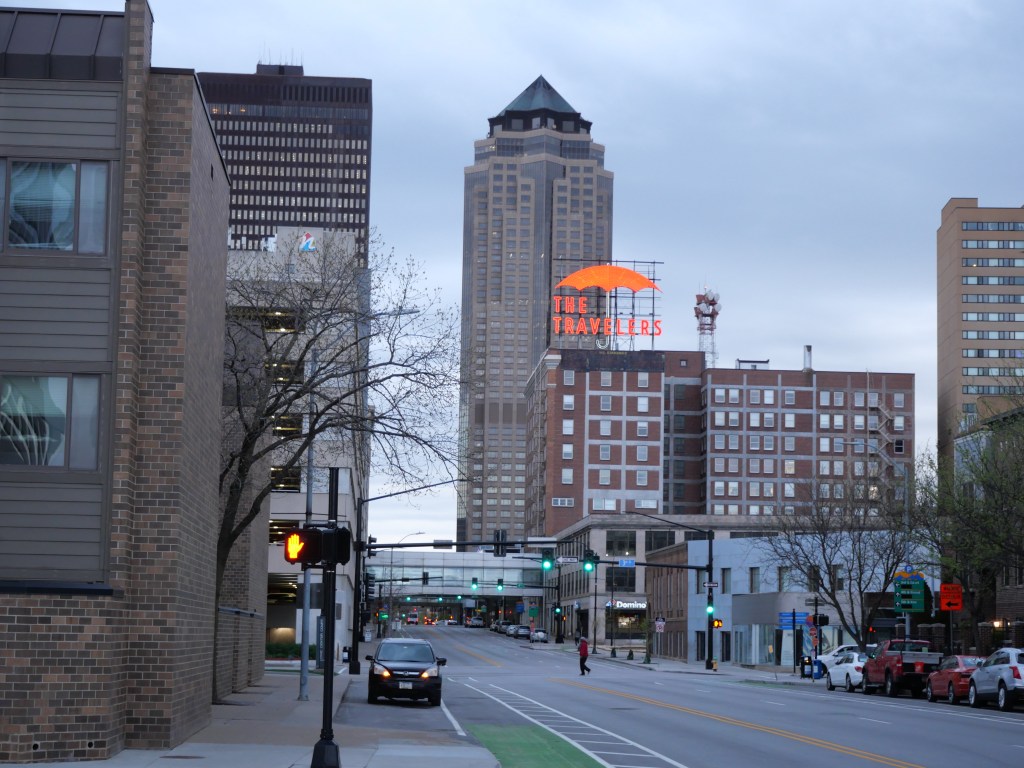
- Solid skyline for its size of size pretty filled out vertical and visually interesting.
- Nice concentration of historic bldgs on Court St and the riverfront but only a sprinkling of historic structures elsewhere.
URBAN WEAKNESSES:
- While young professionals are growing in Dwtn still a dipropionate amount of people in poverty living Dwtn.
- So so transit access being good Dwtn, north, northwest and slightly west and east of Dwtn. Sub par transit access in south Des Moines which is pretty suburban. Western suburbs of Des Moines have the best transit access but good transit access is limited out here.
- Children’s museum is out in the Western Suburbs.
- Two schools within Dwtn and one on the boarder with Sherman Hill. The High School rates well but not the grade school. Still nice to have walkable schools dwtn, which many cities cannot claim.
- Some important retail amenities exist Dwtn including a supermarket, plenty of banks, a handful of clothing stores & gift stores, several dessert joints & gyms, several churches and a major Hospital. But Dwtn lacks the independent stores and boutiques common in most dwtn likely due to the fact that Dwtn caters mostly to office workers and residents and that many of these stores exist across the river in East Village.
- No major universities Dwtn but several smaller satellite campuses. Drake university is the closest larger university 3 miles to the northwest.
- Some nicer modern infill apartment bldgs and iconic commercial towers but much of Dwtn is filled with rather bland office towers and lots of parking lots.
- So so pedestrian activity.”

 Evaluating our Urban Communities [with a focus on America]