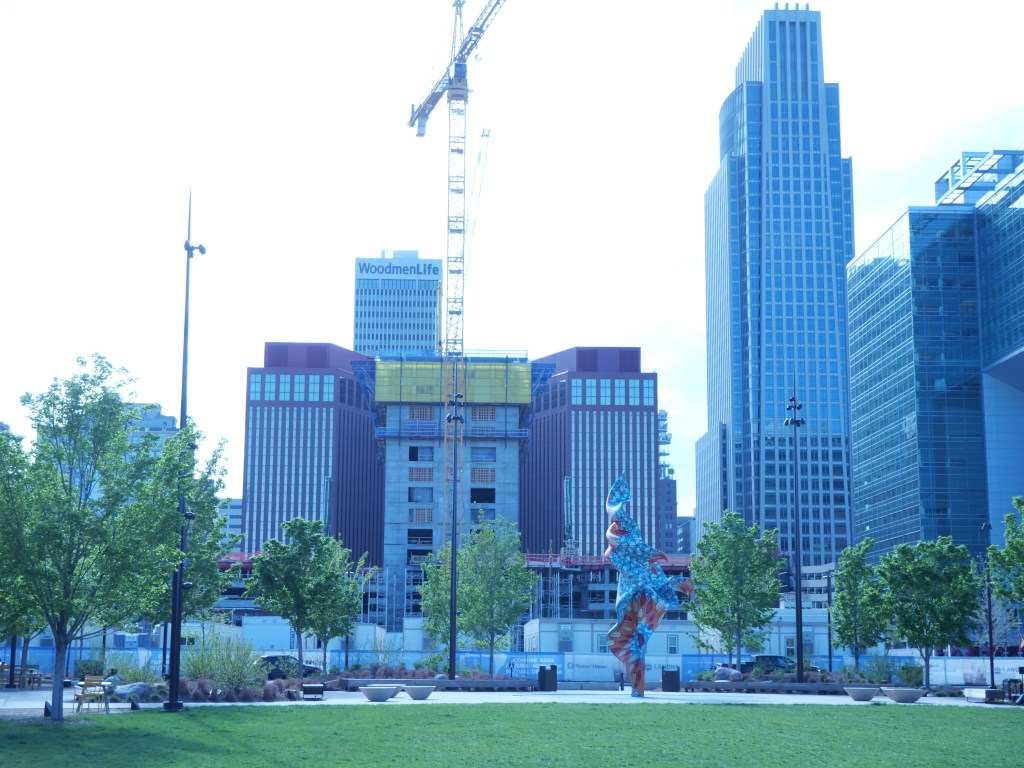
Downtown Omaha developed as the beginnings of Omaha in the 1850s. The Union Pacific Railroad was quickly headquartered here in 1862 and the town exploded. Downtown first developed north of the Union Pacific Railroad station in what is now called The Old Market. The warehouse district has mostly been preserved and is now a bustling walkable district and Omaha’s most important tourist area. Just Northeast of here was the Jobbers Canyon, a large area of massive warehouses. Sadly this was torn down in 1989 but thankfully much of the area has been transferred into high quality Dwtn park space. Another notable historic district was the Sporting District, famous for crime and prostitution in Omaha in the late 19th century and early 20th century. This historic area at 16th and Harney street has some of the best preserved buildings from the turn of the century in Dwtn. Much of the core of Dwtn has been transformed into the outstanding Gene Leahy Makk and the riverfront contains the expansive Heart of America Park and extensive riverfront park space. Lots of dead spaces on the western edge of Dwtn and especially north of I-80 (outside of Creighton University). But some good momentum building with lots of mixed-use development surrounding the ballpark and some good in-fill around Capitol Avenue. The 20 -acre Mercantile development should break ground soon and will help fill in some of Omaha’s dead blocks near Central High School. Also some good momentum north of the Ballpark with the Millworks Commons development, which is a 50 acres urban redevelopment project.
Overall Omaha has 8 Billion dollars of redevelopment planned along with a new streetcar project to connect to Midtown. This will go a long way towards reenergizing its many dead spaces that have persisted for decades along the western and north edges of Dwtn. I wish more Downtowns had this level of ambition.
Click here to view my Downtown Omaha album on Flickr
URBAN STRENGTHS:
* Decent density for an urban district. Very vertical skyline for a City of this size.
* Generally solid sidewalks and ADA infrastructure. Some ADA curb missing on the edges of the Dwtn & the Old Market.
* Quality public transit in the Pre WWII part of Omaha and some of the post WWII development but really only with in the City limits. The western suburban third of Omaha has virtually not public transit options and similar situation in the suburbs with the except of some public transit service in Council Bluffs.
* Thankfully not a full inner belt around Dwtn Omaha but still two highways cutting on the edge of it.
* Pretty good Bike share system across Omaha with especially good service in Dwtn and Midtown but decent service is several other neighborhoods.
* Great racial and economic diversity living in Dwtn.
* Decent # of activities for kids including Children’s & Science Museum. a minor league ballpark, and several large parks.
* Public elementary and high school within Dwtn and one elementary school located just north of Dwtn. All are poorly rated.
* Good array of rentals and generally very affordable. Studios lease for $600-1.4K, 1-beds anywhere from $700-2K, 2-beds for 1.1K-3K, and 3-beds are generally pretty limited. Decent for sale options. 1-bed sell btwn 200K-600, 2-beds for 400K-900K, and a decent # of 3-beds in a similar range with some 1M condos.
* Dwtn is generally safe but has the standard American Dwtn issues of homeless and drinkers. Plenty of dead, and gritty spaces on the edges of Dwtn that invite this.
* Dwtn has some World Class parks that many American cities should be envy of including the Heart of America Park with a lagoon, extensive riverfront park, Gene Leahy Mall with diverse amenities and a outdoor stage, Lewis & Clark Landing Park, Miller’s Landing Park and a handful of smaller plazas.
* Good student population thanks to the 8K students add ending Creighton located on the north edge of Dwtn. Not much else however.
* Solid amenities including plenty of food & beverage businesses, several art galleries & live music venues, good # of museums & historic sites, several performing arts centers including mostly modern ones. Other amenities include a ballpark, a couple arenas, a large convention center, and a modest Dwtn library.
* Decent retail amenities but mostly concentrated in the Old Market. This includes lots of boutiques, clothing stores, antiques, a couple bookstores and specialty stores. Also plenty of dessert joints & banks, and a couple gyms.
* Well preserved warehouse district in Old Town. Decent early 20th century mid rise buildings in the core esp. at 16th and Harney St.
* Nice wide sidewalks with pretty good streetscaping overall. Not as good north of 480.
URBAN WEAKNESSES:
* Generally nicely gridded streets but lots of wide one way pairs and blocks are pretty large.
* Decent Bike lanes within Dwtn but they don’t connect much to surrounding inner ring neighborhoods, which themselves lack bike lanes. Solid bike system in the western suburbs and pretty good in Council Bluffs as well.
* Overwhelming downtown population is either students, young professionals or empty nesters.
* While Dwtn’s park amenities are great I would like to see more smaller parklettes and plazas spread throughout. They are very concentrated along the Riverfront and the Mall moving perpendicular from the riverfront.
* Maybe 30K jobs in Dwtn Omaha. An ok number and Civic leaders are really trying to add another 30K of jobs even after the pandemic.
* No supermarket or drug store dwtn. Only a couple churches dwtn. Limited retail options outside of OId Town especially non-food and beverage businesses.
* Lots of dead space Dwtn outside of Old Town and the Arena District. Eastern side of Capitol Ave is fortunately starting to fill in.
* Decent urban infill along parts of Capitol, surrounding the ballpark, and around Gene Leahy Mall. But most modern buildings are soulless mid-century towers with limited street life creating significant dead zones dwtn.
* Lots of surface parking lots Dwtn especially the western half of dwtn but even more so north of 480.

 Evaluating our Urban Communities [with a focus on America]