Fort Greene was named after an American Revolutionary War era fort built in 1776 under the supervision of General Nathanael Greene. Fort Greene Park, originally called “Washington Park”, is Brooklyn’s first park and in 1864 was redesigned by none other than Frederick Law Olmsted and Calvert Vaux. In the 1850s, Fort Greene’s growth spread out from stagecoach lines along Myrtle Avenue and Fulton Street and became home to many prosperous professionals, second only to Brooklyn Heights in prestige. The mid 19th century brought many Italianate brick and brownstone row houses as Fort Greene continued to grow. The neighborhood is also the historic African-American heart of Brooklyn where many professional Black families began to settle in the mid-19th century. By 1870, more than half of Brooklyn’s Black population lived in Fort Greene, most north of the Park. By the 1870s, Fort Greene was virtually built out but slowly densified and transportation connections improved. Fort Greene is also a haven of the arts thanks to the relocation of the Brooklyn Academy of Music in 1908. Increasingly in the 20th century Fort Greene lost its prestige as more and more wealthy families moved further east. The New York City Housing Authority also built 35 brick project housing in the 1940s and by the 1960s Fort Greene struggled with issues of poverty, crime, and the eventually the crack epidemic in the 1980s. Yet by the late 1980s artists, preservationists and Black professionals began to claim and restore the neighborhood and by the early 2000s Fort Greene was welcoming many new residents & businesses and was well on its way to gentrification. Sadly this partially resulted in a significant drop in the neighborhood’s Black population which decreased from 42% in 2000 to 23% in 2020. While the neighborhood has welcomed more and more affluent White families it has also grown in its Hispanic and Asian Population, which both now comprise about 11% of the population. Fortunately much of the economic diversity has been preserved thanks to a large number of dedicated affordable units and stabilized rentals.
Given its proximity just east to Dwtn Brooklyn, a 25 min subway ride to both Lower Manhattan and Midtown, and excellent walkability and urban amenities, this is a top tier American urban district lined with gorgeous historic brownstones. Fort Greene also has excellent park, retail, and cultural amenities, great schools, and is one of Brooklyn’s safest communities. The only areas to improve the neighborhood is to encourage more urban infill and road dieting along the autocentric thoroughfares of Atlantic and Flushing Avenues. Significant effort should also good towards maintaining affordable rentals and creating new affordable condos likely through a Community Land Trust structure.
Click here to view my Fort Greene Album on Flickr
URBAN STRENGTHS:
* Solid urban density at 50K per square mile.
* Excellent access to CBDs being just east of Dwtn Brooklyn a 25 min subway ride to Lower Manhattan and 30 mins to Midtown.
* Greet ADA Curb and sidewalk infrastructure throughout. About 15-20% of intersections have outdated ADA curbs.
* Solid connectivity and urban grid as well including some diagonal streets too providing smaller blocks. The street grid gets disrupted a bit on the norther edge thanks to the Brooklyn-Queens Expressway and several housing projects.
* Excellent bike infrastructure including several dedicated bike lanes and tons of bike share stations.
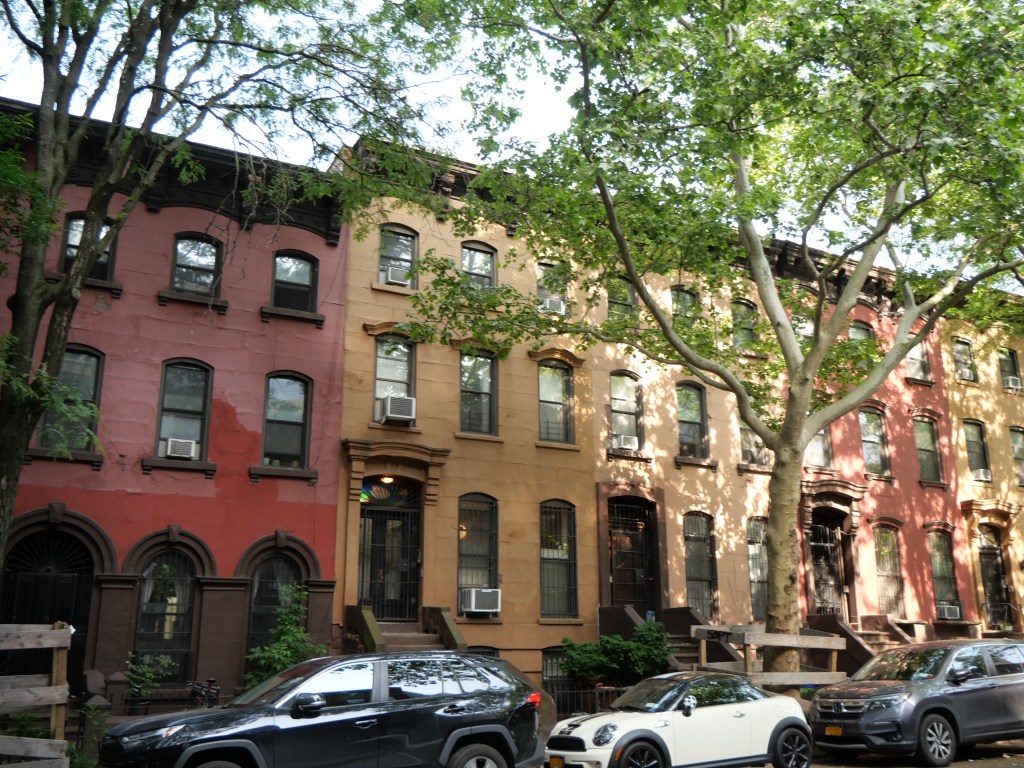
* Excellent urban architecture including an extensive amount of stately late 19th century Brooklyn rowhouses along most residential streets, a handful of good urban infill buildings, quality Dwtn modern infill along the western edge. The only poor architecture is along the Brooklyn-Queens Expressway there is a large unattractive mid-century project and a some low quality industrial uses.
* Very thick tree canopy for such a dense and urban district.
* Other than a couple throughfares (Flushing’s & Atlantic) urban form and streetscaping is excellent.
* Very safe community, one of Brooklyn’s safest.
* Good economic diversity and even better racial diversity. Also solid age diversity and lots of families here.
* Great walkable schools really across all categories and most of the public schools are well rated.
* Solid cultural amenities including plenty of restaurants, bars & cafes, a couple art galleries, several performing arts theaters (mostly included within the Brooklyn Academy of Music), a couple Indie Movie Theaters, the Barclay Center, a couple live music venues, and a couple local museums.
* Solid retail amenities including several supermarket, grocerias, and co-ops, several drug stores, several # of boutiques/gift stores, a couple book stores and hardware stores, a couple gyms and several dessert joints, a couple of florists, 3 public libraries, a local post offices & public library, and a major hospital, On the southern edge of Fort Green there is a Target & Marshall’s, Best Buy, Burlington, and many other stores in the Atlantic Terminal Mall.
* Solid park amenities including the expansive & historic Ft. Greene Park, several well dispersed playgrounds, ball courts, and parklettes, and a public pool.
* Good amount of rental product especially along the western boarder with Dwtn Brooklyn. But market rentals are very expensive. Studios lease btwn n the 2.5K-4.0K,1-beds btwn 2.5K-5.5K, 2-beds btwn 3K-7 K. Not a ton of 3-bed product. Good number of rental stabilized units however and the number of rentals below 2K exceeds far exceeds the # above 2K.
URBAN WEAKNESSES:
- Few churches here.
- Flushing’s and Atlantic are both wide boulevards with a fair amount of unattractive and autocentric uses along them.
- A lot of for sale condo product but generally very expensive. Limited # of studios but plenty of 1-beds selling btwn 500K-2M. . 2-beds range btwn 650K-2.5M with most units selling btwn 1.2M–2.5M. Decent # of 3-beds but very expensive ranging anywhere from 850K-3.5M. Lots of 4-bed townhouses generally selling btwn 2M-4M.”

 Evaluating our Urban Communities [with a focus on America]