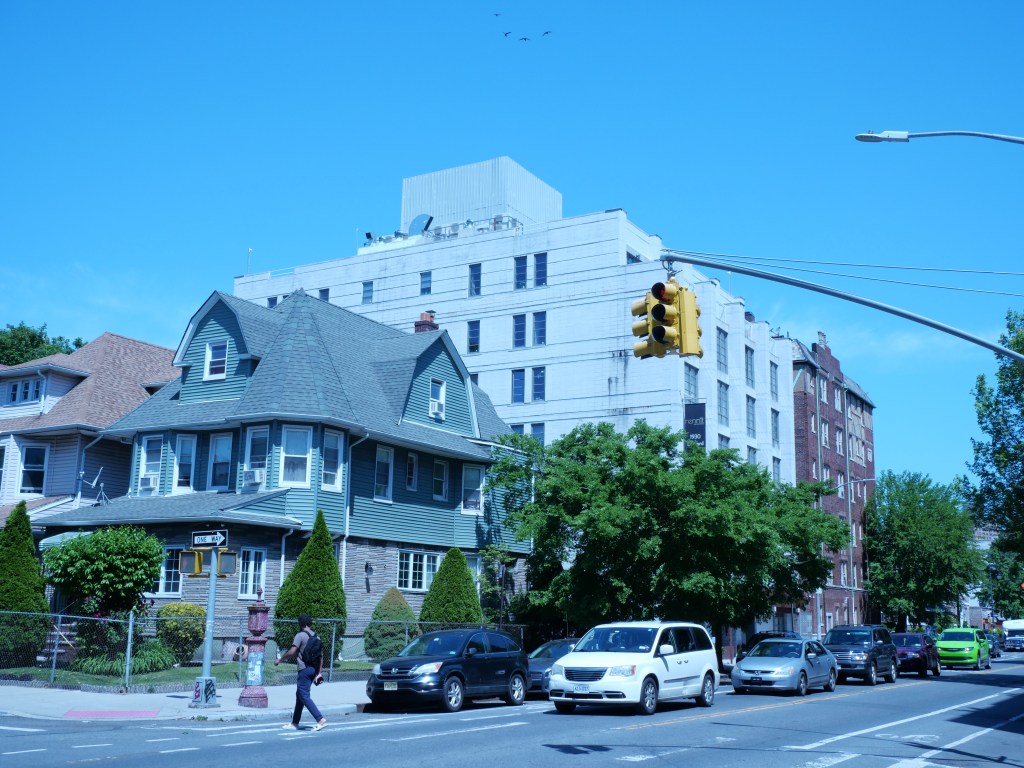
Prospect Lefferts Gardens is a residential neighborhood that many refer to as the broader Flatbush community. Prospect Lefferts Gardens is a combination of the names of three nearby locations which was coined in the late 1960s with the creation of the Prospect Lefferts Gardens Neighborhood Association. It wasn’t until the late 1800s that the area was built up starting with the development of the Lefferts’s estate in 1893 by James Lefferts. In order to ensure that the neighborhood would contain homes of a substantial nature, Lefferts attached land-use deed restrictions to the lots dictating that each lot contain a single family residence built of brick or stone at least two stories in height. These restrictions exist to this day and explain why a good portion of the neighborhood’s historic brownstones remain in tact. The land restrictions became more formalized with the Lefferts Manor Historic District in 1992. Through the decades Prospect Lefferts Gardens developed a very eclectic mix architecture from gorgeous brownstones, to ornate single family homes, to 1920s and mid century apartment bldgs, and even brick/tudor rowhouses and more working class rowhouses on the eastern edges. There is some modern in-fill scattered through the neighborhood (esp. along Clarkson) but the neighborhood has only begun to see gentrification since the 2000s and it seems to be spreading relatively slowly. Since after WW II the neighborhood became more and more ethnically diverse first welcoming African Americans during the Great Migration and then large Caribbean families. Caribbean immigrants have also settled in surrounding areas such as East Flatbush, Flatbush, and Crown Heights. The overlapping sections of these neighborhoods is often referred to as Little Caribbean.
From an urban Prospect Lefferts Gardens is yet another turn of the century Brooklyn neighborhood with great public transit access and walkability. It also has great park amenities thanks to its convenient proximity to Prospect Park, solid cultural and retail amenities, and still contains good racial and economic diversity. Since gentrification got underway in the early 2000s I sense the school quality has improved and crime has dropped. The business districts however ( Nostrand, and Rogers Ave) remain gritty with a fair amount of vacancies and there is a good amount of autocentric uses and surface parking lots along the neighborhood’s eastern and northern edges. The neighborhood needs more dedicated bike lanes and a major supermarket and more boutiques. I hope Prospect Lefferts Gardens can keep its racial and economic diversity moving forward. This will largely depend on whether it can retain its stabilized rental units and expand affordable housing options.
Click here to view my Prospect Lefferts Garden album on Flickr
URBAN STRENGTHS:
- Solid sidewalks and ADA infrastructure. Most intersections have modern ADA curb cuts.
- Great urban density at 56K residents per square mile.
- Very eclectic architecture from gorgeous brownstones, to ornate single family homes, to 1920s and mid century apartment bldgs, and even brick/tudor rowhouses and more working class rowhouses. Some modern in-fill scattered about the neighborhood.
- Good access to Dwtn Brooklyn, Lower Manhattan and Midtown 30-40 mins by subway but not as good as the Inner Brooklyn neighborhoods.
- Nearly before urban grid and connectivity.
- Good bike infrastructure including plenty of dedicated bike stations but only a handful of bike lanes, much less than other surrounding Brooklyn neighborhoods.
- Solid tree canopy except the southern and eastern edges of the neighborhood.
- Good racial diversity and still a Black Majority neighborhood with larger Hispanic and growing White populations. Excellent economic diversity.
- Pretty good age diversity thanks to the diverse array of housing types.
- Decent range of rentals although listed rentals are very expensive. Studios and 1 beds lease btwn 2K-3.5K, 2-beds btwn 2.8-4.2K, and plenty of 3-beds leasing btwn 3-5K with a handful of more expensive options. Good amount of the rental supply is dedicated affordable rentals or rent stabilized as 3/4s of rental product lease under 2K.
- Solid school amenities with a good number of public schools that are generally well rated and pretty good choice of charter and private schools.
- Great park access thanks alone to the neighborhood’s proximity to Prospect Park where no resident is more than a 10 min walk from. Also a handful of small and medium sized parks sprinkled throughout the district.
- Solid cultural amenities including plenty of restaurants, bars & cafes, several art galleries and local music venues, and the Brooklyn Botanic Garden, Brooklyn Zoo, and Brooklyn Museums are short walk to the west.
- Solid retail amenities including several medium and smaller grocery stores, plenty drug stores and hardware stores, a decent # of boutiques/clothing/gift stores (but mostly concentrated on the more gentrified Flatbush Ave), a couple bookstores and florists, several home goods and furniture stores, some gyms and dessert joints, a couple public libraries and post offices sit just outside the neighborhood boundaries. tons of churches, and NYC hospital is along the neighborhood’s eastern edge. An urban home depot and a 5 Below stores are located just south of the neighborhood boundaries along Flatbush Ave.
URBAN WEAKNESSES:
- Streetscaping along the business district are fine with often wide sidewalks but very gritty and outdated.
- Overall solid urban form along the main biz districts of Flatbush, Nostrand, and Rogers Avenue but good amount of surface parking and some autocentric uses here and along the northern border of Empire Blvd.
- Prospect Lefferts Gardens is generally safe but the gentrified western half is certainly safer than the gritter eastern half.
- For sale housing are expensive but much more reasonable that many other Brooklyn neighborhoods. There is a decent # of moderately priced studios selling btwn 200K-550K, 1-beds sell btwn 300K-850K, 2-beds range btwn 400K-1.2M, 3-beds btwn 700K-3M. 4 beds range anywhere btwn 800K and 4M.
- Missing a major supermarket within the neighborhood, a larger Home goods stores, and banks are limited. Also limited # of boutiques and locally owned creative stores more plentiful in other more gentrified Inner Brooklyn neighborhoods.”

 Evaluating our Urban Communities [with a focus on America]