Melrose was originally built as a dense working-class neighborhood in the early 20th century mainly for working class German immigrants looking to escape the slums of lower Manhattan. After WWII the neighborhood transitioned to mostly Irish and Italian immigrants. But by the late 1960s as the slums of Mott Haven expanded northwards, Melrose became a place of concentrated poverty and transitioned to mostly Puerto Rican, Dominican immigrants, and African Americans. President Carter infamously visited the neighborhood in 1977 as part of his tour assessing the damage in the Bronx during the period of mass arsons and destruction. But this is fortunately a happy story. Melrose had a particularly strong community lead rebuilding effort lead by Nos Quedamos starting in the 1980s and most of the vacant buildings have been renovated or rebuilt. Nos Quedamos operates 20 buildings (1400 units) with a mix of affordable rentals and homeownership opportunities. Many attached townhouses were built too, which now sell for 600K-900K allowing working class residents to move into housing stability. Melrose still contains one of the highest concentrations of NYCHA projects in the Bronx but this is a pretty stable community now with much lower rates of crime than the 1990s and limited vacant. Even if the neighborhood gentrified likely half of the housing would remain protected for affordability.
Melrose also contains the HUB shopping district on its southern border where 3rd Ave and Melrose come together providing the district with great retail amenities. Melrose is not surprisingly a very walkable neighborhood thanks to its great subway and bike infrastructure access. It also has solid schools and park amenities. For Melrose to become a top tier urban district it does need to gentrify a bit allowing more retail and especially cultural amenities to flourish. I just hope it can make this transition while preserving its affordable housing. Melrose could certainly use some more economic and racial diversity as it is a 70% Hispanic neighborhood with mostly lower-moderate income households.
Click here to view my Melrose Album on Flickr
URBAN STRENGTHS:
- Generally good sidewalk infrastructure but ADA curb cuts are hit or miss on about half of all intersections.
- Great density at just over 60K residents per square mile.
- Excellent public transit access as 3 subway lines run through the district. Midtown is only a 45 min subway ride.
- Solid bike infrastructure include great dedicated bike stations and a good system of bike lanes.
- There is a decent amount of historic architecture remaining from the turn of the 20th century but its often pretty gritty. Some good rowhouse stock in the eastern half of Melrose historic commercial along Melrose, 3rd , St. Anne, and Prospect.
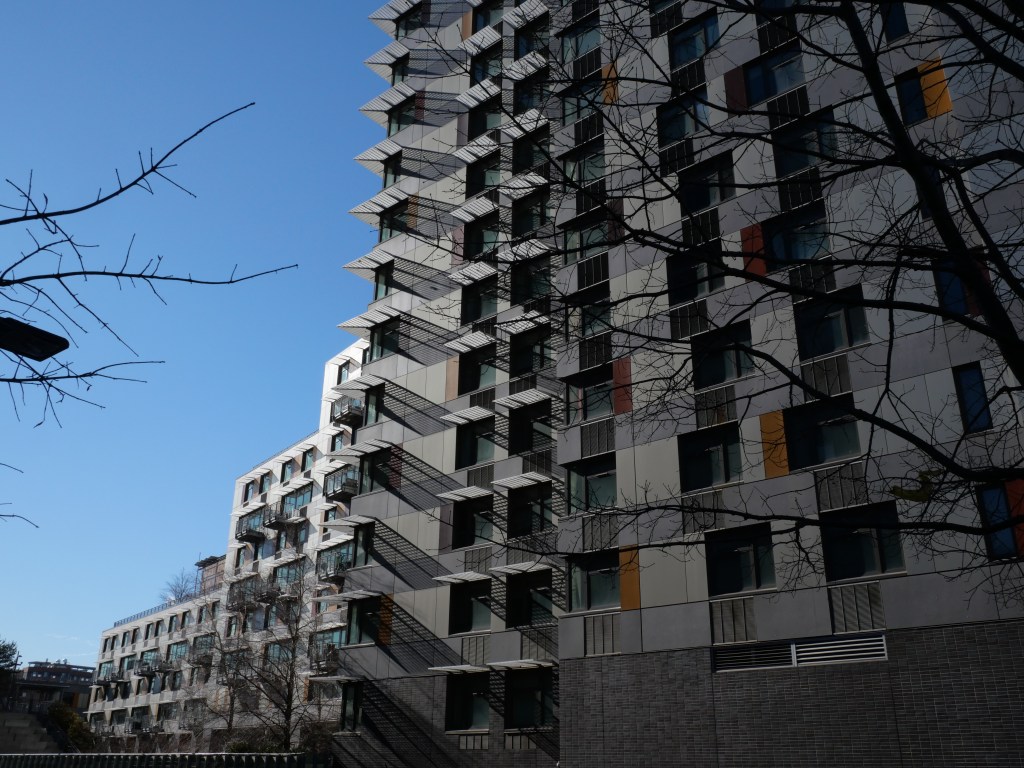
- Lots of 1960s-1980s infill that’s not particularly beautiful but generally has good form. Also plenty of project mid century high rises. Some more recent in-fill that looks nicer.
- Great pedestrian traffic along the commercial corridors and pretty average for NYC along the residential streets.
- Generally solid urban form throughout Melrose with the except of a handful of surface parking lots and industrial uses.
- Streetscaping is a mixed of tired outdated sidewalks and more recently updated.
- Generally goods schools and nice mix of public, private, and charter schools across all grades. Some poorly rated public schools mixed in.
- Melrose plenty rental inventory but most of it is not market rate (6:1 lease below 2K). Few studios that are market rate. Some 1-beds that lease btwn 1.8K-2.8K. 2 & 3 beds lease btwn 2-3Ks.
- Solid parks amenities with a good array of small and medium sized parks well dispersed throughout. The expansive St. Mary’s Park sits on the southern edge of Melrose.
- Solid retail amenities including plenty of supermarkets, several drug stores & hardware stores, tons of boutiques/clothing stores and some departments stores along the Melrose & 3rd Ave corridors, some furniture stores, several gyms. some dessert joints, a couple bike shops, a couple public libraries & post offices, several churches, tons of discount stores, plenty of doctor’s office & medical offices but no hospitals.
URBAN WEAKNESSES:
- Less economic diversity than Mott Haven as I suspect there are less young professionals living here. Most of the population is a mix of households in poverty or lower-middle class.
- Large Hispanic Majority at 75%. 25% of the population is Black. Very small Asian and White populations.
- Like most of the South Bronx Melrose is much safer than it was in the 90s and 2000s. That being said there does still seem to be some crime in the neighborhood but nothing like it used to be. Not a ton of blight in Melrose but still very gritty.
- Tree canopy is better than most South Bronx neighborhoods but still not great.
- While crime is higher than most parts of NYC Melrose’s crime rate has dropped by 60% since 1990.
- Not a ton of for sale product. A handful of 1-bed conds that sell btwn 175K-325K. More 2-beds that sell btwn 150K-400K. Some 3-bed townhouses (musty from the 60s that sell btwn 300K-750K. A handful of 4 & 5 beds that sell for upwards of 1M.
- Okay cultural amenities but pretty underwhelming for NYC including plenty of restaurants, several art galleries and a couple art galleries, a handful of bars & cafes, and a couple night clubs.”

 Evaluating our Urban Communities [with a focus on America]