In the late 19th century University City was primarily a small farming communities. Development of the area really began in the turn of the 20th century largely influenced by Woman magazine editor Edward Gardner Lewis’s decision to break ground for his publishing company’s headquarters: the Magazine Building (now City Hall) in 1903. The building is an ornate octagonal 135-foot tower. He also built several other City Beautiful monuments including Egyptian temple, the Art Academy, and the Lion Gates and incrementally sold off his land holdings around the Magazine Bldg. University City was formally incorporated in 1906and named after Washington University. Between 1910 and 1920, the City was exploding. By the 1920s, University City’s main business corridor, Delmar Boulevard, also referred to as the Loop, was a vibrant streetcar shopping destination. Like inner St. Louis neighborhoods, University City was affected by urban sprawl and white flight. Large numbers of African American families displaced by St. Louis’ extensive urban renewal projects moved in north of Olvie Blvd. Amazingly this black/white divide still largely exists in University City. The city has also had a large middle-class Jewish presence. University City lost about 30% of its population from its peak in 1960s but it appears it’s close to stabilizing at around 35K residents.
From an urban perspective University City is pretty walkable (especially around the Loop area). But it has solid public transit throughout most of this evaluation area and a couple smaller urban biz nodes throughout. Retail and cultural amenities are solid and there are lots of well dispersed parks. There is also a good array of rental and for sale price points making the City accessible to middle and upper middle class households. To become a top tier urban district University City needs more density and expanded mixed-use urban nodes. It also needs better schools, and to better racially integrate the City.
Click here to view my University City Album on Flickr
URBAN STRENGTHS:
* 90% of streets have sidewalks and about 65% of curb cuts are to modern standards.
* Good access to Dwtn via transit is you live close to one of the light rail stops or close to the St. Louis border (about 30-40 mins). The western edge is more like 50 mins away. Easy 15-20 min drive to Dwtn throughout.
* Most of the review area is well served by public transit thanks to several light rail stations on the southern edge.
* Overall University City is a pretty walkable City across walking, public transit, and driving. Most of its commercial activity is concentrated in the Loop in the extremely eastern edge of the City but some other smaller commercial notes (i.e. Delmar & North/South Rd, around he Forsyth Blvd station, and pretty convenient access to Dwtn Clayton for those living on the southern edge).
* Decent economic diversity likely thanks to the student population.
* Overall a very safe City, especially the area included in this evaluation.
* Good park amenities including many well distributed small-middle sized parks, a well funded pool & recreation center, and pretty convenient access to Wash U and Forest Park on the City’s Southeastern border.
* Other than the Delmar Loop area, tree canopy is excellent here.
* Good for sale housing diversity with a good number of condos selling btwn 100K-300K, mix of 2-bed condos and modest SF homes that sell btwn 150K-400K, tons of 3 & 4 beds product ranging anywhere from 300K-850K. Housing market is significantly cheaper north of Olive Blvd. The larger mansions sell for more like 1 M.
* Decent amount of rental product but clustered around the Loop, Midland Blvd, I-170/Forsyth Blvd. 1-beds lease btwn 800K-1.8K, 2-beds btwn 1K-2.5K, & more well dispersed 3-bed rentals (in a lot of SF homes) ranging anywhere from 1K-3K.
* Solid cultural amenities (mostly concentrated along Delmar) including plenty of restaurants, cafes, & bars, and several live music venues. Also a handful of art galleries and a performing arts theater located outside of the Loop and Wash U has an Art Museum and performing arts theater.
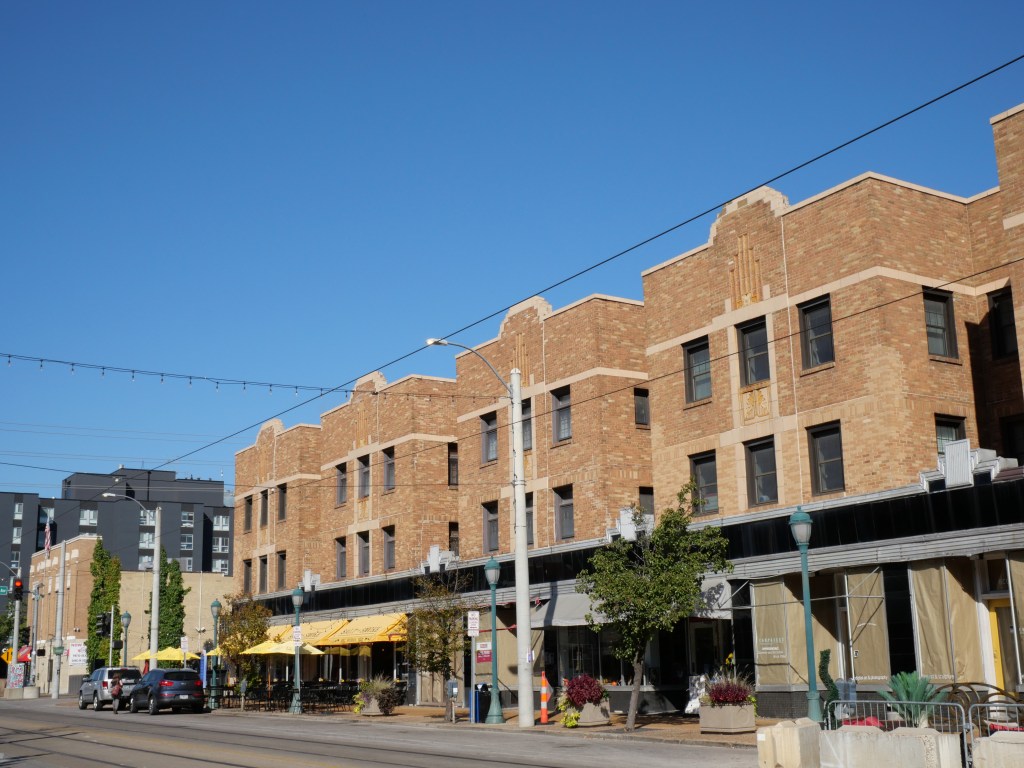
* Lots of nice historic homes from the 1910s-1940s but also some more modest brick ranges from the 1940s & 1950s mixed in. Great historic commercial bldgs along Delmar Blvd.
* Generally good urban form with just a couple of autocentric uses and blocks.
* Pretty retail amenities but 2/3s of amenities are concentrated in the Loop or along the Autocentric Olive Blvd not included in this eval. This includes several supermarkets & drug stores, decent # of clothing/boutiques, a couple gift stores & book stores, a couple banks, several dessert joints, a couple gyms, a couple local post offices, a public library, a couple doctor’s offices and plenty of churches.
URBAN WEAKNESSES:
* Decent density for an inner ring suburb but lower than most urban St. Louis Neighborhoods.
* The larger blocks of connected but many of the residential streets have deadens, are curvilinear or are closed to thru traffic, a common feature of St. Louis.
* Some short dedicated bike lane segment but nothing terribly useful. Like the rest of St. Louis there is no bike sharing system in University City.
* Quite the racial divide within University City. South of Delmar is 90-95% white. North of Delmar to Olive Blvd is a bit more diverse. North of Olvie is very Black with higher poverty rates. Some pockets of Asian populations thanks to Wash * Schools are pretty underwhelming for a relatively affluent inner ring suburb. Mixture of low and medium ratings for the public schools and only a handful of private schools. At least most of the schools are located within the more walkable part of University City.
* The worth urban form in University City includes the massive surface parking lot behind Delmar & Kingsland Ave and Forest Park Parkway (basically a highway) cutting through the southeastern edge of University City.

 Evaluating our Urban Communities [with a focus on America]