Dorchester was founded in 1630 and is actually a few months older than the founding of Boston. When annexed to Boston in 1870, Dorchester was still a primarily rural town and had a population of 12,000. This rapidly changed in the late 19th century with the construction of railroad and several commuter streetcar lines. By 1920 Dorchester hosted 150,000 quickly filled by 1st and 2nd generation European immigrants from Ireland, Germany, Italy, and Poland. During the 1960s–1980s, the ethnic landscape of Dorchester changed dramatically. High amounts of White flight and blockbusting occurred esp. in the Blue Hill section of Dorchester. During this period new immigrants (i.e. Vietnamese, Caribbean, and Cape Verdeans) began replacing White families settling here in the older housing. By the 1980s the Blue Hill Section of Dorchester had become predominately a Black and Caribbean district and large numbers of Vietnamese’s settled around Dorchester Ave. The generally rule of thumb racially for Dorchester is the western edge is more African & Caribbean and the Eastern half is more Vietnam, Irish, & Italian. There is a large Cape Verdean pocked in Upham’s Corner and the northern edge of Dorchester abutting South Boston hosts a large Polish concentration.
Not surprisingly there are several major Commercial Districts in Dorchester (Washington, Dorchester, Blue Hill, Upham’s Corner). Augmenting this are tons of smaller commercial nodes spread throughout the neighborhood. As you can imagine from its population size and period of development, Dorchester is a solid walkable district with great public transit access, convenience to Dwtn and solid retail and cultural amenities. The neighborhood has been on a steady comeback since the 2000s (after several decades of decline) and has little remaining blocks of blight and crime hotspots. There are also great park amenities here, many walkable schools, and a very diverse mix of races and economic incomes. Thanks to around 20% of all rental units being income restricted, the affects of gentrification are slower here than other parts of Boston. For Dorchester to become a top tier Urban District in American it could still use higher density which would facilitate even more retail amenities and better cultural activities.
Click here to view my Dorchester Album on Flickr
URBAN STRENGTHS:
* About 17% of Dorchester residents were school age children in 2015, higher than the citywide share of 11%. The neighborhood is also not over saturated by college students.
* Very diverse community w/ 40% of Dorchester residents as Black/African-American and 1/3 Foreign Born, 20% White, 18% Hispanic & 10% Asian.
* Solid Density Numbers at just over 20K per square mile.
* Very healthy economic diversity. The Medium income is a bit lower than the City as a whole but poverty is around 18% a good mix of all incomes.
* Several business districts and lots of mixed-use nodes throughout the neighborhood.
* Good ADA infrastructure and sidewalks but about 80% of intersections are up to ADA standards.
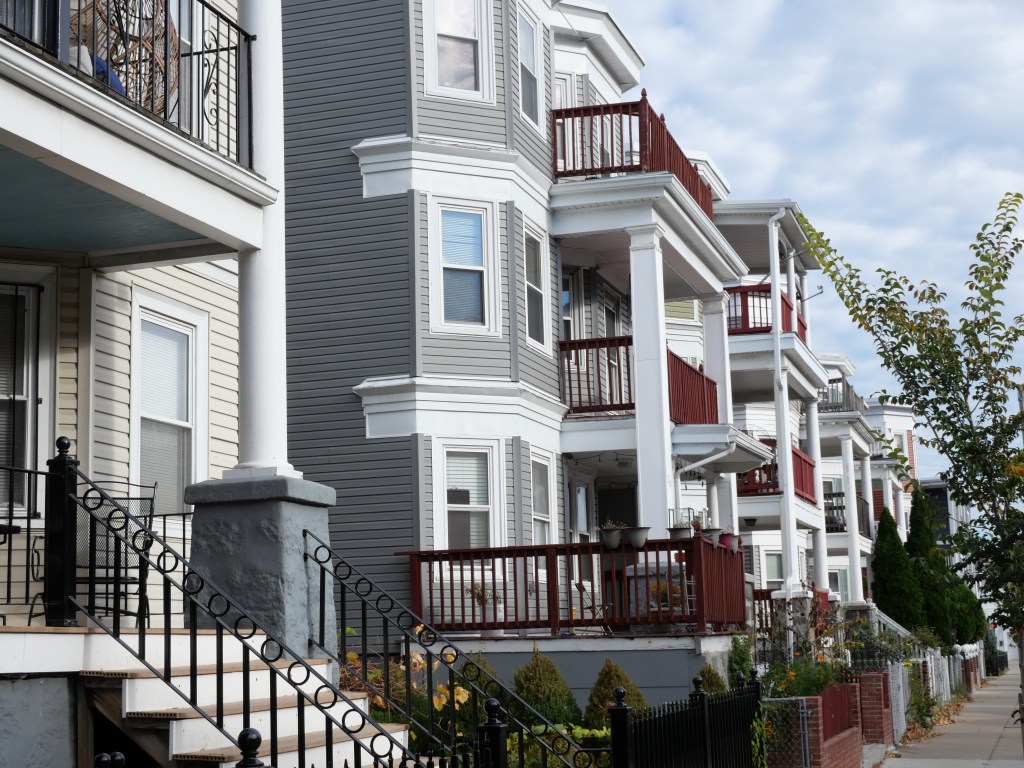
* Nice mix of historic styles from the late 19th to early 20th century including mostly wood frame. Nothing spectacular but not a lot of working housing junk.
* Two public transit wit two light rails running through
* Good number of public & private walkable schools but with mixed rating.
* Solid access to Dwtn largely due to the two rail lines that run through the neighborhood.
* Good coverage with Boston’s bike sharing system and decent dedicated bike lane system with good connections to Dwtn.
* Lots of rental options but expensive for National standards although certainly cheaper than more gentrified Boston districts and cheaper than Roxbury. Studios lease around 2K, 1-beds in the 2Ks, 2-beds btwn 2K-4.5K, and plenty of 3 & 4 beds that lease btwn 2.5K-6K. A sizable # of units at 20% are income restricted. Much less than Dorchester however.
* For sale housing is expensive but lots of smaller more reasonably priced condo options even for 3-bedrooms. 1-beds selling anywhere btwn 200K-600K, 2-beds btwn 250K-1M. 3 & 4 beds sell btwn 300K- the low 1.4M with a handful of more expensive options.. There is also an active Community Land Trust in Dorchester keeping some for sale homes affordable.
* Dorchester host a great array of well dispersed small and medium sized parks throughout and the larger Franklin Park and Dorchester Park. Also plenty of pools and recreation/Community centers.
* Decent amount of modern in-fill generally of good quality. Solid urban form throughout most stretches of Dorchester’s Commercial Districts accompanied by good streetscaping.
* Good retail including a Target, a couple full service supermarkets and plenty of smaller grocerias, several drug stores & banks, several clothing stores/boutiques, a book store, plenty of salons, plenty of bakeries and dessert joints, a couple public libraries and several post offices, plenty of churches, several doctor’s offices & health clinics. The AMC South Bay Center , suburban power center, on the northern edge of Dorchester, complete with a Macy’s Best Buy, Home Depot, Target and Cineplex.
URBAN WEAKNESSES:
* Some pockets of higher crime and blight but increasingly becoming far and between.
* Connectivity of blocks is pretty good in Dorchester but the lack of a solid grit makes navigation complicated. But better than Roxbury.
* Good but underwhelming cultural amenities for Boston. This includes plenty of food & beverage bizs, including many ethnic restaurants, a couple live music venues and local theaters, a cineplex, and several historic sites.

 Evaluating our Urban Communities [with a focus on America]