After being annexed to the city of Boston in 1804 two bridges were built connecting South Boston it to the South End and downtown. This lead to rapid industrialization of the neighborhood and expansion of its working class district. From the 1820s onwards, the Irish have been Southie’s dominant immigrant group. The Irish Potato Famine in the 1840s and displacement from the Boston’s Great fire of 1872 led to waves and wave of Irish immigrants who settled mainly in the Lower End section of Southie between A and F Streets, where they worked as laborers and dockworkers. The neighborhood also attracted a large number of Canadians from the Maritime Provinces, and smaller groups of German immigrants, Polish, Lithuanian, Russian Jews, and Italian immigrants in the late 19th century. Southie maintained its Irish dominance (more so than any other Boston neighborhoods) for a couple reasons :1) its enviable location on the waterfront and its sizeable landmass which allowed generations of Irish American families to move up from the crowded triple deckers of the Lower End to the more fashionable homes in City Point avoiding the need to move to the suburbs; 2) It’s fierce determination to protect Southie from newcomers, especially African Americans. This was most clearly manifested in their opposition to desegregation and busing in the 1970s. This racial animus deterred both African Americans and new immigrants from settling into Southie resulting in the neighborhood’s foreign born population dropping from 14% in 1970 to just 6% in 1990.
Southie’s isolation started to change in the 1990s as gentrification and the desegregation of the Old Colony and D Street public housing projects resulted in new immigrants from Dominicans, Chinese, and Albanians. While South’s Boston’s Irish is still strong, the neighborhood has seen an uptick of non-Irish affluent White households drawn to the neighborhood’s convenient location to Downtown and strong walkability. This is a solid urban district with good retail, cultural, & recreation amenities, generally good schools and while not as expensive as Boston’s premiere neighborhoods (i.e. Back Bay, Beacon Hill, North End, & South) rents and for sale product are more expensive than the average in Boston. At least 18& of all rental units are restricted for affordability. For South Boston to become a premiere urban district in Boston it needs to redevelopment the industrial and unattractive Dorchester Ave on its western edge, create more bike infrastructure, improve its economic & racial diversity, and improve its schools and retail amenities a bit.
Click here to view my South Boston Album on Flickr
URBAN STRENGTHS:
- Great sidewalks and ADA curb cuts.
- Solid density at 17.5K people per square mile. Closer to 30-40K in the core of the neighborhood. The western edge along I-93 is more sparsely populated.
- Convenient access to dwtn across all modes of transportation being only 2 miles away.
- Generally a very clear grid (esp. for Boston Standards) with nice small blocks.
- Overall a very safe community.
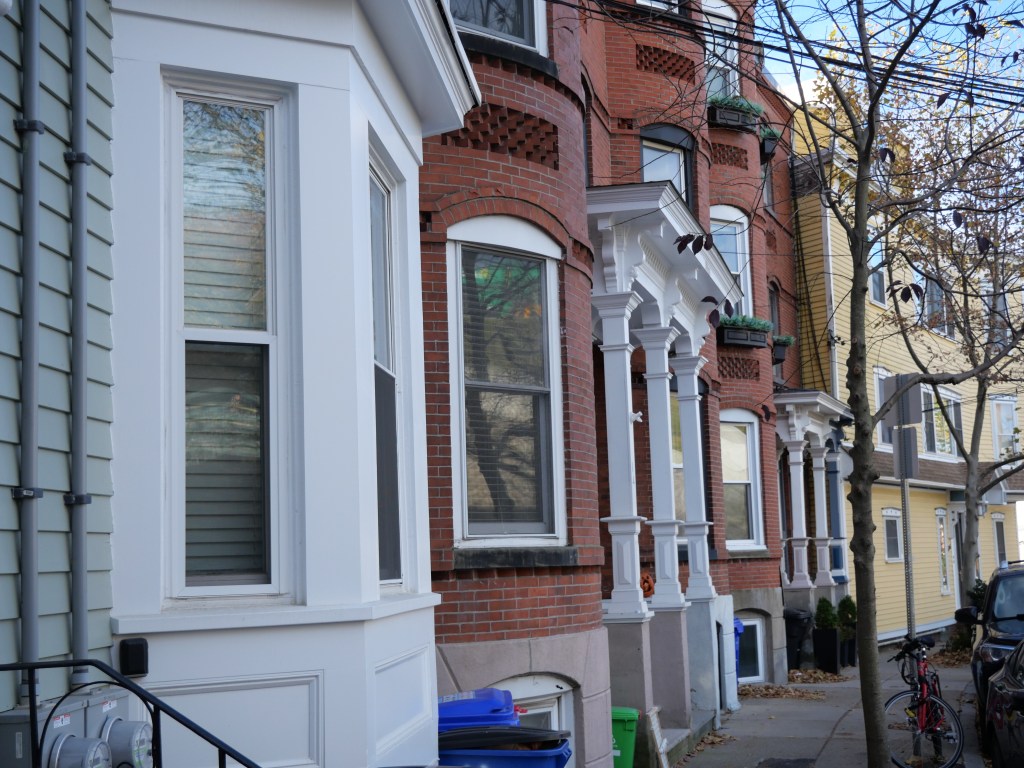
- Solid historic and modern in-fill. Historic housing lacks the detail of other inner city neighborhoods as the neighborhood was built up in the early-mid 19th century as a working class district.
- Overall very good urban form throughout except along Dorchester Ave.
- Plenty of food & bev businesses, a major cineplex, and several historic sites. South Boston is also adjacent about 1.5-2 miles from lots of Museums, Theaters, and live music venues in the Theater District and Fort Point.
- Good but not amazing retail amenities. No major supermarkets but plenty of gourmet and grocerias, several drug stores, plenty of boutiques & clothing stores, several floral shops, a couple furniture stores, tons of gyms, several churches and dessert joints, a couple health centers, a local post office & public library, and the Boston Convention Center is located just north of the neighborhood.
- Solid park amenities including plenty of small and medium sized parks well dispersed throughout South Boston, two beaches, and park spaces doubling as major historic sites such as Thomas Park and Fort Independence.
- Good number of walkable private & public schools but ratings are more mixed esp. the two public high schools.
- Rental units are plentiful but very expensive. Studios & 1 bed range btwn 1.7K-4K, 2-beds 2.5K-6K, Plenty of 3 & 4-beds as well renting from btwn 3.5K-8K. 19% of units are income restricted.
URBAN WEAKNESSES:
- Solid public transit but not as well connected by the T than most Boston inner city neighborhoods as the Red line only runs along the western side of the neighborhood.
- Dorchester Ave is a very industrial and unpleasant street.
- Decent but not excellent bike lane coverage with a handful of dedicated bike lanes and several bike stations but less bike infrastructure than most Inner City Boston Districts.
- So so diversity metrics with diversity being the best but still a white majority neighborhood.
- Thanks to hosting 20% income restricted units South Boston has a decent # of very low-low income households. But very little working class and even middle class households.
- Okay Tree canopy.
- Expensive for sale options but lots of more moderately price 1-bed condos ranging from 275K-800K, 2-beds btwn 300K-1.5M, 3 & 4 beds btwn 600K-3M.

 Evaluating our Urban Communities [with a focus on America]