Development really didn’t come to Mission Hill until the early 19th century with the creation of several breweries at the foot of Park Hill in the 1820s. By the 1870s beer production was the main industry in Mission Hill, and many breweries lined Stony Brook (now a culvert running along the Southwest Corridor). Residential development began in earnest in the mid-19th century with the neighborhood filling in more or less by 1900. By 1894 the electric streetcar was in operation along Huntington Avenue. By this time Mission Hill felt pretty urban with the construction of many triple-deckers throughout the neighborhood. The neighborhood welcomed large numbers of immigrant descent in the turn of the 20th century, mostly Irish, but also Germans, Italians, and others. After the 1950s, the combined effects of urban renewal, white flight, and institutional growth caused many to flee Mission Hill and by the early 1970s, the neighborhood was considered dangerous. This allowed many of the homes to be bought by slum lords and converted into rental (often student) housing. By the 1990s however, many past concerns of safety and disinvestment began to fade and the neighborhood began to gentrify in pockets, especially those designated as Historic Districts.
Current day Mission Hill has really be divided into two half: The Hill part of Mission Hill south of Tremont which is mostly historically in-tact, contains the neighborhood’s largest concentration of homeowners (although still contains plenty of student housing), and host New England Baptist Hospital on top of the Hill. The portion of Mission Hill north of Tremont has been mostly rebuilt during the urban renewal area into low income housing and institutional uses (i.e. Wentworth Institution of Technology). Mission Hill is practically surrounded by hospitals and universities on all sides, especially along Huntington Ave. Tremont St is the neighborhood’s best commercial district and retains most of its historic fabric. Because of its high concentration of institutional uses Mission Hill has limited commercial space resulting in a neighborhood with relatively impoverished retail amenities compared it neighboring Boston districts. Mission Hill excels from an urban perspective with excellent public transit access, amazing access to jobs and dwtn Boston, high levels of safety, good income diversity thanks to the 35% of rental units that are income reserved, good walkable schools and solid cultural and park amenities. But for Mission Hill to become a top tier Boston district it needs more retail amenities, better bike infrastructure, more for sale options, and more homeowners.
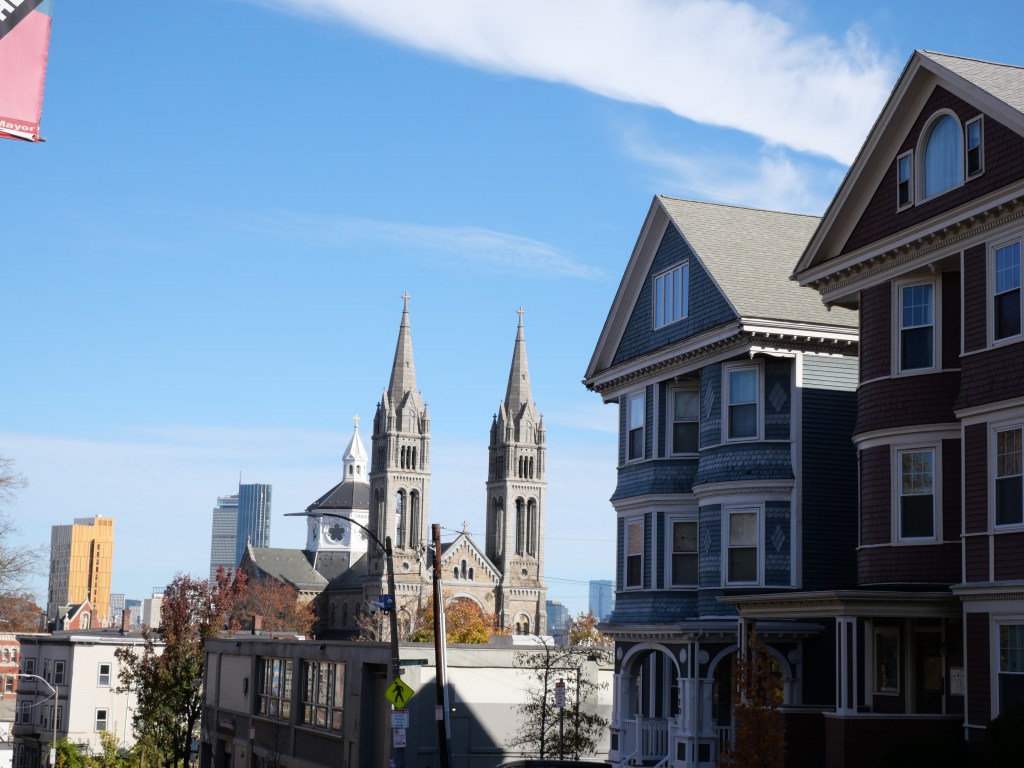
Click here to view my Mission Hill Album on Flicker
URBAN STRENGTHS:
- Good density at nearly 25K people per sq mile but not as high as the top Boston neighborhoods.
- Solid sidewalk and ADA infrastructure.
- Excellent public transit even with a hill in the middle of the district thanks to the two T lines that practically surround the neighborhood.
- Good access to Dwtn but still 4 miles away and a 30 min subway ride. Only 20 min T ride to the Prudential center (Boston’s 2nd Dwtn).
- Great diversity, esp. for a Boston neighborhood with about 50% Caucasians and 15% Black, Asian & Hispanic.
- Overall a safe community.
- Several nice small and medium sized parks including Fitzgerald Park with great views of the City and convenient access to Leveret Pond and Olmsted park. But not as good of park amenities as other Boston districts.
- Solid tree canopy largely thanks to the hill in the middle of the neighborhood.
- Largely aesthetically pleasing historic architecture. Some great historic commercial bldgs with the iconic Boston bay windows and most historical residential bldgs are attractive
- Some excellent commercial and mixed-use infill along Tremont and Huntington Ave. Pretty large urban renewal/projects near Ruggles that isn’t very aesthetically placing and so so from an urban form stand point.
- Good urban form overall, esp. outside for the affordable housing project near Ruggls.
- Decent number of walkable schools but generally good ratings and good mix of grade levels and private vs public options.
Good cultural amenities including plenty of restaurants, bars, and cafes and a couple historic houses. - Rental units are plentiful but expensive. Studios & 1 bed range btwn 2K-4K, 2-beds 2.5K-5K, Plenty of 3 & 4-beds as well renting from btwn 4K-8K. Fortunately 35% of units are income restricted.
URBAN WEAKNESSES:
- Very large student populations which certainly dominates the demographics. Also not a lot of family households.
- Good bike infrastructure but not excellent like other Inner City Boston neighborhoods. Bike stations and lanes are typically on the edges of the neighborhood.
- Decent retail amenities but not great for an inner city Boston neighborhood. This includes one major supermarket and a couple grocerias, a couple banks, a couple gyms, a couple salons & barbers, a local post office & public library, several churches, several hospitals either within or near Mission Hill and this comes with plenty of doctor’s offices.
- Expensive for sale options but some moderately price 1-bed condos ranging from 250K-500K, 2-beds btwn 500K-900K, 3 & 4 beds btwn 500K-2M. Not a ton of for sale inventory.”

 Evaluating our Urban Communities [with a focus on America]