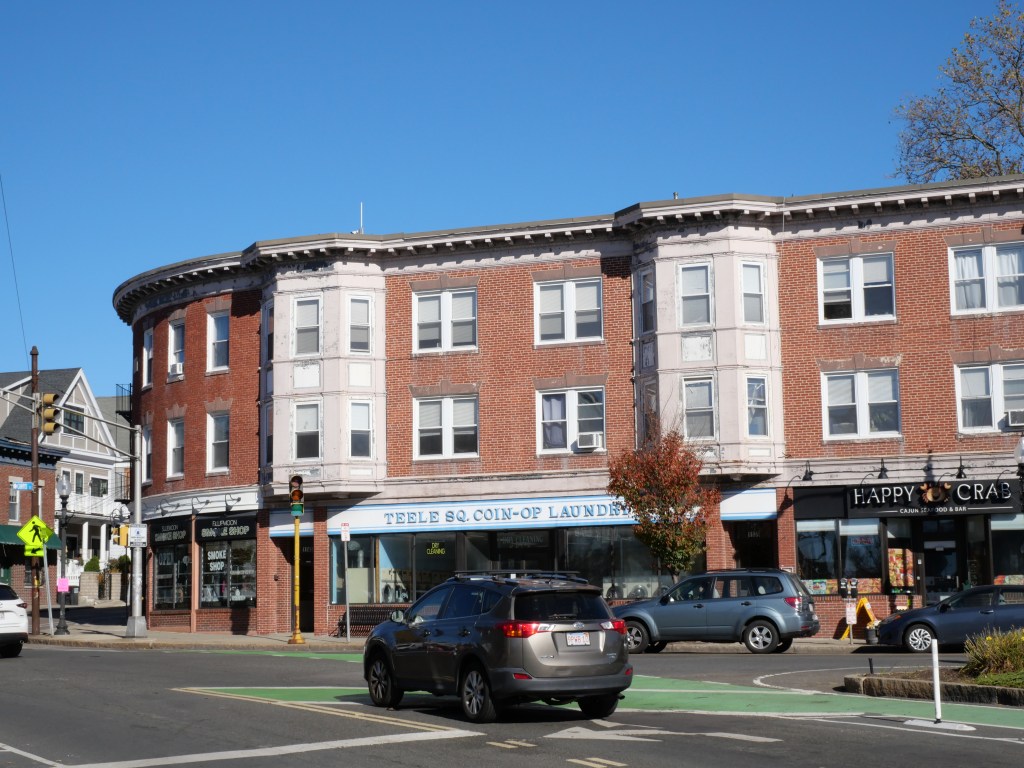
Somerville was established as a town in 1842, when it was separated from Charlestown. Somerville remain a small town until the mid-19th when transportation improvements and industrialization in Boston fostered significant grown. By 1850 the population reached 3,500. The Late Industrial Period (1870–1915) was a time of phenomenal growth for Somerville with the population growing exponentially from 15,000 to 90,000. Additionally, Somerville’s location adjacent to Boston and proximity to rail and road transportation made it an ideal location for distribution facilities. Between 1915 and 1930 population growth slowed reaching the city’s high point of 103K. At this time Somerville was filled with recent immigrant working in the City’s warehouses and factories. 70% of Somerville residents were born either outside of the United States or had parents who were. The population was then estimated to be 60% Catholic. Although Union Square and Davis Square continued to be the largest commercial areas during the first decades of the 20th century, smaller, less-developed squares grew as well including Ball Square, Magoun Square and Teele Square. Somerville continue for a couple decades as a successful urban city but like most of Inner City Boston it fell into a period of decline from the 60s-80s. This was also a period where Somerville lacked any passenger rail service making it harder for residents to conveniently travel to Dwtn. By the mid-80s Somerville began to turn the corner along with many other urban areas in Boston. As the same time the Red Line Northwest was extended to Davis Square in 1984 and Boston’s telecommunication and biotechnology booms was in full swing. Somerville is now considered to comprise one of Boston’s Brain Power Triangle thanks to Tufts’ University location within the City and Harvard University and MIT which sit just outside of it.
From an urban perspective Somerville excels at being a comfortable walkable urban district with great transit and bike access, only a 20 minute train ride to Dwtn, solid walkable schools & parks, good retail & cultural amenities and solid urban form and historic architecture. The biggest downside of Somerville is its high cost of housing, especially for-sale options but it is still not among the most expensive Boston communities. For Somerville to be an elite Boston neighborhood it would need to densify and built up its commercial corridors.
Click here to view my Somerville, MA album on Flickr
URBAN STRENGTHS:
* Lots of great commercial nodes including Davis Square, Teele Square, Ball Square, Magoun Square, Union Square. Broadway, Highland, & Somerville are the longest arterial streets with lots of nice lots of nice-mixed use fabric and small commercial nodes running along them. Broadway in East Somerville is a concentrated biz district for several blocks. Also as major new urbanist site at Assembly Square which used to be industrial development.
* Solid urban form in most of the business district but a couple sections with a fair amount of autocentric uses.
* Good sidewalks throughout Somerville but only about 50% of all curb cuts are ADA standard.
* Some nice historic architecture pockets in Somerville esp. around Davis & Union Square but a lot of historic working class hsg with limited adornment.
* Excellent public transit including 4 subway lines running through it. Somerville also has great bike infrastructure with several dedicated lanes passing through the City and connecting to Dwtn and Cambridge. This creates a very convenient commute to Dwtn and surrounding neighborhoods via all modes of transport.
* Very high levels of safety in Somerville.
* No large parks in Somerville but lots of well dispersed small and medium sized parks include a YMCA indoor pool and public outdoor pool.
* Good tree canopy but not as impressive as many other Boston neighborhoods.
* Solid walkable school options with pretty well rated public school options. Several parochial elementary schools but not much else on the private side.
* Cultural amenities are pretty plentiful including lots of restaurants, bars, cafe and several breweries, a couple local museums & historic homes, a couple community performing arts theaters, an indie theater and a couple live music venues.
* Solid retail amenities including several grocery stores (including a TJ & Whole Foods) and plenty of grocerias, plenty of drug stores, two targets & TJ Max, great concentration of name brand clothing stores in Assembly square, some boutiques and clothing stores, a couple hardware stores and Home Depot, a hand full of book stores, a toy store and a couple bike shops, several banks, tons of dessert joints, bakeries & gyms, 3 public libraries & several post offices, plenty of churches, a general hospital and several medical & doctor’s offices.
* Rental units are plentiful but very expensive. Studios & 1 bed range btwn 2K-3.5K, 2-beds 2.5K-5K, Plenty of 3 & 4-beds as well renting from btwn 2.5K-6K. Brookline does at least have its own Housing Authority that manages about 1.5K units. Another 300 units are managed by the Somerville Community Corporation.
URBAN WEAKNESSES:
* Expensive for sale options but lots of small condos options ranging from 300K-900K, 2-beds btwn 400K-1.5M with most of the in MF buildings, 3 & 4 beds btwn 600K-2.5M.
* Limited economic diversity. Could use better generation diversity.

 Evaluating our Urban Communities [with a focus on America]