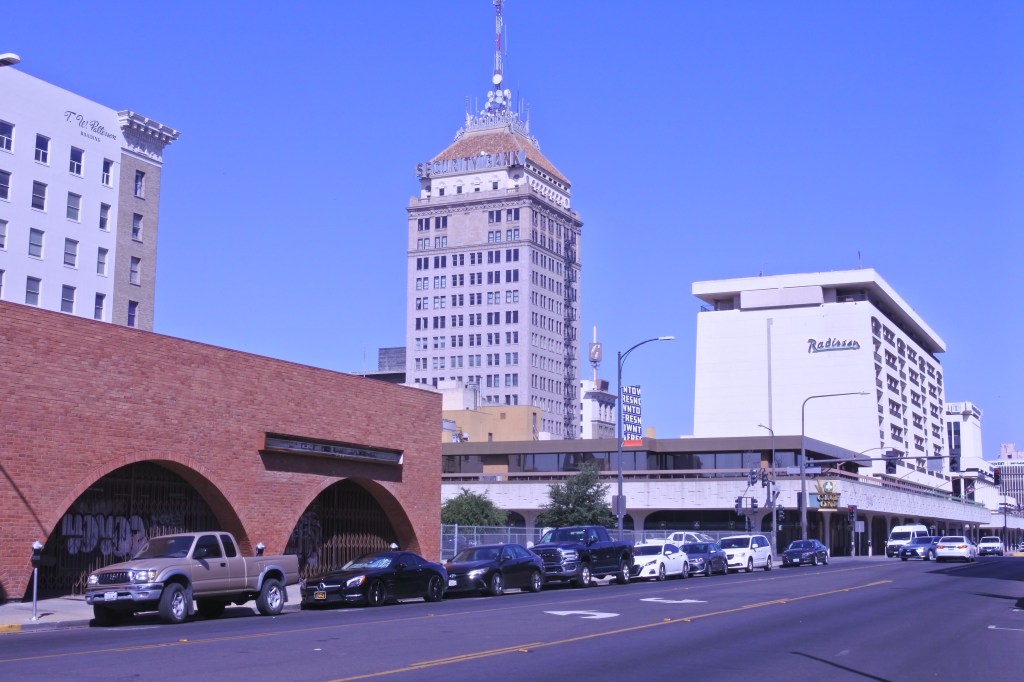
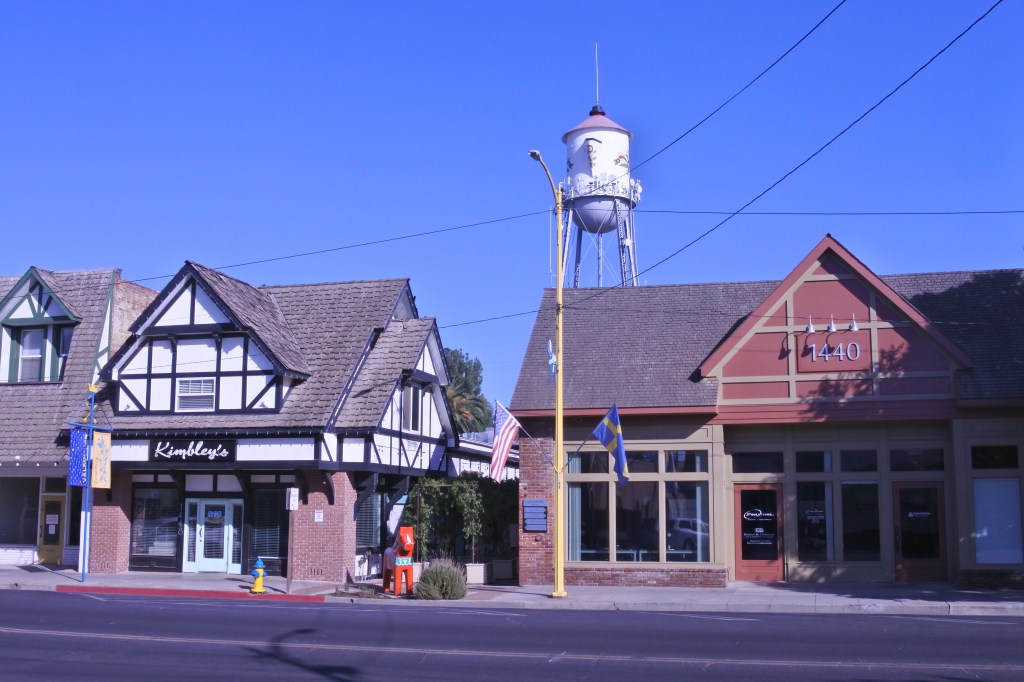
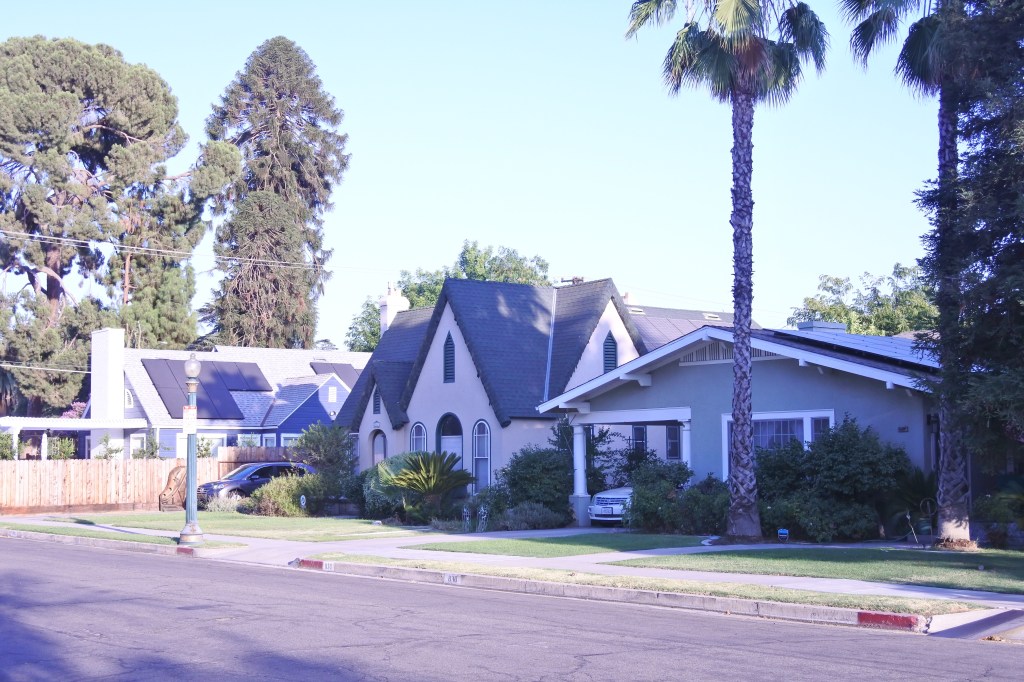
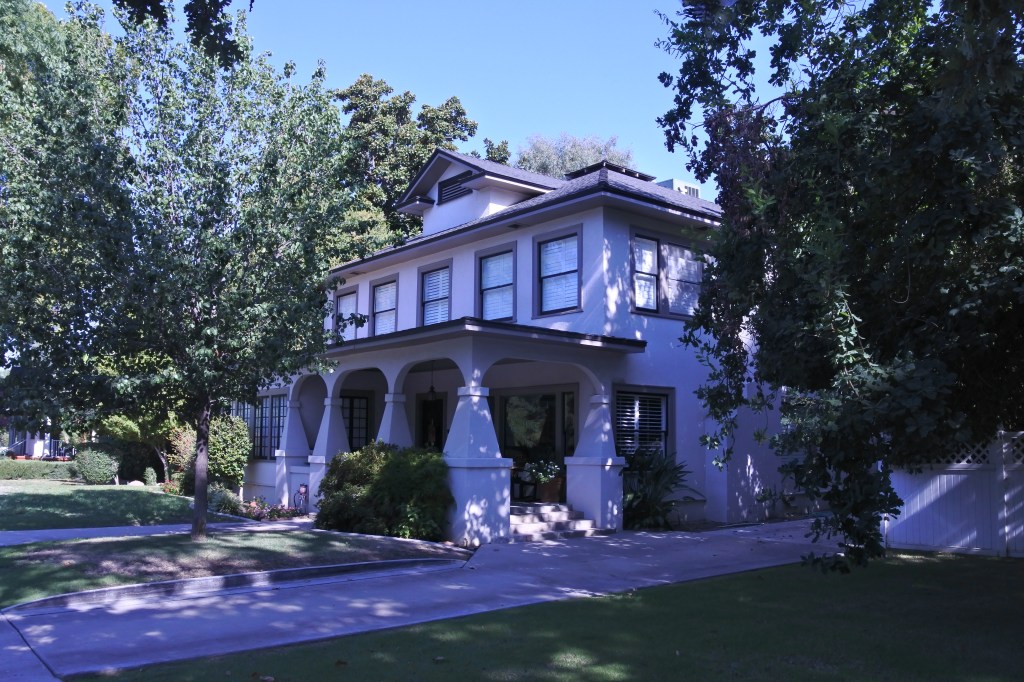
The Tower District, Fresno’s best urban neighborhood

 The Tower District emerged in the early 1900’s as a streetcar suburb of the rapidly growing Fresno two miles north of the City. The neighborhood became a nice mix of middle class and working class residents centered on the Olive Ave Commercial District. The neighborhood’s namesake, Tower Theatre was designed in the Streamline Moderne style in the late 1930s.

While the neighborhood struggled at times during the post World War II years, it never declined into complete abandonment and disrepair.  In the late 80s the Tower District showed signs of new life, which helped galvanize residents to create a  Tower District Specific Plan which was adopted by city ordinance in 1991. This helped spawn new investment in the neighborhood’s resident stock and zero in on revitalizing the neighborhood’s well built Olive Street, which eventually became the City’s leading nightlife destination. The Tower District also contains attractive commercial clusters on the mixed-use Van Ness Ave. Yet its secondary commercial street, Belmont, is rather auto centric and uninspiring.

I already consider the Tower District to be a quality urban district but for it to be great it needs a couple crucial pieces (i.e. a supermarket, better walkable schools, and  more park space). More density and mixed use development along Olive, Van Ness, and especially Belmont would also go a long way to urbanizing the district. A quality mixed-use district along Belmont would create an important walkable hub in the district southern edge and help create a walkable node between Dwtn and Olive Street.

Click here to view my Tower District Album on Flickr

URBAN STRENGTHS:

* Sidewalks are consistently good. ADA curbs are pretty consistent along Olive St but spotty on other streets.
* Solid public transit and convenient access to Dwtn only 2 miles away across all modes.
* Several bike lanes run thru the district.
* Great connectivity with small blocks and gridded street network.
* Solid diversity indicators.
* Excellent historic housing stock. Nice mix of duplexes, larger SF homes, smaller bungalows, and larger apartment bldgs.
* High level of safety in Tower District.
* Solid tree canopy.
* Good urban form and streetscaping along Olive Street throughout most of the district. Not great along Belmont.
* One of Fresno’s most popular urban districts.
* Great cultural amenities here including an excellent array of food & beverage bizs. Also plenty of art galleries, two local performing arts theaters (one of them in the historic Tower Theatre), several night clubs, & live music venues, and quality cultural amenities at neighboring Fresno City College.
* Good retail amenities including a health food store, several drug stores, a dollar store, several boutiques/clothing stores, a couple gift stores, a couple bookstores & record shops, plenty of furniture/ antique stores, tons of dessert stores, several gyms, a local post office, several churches, a couple medical offices, and a hardware store near by. 

URBAN WEAKNESSES:

* Decent density but not great for an urban district.
* Mixed school ratings. Fresno HS is rated poorly while the smaller Design Science HS is rated very highly. A couple elementary schools in the district but generally rated poorly.
* Parks within Tower District are limited to the Ted Willis Community but Fresno’s best urban park and Zoo is located just a couple blocks west of the neighborhood.
* Tower District is missing a supermarket, banks, a public library, department stores, and a major hospital

Lowell and Jefferson, Inner City Fresno Neighborhoods Poised to Revitalize

This evaluation includes all of the Lowell and Jefferson districts, which are north of Divisadero St to the highway. Some consider this part of Dwtn but given its strong residential character I consider it a separate neighborhood.

Lowell-Jefferson began developing in the 1880s when Fresno experienced rapid growth. The neighborhood still hosts a great array of turn of the 20th century American residential architecture, especially in the more poach western sections of Lowell. Historically the neighborhood experienced great socioeconomic diversity with working class homes often mixed in on the same blocks with upper middle class residences. By the mid-century with the rise of autocentric suburbs the neighborhood declined. This neighborhood decline was deepened with the drawn out demolition and construction of the east-west portion of the loop (Highway 180), which took several decades to materialize not opening until 1995. Crime and poverty depended in the 90s and 2000s and many of the single family homes were cut up into apartments. By the 2010s, however, the neighborhood began to rebound with an uptick in renovations and homeownership. Yet there is still much revitalization to do especially along the unattractive commercial corridors of Fresno, Belmont, and Blackstone. Given the neighborhood’s close proximity to Downtown and the City’s relative Californian affordability,  it feels only a matter of time before it revitalizes.

Click here to view my Lowell and Jefferson albums on Flickr

Urban Strengths:

* Generally good sidewalks throughout but ADA standard curb cuts are more the minority than the norm.
* Decent urban density.
* Excellent access to Dwtn Fresno being only 0.5-1 for these neighborhoods.
* A handful of dedicated bike lanes on the edge of the district. Unclear if there are any bike share stations hear.
* Solid street connectivity.
* Good age diversity and lots of families with children living here.
* Some very nice historic housing remains primarily in Lowell where lots of upper middle class SF homes were built. Jefferson has much more working class housing.
* Good number of public highs schools in the neighborhood or nearby with mixed ratings.
* Pretty good housing diversity and affordability with 2-beds selling btwn 100K-300K, 3 & 4 beds sell btwn 150K-500K.
* Same with rentals… 1-beds lease btwn $850 & $1300, 2-beds btwn $900 & $1,500. Some 3 & 4bed product as well. Good # of dedicated affordable rentals as well.
* Culturally the neighborhood has a large # of restaurants (esp. Mexican) and a handful of cafes & bars. There are also a couple live music venues and great access to the Dwtn cultural amenities.

Urban Weaknesses:

* The commercial streets Fresno, Belmont, and Blackstone are all pretty shabby and uninvesting. But they still have some stretches with decent urban form. 
* Very Hispanic neighborhood (73%)
* Very high poverty levels (around 40%).
* Both neighborhoods experienced high levels of crime in the 1990s-2000s which also led to a lot of disinvestment. Things appear to have stabilized in the neighborhoods and organic investment of the existing housing stocks appears to be underway.
* Some decent in-fill along the Dwtn edge but lots of unattractive auto centric commercial.
* A handful of small & medium sized parks.
* Tree canopy isn’t great but gets better in the wealthier western edge of Lowell.
* Okay retail amenities including several Hispanic grocerias, a pharmacy, a couple boutiques, a gyms & bakery, many churches, and a major hospital and connected doctor’s offices. Tons unattractive auto related stores but good access to quality retail amenities Dwtn.

Downtown Bakersfield, CA

My evaluation for Dwtn is smaller than Google Maps and other measures. I include only the areas btwn F St to the west, the river to the east, and Truxtun Ave and 24th st to the south and north, respectively. Blocks outside of this more constrained area lacked a cohesive Dwtn fabric in my estimation. 18th, 19th, Chester Ave contained the best urban form and best vibrancy Downtown. These are in the heart of Dwtn. Edge arterials such as F St, Truxtun, and the wide one way 23rd and 24th pairs are rather auto centric in character and move large amounts of traffic. As a way of trying to drum up interest in Downtown the City has created a couple of subdistricts that are somewhat based on reality. The Arts District  contains Dwtn’s concentrations of theaters and cultural amenities and is roughly bordered by 21st Street, Chester Avenue, 17th Street, and G Street. Civic Center  is the center of government for both the City of Bakersfield and the County of Kern. Mill Creek is along the eastern edge of Dwtn and is centered around  attractive green space lining Mill Creek, the famous Mexicali restaurant, and a handful of new mixed-use apartment buildings. Downtown has decent vibrancy, cultural amenities, and historic stock mostly concentrated in its core with rather autocentric and dead spaces on the edges of Dwtn. Dwtn also excels with quality local shopping and boutique options, decent streetscaping, and some regional amenities. Downtown Bakersfield simply needs more residents and mixed-use development. Other important areas of improvement include more parks, better cultural and regional amenities, larger college presence, and slower more pedestrian friendly streets.

Click here to view my Downtown Bakersfield Album on Flickr

URBAN STRENGTHS:

* Solid bike network throughout most of the Bakersfield City limits, even out to more suburban areas. A dockless bike program also exists serving mostly just the dwtn area.
* Strong street grid that is easy to navigate but roads are overbuilt and wide.
* Some nice pockets of historic architecture, which generally correspond with better urban streets.
* Generally a pretty safe Dwtn. Pretty low homeless for a CA downtown.
* Dwtn streetscaping is pretty decent, esp. the core of Dwtn.
* Bakersfield’s regional amenities include a decent sized convention center and arena, a dwtn post office & library, some museums, plenty of bars & restaurants, a couple live music venues, a couple local theaters, the gorgeous Fox Theater (now a local cinema).
* Some retail amenities including plenty of boutiques, clothing stores, gift shops, and antiques/furniture stores. Also several banks, a toy store, a couple book stores, a couple gyms & dessert stores, several churches and a major hospital is nearby.

URBAN WEAKNESSES:

* Pretty low population density for a dwtn.
* Not much income diversity of the population living Dwtn, but plenty of people of means who work and visit Dwtn.
* Some kid friendly activities Dwtn (Arena complex, Natural Historic Museum but really not a whole lot.
* Well rated Dwtn public elementary school but schools surrounding Dwtn are poorly rated.
* Not a ton of for sale options Dwtn but what does exist is pretty affordable. 1-beds & 2-beds sell for around 200K,  and 3 & 4 beds sell btwn 200K-300K.
* Rentals are also limited but a bit more plentiful. 1 beds lease in the 1Ks, 2-beds lease btwn 1.5K-2K. Larger rentals are largely absent.
* Decent # of nice mid-century buildings but also plenty of unattractive modern building without great urban form.
* Very autocentric and unattractive urban form along the edges of Dwtn.
* Tree canopy is pretty thin larger the result of the climate.
* Park space is limited to Mill creek park on the eastern edge of Dwtn and a couple unimpressive plazas.
* Central Park is the only plaza space with some semblance of a Civic Heart of Dwtn with some events.
* Other than a couple md-sized bldgs. not much of a skyline.
* Sidewalks are consistent but ADA curb cuts are spotty.
* Kern College Community Center is Dwtn but not much else.
* Missing several key amenities including hotels, court houses stadiums, art galleries, and major theaters.
* # of jobs Dwtn is pretty low. Likely btwn 5K-10K

Riviera-Weschester- Bakersfield’s best Urban District

Riviera-Westchester has been Bakersfield’s premiere urban district since the 1920s. The southern 2/3s of the neighborhood were developed before WWII and the 1/3 north of 24th Street was developed in the 40s-60s. The district has held its value ever since and commands the highest prices for Bakersfield neighborhood with decent urbanity.

The district has more typical suburban amenities with low density, good tree canopy, lots of well maintained single family homes, a couple of good schools, great parks, and low crime. It also hosts some decent mixed-use blocks on 19th Street on the edge of Dwtn and while F street is a pretty auto centric commercial district it still has some good urban stretches.

Riviera/Westchester has great access to Dwtn and residents on its eastern edge can walk to Dwtn and enjoy the many cultural and retail amenities it holds. For the neighborhood to be a great urban district it needs much more housing and density, which will help spur more walkability and amenities. Riviera/Westchester also needs more consistent sidewalks and ADA curbs and mixed-use infill along 19th St and F Avenue.

Click here to view my Riviera-Westcheser album on Flickr

URBAN STRENGTHS:

* Decent public transit access and very convenient access to Dwtn across all modes of transit.
*Solid racial diversity and pretty good income diversity. Good generational diversity.
* Very safe district and limited blight.
* Good amount of rentals and moderately priced. 1-beds lease between 1K and the high 1Ks, some 2 & 3 beds that are lease in the 1Ks.
* Pretty good for sale range with the exception of much condo product. 2-beds range anywhere btwn 175K-450. 2 & 4 beds btwn 250K-750K. Some 5 beds sell for around 1M.
* High quality park amenities with 3 lovely parks, the Bakersfield racket club, a recreational trail along the river and a couple small parks. Along the massive Bakersfield ballpark complex is nearby.
* Solid Tree canopy.
* Decent cultural amenities including several restaurants & bars, a couple cafes. But mostly great access to all the cultural amenities Dwtn.
* Ok neighborhood amenities including a, a couple drug stores, tons of salons, a couple boutiques, a couple dessert spots & gyms,  and the dwtn post office and a major hospital are nearby. But lots of retail amenities nearby in Dwtn.
* Lots of attractive historic homes esp. south of 24th St.
* Well regarded neighborhood in Bakersfield.

URBAN WEAKNESSES:

* Very poor density, similar and sometimes even worse than a suburb.
* ADA curb cuts are pretty spotty and concentrated in the more commercial areas.
* About 60% of the district has consistant sidewalks. The SW section is largely missing them and the north 1/3 of the district.
* A very good public elementary school and below average high school are located in the district. Also a good elementary school nearby in Dwtn.
* Modern infill is generally auto centric junk but some good stuff.
* Not great pedestrian traffic.

Oleander-Sunset- an urban district just south of Downtown Bakersfield

Oleander-Sunset is one of Bakersfield’s most urban, diverse, and eclectic neighborhoods. Homes began to fill in during the late 19th century especially east of A Street. Oleander Avenue contains some of Bakersfield nicest historic mansions and was once the City’s most coveted address. The Eastern half of the district has a higher poverty rates but better urbanity (more dense, access to some walkable commercial, and consistent sidewalks).

Oleander/Sunset has good bones and great access to Downtown Bakersfield with pretty good public transit and bike infrastructure. There is the potential for it to be a quality urban neighborhood but several improvements are needed (i.e. better urban form along Chester & Union, improved sidewalks, quality schools, more walkable amenities, and improved safety outcomes). 

Click here to view my Oleander-Sunset Album on Flickr

URBAN STRENGTHS:

* Excellent access to Dwtn being on the southern edge of the central district.
* Great connectivity thanks to the districts highly gridded street network.
* Several dedicated bike lanes in Oleander.
* Solid income diversity and lots of family households here.
* Sale prices are very reasonable esp. for California. 1-beds sell anywhere btwn 100K-300K. 2-beds btwn 150K-300K and 3 & 4 beds btwn 200K-500K. Some 5-beds sell for more.
* Good # of rentals and pretty affordable. 1-beds lease for around 1K and 2-beds 1K to high 1Ks. Plenty of 3 beds that lease btwn the mid 1Ks-2K.
* Decent parks including a pair a attractive mid-sized parks (i.e. Beale & Lowell Park) and lots of ball fields by the high school.
* Decent amenities include lots of small grocerias, a couple drug stores, several boutiques, a bookstore, several dessert joints, plenty of salons & barber shops, several florists, lots of churches, and a couple doctor’s offices.

URBAN WEAKNESSES:

* Sidewalks and ADA curbs are spotty in places
* Okay density.
* Ok transit.
* Residential streets are way to wide.
* Not great diversity as 70% of the neighborhood is Hispanic.
* Several public schools in the neighborhood but poorly rated.
* Moderate level of crime and certainly some blight.
* Tree canopy is spitting and generally better in the western half of the district.
* Some cultural activities including plenty of restaurants, a couple night clubs, and good access to Dwtn amenities.
* Lots of autocentric and uninspiring modern commercial along the main commercial districts (Chester & Union Ave).

Downtown Canton, OH

I loosely define Downtown Canton to be between McKinley to the west, Cherry to east and between north and south 6th Streets. One could argue that the North Market district running from North 6th to 12th street is also part of Downtown as it includes the main library and Canton’s Art Center.

Downtown Canton’s also contains a couple notable subdistricts: 1) The Canton Arts District/Music block centered in the core of Dwtn along Cleveland Street where many 2-4 story historic mixed-use buildings still remain and are filled with retail and food & beverage/theater uses. This is where Canton’s historic building concentration is strongest. 2) The Warehouse District which runs between Market and Cherry Avenues where a scattering of historic warehouse remain standing yet most are underutilized. 3) Saxton Quarter is located south of Tuscarawas St. This is named after the Saxton McKinley House and feels like a marketing attempt to uplift a largely dead part of Downtown. Market Street is the main spine through Dwtn and contains its best architecture and the well designed and active Centennial Plaza. Tuscarawas  is the second main street Dwtn and runs east to west.

All in all for a midsized Midwestern Dwtn, Canton does pretty good thanks to the targeted investment in its core along Cleveland and Market Avenues north of Tuscarawas. Dwtn includes a decent # of local retail, solid cultural amenities, a well designed central plaza and even a semi-pedestrian street along the Court Street alleyway. To move to the next urban level, Canton needs a lot of Dwtn apartments and condos and new development south of Tuscarawas and on its edges to liven these dead areas. Targeted redevelopment of the warehouse district is probably the best place to start.

Click here to view my Dwtn Canton Album on Flickr

URBAN STRENGTHS:

* Good efforts have been made to stabilize dwtn with the focus on the arts, revitalization efforts along Cleveland and Market Avenues, an extensive semi-pedestrian alley along Court Street line with many businesses, and the well designed Centennial Plaza.
* Also decent mixed-use activity along N 6th Street and some along N. 2, 3, 4, and 5th Streets.
* Good cultural offerings including plenty of bars, restaurants, and cafes, a historic theater, several live music venues, many museums and historic sites, and a major cultural arts center.
* Generally good sidewalk and ADA curbs especially in the more invested parts of Dwtn.
* Good historic architecture and much of it is still preserved.
* Decent number of street trees.
* Decent retail amenities but no supermarket.

URBAN WEAKNESSES:

* Lots of dead spaces outside of the core of Dwtn especially the southern half south of Market.
* Tinken Steel’s career Campus on the western edge of Dwtn feels like a suburban community college artificially placed Dwtn.
* Only a handful of rentals and condos Dwtn.
* Only a couple of schools located dwtn and a small Stark County Community College presence.
* So so modern infill

Vassar Park- A Stable Pre-War II Neighborhood on Canton’s Northside

Vassar Park is one of Canton’s more stable and attractive districts with generally stable housing developed between the 1920s-1940s. Some post WWII housing mixed-in making this a newer district than neighboring West Park. Vassar Park also has some retail amenities mixed-in, very affordable housing, a decent amount of rentals, solid racial and economic diversity, and very convenient access to Dwtn.

What Vassar Park needs to be a quality urban district is more parks and retail amenities, improved public transit access, and better ADA infrastructure.

Click here to view my Vassar Park Album on Flickr

URBAN STRENGTHS:

* Housing stock in generally in stock with a mix of modest and larger homes.
* Solid tree cover.
* For sale housing is very affordable ranging from 35K-250K.
* Decent # of rentals and very affordable.
* Solid racial and economic diversity.
* Generally a very family oriented neighborhood.
* Very convenient access to Dwtn Canton, only 1.5 miles away.

URBAN WEAKNESSES:

* ADA curb cuts are limited. Generally good sidewalks.
* Some retail but not supermarket.
* So so public transit access.
* Access to a dedicated bike lane on the southeastern edge but that’s it.
* A handful of schools in Vassar Park and nearby.
* Not much diversity in price point for housing.
* Only a handful of parks although Vassar Park is a very nice centrally located community park.

Canton’s West Park Neighborhood- a relatively intact early 20th century urban district along McKinley Memorial Park

West Park is located between 12th and 30th Street and between Cleveland and McKinley Memorial Park. The district was developed mostly in the early 20th century with a mixture of grand Victorian and Turn-of-the Century houses and elegant apartment buildings along with smaller houses middle class homes. The neighborhood was pretty stable until the 1980s and 1990s when blight and vacancy crept into the district thanks to low real estate prices. Some effort has been made to stabilize the neighborhood and this has prevented widespread abandonment and a mixture of stable and less stable streets. West Park does have some commercial amenities that are pretty walkable along Fulton and Cleveland Avenue but many retail amenities like a supermarket are missing.

To advance West Park to what I would consider a quality urban district it needs more commercial amenities along Fulton & Cleveland, more higher end residential diversity, more stability, and better public transit access. Thankfully since the neighborhood is mostly intact this seems doable. 

Click here to view my West Park Album on Flickr

URBAN STRENGTHS:

* Generally a stable early 20th century middle class district but decent amount of blight mixed in. Very street by street.
* Decent amount of rentals mixed in.
* Generally good tree canopy, but depending on the socioeconomics of your particular street.
* Good sidewalk infrastructure. ADA curbs are good along the main streets but hit or miss on the residential streets.
* Several schools in the neighborhood but mixed ratings.
* For sale housing is very affordable ranging from 50K-250.
* Decent number of rentals and generally very affordable.
* Good racial diversity.
* Excellent access to Dwtn only 1 mile away.
* Decent access to two dedicated bike lanes.
* Great park access with McKinley Memorial park running down its western border and lots of neighborhood parks.

URBAN WEAKNESSES:

* Some retail along Fulton and more so Cleveland but missing a lot of important neighborhood services starting with a supermarket.
* Cleveland Ave is generally ugly and rather autocentric.
* About 1/3 of the West Park neighborhood lives in poverty and medium of income at 30K.
* Public transit access is so . 

The Ridgewood Historic District- Canton, Ohio’s Premiere Residential Neighborhood

Ridgewood  consists of well preserved American Revival Mansions built mostly from the 1920s -1940s. Its homes are architect-designed for the most part and demonstrate the enormous variations of shape, skin, and sensibility that characterize the European Revival styles favored in this period.  The district also boasts of a highly aestetically pleasing envrionment with large shade trees, original brick streets, and locally produced street lighting standards. Due to its historic architectural significance, the Ridgewood was added to the U.S. National Register of Historic Places in 1982 and has remained one of Canton’s most stable communities.

From an urbanist standpoint Ridgewood is really a suburban-urban hybrid. Yes it has consistent sidewalks, mature trees, and some public transit access. But most trips needs to be made by car as the nearest commercial district is rather amenity poor and not a plesant walk. Bike infrastructure is non-existant and rental housing options are limited.

Click here to view my Ridgewood Album on Flickr

URBAN STRENGTHS:

* Canton’s premiere pre WWII mansion district.
* Excellent tree canopy and brick streets. Beautif aesthetic.
* Good sidewalk infrasturcture.
* These mansions are a great value with most costs between 250K-400K. These homes would costs close a 1 M in the equivalent Cleveland neighborhood.
* Very convenient access to Dwtn Canton only 2 miles away. A 7 minute drive and 15 minute bus ride. 

URBAN WEAKNESSES:

* Curbcuts exist but ADA ramp are not up to modern standards.
* Very little mixed use in the district. The nearest commercial district is 0.7 miles away on Cleveland Ave, a pretty sad semi-autocentric commercial district.
* Transit access is pretty limited.
* No dedicated bike infrastructure.
* Rentals are limited but some product availabe on the edges of the district.
* Few walkable schools in the area.

Somerset, PA- On the edge of the Laurel Highlands

In this review I included only the cohesive pre-WII part of Somerset. This account for about 60% of the Borough boundaries. Grand houses are concentrated along Main Street west and east of the center city.

Somerset is one of Western PA’s oldest communities and was a central stage for the Whiskey Rebellion of 1794. The Borough grew quickly in its early days reaching 500 by 1810, 1,000 by 1860, and 2,000 by 1900. Population peaked at 6,700 in 2000 thanks to the Borough incorporating much of the new suburban development.  Yet Somerset has lost population since due to an aging population and lack of immigrant. It now has just under 6K residents.

Downtown Somerset is centered at the cross roads of Main and Center Streets  but mixed use fabric expands a couple blocks from here. Somerset also hosts the county seat, which has likely kept the Borough from declining further. Grand homes line Main Street, both west and east of Downtown. Residential stock off of Main Street is more working class. and uninspiring. Much of the urban fabric in Downtown has been preserved but the commercial streets have become increasing auto centric a couple blocks from the cross roads of Main and Center Streets, especially at the interchange.

Somerset still has a decent amount of local retail, good connectivity, decent schools, inexpensive housing, and is a generally safe community. But nothing reality inspires me about Somerset from an urban point of view. Many of its downtown storefronts are vacant or underutilized, there are not bike paths, public transit is limited, parks are few, and there is really no new development occurring other than strip malls by the interchange. The community could really use a boast from immigration it help it stabilize its population and increase racial diversity.

Click here to view my Somerset Album on Flickr

URBAN STRENGTHS:

* Generally solid street connectivity.
* Consistant sidewalk infrastructure throughout Somerset but ADA curb cuts can mostly concentrated dwtn and along Main Street.
* Decent economic diversity. Decent # of households with children but Somerset like most older PA towns is aging overall.
* Good schools here but only the Catholic elementary and public high school are within walking distance of the center of Somerset.
* For sale housing is generally inexpensive but some diversity. Only a handful of 1-beds that sell for around 100K, 2-beds sell btwn 50K-150, 3 & 4 beds sell btwn 75K=350K but a handful of homes around 500K.
* Somerset is generally safe with not too much crime north is blight widespread.
* Pretty good retail amenities including a couple groceries (Giant Eagle on the outskirts), several drug stores and family dollars, a couple boutiques/gift stores, a hardware store, several clothing and consignment stores, many banks, several boutiques, several dessert joints , a couple gyms, lots of doctor offices and churches, a public library and local post office.
* Decent historic architecture esp. along Main Street and dwtn.
* Decent Tree canopy here.

URBAN WEAKNESSES:

* Poor Density for an urban area.
* Public transit is very limited here.
* Poor access to Dwtn Pittsburgh and job centers. Over a 1 hour drive.
* limited racial diversity, this a very White community.
* No bike infrastructure to speak of.
* Very few rentals listed on the open market. What is available is affordable.
* Many of Somerset’s park amenities are located on the outskirts where it isn’t walkable. Within the center city there is a couple of plazas and cemeteries.
* Okay cultural amenities including several restaurants & bars, a couple cafes & art galleries, the Guild of American Paper cutters Museum.
* Very little in fill to speak of except crummy commercial infill near the highway interchange.
* Good urban massing in the core of Dwtn Somerset but becomes more autocentric as the Center Ave and Pa-31 leave town especially near the highway interchange.