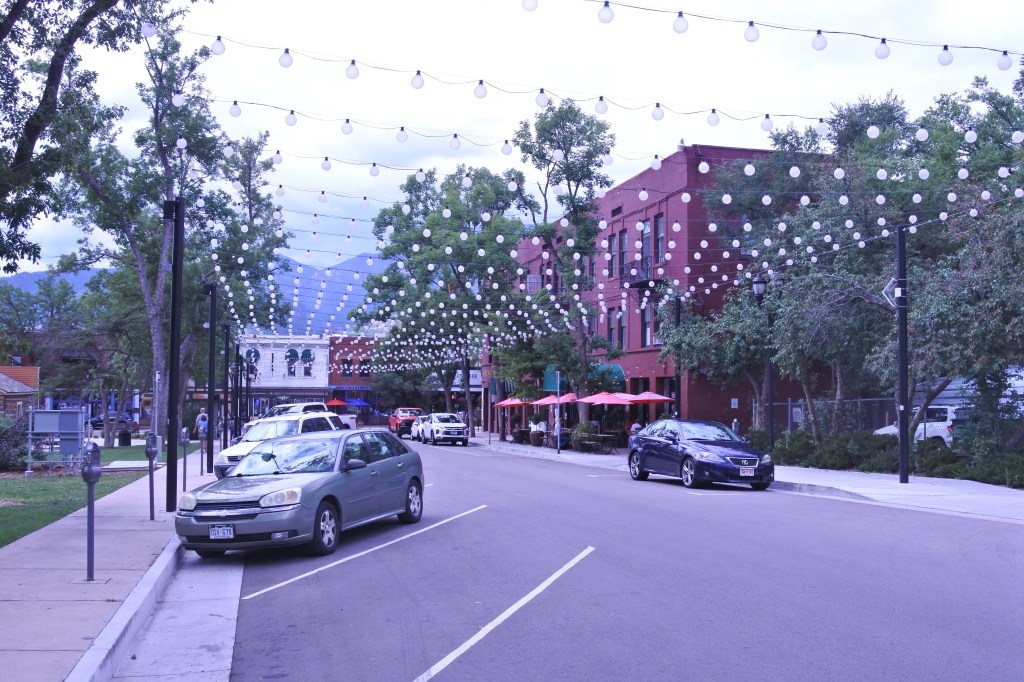
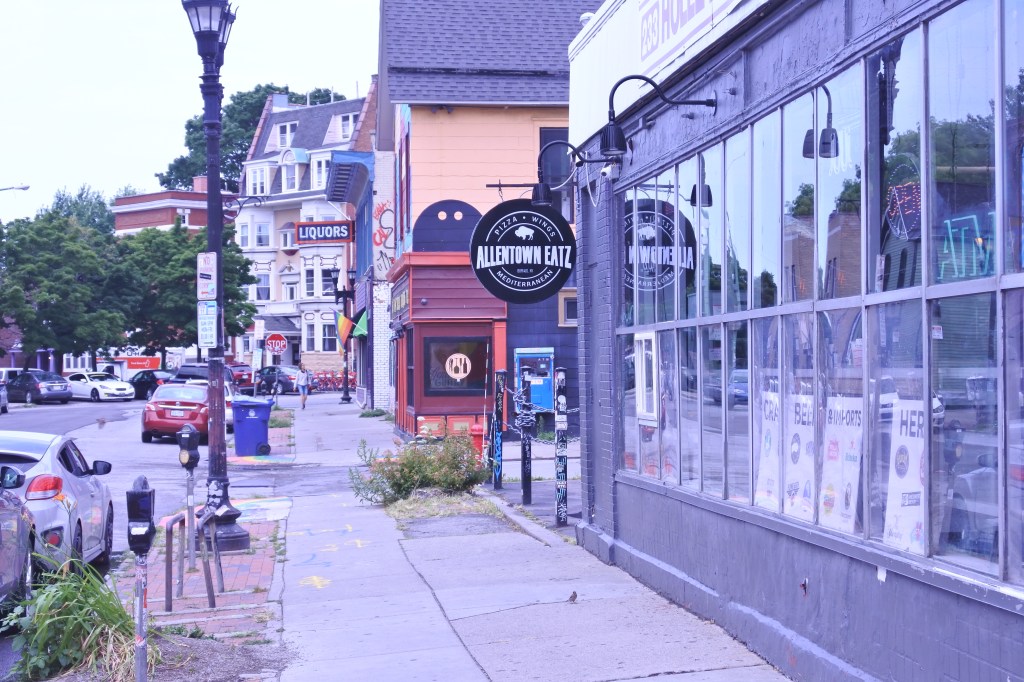
Elmwood Village- Buffalo’s Premiere Urban Distrct and Home to the Olmsted Boulevards

For this evaluation I consider Elmwood Village to be between Elmwood Ave to the West and Main St to east. From North to South the district is between Delaware Park and Utica St.

Elmwood has become one of the premiere urban districts in Buffalo. It features over 300 small local shops, coffeehouses, restaurants, bars, and art galleries. In 2007, Elmwood Village was named one of the ‘Top 10 Great Places in America’ by the American Planning Association. It also contains the best preserved segment of Frederick Olmstead and Calvert Vaux’s original parkway system.  Historically, an address along the boulevard was home to some of Buffalo’s most prestigious residents. Delaware Avenue is Buffalo’s most regal corridor hosting many historic luxury apartments mansions and other major institutions.

Sadly the neighborhood’s eastern border along Main Street has fallen into disrepair and underinvestment. Main street forms an almost impervious border between North Buffalo’s well maintained districts and the very poor African American neighborhoods of East Buffalo. One can tell that Main street used to be a wonderful urban business district with the buildings that remain. Its also where Buffalo’s solo subway line runs connecting Downtown to the University of Buffalo in Amherst to the northeast. Revitalizing the Main street corridor is the missing piece needed to make the Elmwood Village a truly great urban district. It would also have the benefit and bringing back a thriving commercial district to the disinvested neighborhoods of Cold Spring and Masten Park that border Elmwood Village to the east.


Click here to view my album on Flickr

URBAN STRENGTHS:

* Overall great ADA and sidewalk infrastructure throughout. Only a handful of intersection without proper ADA curb cuts.
* Great public transit access bolstered by the Main St Subway line. Because of this Elmwood Village is very convenient to Dwtn and has decent transit access to the UB.
* Great coverage in Elmwood Village by the Buffalo bike share. Decent dedicated bike lane coverage.
* Great economic and decent racial diversity.
* Decent # of walkable schools. The private schools are rated well and the public are rated poorly.
* Crime is pretty low here. Blight and crime pick up near Main Street, the district’s east border.
* Great tree canopy.
* Great access to parks in the northern half of the neighborhood (Delaware Park, Lincoln & Chapin Pkwy), but pretty limited in the southern half.
* Excellent historic architecture.
* Good # of rentals at moderate and higher end prices. 1-beds lease btwn 1K-1.8K, 2 & 3 beds 1.5K-2.8K.
* Good number of quality modern apartments mixed throughout Elmwood Village.
* Vibrant commercial nodes, pedestrians a bit sparse on residential streets.
* Great local buzz here.
* Great cultural amenities including many restaurants, bars & cafes, several art galleries, museums, and live music venues.
* Great retail amenities as well with a co-op store, a Topps, a couple drug stores, tons of boutiques & gift stores, a couple bookstores, several dessert joints & gyms, tons of churches.
* Good urban form and streetscaping along Elmwood. Main street is pretty rough.

URBAN WEAKNESSES:

* Generational diversity isn’t great as households with kids is limited and most of the population are young adults.
* For sale housing are def more on the high side but decent # of more affordable condos. 1-bed condos sell btwn  100Ks-400K, 2-beds anywhere btwn the low 200Ks and 500K. 3 & 4 beds homes sell anywhere btwn 250K-800K. Larger are selling in the low Millions.
* The district’s eastern edge along Main street is severly underinvested.

Forest- Another West Buffalo Neighborhood surrounding Buffalo Psychiatric

Forest is neighborhood  is the northern segment of the larger Upper West District, which also includes the Grant Ferry neighborhood to the South. Forest was developed around the turn of the 19th century and was known as a traditional landing zoning for immigrants thanks to its convenient location near the Lake and many jobs. Grant Ferry initially welcomed many Sicilian immigrants. In the 50s-70s it became home to many Puerto Rican and SE Asian enclaves. Most recently large Somali, Bhutanese, Sudanese, Middle Eastern, Eastern European, and Hispanic immigrants.

Like many American neighborhoods disinvestment came to the Forest neighborhood in the 70s. Historically Grant Street was the blight line dividing more blight and “immigrant” areas to the west and more stable and “White” areas to the east. This is not as hard and fast of a line as it is for the Grant Ferry neighborhood to the south. But unlike East Buffalo, Forest was mostly left standing thanks to a large influx of immigrants.

Gentrification is making the traditional Grant St blight line more and more fuzzy as North Buffalo’s revitalization pushes westward. More and more homes around and west of Grant St are being fully renovated and selling in the 200Ks and low 300Ks. The revitalization of Grant St  is also coming along. Niagara St along the lake recently received a streetscaping overhaul, although still has many missing teeth. Overall Grant Ferry has great public transit, bike infrastructure, diverse housing, great racial & economic diversity, solid cultural & retail amenities, and generally good urban form. Main areas for improvement include: revitalization of Grant Street, need for more parks, better schools, and more diverse for-sale options and more apartments.

Click here to view my album on Flickr

URBAN STRENGTHS:

* Quality public transit access.
* Only 3 miles from Dwtn. Only a 15 minute drive and 28 min bus ride. University of Buffalo is pretty easy to drive to, but challenging transit trip.
* Good bike infrastructure with plenty a nice north-south bike lane on Niagara and diagonal one on Bidwell Parkway.
* Good diverse across all categories.
* Decent amount of rental housing that’s pretty affordable. 1-beds range btwn $850-1.4K,  & 3 beds generally btwn 1K-2k.
* Good mix of affordable, moderately priced, and high end housing. 2-beds sell btwn low 125K to low 200ks, 3 & 4 beds sell btwn the low 100Ks-700K. 
* Great historic architecture in both residential and commercial areas.
* Very good sidewalk infrastructure and generally consistant ADA curbs but sometimes its missing.
* Good cultural amenities including many restaurants, bars, cafes, several art galleries, a couple live music venues, and several museums either within or near the Forest neighborhood.
* Good retail amenities as well including a Co-op grocery store, a farmer’s market store front, a couple grocerias, a couple boutiques & consignment stores, several book stores, a post office, only a couple churches, and great access to the psychiatric hospital.
* Not a ton of modern in-fill but some good mixed use and commercial bldgs along Grant and Elmwood St.
* Urban massing and streetscape are great along Elmwood. Massing is decent along Grant. Niagara is a mixed bag. Lots of warehouses and autocentric industrial businesses mixed together but new streetscaping here.

URBAN WEAKNESSES:

* Several schools on the edges of the neighborhood but not the heart of it. Mixed ratings.
* Crime issues are certainly getting better but plenty of blight and crime issues still west of Ferry Street.
* Decent Park space access but certainly better than neighboring Grant Ferry. There is a nice splash pad park, Bidwell Parky, access to the green space of the State Hospital, and decent access to Delaware Park (.5-1 mile from the neighborhood).
* Condo for sale options are largely missing from the Grant Ferry housing market. There also are few larger apartment buildings. This would go a long way towards adding density to the district.

Grant Ferry- A West Buffalo Neighborhood on the Rise

The Grant Ferry is neighborhood  is a segment of the larger Upper West District, which also includes the Forest neighborhood to the north. Grant Ferry was developed around the turn of the 19th century and was known as a traditional landing zoning for immigrants thanks to its convenient location near the Lake and many jobs. Grant Ferry initially welcomed many Sicilian immigrants. In the 50s-70s it became home to many Puerto Rican and SE Asian enclaves. Most recently large Somali, Bhutanese, Sudanese, Middle Eastern, Eastern European, and Hispanic immigrants.

Like many American neighborhoods disinvestment came to the Grant Ferry neighborhood in the 70s. Historically Grant Street was the blight line dividing more blight and “immigrant” areas to the west and more stable and “White” areas to the east. Streets west of here get progressively worse and streets east of here get progressively more stable as one moves to Elmwood Avenue. But unlike East Buffalo, Grant Ferry was mostly left standing thanks to a large influx of immigrants.

Gentrification is making the traditional Grant St blight line more and more fuzzy as North Buffalo’s revitalization pushes westward. More and more homes around and west of Grant St are being fully renovated and selling in the 200Ks and low 300Ks. The revitalization of Grant St seems to be lagging behind but hopefully will pick up pace. Niagara St along the lake recently received a streetscaping overhaul, although still has many missing teeth. Overall Grant Ferry has great public transit, bike infrastructure, diverse housing, great racial & economic diversity, solid cultural & retail amenities, and generally good urban form. Main areas for improvement include: revitalization of Grant Street, need for more parks, better schools, and more diverse for-sale options and more apartments.

Click here to view my album on Flickr

URBAN STRENGTHS:

* Solid Density
* Quality public transit access.
* Only 2-3 miles from Dwtn. Only a 10 minute drive and 20 min bus ride. University of Buffalo is pretty easy to drive to, but challenging transit trip.
* Great bike infrastructure with plenty of bike shares and a pair of convenient north-south dedicated bike lanes.
* Excellent diversity, especially racial.
* Good # of walkable schools in the neighborhood but mixed ratings.
* Decent amount of rental housing that’s pretty affordable. 1-beds range btwn $800-1.2K, 2-beds generally in the mid 1ks, 3-beds lease btwn the low 1Ks and mid 2ks.
* Good mix of affordable, moderately priced, and high end housing. 2-beds sell btwn low 100Ks to mid 200Ks, 3 & 4 beds sell btwn the low 100Ks-500K. 
* Very good sidewalk infrastructure and generally consistant ADA curbs but sometimes its missing.
* Good cultural amenities including many restaurants, bars & cafes, a couple art galleries & breweries and a couple community theaters.
* Good retail amenities as well including a Save a Lot,  A Co-op, plenty of ethnic grocerias, a hardware store, a couple home goods stores, salons & barbershops, a drug store, several banks, a good number boutiques, gift shops, & consignment stores, a couple dessert joints, and several churches.
* Urban massing and streetscape are great along Elmwood. Massing is decent along Grant but its very warn down by blight. Niagara is a mixed bag. Lots of warehouses and autocentric industrial businesses mixed together but new streetscaping here.

URBAN WEAKNESSES:

* Condo for sale options are largely missing from the Grant Ferry housing market. There also are few larger apartment buildings. This would go a long way towards adding density to the district.
* Crime issues are certainly getting better but plenty of blight and crime issues still west of Ferry Street.
* Parks are pretty limited. The only parks in Grant Ferry include Colonial Circle, Broderick Park (a small part of Unity Island) and a playground.
* Some good modern in-fill along Elmwood but generally pretty limited west of here. What does exist is often crummy autocentric uses.

Mount Lebanon- One of Pittsburgh’s Ritziest Suburbs

Mount Lebanon was a bit of a late bloomer as inner ring suburbs go in Pittsburgh. The City was incorporated in 1912 but had just over 2K residents in 1920. By that time Mt. Lebo had streetcar service but it was the opening of the Liberty Tunnel in 1924 allowing easy automobile access to Pittsburgh that led to a real estate boom. Between the 1920s and 1930s, Mt. Lebanon skyrocketed from 2,258 to 13,403 residents. It then reached 26K by 1950 and maxed out at 39K in 1970. The City has seen a steady decline since but appears to be stabilizing at around 32,000 souls.

From an urban perspective about half of the City has a quality urban environment surrounding the two urban commercial districts along Washington Ave and Beverly Rd.  The T-Line (light rail line) also runs along this portion of Mt. Lebanon providing 3 stations. The southern half of Mt. Lebanon is more quasi urban. There are generally sidewalks here, but the commercial districts are rather autocentric, and home are also less dense and mostly single family.

Overall Mt. Lebanon excels at providing excellent schools, great parks, a very safe community, many wonderful tree lined streets, quality cultural and retail amenities, and a decent housing mix. Mt. Lebanon is, however, a lily white community, lacks much economic diversity, is hit or miss with ADA infrastructure, and doesn’t have great density for an urban area. I’d love to see this City welcome more people and loosening up its zoning laws to permit more multi-family housing.

Click here to view my album on Flickr

URBAN STRENGTHS:

* Good public transit thanks to the line rail line running through the City and decent bus connections.
* Good access to Dwtn via transit or driving.
* Lots of family households here and good age diversity.
* Very safe community.
* Highly rated schools across all types. Most schools have at least decent walkability. Lots of options too.
* Decent amount of rental hsg and pretty moderately priced. 1-beds rent btwn 800K and the low 1Ks, 2-beds low to mid 1Ks, 3-beds 1.5K-2k.
* No spectacular parks here but just many small and medium sized parks are well spread throughout the City. The City’s best recreational facilities are located within Mt. Lebanon park and include a recreation center, indoor and outdoor pool, ice rink, major tennis complex, and soccer and baseball fields.
* Excellent tree canopy.
* Great historic architecture especially the residential homes.
* The Beverly and Washington Ave biz district are vibrant but the suburban ones aren’t and plenty of dead spaces in the residential areas.
* Good cultural amenities including a diverse array of restaurants, plenty of bars & cafes, a cineplex, several breweries and art galleries, a couple historic sites, and a couple bar/live music venues.
* Great retail amenities including several supermarkets & drug stores,  the Galleria Mall (a medium sized mall), a hardware store; decent # of boutiques & gift shops and  a couple book stores along the walkable biz districts; a public library and post office, several dessert options, St. Clair Hospital, and plenty of churches. Many stores are in autocentric settings.

URBAN WEAKNESSES:

* Density isn’t great but not terrible.
* About 70% of City streets have sidewalks. Neighborhood clusters on the edges of town often are with out them and even some arterials. Many residential areas are also missing ADA curb cuts.
* Connectively not great although some assemblance of a street grid.
* Poor bike infrastructure. No dedicated bike stations and few dedicated bike lanes.
* Very lily white community as 95% of Mt. Lebanon is white. Economic diversity isn’t much better.
* Housing is generally expensive but a fair amount of affordable condos and some moderately priced SF homes. 1-bed condos sell btwn 60K-150K, 2-beds condos anywhere btwn 100K-300; 2-beds SF sell btwn 200K-400K, 3-beds are a wide range btwn 200K-800K depending on size and condition; and 4 & 5 beds btwn 250K and the low millions. Overall a decent variety of available for sale housing.
* Some dedicated affordable housing in Mt. Lebanon but not enough.
* Mix of urban and auto centric biz districts. The urban ones are along Washington Ave, Beverley, and park of Cochran. The autocentric ones are along Mt. Lebanon Blvd and Gilkeson.

Bedford, OH- A very diverse Eastside Cleveland Suburb with a rich history

Difficult to parse out exactly what is urban and suburb in Bedford. As a general rule I used the river as a southern boundary, Wellman St as the eastern, Columbus & albot as the northern, and the railroad tracks as the western boundary.

The first settlers to Bedford arrived in 1813. Early settlers to the region were drawn to Tinkers Creek and the hardwood forests. Waterfalls on Tinkers Creek were ideal for mills. In 1837 Bedford Township had a population of 475 people and petitioned to become the Village of Bedford. With the growth of industry in the area Bedford reached 2,000 souls in 1840. Bedford’s population quickly declined, however, as separate municipalities splintered off. In 1900 just under 1,500 people lived here. Population grew swiftly in the 20th century leading to over 7K residents in 1940 and more than doubling to 17K in 1970. Bedford’s population contracted by about 4K but has appeared to stabilize at around 13K.

Bedford has a fairly in tact main street core along Broadway between Franklin and Powers roads. A decent array of local shops and food and beverage businesses are here but I wouldn’t say its thriving. The oldest buildings in town surround Bedford public square. There is a sizable pre-WWII fabric mainly to the east of Broadway with decent urban form. Bedford also has great access to the Metro Parks, a very diverse population, affordable for-sale hsg, good historic architecture, and good public transit.  Bedford struggles with poor schools, low density, limited bike infrastructure, limited rental supply, and many autocentric stretches. I’d love to see more dense mixed-use development here, but the market just isn’t strong enough currently.

Click here to view my Bedford Album on Flickr

URBAN STRENGTHS:

* Good public transit, especially for a suburb.
* Great economic and racial diversity here. Majority African American suburb with 1/3 of the population is White and about 4% is Hispanic. Good generational diversity too.
* For sale housing is very affordable and moderately priced. 1-beds sell btwn 65K-100K, 2-beds sell btwn 100K-150, 3&4 beds sell btwn 85K-250K. High end housing and for sale condos is certainly missing here.
* Good historic architecture.
* Good tree canopy.
* Just west of Dwtn Bedford is the extensive Metroparks surrounding Tinkers Creek. Also a public pool and several ballfields and a nice public square.
* Decent cultural amenities including a good array of restaurants, bars, and cafes, a couple art galleries, and the Bedford Historic Museum.
* Decent retail amenities include a supermarket, a couple drug stores, several boutiques, a couple consignment stores, a vinyl store, bookstore, a couple banks, several bakeries and dessert stores, a dwtn public library and post office, plenty of churches, and a major hospital. Many of the commercial amenities lie within autocentric spaces.
* Bedford is pretty safe overall but some pretty underutilized and sometimes vacant space along the southern reaches of Broadway Ave.

URBAN WEAKNESSES:

* Density is more like that of a suburb.
* Decent access to Dwtn with a 25 min drive and 45 minute bus ride. A bit longer for both modes to University Circle.
* Some gridded blocks but connectivity is so .
* Limited biking infrastructure. Dedicated bike path in the metro parks however, but that connects mostly to other parks.
* Only a handful of schools within the Bedford Dwtn and Bedford schools overall have poor ratings.
* Rentals are pretty limited esp. 1 & 2 bedrooms. What is available for lease is generally pretty affordable.
* Decent but not great ADA infrastructure.
* Modern in-fill in Dwtn Bedford is almost all autocentric and pretty ugly.
* Good urban form and streetscaping along the core of Broadway. But very autocentric in the north and southern reaches of Broadway and along OH-8.
* Pedestrian activity is pretty limited to the core of Broadway Ave and even here it’s not terribly active.
* Dwtn Bedford certainly struggles from a positive image.

Chardon Ohio- heart of Cleveland’s snowbelt and a quiet, bucolic Eastside historic suburb

The core of Chardon is along Chardon square and then extends out along the various roads radiating from Dwtn where there are sidewalks and older homes.

Chardon Township was incorporated in 1812. The town slowly grew decade by decade and by around the Civil War Chardon had reached 885 souls.  This was also around the time of the Chardon Fire which, in 1868, destroyed the majority of the  uptown area around Chardon Square. Fortunately Chardon Square was quickly rebuilt and what followed was a concentrated array of gorgeous Italianate Victorian commercial structures from the 1870s & 1880s. A new more beautiful county courthouse was also built at this time.

Post fire, Chardon’s population continued to modestly grow reaching 1,350 residents by 1900 and 2000 by 1940. Chardon also witnessed a modest amount of post-War II suburban growing doubling to  4,000 people in the 70s and reached just over 5,200 residents in 2020.

From an urban perspective Chardon has a lovely historic square surrounded by well occupied historic commercial bldgs on the west side and more institution buildings on the east. Several historic residential streets radiate out from Chardon Square, but a street grid is limited and the City quickly transitions into more suburban/bucolic development. Chardon is also very isolated, located more than 30 minutes from any major employment center and thus has poor public transit. But the City posts good cultural and retail amenities, great schools, decent parks, moderately priced housing, and a safe and quite environment.

Click here to view my Chardon Album on Flickr

URBAN STRENGTHS:

* ADA infrastructure is good along the Chardon Square and hit or miss in streets move out.
* Good cultural amenities including a good array of restaurants, cafes, and a couple of community theaters,
* Good generational diversity with lots of families living here, but young adults are a bit limited.* Very high quality schools located within or just north of the core town.
* For sale housing prices are very reasonable here with 1-beds selling around 100K, 2-beds 150K-300K 3 &4 beds btwn 175-400K.
* Decent park amenities with the attractive central Chardon Square and Chardon Park, which includes a pool, several ballfields and other attractions.
* Very good tree canopy overall.
* Great historic architecture, especially the wonderful concentration of 1870s-1890s Italian commercial structures (thanks to a fire!). The residential homes are also very attractive.
* This is a very safe community.
* Good retail amenities although many reside just outside of the core area in strip malls (e.g. several supermarkets, a big lots, a home depot, a couple drug store, several banks, ). Around the square there are several boutiques,  antique, and home good stores, a couple banks, a couple gyms, several churches, a dwtn post office and public library.
* Definitively an in-demand Cleveland suburb.

URBAN WEAKNESSES:

* Density is similar to that of a suburb.
* Very limited transit provided by Geauga County.
* 35-40 minutes drive to all major employments areas (Chagrin Highlands, University Circle, and Dwtn. No real transit connections.
* Decent connectivity. Along the square but it quickly fades out.
* Bike infrastructure is overall limited but a nice dedicated recreational path cuts through town.
* Horrible racial diversity with over 96% of the population as white.
* Okay economic diversity.
* Rentals are reasonably priced but very limited, especially 1 & 2 bedrooms.
* No art galleries, live music venues, nor museums in Chardon.
* A decent amount of unattractive autocentric in-fill on the edge of the core. No inf-ill around Chardon Square.
* Not a ton of pedestrian activity but some around Chardon Square.

Downtown York, PA

Downtown York is another great example of a well-built historic PA mid-sized Downtown. For a long time York lived under the shadow of Lancaster 40 minutes to the east. Lancaster was the sought out and revitalized downtown with great vibrancy, shops, and tourism. York was the beat down, poverty stricken old and dying Pennsylvania city. Fortunately that dynamic is changing thanks to Hispanic immigration, which has stabilized and even grown the city’s population since 2000. And the revitalization efforts of a wealthy civic leader who has begun renovating historic buildings and filling them with local artists and local businesses.

I would categorize George Street as York’s Main Street. It’s lined with the City’s tallest buildings, many significant institutions & office towers, the Capitol & Valencia theater, and the City’s central Market Square. Market St is the Downtown’s second main street. The western half functions as a traditional main street, which is nicely streetscaped and hosts several historic sites. The eastern half is regal 3-5 story buildings from the 19th century with mixed-uses. The Western half of Philadelphia St and Queen St. are also pretty important streets hosting significant Downtown buildings and quality historic fabric.

My hope is the Downtown York can continue its positive revitalization trajectory and begin to fill in its dead spaces and add more retail and cultural amenities.

Click here to view my York Album on Flickr

URBAN STRENGTHS:

* Very compact and intact Dwtn area.
* Great historic architecture.
* In tact and active historic market.
* Lots of rowhouse, residential fabric within the Dtwn area.
* Good cultural amenities including plenty of restaurants, bars & cafes, several art galleries, a couple local theaters, several breweries and a couple live music venues.
* Pretty good retail amenities including the Central Market, plenty of boutiques & gift shops, some small grocerias, dwtn post office & library, a couple of drug stores, etc.

URBAN WEAKNESSES:

 * So  density and dwtn population. Could be better.
* There is one dedicated bike lanes cutting down King St. but bike infrastructure could certainly be better.
* No supermarket are other retail amenities found is very vibrant districts.
* Some underutilization, grit, and vacancy on the edges of Downtown. 

Downtown Roanoke, VA

Downtown Roanoke is a very  intact downtown with much of its historic fabric and buildings still standing. The City also managed to keep its historic market, which has become a wonderful catalyst for the revitalization of the Downtown area. Many non-food related stores (boutiques, clothing, and specialty retail) have opened within or near the historic market. Outside of the Market District other parts of Dwtn are experiencing revitalization including Campbell St., Jefferson St.,  and the West Station Conversion. Just north of Downtown is the Hotel Roanoke and Conference Center, a historic hotel built by the Norfolk & Western railroad company next to their large station. This is a reminder that Roanoke used to be a major railroad town.

The Western and southern edges of Downtown are pretty underutilized but promise hope for additional revitalization efforts Dwtn. Fortunately there are still plenty of historic buildings in these areas that can help spark revitalization efforts before the market is ready for new construction.

Click here to view my Album on Flickr

URBAN STRENGTHS:

* Very intact historic fabric.
* Vibrant historic market and district in the heart of Dwtn. In addition to restaurants & food stores there are plenty of boutiques and unique stores in the market district.
* Lots of recent renovations and rebirth Dwtn.

URBAN WEAKNESSES:

* Pretty limited skyline.
* Decent number of surface parking lots in the SW quadrant of Dwtn.
* So  density Downtown. Could certainly use a larger population to support important retail amenities like a supermarket.

Downtown Reading, PA

Downtown is generally between Walnut to the north and Chesnutt to the south and from the River east to about S 8th St. Penn and 5th Avenue are the main Dwtn Thorofares with Penn being primarily retail and commercial and 5th very mixed-use and institutional.

Downtown Reading represents eastern Pennsylvania development patterns well… dense attached buildings developed in a mixed-use pattern before more seperated business districts gained momentum in the early 20th century. And due to Reading’s post War II economic slump, urban renewal was limited in Downtown Reading, leaving most of its historic and dense fabric intact. Downtown Reading is one of most dense Mid-sized Downtowns in America! But it still remains pretty economically depressed and therefore trendy restaurants, bars, shops, and entertainment venues in more successful dwtns don’t exist here. Instead many Hispanic restaurants and grocerias exist along with lowerend shopping options. I hope the fabric doesn’t change much for Downtown Reading, but I do hope more revitalization occurs bringing more economic diversity and amenities to the district.

Click here to view my Downtown Reading Album on Flickr

URBAN STRENGTHS:

* Around 10K per square mile, very dense for a Dwtn district.
* Very mixed use Dwtn.
* Great historic architecture.
*  Pretty good cultural amenities including a lot of ethnic restaurants, some bars, a cineplex, several performing arts centers, a hocky arena, and convention center.
* Good amount of retail but more working class stores. No supermarket by lots of ethnic grocerias and clothing joints.

URBAN WEAKNESSES:

* Plenty of grit and buildings needed revitalizing in parts. Some vancancies.
* Limited surface parking and dead spaces.
* Missing higher end restaurants and bars of more revitalized Dwtns.
* Nice bike trail along the river but very limited within Dwtn and within Reading neighborhoods. Also no bike share in the City.

Downtown Huntsville, AL

Dwtn Huntsville is contained mostly within the Lincoln/Monroe/Williams boulevard loop. Good urban fabric of mostly low and medium rise historic buildings in the core of Downtown around the court house and between Jefferson and Greene Streets. Out of this area, the urban fabric breaks down with lots of surface parking lots and autocentric uses. The Big Spring park development just west of the core is a decent modern appendage to the Dwtn core. Nice walking paths and park around a lake along with newer office/residential/hotel development. Big Springs, however, felts pretty suburban office park like. Some quality mixed-use development is popping up along Jefferson near the historic core of Dwtn. Hopefully more of this type of development is built to better fill out the dead spaces of Dwtn and expand its vibrant core.

Click here to view my Downtown Huntsville album on Flickr

URBAN STRENGTHS:

* Nice in-tact historic core around the Court house and between Jefferson and Greene Streets for several blocks.
* Big Spring provides a great dwtn park seamlessly connected to the heart of Dwtn at Courthouse Square.
* Great cultural amenities typical of most southern Dwtns. More atypical is the dense concentration of museums.
* Decent retail amenities including the typical dwtn stores of banks, boutiques, creative stores, dessert shops, and gyms.
* Good parks.
 * Lots of early- mid 1800 century sites have been preserved.

URBAN WEAKNESSES:

* So  downtown residential base. About average for a southern Dwtn. Certainly is poised for more residential growth.
* Missing major retail amenities like a supermarket, drug store and Dwtn library and post office.
* Not a huge jobs presence. Office bldgs are pretty limited.
* Lots of surface parking & autocentric uses outside of the core of Dwtn.