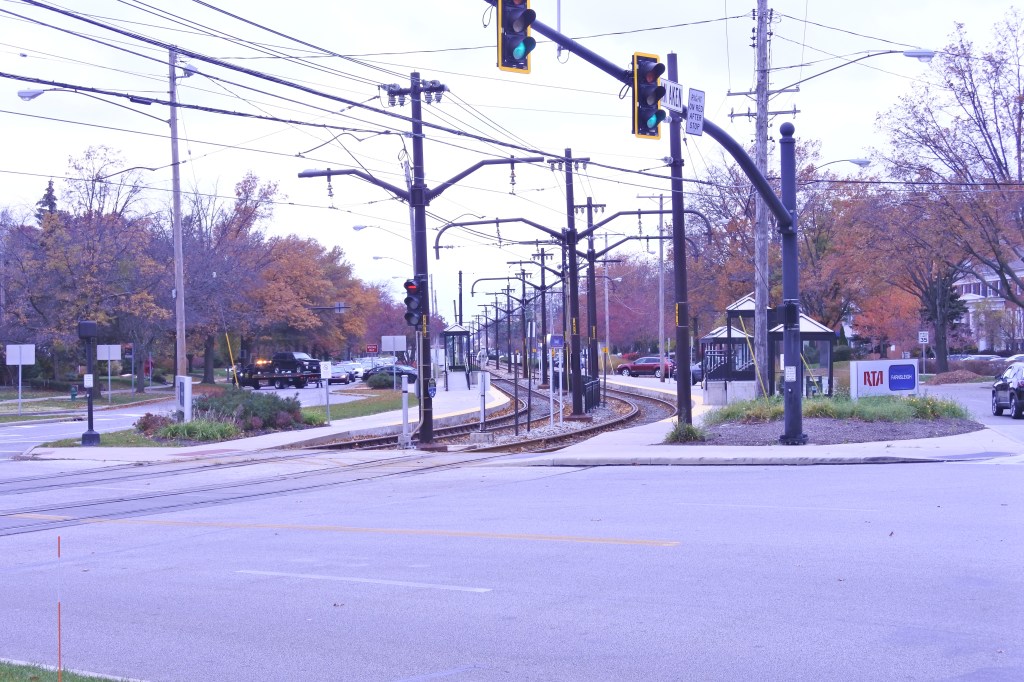
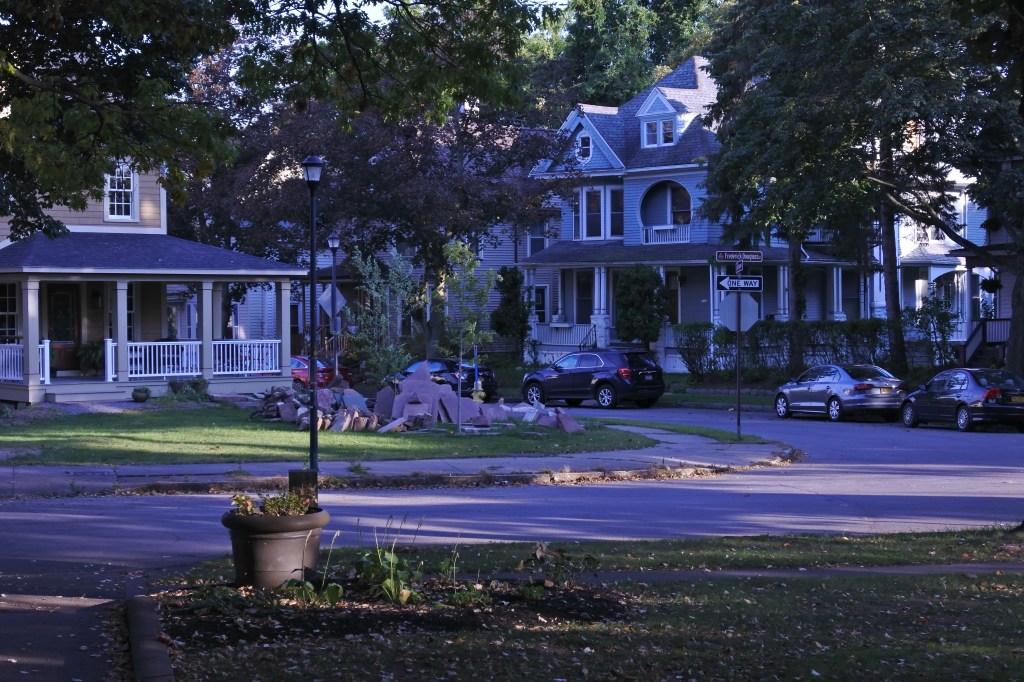
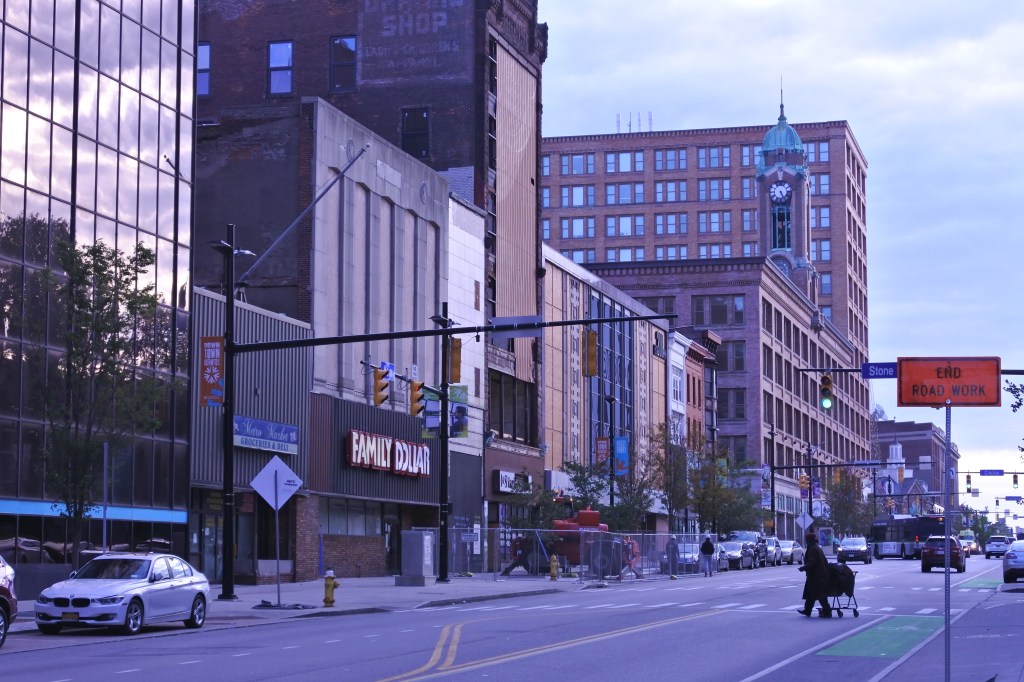
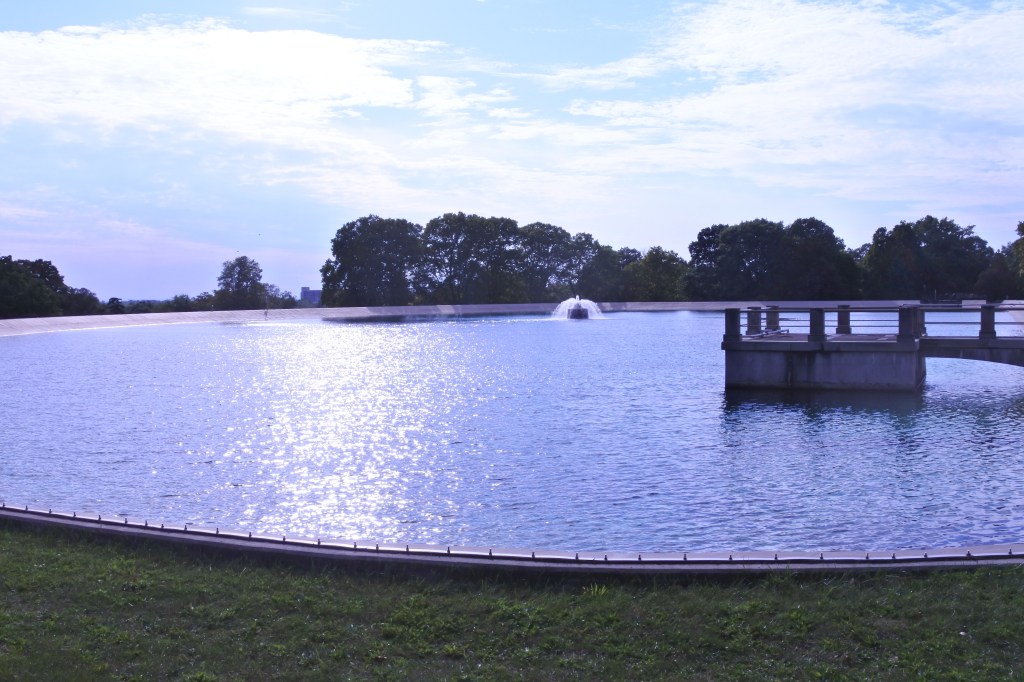
The neighborhood is named after Highland Park, an expansive park located on the neighborhood’s southern border that is one of several in Rochester originally designed by Frederick Law Olmsted,
Highland Park was developed mostly between the 1980s and 1930s and is a comfortable historic middle class streetcar neighborhood friendly to families but also very economically diverse. The district shares a border with South Wedge along South Avenue giving it convenient access to the main retail amenities located there. Clinton Ave is another urban biz district running along the northern edge of Highland Park. This is a decent urban biz district with a good amount of services but quite a lot of auto centric development too. Other urban areas that could improve in Highland Park include better public transit access, more intersections with ADA compliance ramps, more dedicated bike lanes, several schools located within the neighborhood, more cultural amenities and more rental housing options.
Click here to view my Highland Park Album on Flickr
URBAN STRENGTHS:
* Very convenient access to Downtown. * Excellent diversity esp. economic. * Nice diversity of affordability & moderately priced for sale housing. 1-bed homes sell in the 100Ks, 2-beds in the 100Ks & mid 200Ks, 3 & 4 bedrooms anywhere between the 100Ks and mid 300Ks depending on size & condition. * The expansive Highland Park sits squarely within the southern portion of the neighborhood’s boundaries. Also a nice but small neighborhood park called Ellwanger and Berry Park. * Culturally there is a good array of restaurants, bars, and cafes. There is also the Lamberton Conservatory Warner Castle within Highland Park. * Retail amenities include a small local Grocery store, a Pharmacy, a butcher, a decent # of boutiques, several dessert joints, and local stores.. There is also a local public library and a major hospital. * Good urban massing along South Ave but its more residential here than in South Edge. Clinton is a mix of urban and auto centric massing.
URBAN WEAKESSES:
* Public transit access is so here. * Good sidewalk coverage but most intersections don’t have current ADA ramps. * Only on dedicated bike lane and not dedicated bike stations in Rochester. * Rental housing is very limited but generally moderately priced. * No schools within Highland Park but a couple goods schools in adjacent districts that are quasi walkable. * No art galleries, live music venues, theaters, and few museum sites here. * Modern in-fill is limited mostly to crummy auto-centric buildings.
South Wedge is one of Rochester’s oldest neighborhoods outside of Downtown and began in the 1820s as a series of small houses owned by families tied to the Erie Canal trade. By the time Frederick Douglass moved to South Wedge along South Ave in the 1860s, the area was bustling and hosted the city’s first street railway.
After World War II the Wedge began a slow decline as residents moved to the suburbs. Businesses closed until the Wedge hit rock bottom in the 1970s. At this time around 25% of all housing units were vacant and crime was high along on South Avenue. But the fortunes of South Wedge really started to rise in the 2000s. Neighborhood groups worked hard to remove crime hot spots on South Ave and bring businesses back. Today South Avenue is one of the most interesting business districts in Rochester with lots of creative and locally owned shops. Architecturally the neighborhood has a nice variety of homes built between the 1840s and 1920s. Many handsome mixed-use buildings line South Avenue as well some decent urban in-fill development.
Main areas for South Wedge to improve upon include more rental housing options (something that is partially being helped with the new infill development along the River), better walkable schools, better cultural amenities, improved urban form along Mt. Hope Avenue, and a full service grocery store.
* Very convenient access to Downtown. * 2 nice north to south dedicated bike lanes but no dedicated bike stations in Rochester. * Nice diversity of affordability & moderately priced for sale housing. 1-bed homes sell in the 100Ks, 2-beds in the 100Ks & low 200Ks, 3 & 4 bedrooms anywhere between the 100Ks and mid 200Ks depending on size & condition. * Several affordable housing buildings in the neighborhood.. * Great park amenities including the Genesse Riverway Trail/Gateway Park, Highland Park to the south, and a couple smaller parks within the neighborhood. Solid tree canopy as well. * Culturally there is a good array of restaurants, bars, cafes, and a brewery. There is also the Lamberton Conservatory, Warner Castle, Sunken Garden within Highland Park along with walkable access to some cultural amenities Downtown. * Retail amenities include a Co-Op and local small Grocery store, a Pharmacy, a bookstore, a butcher, a decent # of boutiques, several dessert joints, local stores, and home good stores. There is also a local public library and a major hospital. * Some decent infill with several new mixed-use buildings along South Ave and new MF housing along the river. * Generally good urban massing along the main biz district (South Avenue). Much less so along Mt. Hope and Clinton Avenue which often have a mix of auto centric and industrial uses.
URBAN WEAKNESSES:
* Rental housing is very limited but generally moderately priced. * A couple walkable schools within or nearby but generally not great ratings. * Only 1 art gallery, live music venues, theaters, and few museum sites here. * Retail wise only a couple banks and no chain supermarket, nor local post office.
Park Avenue itself was first laid out in 1852 but did not assume its current form until 1875. Park Avenue became one of downtown’s earliest suburbs, filling out by the early 20th century. Decline began in the neighborhood as early as the Great Depression when many of the larger homes were subdivided into apartments. Revitalization efforts took off in 1969 with the creation of the Avenue Neighborhood Association in 1969 to focus on codes, preservation, and revival. Park Avenue, however, never experienced the same amount of decline as other Rochester neighborhoods and by and large retained its urban fabric and buildings.
Now Park Avenue is one of the most urban desirable neighborhoods in Rochester and especially caters to college or young professional. I would argue that the division of many large homes into apartments boosted its urbanity allowing more density and diverse housing options. Park Avenue hosts two attractive biz districts along Park Avenue (a collection of many urban nodes mixed with residential) and Monroe Street. Park Avenue also hosts decent schools, great cultural and retail amenities, great access to Dwtn , and is generally very safe.
Main areas where Park Avenue could improve include more park space. Yes, Cobb Hill Park is large and within a mile of the neighborhood, but there are really no other parks within the neighborhood. Racial and generational diversity is also very limited as this is a very white and young district. Public transit should also be much better considering how close Park Avenue is to Downtown and Monroe Street should have an overlay district to promote more urban and mixed use development to replace auto centric uses.
.* Decent # of schools ranked moderately well. Several large specialty high schools here. * Solid tree canopy and very safe district overall. * Generally quality sidewalk and ADA infrastructure. * Gorgeous historic architecture. * Generally quality urban form in biz district. Monroe does have some auto centric spots but overall is pretty good. Park Avenue is great! * Pretty vibrant district, especially for a midwestern City. * Public transit is ok but pretty sub-par for an inner ring neighborhood. * A couple north-south bike lanes but no bike share yet in the City. * Excellent economic diversity. * Even for a higher end district medium rent is quite affordable hovering around $1,000. A moderate amount of dedicated afford. units here. * Only a handful of condos available. They sell in the 100Ks. 2 & 3 beds sell for anywhere btwn 200K-400K depending on size and condition. 3& 4-beds 200K-500K. 4 & 5 beds are a bit more expensive but top out at 500K. * 1 bedroom rentals are a bit limited. 1-beds lease around 900K, 2-beds in the low-mid $1,000s, 3 beds in the mid to high $1,000s. * Very good cultural amenities in Park Ave including many restaurants, bars, & cafes. Also many art galleries, a couple community theaters and convenient access to many museums in neighboring East Ave and Downtown. * Retail amenities include 2 supermarkets, a couple drug stores, There are also several gyms, a rock claiming wall, tons of boutiques, home good stores, and dessert shops.
URBAN WEAKNESSES:
* The expansive Cobb’s Hill sits on the SE border of district. This an excellent park with lots of amenities but virtually no other parks exist within Park Avenue. For most residents this isn’t walkable. * About 85% of the population is white so pretty poor racial diversity here. Not very many family households either. * Public transit access is so . Very underwhelming for an neighborhood so close to downtown. * Limited in-fill housing, and what exists is mainly auto centric. * Okay racial diversity. Limited family households here.
East Avenue is home to the City’s best collection of large 19th and early 20th century homes, historic churches, and museums. This is the neighborhood where George Eastman constructed his mansion and estate in the early 1900s. It also is located just east of Downtown and has several nice urban biz districts (i.e. Park Avenue, East Avenue & Union, and University & Atlantic Ave.). The district also hosts a vibrant food and beverage scene, quality retail amenities, and a diverse array of often moderately priced housing options.
But there are also several areas that the East Avenue neighborhood does not excel at from an urban perspective. Its urban density of around 8,000 people per square mile creating many dead spots, its public transit service is wanting, there are several very autocentric stretches along University Avenue, and it has a very low percentage of family households. An ambitious densification plan and urban form overlay along University Avenue could go a long way towards improving the urbanity of this neighborhood.
* Quality sidewalk infrastructure, but plenty of intersections without ADA compliant ramps. * Excellent access to dwtn. * Excellent economic diversity. * Even for a higher end district medium rent is quite affordable hovering around $1,000. A moderate amount of dedicated afford. units here. * Very diverse array of for sale price points. Several condo buildings selling 1 bedroom units in the 100Ks. 2-beds sell for anywhere btwn 150K-400K depending on size and condition. 3& 4-beds 200K-500K. The large historic mansions sell btwn 500K-800K. * Rentals are a bit limited but moderately priced. 1-beds lease around 1K, 2-beds in the low-mid $1,000s, 3 beds in the 2Ks. * Decent # of schools ranked moderately well. Several large specialty high schools here. * Excellent Tree canopy. * Very good cultural amenities in East Ave including many restaurants, bars, & cafes. Also several theaters & live music venues, a handful of art galleries, and a concentration of the best museums in Rochester. * Retail amenities include 2 supermarkets, a couple drug stores, a mix of chain and local retail. Chain retail is mostly along auto centric biz district and local retail in more urban biz districts. There are also several gyms, a rock claiming wall, and home good stores. * Very safe district. * Gorgeous historic architecture.
URBAN WEAKNESSES:
* Transit is only so . Rather disappointing for a neighborhood adjacent to Dwtn. * A couple north-south dedicated bike lanes but not bike share yet. Apparently this will come soon. * This is a very young and childless district. Very few families reside here. Racial diversity isn’t’ much better as around 80-85% of all households are white. * The expansive Cobb’s Hill sits on the SE border of district. This an excellent park with lots of amenities but virtually no other parks exist within East Avenue. For most residents this isn’t walkable. * Mix of quality urban form and auto centric form in the biz districts. * Most in fill is auto centric buildings. But new MF apartments replacing the inner belt along Union (district’s western edge), and these are of some urban quality. * Vibrancy along Park Avenue and East & Union but rest of neighborhood is pretty dead.
The historic core of Sonoma is what I used for its evaluation. This includes the area half a block north of Spain St., 5th St to the east, Napa/Leveroni to the south, and 5th to the west.
Sonoma was founded originally as a mission in 1823. This was actually the only mission built by Mexico and not Spain. But the mission also served a secular purpose, to fortify Mexican presence north of San Francisco Bay and deter Russian encroachment into the region. Sonoma continues this role for the Mexican government until the Bear Flag Revolt in 1846, when American filibusters overthrew the local Mexican government and declared the California Republic, helping to usher in the American Conquest of California. Sonoma was originally the county seat for Sonoma County. But this did not last long as Santa Rosa quickly took over as the county seat. Sonoma remained small and grew to only 2,000 souls by 1950. Post WW II development picked up and now the City has 11K residents.
The City’s core is still built around the original Sonoma Plaza lined with many restaurants, bars, and local shops housed in attractive historic buildings. Surrounding streets hold many attractive turn of the 20th century homes. Unfortunately due to development restrictions even central Sonoma is low density, in line with a suburb. Open fields and suburban development are located even in the Sonoma core breaking the urban fabric. Sonoma is also very expensive with limited rentals available. Fortunately there are several hundred dedicated affordable units with many of them located in the core. However, Sonoma relaxes its very restrictive development regulations allowing the community to improve its urban fabric but also help reduce the Bay Area’s overall housing shortage.
* Decent diversity especially generational diversity with around 50% of households as families. * Good array of walkable schools within or near the historic Sonoma core. * Several 100 affordable units located in town. * This appears by all measures to be a very safe community. * Solid historic housing. * Very nice historic plaza in the center of town. Several other smaller parks spread through central Sonoma but not a ton. * Culturally Sonoma does well with many restaurants, bars, cafes, and art galleries. There are also a couple local theaters, several local museums, and a local music venue. * Retail wise Central Sonoma has a Whole Foods, drug store, Safeway, plenty of boutiques and local stores around the square, plenty of banks antique stores, and home good stores, a couple bookstores, a post office, and a couple of dessert spots. This is also a major hospital and small department store located in town. * Excellent tree canopy, especially SE of the square.
URBAN WEAKNESSES:
* Very low density. Lots of undeveloped plots even in the historic part of Dwtn. * Generally sidewalks in Sonoma but 1/2 the time not ADA compliment curbs. * Poor access to Bay area Dwtns. 1 hr. drive to Dwtn San Fran & Oakland with no traffic but not transit access. * Some bike lanes but not connected to the largest bike system. * Rentals are pretty limited here but at least a bit more affordable than most California Cities. 1-beds start in the high $1,000s. 2-beds in the low $2,000s, and 3-beds generally in the 3Ks. * Some “moderate” condos selling btwn 400K-700K. 2-beds sell anywhere btwn 600K-2M depending on size & finish. 3&4 bed anywhere btwn 800K-3.5M. * Modern in-fill is a very mixed bag. Lots of auto centric commercial and suburban houses mixed in. * Good urban massing and streetscape around the historic Sonoma Plaza but plenty of surface parking and auto centric businesses along the arterials coming out of dwtn. Lots of vacant lots within the historic core due to restrictive development laws.
Only a sliver of Sausalito along the coast line is what I consider to be urban. Once you go up the famous hillside, sidewalks and walkability basically disappear. This evaluation is roughly between Napa to the North and Valley to the south.
In the 1870s, Sausalito was connected to reliable rail and ferry service connecting it to San Francisco and setting the stage for future development. By 1940 the town had 3,500 inhabited. Sausalito experienced another growth spurt during WWII as it became a major shipbuilding center. This industrial character, however, quickly gave way to a more wealthy and artistic enclave with new residents taking advantage of its hills and gorgeous location along the sea. This also lead to an increase in tourism. Yet those living on boats and those living on the hills could not live harmoniously forever. Its California! Beginning in the 1970s, an intense struggle erupted between houseboat residents and developers, dubbed the “Houseboat Wars”. Forced removals by county authorities and sabotage by some on the waterfront characterized this struggle. The result was the banishment of all boat communities to just outside the Sausalito limits. Today along three houseboat communities still exist.
From an urban perspective this is a funny mix of great urban attributes and major failures. On the positive side Sausalito has an amazing dining scene and local shops. Shops cater to much more than your typical tourist destination. There are also many art galleries here, all set along a beautiful bay and relatively comfortable commercial district. Sausalito’s biggest failure is its exclusivity. Small condos start at 600K and there are few rentals here. Racial and economic diversity is also limited. The hills quickly rise from the sea making an urban environment difficult for much of the City. Public transit access to Dwtn San Fran is also not great.
* A decent bike lane running down Bridgeway but not dedicated bike stations. * Good generational diversity with about 40% of households as family ones. * Very nice waterfront and several attractive smaller parks. Golden Gate View Park is only 1/2 south but only car and bike access. * Great cultural amenities including many restaurants, bars & cafes, tons of art galleries, a couple theaters, a couple local museums and some live music and night clubs. * Several excellent schools but located .5 miles to a mile from the walkable part of Sausalito in or near Marina City. Not terribly walkable. * Some great retail amenities many boutiques, home goods stores, antique stores, souvenir shops, and specialty retail and a drug store, hardware store, and post office. * A good amount of petty thefts but limited major crimes. Overall very safe place. * Excellent architecture both historic and new. * Generally very good urban form but still a good amount of surface parking lots. * Very vibrant with all the tourists.
URBAN WEAKNESSES:
* Decent access to San Francisco, especially driving. One can also drive to Oakland in 45 mins but generally lot great public transit access. * With all the hills and circular roads, not great connectivity in Sausalito. * Very expensive place to live with medium rent at $2,600. * Poor racial and economic diversity. * Some 1-bedroom condos starting around 600K. But most selling in the low 1 Millions. 2-beds sell anywhere btwn the low 1 Ms and low 2Ms. 3 & 4 bedrooms sell for btwn mid 1Ms and mid 2Ms. * Leases are very limited. Some 2-bedrooms rent btwn 3K-5K. 3-beds for even more. * No supermarket in dwtn Sausalito. * Generally pretty walkable but lots of hills and missing ADA curbs.
I only evaluated the more urban dwtn center of Novato this is roughly btwn Novato/Diablo Blvd, 7th St, Carmel/Olive Ave., and the Redwood Hwy.
The town was originally a Mexican community starting in the 1830s but remained very small. American pioneers planted orchards and vineyards in the 1850s. Is population started to grow with the construction of a railroad in 1879 connecting it to surrounding towns Sonoma County. The area around the train depot became known as New Town, and forms the edge of what today is Old Town Novato (mostly demolished). After World War II, Novato grew quickly with the construction of tract homes and a freeway. As the area was unincorporated much of the growth was unplanned and uncontrolled. Novato was finally incorporated as a city in 1960 with 17K residents.
From an urban perspective, Downtown Novato is an area of decent urban form but with lots of cultural and retail amenities. The historic Grant main street is packed with restaurants, bars, boutiques, and interesting stores. Housing prices are astronomical like the rest of California but fortunately the City had the will to construct several hundred units of affordable housing and many of them are located Dwtn. Novato does have direct rail connection to Dwtn San Fran but that trip takes at least an hour. Only 40 min drive (without traffic of course) to Dwtn San Fran and Dwtn Oakland.
The most important thing to improve from an urban perspective in Dwtn Novato is more density. For one, the communities in Marin County need to welcome more people considering the Bay Area’s severe housing shortage. 2nd many of these Marin County communities has transit access and thus could hosts very dense TOD downtowns. Increased density would also improve the overall urban quality of Downtown Novato as well. Specific areas for improvement include better park amenities, more walkable schools, and improved urban form.
* Several dedicated bike lanes run through dwtn. Good connections to the regional network. No dedicated bike stations. * Good overall diversity among all factors. Specifically a very high number of families live here. * Very safe district. * Fortunately the City has a good # of affordable housing. Around 300-500 units in the dwtn area. * Good array of cultural amenities including many restaurants, bars, cafes, and breweries. Also plenty of art galleries, a cinema, performing arts center, and a couple local museums. * retail amenities include several supermarkets (Trader Joes, Whole Foods, and Safeway), several drug stores, a couple book stores, lots of boutiques & creative stores, banks, Gyms, and plenty of dessert shops. * Quality streetscaping.
URBAN WEAKNESSES:
* Not great density at only 7,000 per sq mile * A couple roads on the edges of the Novato central district are without sidewalks. Most intersections have modern ADA curb cuts. * Drives to dwtn Oakland and San Fran are around 40-45 mins so not terrible. But only transit to San Fran 1:15 is somewhat viable. Dwtn San Jose is a very long trip. No other larger employment centers in Marin County. * No schools within Dwtn Novato but several quality options about a 1 mile that are semi-walkable. * Housing is very expensive starting with a handful of 1-bedrooms selling around 500K. A good amount of 2-bedrooms all selling btwn 600K-900K. 3-bedrooms are a bit more expensive and 4 bedrooms are around 1M-1.5M but mostly outside the downtown area. * Rentals are much more limited and expensive. The few 1-bedrooms lease for around 2K, 2-bedrooms 2K & 3K, and very few 3-bedrooms. * Only the Lee Garner Park is in the Dwtn area. Some good parks a couple miles away but not walkable. * Much of the modern in-fill is autocentric. * Good massing in the core of dwtn on Grant Street but plenty of strip malls and autocentric development even in the dwtn area.
Japantown is a very small neighborhood mainly centered around Jackson Ave. I expanded the boundaries a bit to include the area between 1st and 10th streets and Empire and Taylor Streets.
This is the historic center for San Jose’s Japanese American and Chinese American communities. San Jose’s Japantown is one of only three Japan towns that still exist in the United States; one in San Francisco and Los Angeles. By 1941, there were 53 businesses in Japantown. Sadly the population was forcibly removed from Japantown and unjustly incarcerated in camps due to the conflict with Japan. On their return after the war many resettled outside of the neighborhood. Yet Japanese culture and the vitality of their community remained especially with many Japanese businesses and Japanese festivals.
Today about 17% of the population of Asian but this is a mixture of Japanese, Koreans, and Chinese. There is now a large Mexican presence in the neighborhood. From an urban perspective Japantown is a comfortable relatively walkable district with solid density, good public transit, great bike infrastructure, and convenient access to Downtown. Amenity wise there is a large concentration of Asian restaurants and businesses here, plenty of cafes, boutiques, and gift shops along with some other retail amenities. Areas to improve upon include walking access to more and better schools, the need for a supermarket and drug store, more walkable parks, and more affordable for sale housing. There is actually a high concentration of affordable senior housing here, but for sale one-bedroom condos start at 700K.
* Great public transit and access to Dwtn (only 1.5 miles away). * Excellent bike access with many dedicated bike lanes and dedicated bike stations. * Only 17% of the pop. remains Asia great diversity with large numbers of Hispanics and Mixed Races. * Pretty wealthy district but only a bit more than the City average of 115K. * Excellent streetscaping in Japantown. * Good amount of dedicated amount of affordable housing esp. senior housing. * Urban in-fill is generally very good. * The neighborhood generally seems very safe. * Great tree canopy especially along the residential streets. * Cultural amenities including a great array of Asian restaurants, a decent # of bars, cafes, a couple breweries, the Japanese American Museum, a couple art galleries, and the Contemporary Asian Theater. * Retail amenities include plenty of Japanese grocerias, plenty of gift stores, a public library, lots of boutiques, a toy store, an art store, and a good number of churches.
URBAN WEAKNESSES:
* A couple parking lots and autocentric spots but overall the urban form in the commercial district is very good. * Medium rent is very high at $2,300. * Really only 2 walkable schools with ok ratings. A public grade and middle school. Several schools 1.5-2 miles away. * Rentals are a bit limited and certainly expensive. 1-bedrooms lease in the $2,000s, 2-bedroosm in the 2K & 3Ks. Very few 3 bedrooms. * A handful of condos for sale. 1-bedrooms sale around 700/800K, 2-bedrooms vary btwn 700K and the low Millions. 3 & 4 -bedrooms in the low Millions. * No parks within Japantown but several nearby including the expansive Guadalupe River Park a mile away. * No supermarket nor drug store walkable to the district, no post office,
San Jose was settled originally by the Spanish as a mission town in 1777 called Pueblo de San José de Guadalupe. The area that now makes up downtown was settled twenty years later, when Pueblo de San Jose de Guadalupe was moved somewhat inland from its original location on the banks of the Guadalupe River. In 1850, San Jose incorporated to become California’s first city and the location of the state capitol (this lasted only a couple years). Before WWII the downtown area was typical of a small, agriculture-based city of under 100,000 residents until city manager A. P. Hamann organized aggressive expansion during the 1950s and ’60s. As the city rapidly expanded into outlying areas, the downtown area unfortunately entered a period of decline.
But this did not last long as Downtown San Jose is the cultural and political center of one of the largest tech clusters in world, Silicon Valley. By the 1980s investment poured back into Downtown with the construction of many office tours, new residential housing, a renewed focus on the arts, and the construction of the San Jose State Event Center. Downtown is now home to Adobe’s World Headquarters, BEA Systems HQ, and numerous facilities and offices of major tech companies, including Amazon Lab126 and Google. Google is planning a 67 Million expansion and develop and will break ground in 2022.
At first glance Downtown San Jose can feel rather sterile and cold. But when one dives into it deeper one discovers that it upholds urban design principles quite well. Downtown has a solid population with just over 12K per square mile, effective public transit and excellent bike lane system that expends out to most of the City, comfortable street scape, generally good urban design with few surface parking lots, quality parks, and excellent cultural amenities. There are certainly areas for improvement including the need for much better neighborhood retail amenities, more bike rental stations, more interesting high rise buildings, and a larger concentration of the region’s share of jobs. While dedicated affordable housing is highly concentrated dwtn, market prices are very expensive, similar to prices in San Franciso. Fortunately there are many development plans in the works, including the 67 M Google development, which will bring many more residents and jobs to Downtown. I believe this will help tremendously in creating a more bustling and interesting Downtown San Jose.
Click here to view my Downtown San Jose album on Flickr
URBAN STRENGTHS:
* High quality ADA infrastructure in Dwtn San Jose. * Good density level for a Dwtn at around 12K per square mile. * Solid public transit within the City of San Jose and good connections to its suburbs. So public transit connection to the San Jose Airport. * Likely one of the best dedicated bike lane coverages in the Country is here in San Jose Better than Oakland and San Fran. Network is well connected to surrounding suburbs too. * Highly level of grid network and streets are generally not too wide and lanes are carved away for dedicated bike lanes. Sometimes feels a bit too easy to drive. * Very good racial and economic diversity downtown. About 25% of residents are below the poverty line but the medium income is around 75K. Surprisingly around 35% of dwtn households are family ones. Also a Children’s Museum Dwtn. * Medium rent is around $1,500 helped by the fake that Signiant portion of San Jose’s Total Affordable Housing is Dwtn. * A decent # of grade schools (both public & private) dwtn and a large Catholic High School. * Generally a safe dwtn helped with having a BID. Still a fair amount of homeless and panhandling, esp. on the north end of Downtown around St. James Park. * The office towers are pretty bland but some decent residential in-fill with good urban form. * Some very nice park spaces especially along the Guadalupe River. Pretty good civic plaza at Caesar Chavez Park * Culturally Downtown has a great array of theaters, performing arts centers and cineplexes. The symphony, opera, & ballet are all here. Solid array of restaurants, bars, & cafes, live music venues, and clubs. Dwtn also hosts a large Convention Center, and Sharks arena, a good array of museums & art galleries, a major dwtn post office & library, and a great government complex. * Retail amenities include a bargain supermarket, some nice local stores & boutiques (esp. along San Pedro), plenty of banks & dessert joins, a couple gyms & book stores, and plenty of churches. * Great college presence with over 30K students attending San Jose State. * While a bit sterile, Dwtn has a very good streetscape.
URBAN WEAKNESSES:
* Dedicated bike coverage is a bit limited only covering Dwtn and some inner city neighborhoods to the north and west. * Not many elderly residents residing Dwtn. Its mostly students, young professional, and middle aged adults. * Market rate housing is very expensive overall. Studios start at 2K, 1-bedrooms, 1-bedrooms in the 2Ks, 2-bedrooms in the 2ks & 3Ks, and few 3 bedrooms but those run in the 3K & 4Ks. * Some studios listed around 500K. 1-bed condos sell btwn 600K-900K. A lot more 2-bedroom condos and townhomes selling btwn 700K and the low Millions. Some 3-beds townhomes and SF homes selling btwn 1M-1.5M * Other than a 15 story historic tower the skyline is mostly bland, boxing mid rises. * Only about 45K jobs currently in Dwtn. This is even less than San Jose, but several office towers are afoot to bring many more jobs in. * Retail amenities are a bit lacking. No full service grocery store, nor drug store, and not a ton of local retail. * Some surface parking remain but not too bad. Generally quality urban form Dwtn. * Vibrancy is kinda lacking.
Under Spanish and Mexican rule, what is now the Financial District and Yerba Buena Gardens, was the site of a harbor named Yerba Buena Cove with a small civilian outpost to support the military population of the Presidio and the Mission Dolores. Due to its sandy and marshy soil the Spanish/Mexican government decided to focus their pueblo settlement at San José and the current Mission District in San Francisco. It was not until 1835 that the first settlers established themselves at Yerba Buena Cove. The Cove’s potential as a seaport made it the eventual center for European and American settlement which really accelerated after the California Gold Rush. The Downtown district became the financial capital of the west coast and only location of West Coast Skyscrapers along Market Street. After the great fire of 1906 Downtown was largely rebuilt with low-rise, masonry-clad buildings ranging from six to twelve stories. During the late 1920s, several Neo-Gothic high rises, were constructed. The Financial district then boomed with many Highrise towers in the 60s-80s. Yet many in San Fran saw this as a threat to the character of San Francisco descripting it as the Manhattanization of the City. This caused widespread opposition citywide and height restrictions were placed on new high-rise construction leading downtown to shift more to neighborhoods South of Market where high rise construction was still allowed. While I lament the anti-density sentiment this “skyscraper revolt” lead too, I’m happy that it led to an expansion of the City’s high-rise districts, creating a more dynamic and interesting skyline in San Fran.
Somewhat of a surprise to me, Downtown San Fran is my highest scoring Downtown district, beating out the likes of Midtown, Lower Manhattan, Chicago’s Loop District, Center City Philly, and Dwtn Boston. I attribute this mainly to Dwtn San Fran density (around 25K per square mile), which fosters great neighborhood amenities, high affordability levels (with 65% of all units as dedicated affordable housing), great cultural and park amenities, and an excellent bike and transit system connecting well to its neighborhoods and the entire Bay Area. Even so there are certainly aspects to improve. #1 on my list is improving the homeless situation. This causes some legitimate safety concerns but it is why many are distasteful of Dwtn. There are also very few universities Dwtn and schools could be improved. I also think Dwtn should be allowed to densify more. This could easily be a Dwtn with over 75K per square mile, something that makes a lot of sense with decreased office demand.
Click here to view my San Francisco Downtown Album on Flickr
URBAN STREGNTHS:
* Great downtown density at around 25K per square mile. * Public transit is excellent within the City and good in the overall region. Because development is hemmed in by the mountains and at least a medium density, most suburbs even have decent transit access. But the BART seems is very expensive to travel across the region and timely. To travel from Dwtn San Fran to Dwtn San Jose takes almost 2 hrs. Good connections to San Fran Airport and Dwtn Oakland. * Excellent dedicated bike system across the Bay Area feeding in well to Dwtn San Fran. Probably the best system of any US region. * Street Connectivity is generally at a high level in San Fran due to the grid network, good dedicated bike lane system, and lots of narrow cut through streets. Some wider one way streets but not too bad. * Excellent bike infrastructure with a very high concentration of rentable pedal & electric bikes Dwtn. Great dedicated lane coverage connecting well with most San Fran neighborhoods. Some of the hilly districts don’t have a ton of bike lanes. * High levels of racial and economic diversity residing in the Dwtn area. * Around 28% of households are family households, quite high for an American Dwtn. Good age distribution as well with a large number of elderly living in the Financial district and more young and middle aged people residing in other districts. Some Children friendly activities Dwtn like the Children Activity Center and Yerba Buena Gardens. * 60-65% of all housing units are permanent afford housing units. This probably cuts the number of rental control units down (only around 33%). Median rent is ~$1,300, quite low for San Fran. * The elevated Sales Force Park is a high quality park space. The rest are community sized small & medium parks spread throughout. Also good water front parks too. Dwtn hosts FOUR active civic centers (Civic Plaza, Yerba, Union & Sales) each acting as civic centers for their section of Dwtn. * Def a top-tier American Dwtn with retail and cultural amenities. A very livable Dwtn. * Great ADA infrastructure overall. * One of the most iconic skylines in America.
URBAN WEAKNESSES:
* Only about 35% of all units downtown are rental controlled. * Plenty of schools dwtn but many of them are smaller private schools. Good # of public grade schools. * Market rents are pricey but lots of options. Some efficiency units rent in the $1,000s but most studios & 1 beds lease in the 2Ks and low 3Ks. Some 2-beds lease in the 2Ks but most go for 3K-5K. Lot a ton of 3-bed product. This can range anywhere from 3K-8K. * For sale is also very expensive. But some moderately priced housing with studios selling for anywhere btwn 300K-800K. Plenty of 1-bedrooms in this range too but many of them all sell around 1 M. A handful of “moderately priced” 2-bedrooms but most sell btwn 1-2M. Plenty of 3-bedroom product but only a handful of it sells around 1 M. Most is 2M+ * Dwtn only hosts one major sports arena. Also no major dwtn post office remains. * Dwtn San Francisco was certainly a strong job center pre-pandemic with around 300K employees. But even before the pandemic there were signs of changes with increasing vacancies and rents sky high. Given its great neighborhood amenities, Dwtn San Fran should emerge as an even better mixed-use district, even if office wanes. * Safety is a mixed bag in Downtown. The Financial District and South Beach are safety by most measures. SoMa and areas around Union Square & Civic Square can be a bit rough. Lots of homeless in these pockets. * Only several small satellite colleges in Dwtn. Nearest large university is 3.5 miles away. * Some image problems dwtn with its large homeless presence.