Originally referred to as Brooklyn Village, Brooklyn Heights has been a prominent area of Brooklyn since the early 19th century. It was the first part of Brooklyn to see major residential development and became New York’s First commuter suburb with the establishment of regular ferry service making it an easier commute to Lower Manhattan than from the Upper West and East sides. By the Civil War there were over six hundred brownstones built and by 1890 the neighborhood was completely built out. Brooklyn Heights contains the largest concentration of Anti-Bellum housing in New York with the majority of such structures concentrated in the northern edge. The neighborhood also became a hot spot of leading abolitionist leaders and major stop along the underground railroad. By the early 20th century, Brooklyn Heights was well connected by subways going into Manhattan and the neighborhood lost its specialness, which lead it to transition from a more exclusive neighborhood to one welcoming more and more working and middle class families as most mansions were divided up into apartments and boarding houses. Artists and writers began to move into the neighborhood and large hotels sprung up in the 1920s. During the 1940s and 1950s Robert Moses forced his Brooklyn-Queens Expressway along the western and northwestern edges of the neighborhood removing a significant chunk of Brooklyn Heights’ oldest Brownstones. The Cadman Plaza development along the eastern edge in 1960 displaced 1,200 residents but at least provided modest rental and co-op housing. Neighborhood opposition led the Brooklyn-Queens expressway to be routed from the heart of the neighborhood to the bluff and helped created the Brooklyn Heights Promenade. Brooklyn Heights also hosted the City’s first major preservation movement leading to the City’s first Historic District in 1965 protecting a large chunk of the neighborhood’s historic character. This helped lead to Brooklyn Heights being one the first Brooklyn neighborhoods to gentrify in the 1970s & 80s. The 2010 brought the extensive Brooklyn Promenade and Pier parks giving the neighborhood excellent park amenities.
Brooklyn heights contains main business districts: Montague, Atlantic, and several blocks of Henry. The Eastern edge of the Brooklyn Heights is the Downtown transitional zone along Court Street and a block of Montague. From a urban perspective there area only a few areas of improvement I see. Brooklyn Heights needs a lot more affordable housing units, which can only be built if the historic preservation designation is relaxed. This would help add much needed economic and racial diversity. The district could also use a sprucing up of its streetscaping as well and more schools and larger affordable housing units to welcome more families.
Click here to view my Brooklyn Heights Album on Flickr
URBAN STRENGTHS:
* Great density at just over 70K per square mile.
* Top notch transit access and excellent access to Dwtn Brooklyn just to the east and only a 15-20 min train ride to Downtown Manhattan and Midtown.
* Connectivity is great except for the fact that I-278 cuts through the northern and western edge of the neighborhood.
* Excellent bike infrastructure including several dedicated bike lanes and good access to bike rentals.
* Overall a very safe community.
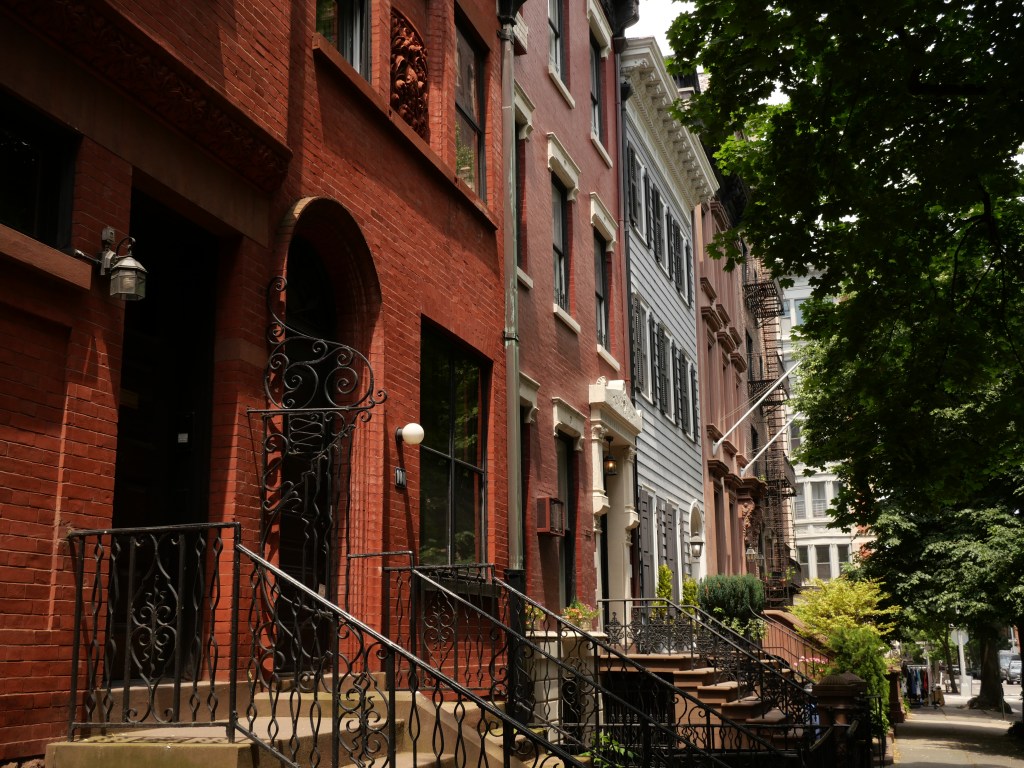
* Excellent historic architecture. A great mix of mid-late 19th century rowhouses & brownstones and early 20th century apartment bldgs.
* Great tree canopy especially considering how dense the neighborhood is. Feel more like a tree canopy in Paris.
* Good amount of rental product as well but also very expensive. Studios lease btwn 2.5K-4K, 1-beds btwn 3K-4.5K, 2-beds btwn 4K-8K. Only a handful of 3-beds. However, there are a fair amount of rent stabilized units as Medium rent is around 3K and half the units rent below 2K.
* Excellent park amenities thanks to the new and extensive Brooklyn Bridge and Pier parks developed along the East River between 2010-2021. The parks include roller rinks, pickle ball courts, recreational trails, large lawns with great views of Lower Manhattan, playgrounds, dog parks, beaches, basketball courts, soccer fields, marinas & more. Up the hill is the Brooklyn Heights Promenade was created in the 1950s above the Robert Moses designed Brooklyn-Queens Expressway. The Cadman & Columbus Plazas also sit on the neighborhood’s eastern edge.
* Pretty good school access including a well rated public and private grad school, a couple specialty public high schools and several other well rated private or specialty public schools in surrounding districts.
* Very vibrant foot traffic but not overwhelming like in Midtown.
* Excellent retail amenities including several supermarkets & drug stores, a Marshall’s Mitchell’s, Five Below and easy access to all the Department and name brand clothing stores in Dwtn Brooklyn, good # of boutiques/gift stores,/home good stores, a couple book stores, a couple hardware stores, several gyms and dessert joints, plenty of churches, a major hospital & lots of doctor offices, plenty of salons, and Dwtn library & post office.
* Good cultural amenities including plenty of restaurants, bars & cafes, a couple live music venues & night clubs, a couple museums on the edge of Dwtn Brooklyn, a couple performing arts theaters, and convenient access to the indie theater in Dwtn and its cultural amenities.
URBAN WEAKNESSES:
- Not much modern in-fill other than a handful of buildings along the neighborhood’s eastern edge with Dwtn but this doesn’t negatively impact much the urban quality of the neighborhood.
- Overall not great diversity as this is a majority white neighborhood. But a decent amount of lower-middle class households likely thanks to rent stabilization.
- A lot of for sale condo product but generally pretty expensive. Fair amount of studios and 1-beds selling btwn 300K-500K. But most of these units sell btwn 500K-1M. 2-beds range btwn 600K-2M with most units selling btwn 900K-1.3M. Good # of 3-beds but very expensive ranging anywhere from 850K-4.3M with most product selling btwn 1.5M-3.5M. Some 4-bed product generally selling for a couple Million more.
- Some of the streetscaping looks a bit tired and some intersections have outdated ADA curb cuts.”
 Evaluating our Urban Communities [with a focus on America]