Center City Dublin

Center City is really characterized by three separate subdistricts: Temple Bar running along the Liffey River, Georgian Dublin south of Trinity College spreading south and east to the canals, Trinity College, and the more “unlabeled” part of Center City between Temple Bar and Portobello.

Temple Bar is characterized by excellent narrow streets running between the river and R 137, an excellent mixed-use historic street. Temple Bar is the most touristy part of Dublin filled with bars, restaurants, live music and plenty of tourist traps. But it is quiet charming with its coble stone streets and 18th century and 19th century buildings.

Georgian Dublin:  This occupies a large part of Central Dublin extending south from Trinity College all the way south and east to the canal and westward to Aungier St. The district contains some of the best urban fabric of all of Dublin with consistent 3-5 story early 19th century flat Georgian architecture. The premiere park in the district is Stephen’s Square. But there are several other lovely squares (i.e. Merrion Square Park, Fitzwilliam Sq, Wilton Park, and Iveagh Gardens).  The most regal Georgian flats surround the squares or are along Harcourt St. Several excellent business districts cut through the district including Leeson Street Lower, Bagget Street Lower, Camden Street, R138, Pembrooke St, and Dawson St.

Trinity College/Center City: Trinity College is located just east of Temple Bar and is a gorgeous campus with many historic gothic buildings from the late 18th to 19th century.  North of here is a non-descript district mixing historic Georgian architecture and a lot of mixed-use in-fill spilling over from the Docklands. The area between Temple Bar south to Kevin Street and west to Patrick Street is the core of Center City Dublin. This includes some of the most important Dublin landmarks (i.e. St. Patrick’s Cathedral, Christ Cathedral, Dublin Castle, St. Audoen’s Church, Dublin Linn Garden, George’s Street Arcade, and Stephen Green’s Shopping Centre). The City’s best pedestrian mall/shopping district is also here along Kings Street/Clarendon Row/Grafton St/Wicklow Street. William/St. Andrea’s Street is a wonderful semi-pedestrian street nearby. R 137 is a solid business district that forms the Center City’s northern and western border with Temple Bar and the Liberties, respectively. Augier St is a wonderful business district with tons of gorgeous mixed-use architecture running north-south through the district and hosting George’s Arcade.

Click to the right to view several of my Center City Dublin Albums on Flickr: Center City, Temple Bar, and Georgian Dublin

URBAN STRENGTHS:

* Great dedicated bike lane system, many of them being separated.
* Highly walkable, mixed-use fabric with many business districts, landmarks, squares, and pedestrian street with excellent shopping options.
* Excellent cultural amenities including tons of restaurants, bars, numerous art galleries, plenty of museums and historic sites, tons of live music venues in Temple Bar, and several performing art and movie theaters.
* Lot of gorgeous historic architecture especially in the Temple Bar and Georgian subdistricts. Wonderful historic commercial buildings along Kings Street, Clarendon, Grafton, William St, Dame St, and Augier St.
* Several excellent urban plazas and squares.

URBAN WEAKNESSES:

* Fair amount of ugly post WWII buildings in Center City between Temple Bar and Portobello.
* Tree Canopy is limited to the squares and plazas.
* Connectivity and imaginability are a bit challenging with all the winding and dead-end streets.
* Disappointing access to the river in Center City. Just a simple sidewalk runs along the riverside.
Center Cork, Ireland

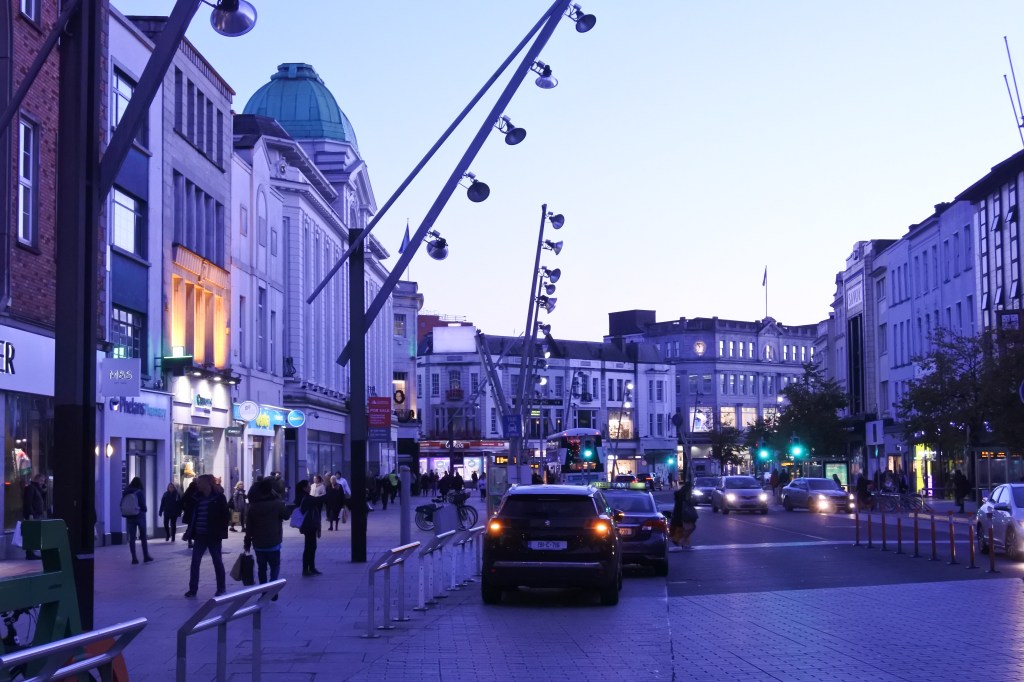
Centered City is located in the middle of the River Lee and is the location of the City’s original trading post settlement. Centre City really is a delight with many comfortable pedestrian streets lined with shops, restaurants, and bars, extensive mixed-use fabric and several great landmarks and gathering places. The most vibrant part of Centre City is between S Mall and Saint Patrick Street where Oliver Plunket bisects. Oliver Plunket St is the longest pedestrian street that cuts through the Heart of Centre City. Several narrow streets run perpendicular to Oliver Plunket St and are at least partially pedestrian. Saint Patrick Street/Grand Parade hold excellent retail amenities, wide, plaza wide sidewalks and the excellent English Market and Bishop Lucey Park.  Cornmarket Centre Shopping Mall is another great hub surrounded with lots of shops and the activity Main Street business St a block away.

Its hard for a mid-city to beat Center City from an urbanist perspective but there are some areas where it can improve including better tree canopy, more park and plaza space, and more recreational space along the riverfront. This is a very tight and built up Center City, so creating new park spaces is a challenge but they did find a way to install a great separate bike lane system in Center City. One would think they could find a way to add more parks and plazas.

Click here to view my Center City Cork Album on Flickr

URBAN STRENGTHS:

* Excellent historic architecture throughout
* Very vibrant and mixed-use. Center City packs in a lot!
* Great shopping options still in Center City especially along St. Patrick St. & Grand Parade. Wonderful wide sidewalk and new streetscaping along these streets as well.
* English Market is a top notch historic market supported by many businesses.
* Extensive pedestrian street running down Oliver Plunket St (car free at least most of the time). Many pedestrian or limited traffic roads running perpendicular to Oliver street connecting to St Patrick St to the north and less so to S Mall to the south. Maylor St is prob the 2nd longest mostly pedestrian St. and hosts many shops.
* Also nice Commercial districts along Washington, Sheares St., Main St., S Mall, and Cornmarket St which hosts the Cornmarket Centre shopping Mall.
* Several well planned and designed separated bike lanes. Impressed they could create these considering how limited roadway space is in the Center City.
* Several wonderful historic churches dwtn (i.e. St. Augustine’s, St. Peter & Paul’s, St. Francis, Holy Trinity.
* Excellent cultural amenities including tons of bars & restaurants, a movie theater, tons of performing arts theaters, and many live music venues.

URBAN WEAKNESSES:

* While Center City bike lane network is great it doesn’t connect well to the inner City neighborhoods and Cork as a whole.
* Limited tree canopy Dwtn.
* No real park space or recreational trail along the waterfronts.
* Limited Park and plaza space in Center City.

Center City Rouen, France

The urban quality of Center City Rouen is as good as any American neighborhood/downtown hosting a very walkable mixed-use environment with lots of historic landmarks and destinations.. Rouen also preserves an incredible number of half-timber structures, probably one of the highest concentrations in all of France. It somehow managed to save much of its historic fabric even after extensive bombing during WWII. And what had to be rebuilt during the mid 20th century is still great urban form. The most notable landmark is the Rouen Cathedral, which also miraculously survived the bombing. The Cathedral’s gothic façade (completed in the 16th century) was made famous in a series paintings by Claude Monet. One these paintings is housed in the Rouen Museum of Fine Arts only a 1/4 mile from the cathedral.  This landmark is joined by several other notable churches that mark the skyline  (i.e. St. Maclou Catholic Church, Saint-Ouen Abbey Church, and  Hôtel de ville de Rouen).  Other famous sites in Center City including The Gros Horloge (an astronomical clock dating back to the 14th century) and the St Joan of Arc modernist church where Joan of Arc was burned at the sake.

Center City flows very nicely comprised of several well designed plazas, markets, squares, theaters, and landmarks all located with a 1/4 of mile of each other. This is exactly the type of urban environment that urbanist Jane Jacobs loved. Plenty of pedestrian streets or low traffic alleyways also fill Center City creating a very comfortable walkable environment. Center City also hosts a great array of retail and nightlife amenities all well connected by a couple light rail lines and a subway. One area in which Center City could see improvement is cleaning up its waterfront along the Seine. The area is choked by roadways and an abandonded rail line that should be converted into a recreational path. Tree canopy is also lacking here.

Click here to view my Rouen, France album on Flickr

URBAN STRENGTHS:

* Some incredible landmarks including the Cathedral of Rouen, St. Maclou Catholic Church, Saint-Ouen Abbey Church, Hôtel de ville de Rouen, Le Gros-Horloge, Rouen Museum of Fine Arts, Donjon de Rouen
 Castle, St Joan of Arc’s Church and countless half-timber buildings.
* Lots of pedestrians ways, most notably the Rue du Gros Horloge
* Great historic architecture even with the bombing. Incredible what was able to be saved. Modern mid-century infill built after the war is generally quality urban form. Most architecture spans from the  16th-20th centuries. Lots of variety.
* Several nice plazas including Marche Saint Marc, Parc del’Hôtel-de-Ville Garden, Fontaine Sainte Marie, Place de Vieux Marche, Square Verdrel
* Extensive compact mixed-use area in Center City.
* A gentle rise on the northern edge of Center City creating some interesting elevation changes.
* Lots of narrow alleyways creating many interesting passageways and urban spaces.
* Great cultural amenities in Center  including many restaurants, several theaters, a cinema, lots of night clubs & bars, a couple live music venues, and tons of art galleries and museums.
* Good transit access dwtn; a mix of subways and streetcars

URBAN WEAKNESSES:

* Some blander modern architecture on the eastern edge of Center City but still good urban form.
* Tree canopy isn’t great.
* Limited dedicated bike lanes but plenty of low traffic alleyways to transverse.
* Poor waterfront access along the Seine. There is even an abandonded rail line that could easily be converted to a waterfront trail.

Center City Le Mans, Francae

Center City Le Mans would be a great downtown by American standards but for a mid-sized French City its pretty middle of the road. Center City hosts an excellent Old Town District clustered around its La Grande Rue, where dozens of medieval half-timbered houses and grand Renaissance mansions line dense cobblestone medieval streets. This comprises about 1/3 of the Center City in its northwest quadrant.

The Place de la republique is the flat part of Center City centered on Place de la République. This is a lively district with mostly historic 18th & 19th century architecture set on dense mix-use blocks and frequent pedestrian only streets.  I find the eastern half of this district to be the most lively and healthy from an urban perspective with modern office buildings mixed in with historic blocks where lots of attractive small plazas, fountains, and pedestrian streets can be found. Pretty intense mid-century buildings in this area along General de Gaulle and  François Mitterrand but a high quality urban form is still retained even if its pretty ugly from an aesthetic standpoint. The southern edge of Place de la republique is still good urbanity but is more residential in character and hosts some ugly modern buildings with poor urban design. Also some bad surface parking decisions were made here.

Click here to view my Le Mans album on Flickr

URBAN STRENGTHS:

* Excellent half timber district (Old Town) on the bluff center on Grande Rue. Lots of attractive 18th and 19th century architecture in the flat part of Center City. (Republique)
* Beautiful historic Gothic Cathedral (Cathedral of Saint Julian of Le Mans) located in Old Town.
*Place de la republique is a lively plazas hosting regular outdoor markets lots of outdoor seating
* Pretty consistent vibrant mixed-use blocks throughout dwtn. Very walkable and active.
* The two streetcar lines runs through Center City providing dwtn excellent public access to the rest of the City.

URBAN WEAKNESSES:

* Some bad connectivity given the hillsides and medieval nature of the street grid.
* River front park is a bid underwhelming. While there is a nice walkway, lots of surface parking concentrated here. Still some cool park spaces running along ancient walls going up to the Old Town district.
* ADA infrastructure is spotty especially in the Old Town District.
* Filled a plaza (Rue d’Alger) with surface parking. A very American thing to do!
* The southern edge of Center City can be pretty gritty with some poor urban design decisions.

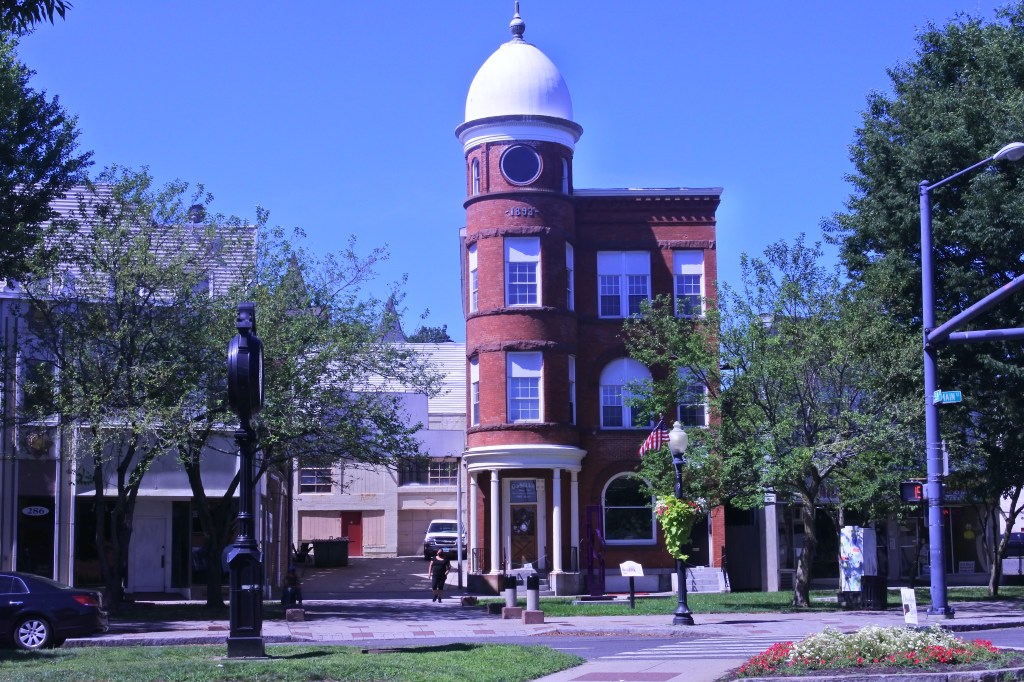
Danbury, CT- Historic hat making capital of America

I restricted my evaluation to Dwtn Danbury which a linear area center around Main street between South St and Garamella Blvd.

Danbury is nicknamed the “Hat City” as it was the center of the American hat industry during the 19th and early 20th centuries. Its name comes from English city of Danbury in Essex. Danbury was originally settled by colonists in 1685. When it incorporated in 1822 it had  4,000 residents. By 1900 it grew to a sizable city of 20,000 and 30,000 by WWII.

Center City Danbury is basically a main street with several larger public and religious buildings surrounded by some residential streets. Main Street experienced several decades of decline but fortunately its urban form remained mostly in tact. Grassroots efforts are well underway to revitalize Center City Danbury with an organized Downtown Business District, new shops, and public investment. Some new residential has also been constructed since 2000 but not enough to create a vibrant downtown. Other areas Center City could improve include better park and recreation space, bike infrastructure, and more retail and cultural amenities.
Click here to view my Danbury, CT album on Flickr

URBAN STRENTHS:

* Quality sidewalks throughout. Up to date ADA infrastructure is a mixed bag.
* Good local transit along with access to the east coast’s regional lines.
* Great racial diversity and good generational diversity with lots of family households.
* Some blight but crime is below national averages.
* Dwtn cultural amenities are a bit limited but include several diverse restaurants, handful of bars & cafes, the historic Palace Danbury, and a couple historic sites. Ives College is also down the street and brings some good performing arts.
* Retail amenities a public library and post office, good array of boutiques, several ethnic grocerias, and other general retail.
* Several public and catholic elementary schools within are near Center City Danbury. 

URBAN WEAKNESSES:

* Some jobs in Danbury. Commuting to larger Cities in the Stamford Metro, New Haven, or Hartford are all btwn 45- 1 hr.
* No bike infrastructure. 
* Some economic diversity but median income is on the low side.
* Rental product is pretty limited but average price. For sale product also limited but diverse price ranging from 100K-350K.
* Some park space dwtn including the Danbury City Green (nice pavilion and lawn) and Elmwood Park.
* Street grid is very curvy and easy making it easy to get disoriented in Center City Danbury