It is a bit difficult to untangle Dwtn Minneapolis from its surrounding inner city districts. My approach was to include the core of Dwtn and the parts of the surrounding inner city district that feel Dwtn in fabric. I used 3rd avenue/I-394 as the northern border including a couple blocks of the Warehouse District, the eastern edge of Loring Parks as the Western border, Grant St and I-94 as the southern, Fifth Avenue as the SE border as Elliot Park was not included in this evaluation, and the Mississippi River as the Eastern border including both the Gateway and Dwtn East neighborhoods within the Dwtn evaluation area.
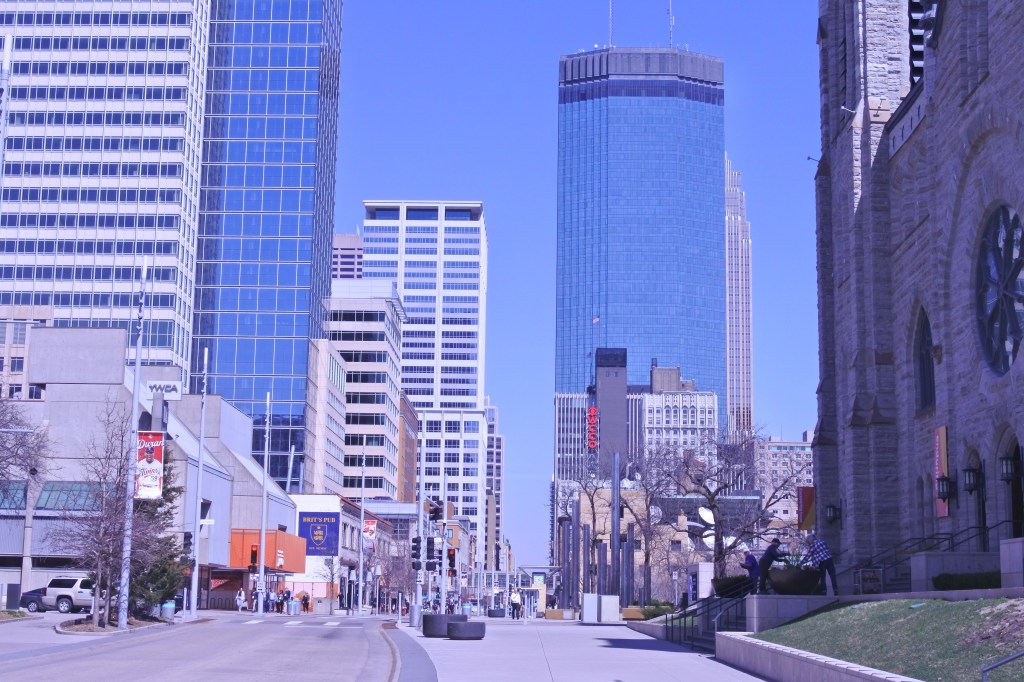
Downtown Minneapolis is very much a Midwestern Downtown with its large surface area, vertical modern high-rises accompanied by large plazas and extensive nearby parking garages & lots, wide streets, an extensive highway network inclosing it, and overall a grand and regal feel to it. And outside of Chicago, Dwtn Minneapolis has a strong argument for being the best Dwtn in the Midwest thanks to its large Dwtn population accompanied by big city amenities (supermarkets, a target, several malls, and extensive theaters and live music venues). Dwtn also excels with great sidewalk and ADA infrastructure, an excellent bike and transit network that extends across the entire City of Minneapolis and beyond, great concentration of 3 professional sports venues a top notch convention center, and over 100K employees working here (at least pre-pandemic).
But there are several aspects of Dwtn Minneapolis that are not top-notch that leave the door open for Midwestern cities like Cleveland, Cincinnati, Detroit, Indianapolis, and Milwaukee to claim Midwestern’s second best dwtn title. Dwtn Minneapolis has good but not great park amenities. The Commons is not a strong Civic Heart and outside of the Riverfront and Loring Park, park spaces are limited. Street vibrancy is not what it should be for a Dwtn hosting 20K people. This is largely due to a lack of street boutique retail as retail is concentrated in indoor malls and the City’s extensive skyway system. But it is also due to Dwtn’s wide streets and remaining surface parking lots and extensive parking garage network. Dwtn could also use more K-12 schools making it more walkable to families and should try to increase the number of students Dwtn to add to street vibrancy. Other than post-pandemic retail and office struggles, the trajectory is good for Central Minneapolis. I foresee its population continuing to grow, new mixed-use infill claiming more and more surface parking lots, better car free modes of transportation. But the open question is whether Central Minneapolis will become a great Dwtn more similar to Chicago? Will it perhaps close down the inner belt that separates it from many great inner city neighborhoods? We shall see.
Click here to view my Downtown Minneapolis album on Flickr
URBAN STRENGTHS:
* Great density for an Dwtn district and pre=pandemic had over 100K working dwtn.
* Excellent sidewalk and ADA curb cut infrastructure. Only about 10% of intersections are without upgrade ADA curb cuts.
* Almost all of Minneapolis proper has solid public transit access. The City has also recently built 3 light rail lines and many Bus Rapid Transit routes. Public transit service however out to the suburbs is generally only good for 2-4 miles.
* Minneapolis has an extensive bike lane system serving well every neighborhood within the City and including tons of bike lanes even dwtn. The bike share system, while dockless, forces uses to park bikes on City bike racks. Decent bike connections to the suburbs but they are often fragmented esp. to the north and west of the City where there are more lakes.
* Excellent Dwtn Grid. Easy to navigate.
* Good amount of for-sale product with 1-bed condos selling btwn 150K-600K (some luxury product selling for 2 M), plenty of 2-bed condos selling btwn 200K-800K, and a good amount of 3-bed product generally starting in price at 450K but some cheaper product selling around 200K.
* Tons of rental product with plenty of studios leasing btwn $750K-2K, 1-beds btwn $950-2.5K, 2-beds ranging anywhere from 1.3K-4K. Decent # of 3-beds but generally pretty expensive.
* Very attractive skyline with many vertical towers well concentrated in the core of Dwtn.
* Good but not world-class parks in Dwtn Minneapolis. The highlight is certainly the extensive riverfront parks along the Mississippi River which includes the raised Gold Metal Park, Mill Ruins, and the extensive recreation trail. Loring Park on the western edge of Dwtn is also a highlight including the Loring Greenway that cuts into Dwtn. The Commons Park functions as “Civic Heart” of Dwtn. While it has planned activities is pretty bland and not well trafficked. A couple other smaller plazas spread through Dwtn.
* Solid cultural amenities including plenty of restaurants, bars, & cafes, a handful of art galleries & breweries, plenty of theaters & music venues especially concentrated along Hennepin Ave, tons of night clubs, and a couple of museums. Regional amenities include a large convention center, professional baseball, basketball, & football arena.
* Decent college enrollment of about 7K between Minneapolis College, Minneapolis Community & Technical College, Dwtn St. Thomas University, and North Central University but a bit underwhelming for a City of Minneapolis’ size.
* Solid architecture with a good amount of quality historic buildings, attractive midcentury high-rises, and solid modern apartment bldgs.
* Good retail amenities including 4 major grocery stores, a Target, several drug stores, several indoor malls & all the shopping inside the skybridge system, the Dayton Project Dept Store, plenty of salons, a couple bookstores, several dessert joints & gyms, plenty of churches, a major hospital, a Dwtn post office & public market.
URBAN WEAKNESSES:
- Diversity indicators Dwtn are so so.
- Too many wide streets including 3-4 lane one way pairs. Too easy to drive into Dwtn.
- Schools dwtn are generally small or not rated highly. Best school is the FAIR Senior High.
- Certainly some dead spots dwtn but several pretty active areas (i.e. Nicolette Mall, Downtown East, Convention Center)
- Vibrancy is ok and could be so much better if it wasn’t for Downtown’s extensive skybridge system, many autocentric uses, parking garages, and parking lots.
- Much of the retail is concentrated in the many Dwtn malls and skyway system. Limited amount of street retail that lends itself well to more local boutiques. The pandemic has also not been kind to Dwtn’s retail activity. Some of these smaller shops are located in the Warehouse District which sits on the north edge of Dwtn. “

 Evaluating our Urban Communities [with a focus on America]