The area around Como Lake was originally swamp and oak savannas. But in 1873 the City of Saint Paul acquired the 300 acres of land around Como Lake and quickly turned it into a park. Incrementally major cultural amenities came to the park including the Saint Paul Zoo in 1897 and then the Marjorie McNeely Conservatory in 1915. The park remained on the periphery of Saint Paul for many decades and it wasn’t until the 1920s that the neighborhood around the park was really developed. The Como Park neighborhood filled in by WWII but unfortunately a historic business district just serving Como Park was never really created. Eventually several strip malls were built at the intersection of Lexington & Larpenteur but it is very autocentric.
Como Park however excels at providing amenities typical for more suburban areas including great parks, good schools, a wide array of for-sale housing options, and a high level of safety. The neighborhood stills has some walkability thanks to its gridded streets, sidewalks, bike infrastructure, decent public transit service, and convenient access to Dwtn. Como Park also has a decent amount of rental options good cultural amenities thanks to the Zoo and conservatory. But for Como Park to become a great urban district it needs a lot more density, more mixed-use buildings, a couple of strong walkable urban commercial nodes, and a lot more retail amenities.
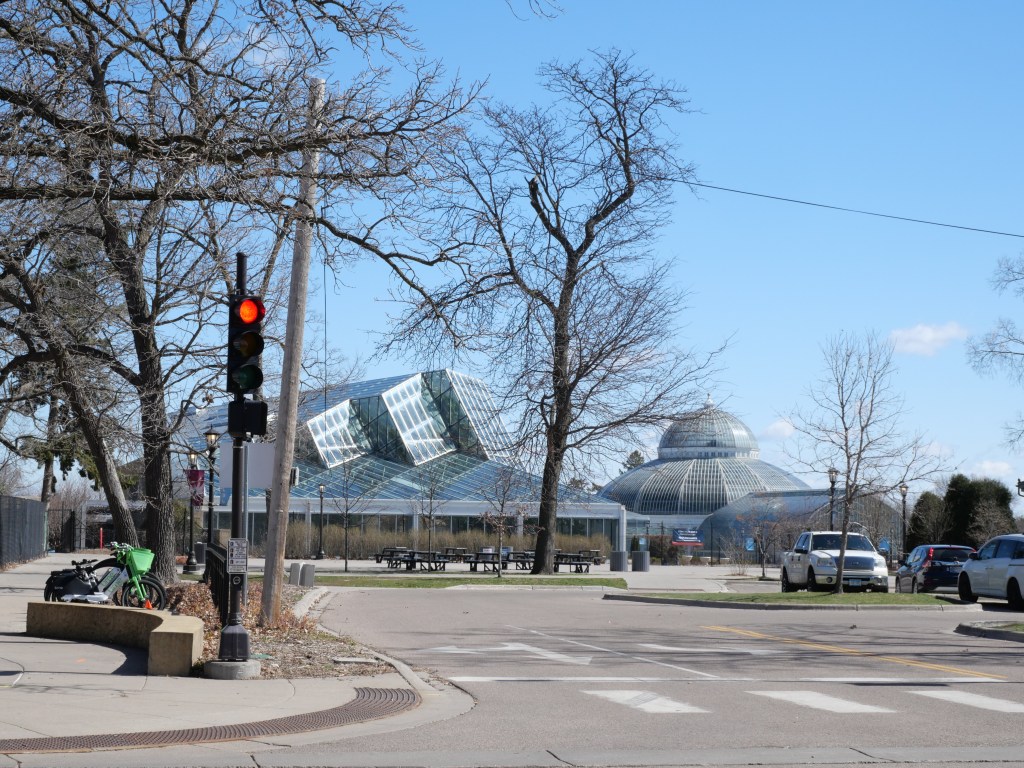
Click here to view my album on Flickr
URBAN STRENGTHS:
* Solid sidewalk infrastructure but only about 40% of the intersections are ADA standard.
* Good public transit access but better in the southern half of the neighborhood.
* Good access to Dwtn across all modes. Only a 10 minute drive and 25 mins bike or transit. Bike and transit to Dwtn Minneapolis is about 45 mins.
* 4 dedicated east to west bike routes, all connecting nicely to Como Park, which has great bike access itself.
* One of St. Paul’s safest districts.
* Mixture of plain and more ornate pre-WWII homes. Construction is mostly btwn the 1920s-1940s.
* Ok cultural amenities including a handful of food & beverage amenities but some major cultural amenities in Como park including the Botanical Gardens, Conservatory, Zoo, a kiddie park, and an outdoor amphitheater.
* Good walkable school diversity and generally good ratings.
* Very good for sale diversity. A handful of 1-bed options selling in the 100K & 200ks, 2-beds sell btwn 150K-450, 3 & 4 beds sell btwn 150K-700K.
* Decent rental options w/ studios leasing btwn 800K-1.4K, 2-beds btwn 1K-2K. Some 3-beds as well for a bit more.
* Excellent park amenities thanks to the expansive Como Park located in the heart of the community. The Park includes a large lake, a zoo, golf course, a major regional pool, and plenty of sports fields. But also 3 recreational centers set in small parks, and several cemeteries on the edge of Como Park’s borders.
* Solid tree canopy throughout.
URBAN WEAKNESSES
* Pretty low density for an urban area.
* Pretty white neighborhood but some racial diversity.
* Most of the Post WW II construction is autocentric commercial.
* Pedestrian activity is pretty low.
* The park is a great center point to the district but really no distinctive business districts here.
* Retail amenities are limited within the neighborhood to an Aldi’s, drug store, a dollar store, a bike store, a couple salons, a hardware store, a couple antiques stores, a couple dessert joints & gyms, plenty of churches, and a couple doctor’s offices. Most of the retail is located in two decent size strip malls where Lexington & Larpenteur intersect.
* No cohesive urban district. The most retail is where Lexington & Larpenteur intersect and this is very autocentric. A couple wide car centric boulevards throughout.
 Evaluating our Urban Communities [with a focus on America]