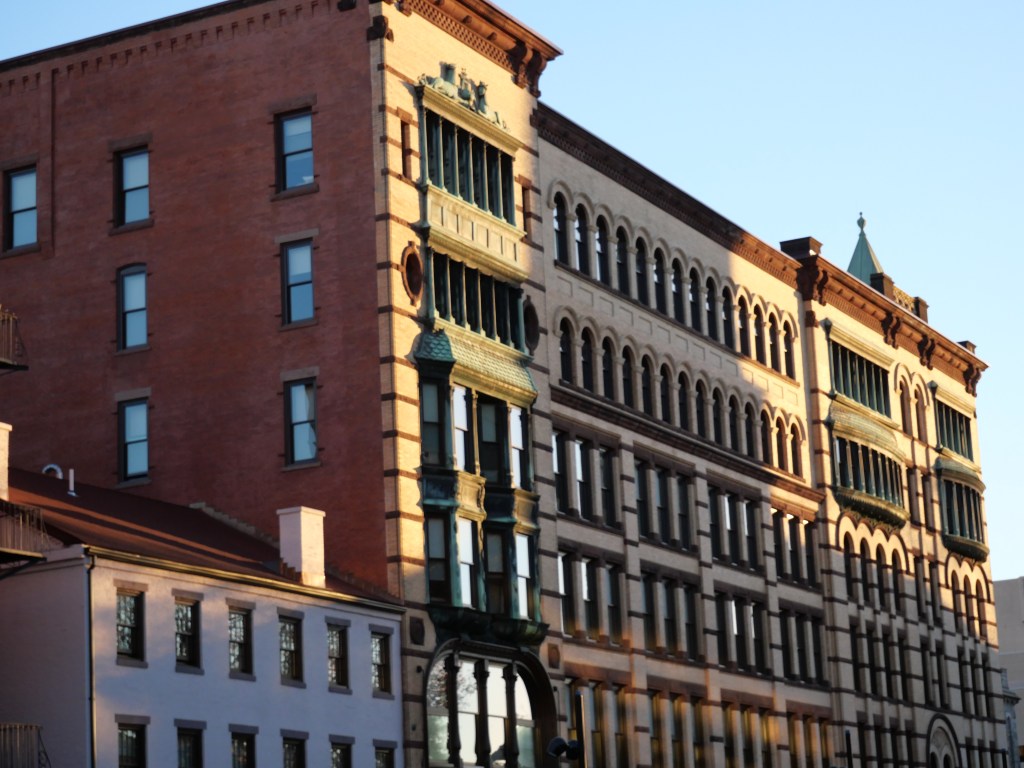
Main street is the heart of Dwtn running north to south throughout its entire duration. I consider where Main Street and Court House Place Square meet as the heart of Dwtn as this is the convergence of the Springfield Convention Center, several vibrant blocks of Main Street, the Civic Heart of Springfield with many historic Civic Buildings and the MGM Casino (technically in the South End). East of Dwight Street the urban form starts to break down with more parking lots, modern bldgs with poor urban form, and less vibrancy. A couple blocks just west of the Armory host the Armory Quadrangle Historic District a collection of attractive Boston looking apartment bldgs with bay turrets and other historic institutional buildings. Downtown connects most seamlessness with the South End neighborhood to the south especially via Main Street as quality urban cohesive blocks continue for several blocks south through the neighborhood. For Downtown Springfield to become a great Downtown it primarily needs much more population and density to help support more neighborhood retail amenities and much better vibrancy especially north of the railroad tracks and east of Dwight Street. Downtown has strong bones along Main Street and several surrounding blocks to build from and expand to the less developed parts of Downtown.
Click here to view my Downtown Springfield album on Flickr
URBAN STRENGTHS:
* Lovely set of intact historic commercial buildings from the 19th to early 20th century. * Really like the historic center of Dwtn at Court House Place with the City’s most prominent Civic and Historic Gov’t Bldgs surrounding it. * Main Street south of the Train Station is very in-tact with many mid to late 19th century commercial bldgs btwn 4-8 stories. Worthing St is also making a comeback with many revitalized historic bldgs, new pedestrian friendly streetscaping and light crossing over the Street. * Nicely renovated Historic Union Station which was restored in 2019 moving the Amtrack Station back to the station after many years of disrepair. * Excellent cultural amenities dwtn including tons of food & beverage businesses, plenty of theaters & live music venues, a cineplex and plenty of Museums and art galleries especially within or near the Springfield Museums Complex.
URBAN WEAKNESSES:
* North of the railroad tracks and east of Dwight Street has lost much of its urban form and lacks a sense of place and vibrancy. * So so density for an Dwtn area. * Not a ton of condo options but some options along Dwight Street and very affordable. Not a ton of rental options either dwtn. * Not a lot of solid urban infill in Downtown. This is largely due to Dwtn’s lacking of housing options. * Good smaller retail amenities like boutiques, clothing stores, and gift stores but Dwtn lacks a major supermarket and other important neighborhood retail amenities. * Other than a recreational trail only the river, bike infrastructure is limited. * Several small plazas and parks dwtn but the recreational trail along the river is really the only large park dwtn.
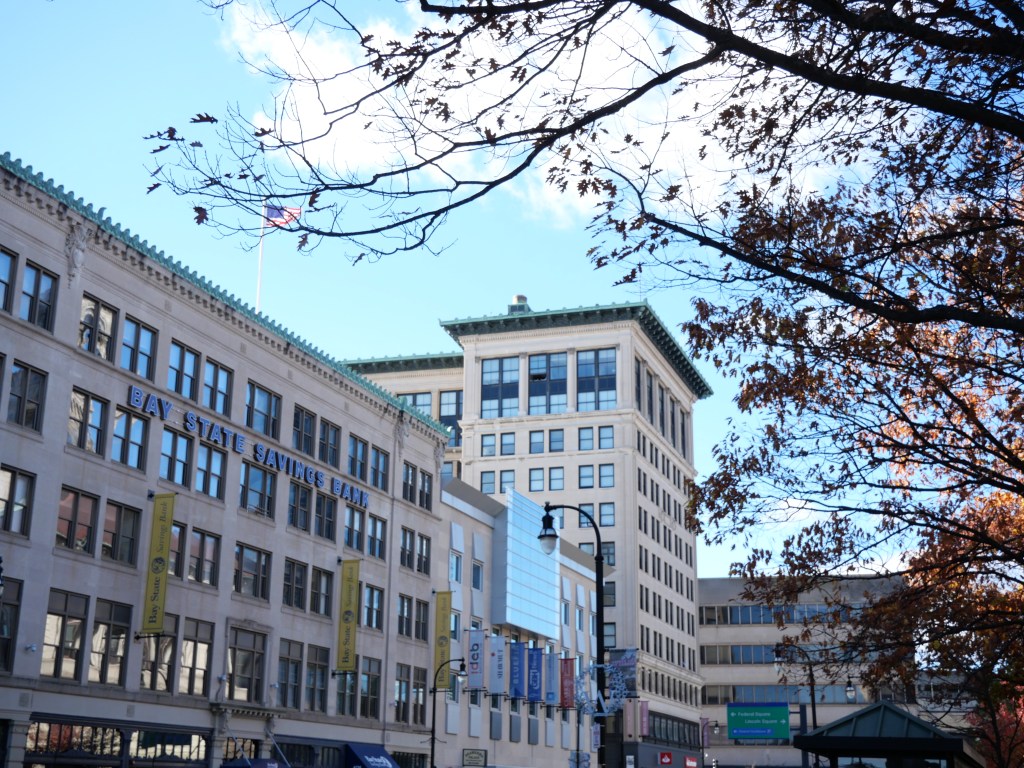
Downtown Worcester likely began as a wholesaling district in the mid 19th century centered around Main Street and expanded eastwards, especially along Franklin St., until it hit the railroad tracks and Worcester’s Warehousing district. Like most American Dwtns, Downtown Worcester experienced profound changes and disinvestment in the post War era. A huge portion of downtown Worcester was demolished for new office towers and the Worcester Center Galleria shopping mall. This occurred in the eastern portion of Downtown between the railroad tracks and a block east of Main Street. The result was an environment filled with many parking garages and lots and a very dead and soulless environment. After only 30 years, the Galleria would be demolished and become a redeveloped City Square, an improved but still not spectacular new urbanist development in the early 2000s. This area also brought other major investments to Dwtn including a new Convention Center, the DCU Arena, Polar Park home to the AAA Woosoxs, the renovation of Worcester’s Union Station reopened and more recently the creation of the Worcester Public Market in 2020.
My favorite part of Downtown Worcester is the historic western edge centered along Main Street. The street is filled with gorgeous historic mid to late 19th century 5-15 story historic bldgs, many historic theaters, prominent civic buildings, the historic Worcester Commons, and a great pedestrian friendly streetscaping project along Main St. But along with the soulless urban renewal portion of Downtown, there are also some glaring deficiencies including a complete lack of bike infrastructure within Dwtn and throughout the City, limited park amenities, limited Dwtn workforce, limited K-12 schools, pricy rentals, and limited tree canopy. Dwtn Worcester has a decent population based and cultural & retail amenities. It just needs to better enliven its downtown and fix these key areas to become a thriving and competitive American Dwtn.
Click here to view my Downtown Worcester Album on Flickr
URBAN STRENGTHS:
* Excellent density esp. for a mid sized City * Most intersection are up to ADA standard and good investments in the Streetscaping, esp. Main St which is very friendly to pedestrians. * * Good public transit Dwtn and to the inner City neighborhood. So transit access outside of these inner city neighborhoods and very limited transit service to the suburbs unless you are along one of the Massachusetts transit stops. * Good racial & economic diversity living dwtn. * Good mix of students, young professionals and older adults. While unsurprisingly there are few family households here there are at least two sports venues for more family activities. * A good amount of homelessness exists dwtn but overall its pretty safe. * Excellent set of historic office buildings especially along or near Main Street and warehouses along and near Green Street. * Generally good form along Main St and Green St but lots of open space and urban infill with poor urban form in-between. * Good food & beverage businesses especially craft breweries. Also several museums and art galleries, several theaters including some really gorgeous historic ones that also double as live music venues. For regional amenities there is a minor league ballpark, arena, & convention center. * Pretty good retail amenities including a Supermarket located just south of Dwtn, the Worcester public market, a couple pharmacies, a decent # of clothing stores, several furniture & gift stores (concentrated in Green Island), a book store, several dessert joints, a couple gyms, a dtwn public library & post office, some banks, a couple major hospitals accompanied by several doctor’s offices, and several churches.
URBAN WEAKNESSES:
Weird mix of typical narrow chaotic New England street grid in the western half of Dwtn and wide Blvds in the eastern half.
Pretty terrible bike infrastructure with only a handful of short bike lanes segments in the City or region and not bike sharing system. The only bike path of note is the Black Stone Bike trail running along the southern portion of the City and just below it.
No K-12 schools within Dwtn although there are some decent options in nearby neighborhoods.
Worcester has a large college population but not right in dwtn. Only a small satellite campus dwtn. Worcester Polytechnic Institute is about 1/2 from Dwtn with an enrollment of 7K. Clark University, Worcester State, and Holy Cross are a couple miles away.
Good # of rentals but pricey. Studios lease btwn 1.3K-2K, 2-bed btwn 1.8K-3K but really no 3-bed options.
Condos are more reasonably priced but limited. 1 & 2 bedrooms range from 150K-300K.
Skyline doesn’t have any particularly tall or unique buildings but at least has a good concentration of bldgs with a similar 10-20 story range.
Only a couple parks in Dwtn but they are pretty solid Civic Spaces (Franklin Square), especially Worcester Common.
Not great tree canopy.
Some modern infill and mixed urban quality.
Only about 5K people work in Dwtn which is one of the lowest dwtn employment concentrations I’ve encountered esp. for a metro of 860K.”
Current day Dwtn Providence was originally known as “Weybosset Neck” or “Weybosset Side”. It was first settled by religious dissidents from the First Congregational Society in 1746. Their settlement was located near present-day Westminster Street. Downtown did not witness substantial development until the early 19th century, when Providence began to compete with Newport RI thanks to the British destruction of much of Newport. From there on Dwtn Providence developed like typical American dwtns first becoming a warehousing, storage, and general goods district, then hosting a concentration of Department stores, offices, and theaters in the early 20th century.
But like most American Dwtn’s, Providence was scared and isolated by significant highway development receiving an innerbelt looping around 2/3s of the downtown area and isolating it from South Providence, West End, Federal Hill, and the Smith Hill neighborhoods. By the 1970s downtown was widely seen as a dangerous place to be after dark and witnessed significant disinvestment and abandonment. Johnson and Wales University used this opportunity to purchase many of the vacant properties for cheap and significantly expanded its main Dwtn campus and in the process helped stabilize Dwtn. The 1980s and 1990s kicked off major reinvestment projects in Dwtn including reopening access to the city’s natural rivers, Water place Park new development around the Capitol, and the opening of Providence Place, an extensive mall with several department stores and Cineplex. Significant investments were also made to bolster the arts lead by the Providence Performing Arts Center and Trinity Repertory Company.
From an urban perspective Downtown providence punches above its weigh class for a metro at just over 1.5 M. It has a compact historic core which is generally in tact with a great array of historic bldgs, solid dwtn population, good retail amenities (thanks to the Providence Place Mall), good cultural amenities, compact feel and good walkability including the ability to walk to Brown in 10-15 minutes, large college presence, and well connected by bike and transit modes. But for this to become a top tier American Dwtn it needs to reinvent itself in the wake of the Covid-19 shuffle. Recent news articles point to a Dwtn which is struggling to maintain its vitality with the decrease in dwtn workers. Downtown Providence needs to build on its quality built environment and compactness and truly become the 5 minute neighborhood it was meant to be. There are many surface parking lots, especially on the southern edge of Dwtn and in the Jeweler Subdistrict screaming for new density and housing.
Click here to view my Downtown Providence Album on Flickr
URBAN STRENGTHS:
* Solid population for a dwtn. * Great public transit within Providence with 7.5 rating. Public transit to the suburbs is a mixed-use bag with better transit in the older suburbs than the newer ones. * Decent dedicated bike lanes within Providence and Dwtn but not as fully as one would like. Some good lengthy bike lanes out to the suburbs but not plentiful. Providence has dockless system across the City but not as good as dedicated bike sharing stations. * Excellent Historic architecture, mostly late 19th century 4-6 story bldgs but also some boutique skyscrapers too.* * Most intersections have ADA curb cuts and good sidewalks. * Not the most gridded Dwtn but lots of short blocks. * Excellent racial and economic diversity metrics Dwtn. * Some amenities dwtn for kids including the History & Children’s museum, Hockey Team, and winter ice rink. * Generally a very safe dwtn with low levels of crime and limited blight. * Very nice cluster of private, public, and arts schools in the heart of Dwtn with mixed ratings. Several quality schools on the western edge of Dwtn including the highly rated Classical High School with 1,000 students. * Also good college presence dwtn with several satellite campus dwtn, the heart of Brown University is only a 15 min walk with several colleges located closer, and Liston Community college is located just south of Dwtn. * Decent # of rentals but market rate is generally expensive. 1-beds lease btwn 1.8K-the low 3Ks, some 2-beds in the 2Ks & 3Ks, and some 3-bed product. Plenty of permanent affordable rentals however. * Solid parks in Dwtn including a recreational trail running along Providence River, the new 195 District Park & Station & Waterfront Park, the Civic hubs of Burnside & Biltmore Parks, and several smaller plazas. * Compared to most dwtn’s surface parking lots aren’t terrible. Only a handful in the core of Dwtn but they become and more and more pervasive as one heads to the southern end of Dwtn (the Jewelry District). * Solid cultural & regional amenities including plenty of food & beverage bizs, plenty of art galleries, plenty of nightclubs & a handful of live music venues, lots of performing arts venues, (both old & modern), a cineplex, several museums & historic sites (esp. when you count statehouse and those across the river), a convention center. Excellent concentration of gov’t offices across local and state. * Solid retail amenities including a couple drug stores, the Providence Place Mall (which is pretty healthy with lots of clothing stores, food options, retail stores and several; dept stores) several boutiques, gift stores, book stores and churches in the Historic dwtn. Also a handful of dessert joins, gyms, home good stores but less than most dwtns. A major hospital is just south of dwtn.
URBAN WEAKNESSES:
Dwtn population is largely students and young adults.
No supermarkets dwtn but there is a Trader Joe’s just across the river.”
Dwtn providence is not the most vertical dwtn or extensive but a nice cluster of bldgs btwn 300-430 feet topped out by the antique Industrial Nat Bank Bldg. The modern skyscrapers that surround it a decent.
Okay for sale product too with 1-bed condos selling btwn 250K-500, some 2-beds btwn 500k-750K, but limited 3-beds.
Decent but not top notch urban infill. Lots of quality urban infill for 1990s/early 2000 standards but the design is pretty bland yet with decent urban form. The modern office towers are decent but not distinctive, also some unattractive 1960s-1970s apartment bldgs surrounding the Cathedral.
Streetscape is fine but generally pretty dated and often narrow.
Sports amenities are limited to the Bruins hockey arena, a minor league team. # of restaurants is a bit limited for a dwtn area.
Downtown Grand Rapids is the original settlement for the City like most American cities and transitioned from a mostly manufacturing/warehouse area for the city’s flourishing furniture corporations in the mid-late 19th century to a more traditional American dwtn in the early 20th century. Dwtn doesn’t have well branded/defined districts but I would generally divide it into 4 quadrants: The SW quadrant is the Warehouse District with lots of loft conversions, unique stores & boutiques and some newer developments like Studio Park and Van Andel Arena. The SE Quadrant host the Trinity Health District with Dwtn’s worse urban form. There is the Historic Core centered btwn Fulton & Lyon and Division and the River contains a great collection of well maintained turn of the century historic commercial bldgs and Dwtn’s Civic Heart (Rosa Parks Circle). North of here is the Medical Mile containing Corewell Hospital, many research facilities, and the City Civic Center.
Downtown Grand Rapids is a solid urban Downtown in the top tier of Dwtns in metro areas btwn 1M-1.5M. Dwtn excels at hosting a great collection of well maintained historic bldgs, comfortable sidewalks & streetscaping, good cultural and regional amenities, quality school & high levels of university students. Recent in-fill has generally been at a high urban quality and retail amenities are decent. For Dwtn Grand Rapids to become a top tier urban district it needs to continue attracting more residents, improve its bike infrastructure, create more and better park amenities, and fill in a decent # of surface parking lots especially during Trinity Health Hospital.
Click here to view my Downtown Grand Rapids Album on Flickr
URBAN STRENGTHS:
Solid grid and connectivity. Dwtn has several wide main streets common for Mid-western Dwtns but no wide 1-way pairs. Two highways cut through dwtn but not inner belt.
Solid public transit Dwtn and surrounding pre-1920s neighborhoods. Decent transit for neighborhoods developed before WWII. Hit or miss transit service for suburban areas, but most suburbs have some level of transit.
Decent number of activities for families dwtn with several family friendly museums and a sports arena mainly used for Hocky.
Solid K-12 schools with pretty well rated public schools and a good # of private/charter schools.
Better rental options with some studios leasing in the low 1Ks, more 1-beds that lease btwn 1-2K, wide variety of 2-beds that mostly range from 900K to 2.5K, but some that lease around 5K, but only a handful of 3 & 4 bed options.
Pretty good college present Dwtn with 12K students enrolled at Grand Rapids CC which has a large presence in the SE edge of Dwtn with multiple bldgs. There are a couple other smaller satellite campuses Dwtn including a pretty large one from Grand Valley State University.
Very solid stock of attractive historic architecture including a nice mix of late 19th century 4-6 story Italianates, several midsize antique towers, and lots of warehouse bldgs south of Fulton.
Plenty recent multi-family infill and several decent newer residential towers. Plenty of bland mid-century architecture too although the City Hall bldg is to some pretty interesting.
Decent retail amenities including a supermarket, a couple drug stores, a good amount of boutiques, consignment stores, and gift shops, a handful of antique stores & bookstores, plenty of banks, plenty of salons, some dessert joints, a couple of gyms, two major hospitals, and plenty of churches.
Solid cultural amenities including plenty of restaurants, bars, & cafes, several live music venues, a major theatre complex, several performing arts theaters (although mostly modern), plenty of art galleries, a decent # of museums (esp. if you include those across the river), and a couple historic sites. For regional amenities Dwtn hosts a large convention center and indoor arena.
Solid employment #s Dwtn (at least pre pandemic) of around 35-40K.
URBAN WEAKNESSES:
* Density is so so but certainly could be better for a stable dwtn like Grand Rapids. * No direct transit line from the airport to Dwtn. Takes about 1 hr. using 2 bus lines. * Bike infrastructure is pretty mediocre. Some bike lanes in and around dwtn and decent lanes across the City but not consistent connections across the City and into Dwtn. Some bike lanes in the suburbs but not good connections into the City. There is no dedicated bike share System in the City. * Pretty good range in prices for for-sale options but a bit limited. Some 1-bed condos that sell anywhere btwn 200K-400K, more 2-bed condos ranging from 200K-800K, Only a handful of 3 & 4 beds that are generally more expensive. * Park and recreation space is pretty underwhelming for a Dwtn. There is a recreational trail along the east side the grand trail but it feels free urban. Several smaller plazas and parklets and 4 medium sized parks (Rosa Parks Circle, Calder Plaza, Veterans Memorial Park, and Hearthside Park). The Rosa Parks Circle was a good additional to dwtn and has provide a much needed Civic Heart with lots or programing (including an ice rink). Calder Plaza also has some events but not in the heart of Dwtn and is a pretty cold modernist plaza. * Some more interesting medium sized high-rises along the river. But other the Grand Rapids skyline is pretty so so. Just not a critical mass of vertical buildings or other stand out landmarks. * Good number of surface parking lots especially surrounding the two hospitals Dwtn. The number of surface parking lots around Trinity Health Center is particularly atrocious in the SE corner of Dwtn. At least the Medical Mile area is seeking lots of new construction.
Historically, Downtown Brooklyn was built just up the hill from where present day Dumbo and Vinegar Hill stand in the middle 19th century as growth from the Port of New York on Manhattan caused shipping to spill over into Brooklyn. As Brooklyn came into its own in the late 19th century , Downtown Brooklyn became primarily a commercial and civic center hosting the Brooklyn City Hall and Courthouse with relatively little residential development and only a handful of antique skyscrapers for office uses. The 1950s brought several generally harmful urban renewal projects to Dwtn including the redevelopment of several blocks project housing, street widening (i.e. Boerum Place) which leads to a widened approach to the Brooklyn Bridge, and the construction of I-278. My sense is that not much changed in Dwtn Brooklyn between the 1960s and 2000s. But by 2000 after an important report by the Regional Plan Association, Downtown Brooklyn pivoted to spur new growth by encouraging both new commercial and residential high-rises and realizing the report’s findings that it could become the City’s third-largest business district thanks to its proximity to Lower Manhattan. The major catalytic event was the rezoning of Downtown in 2004, By 2015 Dwtn Brooklyn was also becoming a growing hub for education and by my estimates hosts at least 30K college students.
Thanks to its residential density, excellent transit & bike infrastructure, great retail amenities & vibrant pedestrian activity, solid park amenities, and proximity to Manhattan, this compact CBD is one of America’s best urban Downtowns even if it is overshadowed by Midtown and the Financial District. The biggest challenge facing Downtown Brooklyn is staggering high housing costs, although at least half of the rental product is rent stabilized. I would also like to see more cultural amenities in Dwtn (i.e. more restaurants, bars, theaters, and live music venues). While Dwtn has a great array of Department stores and name brand clothing stores concentrated along Fulton Street, it lacks locally owned boutiques and creative retail stores.
Click here to view my Downtown Brooklyn Album on Flickr
URBAN STRENGTHS:
Solid architecture all around both historic and post WWII. Buildings generally have very good urban form.
Top notch density for a Dwtn area at 50K per square mile. Only Midtown and Dwtn NYC are denser.
Very limited surface parking and autocentric uses in Dwtn Brooklyn. The worst urban form are the two mid-century public housing projects (Concord Village & University Towers) which have surface prkg btwn the buildings. If these aren’t that egregious.
Excellent ADA & sidewalk infrastructure throughout.
The Skyline is not quite as nice as Downtown NYC, Midtown and Chicago but still pretty top-notch for American skylines.
Great pedestrian activity.
Excellent public transit hub providing a central point to the entire Borough of Brooklyn and out to Long Island.
Excellent bike infrastructure within Dwtn Brooklyn with plenty of dedicated bike lanes. The Bike share system and comprehensive bike lanes however really only extends out to about 1/2 of Brooklyn and loses steam in southern and southeastern Brooklyn.
Good number of schools in Dwtn Brooklyn with generally good ratings. Lots of specialty High Schools (both private and public). Some really good public schools in adjacent Brooklyn Heights.
Great number of apartments in Dwtn Brooklyn but the market rate units are very expensive. Fortunately about half of the units are either rent stabilized or permanent affordable units under 2K. Market studios lease btwn 3K-5K, 1-beds 3K-6K, 2-beds 4K-8K. And some 3-beds units that are even more expensive.
Solid park amenities including the large Cadman Plaza Park. Commodore Berry Park w/ a public pool, several smaller parks, and the large Fort Green Park just east of Dwtn.
Columbus Park/Korean War Memorial/Cadman Plaza Park are really one unified plaza space with Columbus Park sitting just outside of Brooklyn City Hall. This is the civic heart of Dwtn and seems to get a good amount of events and active use.
Good cultural & regional amenities in Dwtn but a bit underwhelming for NYC. In addition to plenty of food & beverage amenities there are a handful of art galleries, a couple museums, the Dekalb Market Hall, a indie movie theater, a couple theaters and night clubs, and the Barclay arena is just south of the neighborhood. Great surrounding cultural amenities in the adjacent neighborhoods and only a 20 min subway ride to Manhattan.
3rd largest employment hub in NY with btwn 50K-85K depending on how you measure Dwtn. Job # are on the increase.
Great retail amenities including several supermarkets, a dwtn target, a Macy’s, Burlington, and several other big retailer names concentrated along Fulton St, a couple of pharmacies, a couple bookstores, several furniture stores, a hardware store, lots of jewelry stores, plenty of bakeries & gyms, a dwtn post office & library, a Brooklyn Hospital is just east if Dwtn. Not a ton of boutiques and local gift stores here however.
Several large enrollment universities in and near Dwtn Brooklyn. About 30K students.
URBAN WEAKNESSES:
Decent age diversity and % of families with Children for a dwtn area but very limited kid friendly activities dwtn.
Generally good connectivity and many shorter blocks but a good amount of highways and boulevards break out the street grid.
Good amount of for sale condos but also very expensive. Studios and 1-beds sell btwn 300K-1M, 2- beds btwn 650K-1.5K Decent amount of 3-beds but very expensive. Selling generally btwn 1-3M.
Decent number of restaurants & bars in Dwtn Brooklyn but kinda underwhelming for New York. Only a handful of breweries. Also not major conversion center here. .”
It is a bit difficult to untangle Dwtn Minneapolis from its surrounding inner city districts. My approach was to include the core of Dwtn and the parts of the surrounding inner city district that feel Dwtn in fabric. I used 3rd avenue/I-394 as the northern border including a couple blocks of the Warehouse District, the eastern edge of Loring Parks as the Western border, Grant St and I-94 as the southern, Fifth Avenue as the SE border as Elliot Park was not included in this evaluation, and the Mississippi River as the Eastern border including both the Gateway and Dwtn East neighborhoods within the Dwtn evaluation area.
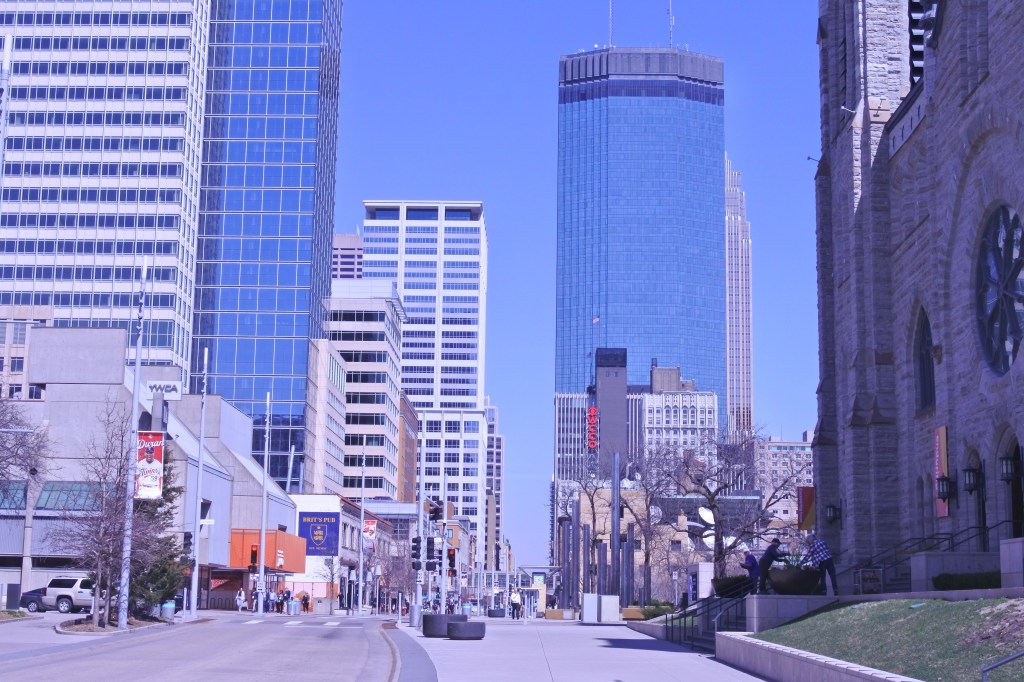
Downtown Minneapolis is very much a Midwestern Downtown with its large surface area, vertical modern high-rises accompanied by large plazas and extensive nearby parking garages & lots, wide streets, an extensive highway network inclosing it, and overall a grand and regal feel to it. And outside of Chicago, Dwtn Minneapolis has a strong argument for being the best Dwtn in the Midwest thanks to its large Dwtn population accompanied by big city amenities (supermarkets, a target, several malls, and extensive theaters and live music venues). Dwtn also excels with great sidewalk and ADA infrastructure, an excellent bike and transit network that extends across the entire City of Minneapolis and beyond, great concentration of 3 professional sports venues a top notch convention center, and over 100K employees working here (at least pre-pandemic).
But there are several aspects of Dwtn Minneapolis that are not top-notch that leave the door open for Midwestern cities like Cleveland, Cincinnati, Detroit, Indianapolis, and Milwaukee to claim Midwestern’s second best dwtn title. Dwtn Minneapolis has good but not great park amenities. The Commons is not a strong Civic Heart and outside of the Riverfront and Loring Park, park spaces are limited. Street vibrancy is not what it should be for a Dwtn hosting 20K people. This is largely due to a lack of street boutique retail as retail is concentrated in indoor malls and the City’s extensive skyway system. But it is also due to Dwtn’s wide streets and remaining surface parking lots and extensive parking garage network. Dwtn could also use more K-12 schools making it more walkable to families and should try to increase the number of students Dwtn to add to street vibrancy. Other than post-pandemic retail and office struggles, the trajectory is good for Central Minneapolis. I foresee its population continuing to grow, new mixed-use infill claiming more and more surface parking lots, better car free modes of transportation. But the open question is whether Central Minneapolis will become a great Dwtn more similar to Chicago? Will it perhaps close down the inner belt that separates it from many great inner city neighborhoods? We shall see.
Click here to view my Downtown Minneapolis album on Flickr
URBAN STRENGTHS:
* Great density for an Dwtn district and pre=pandemic had over 100K working dwtn. * Excellent sidewalk and ADA curb cut infrastructure. Only about 10% of intersections are without upgrade ADA curb cuts. * Almost all of Minneapolis proper has solid public transit access. The City has also recently built 3 light rail lines and many Bus Rapid Transit routes. Public transit service however out to the suburbs is generally only good for 2-4 miles. * Minneapolis has an extensive bike lane system serving well every neighborhood within the City and including tons of bike lanes even dwtn. The bike share system, while dockless, forces uses to park bikes on City bike racks. Decent bike connections to the suburbs but they are often fragmented esp. to the north and west of the City where there are more lakes. * Excellent Dwtn Grid. Easy to navigate. * Good amount of for-sale product with 1-bed condos selling btwn 150K-600K (some luxury product selling for 2 M), plenty of 2-bed condos selling btwn 200K-800K, and a good amount of 3-bed product generally starting in price at 450K but some cheaper product selling around 200K. * Tons of rental product with plenty of studios leasing btwn $750K-2K, 1-beds btwn $950-2.5K, 2-beds ranging anywhere from 1.3K-4K. Decent # of 3-beds but generally pretty expensive. * Very attractive skyline with many vertical towers well concentrated in the core of Dwtn. * Good but not world-class parks in Dwtn Minneapolis. The highlight is certainly the extensive riverfront parks along the Mississippi River which includes the raised Gold Metal Park, Mill Ruins, and the extensive recreation trail. Loring Park on the western edge of Dwtn is also a highlight including the Loring Greenway that cuts into Dwtn. The Commons Park functions as “Civic Heart” of Dwtn. While it has planned activities is pretty bland and not well trafficked. A couple other smaller plazas spread through Dwtn. * Solid cultural amenities including plenty of restaurants, bars, & cafes, a handful of art galleries & breweries, plenty of theaters & music venues especially concentrated along Hennepin Ave, tons of night clubs, and a couple of museums. Regional amenities include a large convention center, professional baseball, basketball, & football arena. * Decent college enrollment of about 7K between Minneapolis College, Minneapolis Community & Technical College, Dwtn St. Thomas University, and North Central University but a bit underwhelming for a City of Minneapolis’ size. * Solid architecture with a good amount of quality historic buildings, attractive midcentury high-rises, and solid modern apartment bldgs. * Good retail amenities including 4 major grocery stores, a Target, several drug stores, several indoor malls & all the shopping inside the skybridge system, the Dayton Project Dept Store, plenty of salons, a couple bookstores, several dessert joints & gyms, plenty of churches, a major hospital, a Dwtn post office & public market.
URBAN WEAKNESSES:
Diversity indicators Dwtn are so so.
Too many wide streets including 3-4 lane one way pairs. Too easy to drive into Dwtn.
Schools dwtn are generally small or not rated highly. Best school is the FAIR Senior High.
Certainly some dead spots dwtn but several pretty active areas (i.e. Nicolette Mall, Downtown East, Convention Center)
Vibrancy is ok and could be so much better if it wasn’t for Downtown’s extensive skybridge system, many autocentric uses, parking garages, and parking lots.
Much of the retail is concentrated in the many Dwtn malls and skyway system. Limited amount of street retail that lends itself well to more local boutiques. The pandemic has also not been kind to Dwtn’s retail activity. Some of these smaller shops are located in the Warehouse District which sits on the north edge of Dwtn. “
1841, Father Lucien Galtier established a Catholic chapel (near present-day Second Street and Cedar Street), on the bluffs above the Lower landing naming it in honor of his favorite saint. This is essentially where Saint Paul’s development first began although the Upper Landing Development near modern day Irvine Park was established soon over. Downtown Saint Paul naturally grew out of the Lower Landing site evaluating into the Lowertown District as shipping and commerce grew thanks to this being the first port of access to the Twin Cities. By the 1870s Lower landing grew into a major shipping and rail yard with more and more warehouses. Eventually by the late 19th century commercial buildings incrementally filled in the rest of current day Dwtn St. Paul. The next major development in Downtown was the creation of the Minnesota State House which was completed in 1905. The early 1950s saw the creation of the expansive State mall that currently surrounds the Capitol. This was in reality a major urban renewal project that razing several blocks of a deemed undesirable neighborhood north of Dwtn. This coupled with extensive highway and innerbelt construction left Downtown St. Paul with a significant amount of dead and underutilized spaces. Like Downtown Minneapolis, Downtown Saint Paul adopted an extensive skyway system consisting of 40 bridges and experienced a skyscraper-building boom beginning in the 1970s. Interestingly, because the City Center is directly beneath the flight path into the airport across the river there is a height restriction for all construction.
The scares of Saint Paul’s extensive highway and urban renewal projects are still very visible today and have left Dwtn with a low level of vibrancy on its streets. Nevertheless Downtown has seen a resurgence of Dwtn living and has grown from 5K to 10K between 2010 and 2020. Like most American dwtn’s Saint Paul also has a solid concentration of theaters and cultural/regional amenities, decent park spaces, plenty of Museums, a supermarket, and decent retail amenities. Dwtn hosts around 60K office workers (pre-pandemic), is a solid hub for transit and biking access across the City. But for this to be a great Dwtn, it needs not only more population but an improved urban realm erasing many of the mid-century development mistakes. Significant attention should be made to redeveloping dead spaces surrounding the Capitol Complex, adding more retail amenities, and creating a better sense of place Dwtn. Given St. Paul’s relatively modest size, I think this is a very doable proposition.
Click here to view my Dwtn St. Paul album on Flickr
URBAN STRENGTHS:
Excellent ADA infrastructure. Good wide sidewalks and nearly every Dwtn intersection has modern ADA curbs.
“* Good density for a Dwtn area.
Solid public transit access throughout most of Saint Paul and especially good Dwtn and the surrounding neighborhoods. Decent transit service only extends a couple miles out to the suburbs north and south of the City.
Good amount of attractive historic architecture but less than most mid-western cities.
While Saint Paul only has a dockless bike share system Citywide it has a good array of bike lane connections including a couple lane seperated options within Dwtn, good connections to city neighborhood (especially to the west and north), and decent bike connections to the suburbs, especially to the south. Suburban connections are pretty fractured north and east of the City thanks to all the Minnesota lakes.
Cultural amenities include a good number of museums including family friend options like the Children’s Museum & Science Center.
Good diversity indicators among residents living dwtn and pretty friendly place for families to visit.
Decent skyline thanks to a good cluster of medium sized skyscrapers. Not many distinctive skyscrapers however.
Solid park amenities including Rice Park & Mears Park, which serve as Dwtn’s Civic Plazas, some decent riverfront parks along the water and up on the bluff, a couple small plazas, the extensive but dead mall space Infront of the Capitol Bldg, and Bruce Vento Nature Sanctuary, an extensive reclaimed industrial sight now run by NPS.
Excellent dwtn mark that is open on the weekends. This has been part of St Paul’s history for 165 years.
Solid # of rental options including plenty of studios leasing generally in low 1KS, 1-beds lease in the 1Ks, 2-beds btwn 1.5Ks-2.5Ks. Decent amount of dedicated affordable rentals as well dwtn.
Pretty good number of for-sale options that are generally moderately priced. 1-bed condos sell btwn 100K-350K, good diversity with 2-bed condos selling btwn 150K-600K, and some 3-bed condos selling btwn 330K-700K.
Solid cultural/regional amenities including a decent # of restaurants & bars, plenty of cafes, good array of Dwtn museums and a couple art galleries, a minor league sports arena/convention center & ballpark, a couple night clubs & live music venues, and several theaters mostly located near each other. Good concentration of governmental buildings Dwtn augment by all the state offices surrounding the Capitol Building.
Pre-pandemic Dwtn hosted around 60K, a respectable # considering Minneapolis hosted over 100K in a metro of 3.7 M
Decent retail amenities include a supermarket, a couple drug stores, some boutiques & gift shops, a couple book stores, a major Dwtn public library & historic post office, plenty of banks, several dessert joints & a couple gyms, a major hospital & several doctor’s offices.
URBAN WEAKNESSES:
Not a fan of much of Dwtn St. Paul’s modern in-fill. There is limited mixed-use residential and plenty of bland office towers and auto centric uses.
While there is a decent dwtn population, Dwtn Saint Paul feels pretty dead. This is likely due to a lower amount of cultural & retail dwtn amenities as most American Dwtn, lots of bland office towers, parking lots, and more autocentric urban renewal uses, and a local a strong civic center to Dwtn.
Dwtn grid is fine but too many boulevards and large 1-way streets. Its way too easy to drive to Downtown St. Paul.
Neither Mears Park or Rice Park are strong Civic Spaces. While they do a fair amount of programming they generally feel pretty dead and the design is nothing special.
Excellent Performing Arts High School Dwtn. But not much else schoolwide other than a couple small charter school and underperforming public middle school.
Two community colleges on the edges of Dwtn (St. Paul College and Metropolitan State) with a combined enrollment of about 7K. Given these are commuter colleges and not well connected to Dwtn, not sure if they add much vibrancy to Dwtn.
Elliot Park is one of Minneapolis’s oldest neighborhoods and was plotted starting in 1856. The neighborhood is named after Mr. Joseph Elliot, an area physician, who donated his farm land to the city in 1893 which turned into present day Elliot Park. Sitting just outside of the City’s main commercial district (Hennepin Ave) and the mills along the Mississippi River, Elliot Park became a destination for Minneapolis’ wealthiest residents in the late 19th century. Several large mansions sprang up along Park Avenue. But this was short lived.. As the city grew and encompassed the neighborhood, most of the wealthy citizens left for nearby Lowry Hill and Kenwood districts and Elliot Park densified and built more and more 3 & 4 story apartment buildings. The area began to decline in the mid-20th century as white flight and highways decimated the district. Elliot Park’s population decline and lower income families became concentrated in Elliot Park.
Thankfully this was not to last and by the turn of the 20th century Elliot Park began to gentrify and its population grew taking advantage of the general raise in popularity of Central Minneapolis. Elliot Park does a nice job of mixing historic structures and homes from the late 19th century with quality urban in-fill largely constructed since 2000. Elliot Park is generally a very walkable neighborhood with great access to many of Central Minneapolis’ amenities. It also has good park amenities, diversity housing options, and pretty good food & beverage amenities. For Elliot Park to be a top tier urban district it needs much more retail amenities. There is no supermarket and limited local retail in the district. This can be fueled by increased urban-infill filling in the decent number of surface parking lots remaining and intentional mixed-use development.
* Excellent density. * Great sidewalk and ADA infrastructure throughout. * Great proximity to Dwtn as it is literally within a 5 minute walk of the neighborhood. * Good racially and economic diversity. * Not a ton of parks but three quality parks in Elliot Park including Elliot Park (includes a wading pool & recreation center), Franklin Steele Park, and the Commons. * Decent tree canopy, especially the more residential/historic sections on the southern edge of Elliot Park. * Nice mix of historic and modern urban in-fill. Some ugly infill as well but generally pretty urban. * Lots of rental options including a good array of price points. Plenty of studios leasing anywhere btwn $500-1.5K, 1-beds btwn $900-2K, 2-beds btwn 1K-3K. Only a handful of 3-beds. Decent number of affordable housing as well. * Some condo options with 1-beds selling in the 100Ks & 200ks. 2-bed are a mix of condos and townhouses selling btwn 200K-600K. Good amount of 3-beds selling btwn 300K-800K. A handful of 4-beds. * Decent cultural amenities especially with its proximity to Dwtn Minneapolis. Good # of food & beverage bizs, a handful of art galleries, a couple live music venues, and US Bank Stadium. North Central University is here and hosts decent # of cultural activities. * Urban massing and streetscaping is generally pretty good.
URBAN WEAKNESSES:
A mix of poorly rated public schools and small private schools in Dwtn Minneapolis and nearby.
Some safety concerns but Elliot Park seems a lot safer than it was 15 years ago.
Ok retail amenities within Elliot Park itself including a drug store, a couple banks, a major hospital and lots of medical offices, a couple clothing stores & salons, a handful of dessert joints and gyms, and plenty of churches. Decent access to retail amenities in surrounding Downtown Districts.
It is very difficult to carve out a urban evaluation area for Council Bluffs. I focused in on the historic dwtn and did my best to include more or less connected urban areas to the Dwtn. I used the train tracks as the western border, 9th & 5th Ave as the southern, Avenue G as the northern and then had to continue the norther and southern borders eastwards to connect to where Lincoln intersections with Broadway to capture the urban main street continuing eastward along Broadway and its connecting urban residential streets.
At a population of 62K this is Iowa’s 10th largest city. Until about 1853 Council Bluffs was known as Kanesville, the historic starting point of the Mormon Trail. Council Bluffs (rather than Omaha) was designated by President Abraham Lincoln as the official starting point of the transcontinental railroad, which was completed in 1869. By the 1930s, Council Bluffs had grown into the country’s fifth largest rail center. The railroads helped the City become a center for grain storage. By the late 20th century the city and region were suffering economic stagnation as it struggled to develop a new economy. The City’s population dipped to 54K in 1990 but has since rebounded most of this likely due to sprawl.
Dwtn Council Bluffs is a decent mixed-use area with a great central plaza, two main biz districts (Main & Broadway), solid parks, good retail and cultural amenities, a good stretches of historic commercial and stately homes (along Main street), and lots of housing options and relatively affordable. As Council Bluffs was the center of a pretty large historic City there is an interesting mix of more Dwtn and neighborhood amenities. But Dwtn Council Bluffs has plenty of blight and underutilized autocentric stretches. For Dwtn Council Bluffs to become a top tier urban district it needs to continue to build quality urban infill and work towards creating a truly walkable core for a largely autocentric Council Bluffs City.
Click here to view of my Dwtn Council Bluffs Album on Flickr
URBAN STRENGTHS:
* Sidewalks and ADA infrastructure is generally good but about 1/3 of all intersections are without curb cuts and some very narrow sidewalks in parts. * Good dedicated bike connection to Dwtn Omaha via a seperated train connecting pretty well to a pedestrian Bridge over the Missouri River. A couple dedicated bike stations as well. Bike connection is 40 mins which is similar to the bus distance. Driving is an easy 15 mins. * Good supply of rentals mixing very affordable and moderately priced stuff. Lots of dedicated rental in the Dwtn area. * For sale housing is a mix of affordable and moderately priced housing but decent variation. Some 1-bed homes that sell btwn 40K-85K. 2-bed homes sell btwn 50K-225K. 3 & 4 bed product sells btwn 75K-410K. * Good park amenities including an excellent historic square park (Bayliss Park), two YMCA’s, expansive Fairmount Park with a view, and a couple other small parks. * Excellent tree canopy along the hillsides, less so on the more urban flat areas. * Cultural amenities include a good # of food & beverage amenities, a couple night clubs, a couple live music venues & art galleries., the Hoffman Arts Center, and several museums. * Decent retail amenities including a hardware store, a supermarket, several drug stores, lots of banks, only a couple boutiques/gift stores, a couple antique stores, a Dwtn public library, a record store, a florist, several salons, a couple dessert joints, and plenty of gyms, major hospital nearby and plenty of medical offices, and plenty of churches. * Mix of quality urban form & massing and pretty terrible autocentric stretches across all the biz districts (Broadway, Main, and the more Dwtn feeling blocks surrounding Bayliss Park). Similar dynamic with urban in-fill. * Great historic commercial building surrounding Bayliss Park and along stretches of Main and Broadway. Great historic residential around Bayliss Park and up the hill from Main Street. * Good mix of uses throughout most of Dwtn Council Bluffs.
URBAN WEAKNESSES:
Public transit is pretty sub par for an urban area.
Pretty low density for an urban district.
Good street connectivity in the core of Dwtn but it falls off eastward along Broadway Ave.
Pretty high poverty rate in Council Bluffs.
Lots of unadorned historic worker housing in the Dwtn area.
Pedestrian activity pretty underwhelming for a Dwtn area.”
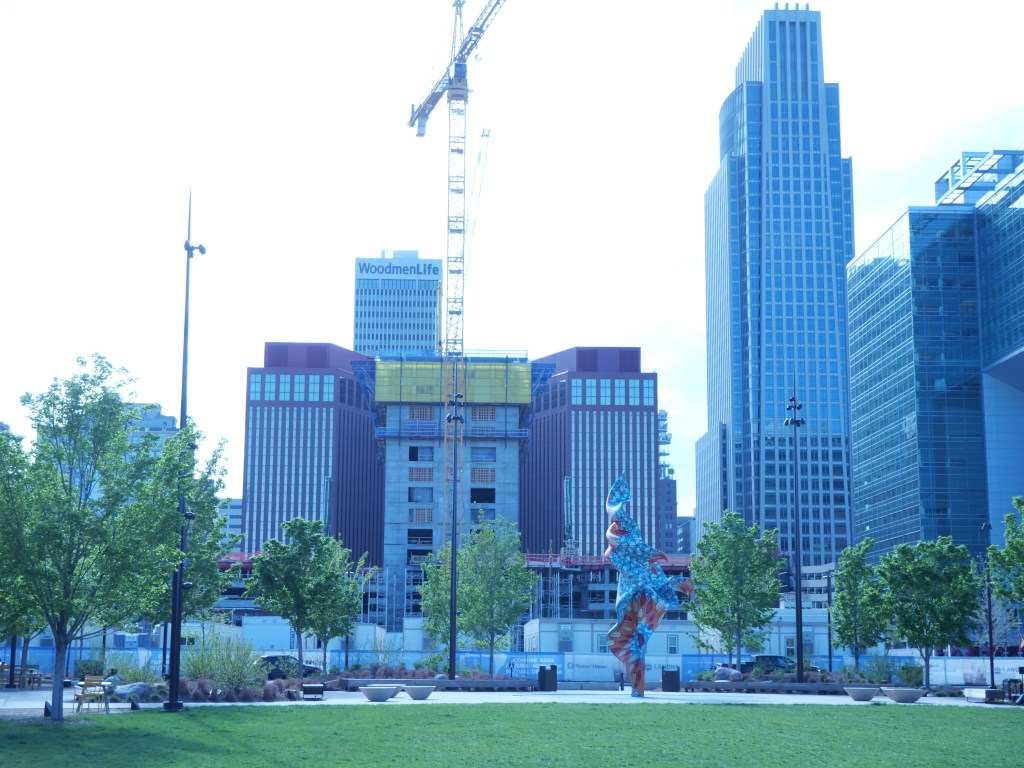
Downtown Omaha developed as the beginnings of Omaha in the 1850s. The Union Pacific Railroad was quickly headquartered here in 1862 and the town exploded. Downtown first developed north of the Union Pacific Railroad station in what is now called The Old Market. The warehouse district has mostly been preserved and is now a bustling walkable district and Omaha’s most important tourist area. Just Northeast of here was the Jobbers Canyon, a large area of massive warehouses. Sadly this was torn down in 1989 but thankfully much of the area has been transferred into high quality Dwtn park space. Another notable historic district was the Sporting District, famous for crime and prostitution in Omaha in the late 19th century and early 20th century. This historic area at 16th and Harney street has some of the best preserved buildings from the turn of the century in Dwtn. Much of the core of Dwtn has been transformed into the outstanding Gene Leahy Makk and the riverfront contains the expansive Heart of America Park and extensive riverfront park space. Lots of dead spaces on the western edge of Dwtn and especially north of I-80 (outside of Creighton University). But some good momentum building with lots of mixed-use development surrounding the ballpark and some good in-fill around Capitol Avenue. The 20 -acre Mercantile development should break ground soon and will help fill in some of Omaha’s dead blocks near Central High School. Also some good momentum north of the Ballpark with the Millworks Commons development, which is a 50 acres urban redevelopment project.
Overall Omaha has 8 Billion dollars of redevelopment planned along with a new streetcar project to connect to Midtown. This will go a long way towards reenergizing its many dead spaces that have persisted for decades along the western and north edges of Dwtn. I wish more Downtowns had this level of ambition.
Click here to view my Downtown Omaha album on Flickr
URBAN STRENGTHS:
* Decent density for an urban district. Very vertical skyline for a City of this size. * Generally solid sidewalks and ADA infrastructure. Some ADA curb missing on the edges of the Dwtn & the Old Market. * Quality public transit in the Pre WWII part of Omaha and some of the post WWII development but really only with in the City limits. The western suburban third of Omaha has virtually not public transit options and similar situation in the suburbs with the except of some public transit service in Council Bluffs. * Thankfully not a full inner belt around Dwtn Omaha but still two highways cutting on the edge of it. * Pretty good Bike share system across Omaha with especially good service in Dwtn and Midtown but decent service is several other neighborhoods. * Great racial and economic diversity living in Dwtn. * Decent # of activities for kids including Children’s & Science Museum. a minor league ballpark, and several large parks. * Public elementary and high school within Dwtn and one elementary school located just north of Dwtn. All are poorly rated. * Good array of rentals and generally very affordable. Studios lease for $600-1.4K, 1-beds anywhere from $700-2K, 2-beds for 1.1K-3K, and 3-beds are generally pretty limited. Decent for sale options. 1-bed sell btwn 200K-600, 2-beds for 400K-900K, and a decent # of 3-beds in a similar range with some 1M condos. * Dwtn is generally safe but has the standard American Dwtn issues of homeless and drinkers. Plenty of dead, and gritty spaces on the edges of Dwtn that invite this. * Dwtn has some World Class parks that many American cities should be envy of including the Heart of America Park with a lagoon, extensive riverfront park, Gene Leahy Mall with diverse amenities and a outdoor stage, Lewis & Clark Landing Park, Miller’s Landing Park and a handful of smaller plazas. * Good student population thanks to the 8K students add ending Creighton located on the north edge of Dwtn. Not much else however. * Solid amenities including plenty of food & beverage businesses, several art galleries & live music venues, good # of museums & historic sites, several performing arts centers including mostly modern ones. Other amenities include a ballpark, a couple arenas, a large convention center, and a modest Dwtn library. * Decent retail amenities but mostly concentrated in the Old Market. This includes lots of boutiques, clothing stores, antiques, a couple bookstores and specialty stores. Also plenty of dessert joints & banks, and a couple gyms. * Well preserved warehouse district in Old Town. Decent early 20th century mid rise buildings in the core esp. at 16th and Harney St. * Nice wide sidewalks with pretty good streetscaping overall. Not as good north of 480.
URBAN WEAKNESSES:
* Generally nicely gridded streets but lots of wide one way pairs and blocks are pretty large. * Decent Bike lanes within Dwtn but they don’t connect much to surrounding inner ring neighborhoods, which themselves lack bike lanes. Solid bike system in the western suburbs and pretty good in Council Bluffs as well. * Overwhelming downtown population is either students, young professionals or empty nesters. * While Dwtn’s park amenities are great I would like to see more smaller parklettes and plazas spread throughout. They are very concentrated along the Riverfront and the Mall moving perpendicular from the riverfront. * Maybe 30K jobs in Dwtn Omaha. An ok number and Civic leaders are really trying to add another 30K of jobs even after the pandemic. * No supermarket or drug store dwtn. Only a couple churches dwtn. Limited retail options outside of OId Town especially non-food and beverage businesses. * Lots of dead space Dwtn outside of Old Town and the Arena District. Eastern side of Capitol Ave is fortunately starting to fill in. * Decent urban infill along parts of Capitol, surrounding the ballpark, and around Gene Leahy Mall. But most modern buildings are soulless mid-century towers with limited street life creating significant dead zones dwtn. * Lots of surface parking lots Dwtn especially the western half of dwtn but even more so north of 480.




 Evaluating our Urban Communities [with a focus on America]