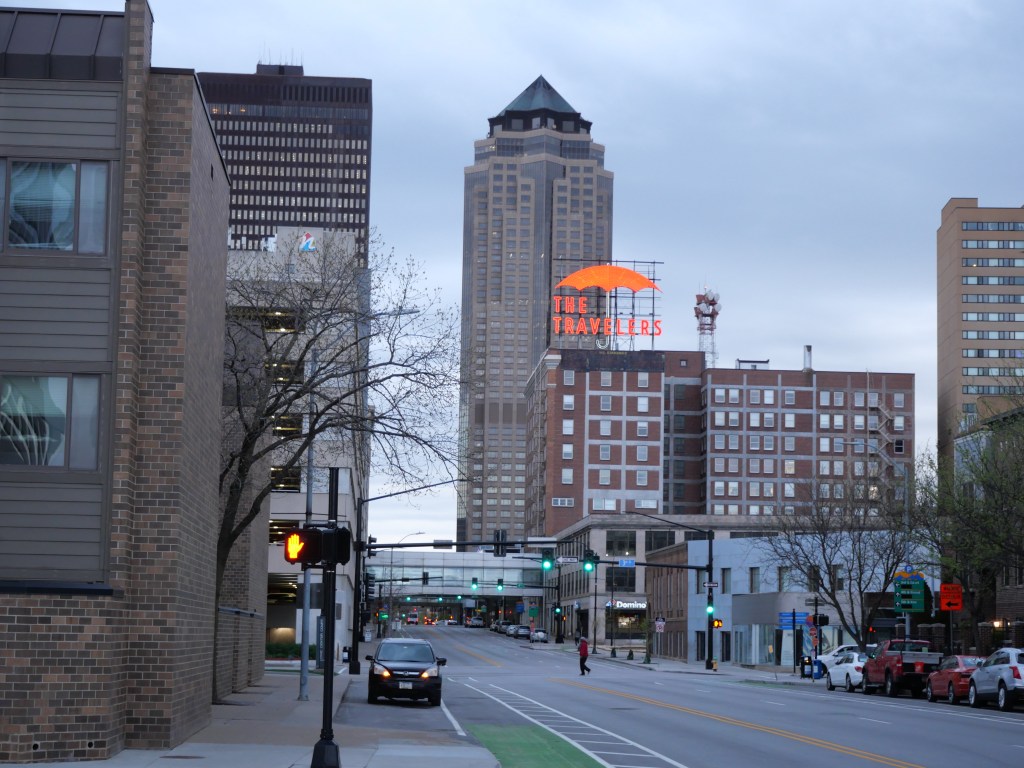
Downtown Des Moines, IA

For the downtown evaluation I include 15th St as the western edge, I-235 as the north, and MLK as the southern edge. Between MLK and the river is a former brownfield that is slowly being redeveloped as mixed-use fabric. This should be nice when it is finished but is still long way to go before its a cohesive neighborhood and partially removed from the rest of Downtown.

Downtown Des Moines like most American cities is the place where Des Moines was founded starting with the establishment of  Fort Des Moines in 1843. The area served as a military outpost designed to control conflicts between Native Americans and settlers. By 1851, it was incorporated as a city and quickly grew thanks to its strategic location at the confluence of the Des Moines and Raccoon Rivers. City leaders wisely created greenspace and civic centers along both sides of the rivers (instead of industrial uses) and created the Civic Center Historic District flanked by several early 20th century Beaux Arts buildings on both sides of the river. By the mid to late 20th century Downtown Des Moines hosted several large corporations typically specializing in insurance and finance each with their own expansive headquarters. Like other northern midwestern cities, Des Moines also invested in a pretty extensive skywalk network over four miles long.

While Dwtn hosts an impressive 70K dwtn workers this has created lots of dead parking spaces, office towers without much street activity, and a lack of activity after 5 PM. Fortunately Civic leaders have woken up to this reality and over the past 2 decades investments have made Des Moines better for living and hanging out. Other key revitalization efforts include the  face lift of the Walnut Street Corridor with new streetscaping and opening of high end retail and restaurants. Major investments were made to the 1.2 Riverwalk where the Civic Center Historic District is located.  The Western Gateway was redeveloped as a 7 block long  Sculpture Park boasting 28 pieces of art and over 4.4 acres of green park space. Investments have also been made in the Court Avenue District hosting a collection of wonderful late 20th century commercial buildings and now the main night life hub of Dwtn.  But for Dwtn Des Moines to top the list of mid-sized City Downtowns it needs more multi-family buildings developed on existing surface parking lots, less parking garages, more local retail and boutiques that help drive active street life and reduce dead spaces.
Click here to view my Downtown Des Moines Album on Flickr

URBAN STRENGTHS:

  • Excellent sidewalk and ADA infrastructure throughout all of Dwtn. Almost all curb have modern ADA standards.
  • Decent population for a Dwtn area.
  • Excellent logical grid Dwtn but too many wide one-way pairs and its too easy to get to Dwtn by car.
  • Pretty good bike infrastructure in Dwtn Des Moines including several dedicated bike trails and riverfront trail and solid bike sharing system that covers Dwtn and several inner city neighborhoods. Pretty good network across the regional with several expansive trails connecting to Dwtn running along the rivers. Decent connections to inner city neighborhoods and expansive trails in the Western Des Moines suburbs.
  • Museums dwtn include Science Center, several historic sites, minor league ball park & arena.
  • Decent rental supply and pretty affordable compared to other US cities. Studios lease btwn $800-1K, 1-beds btwn 1K-1.8K, 2-beds btwn similar price but a bit more expensive but 3-beds are very limited.
  • Lots of for sale product as well and pretty affordable with 1-beds selling btwn 150K-400K. 2-beds sell btwn 200K-500K, and a decent amount of 3-beds selling anywhere btwn 350K-700K.
  • Good parks in Dwtn Des Moines including an extensive waterfront and recreational trail, the well designed Cowles Commons, the several block long Pappajohn Sculpture Park, and several smaller plazas.
  • Des Moines has really two civic plazas (Pappajohn Sculpture Park and Cowles Commons) with Pappajohn as the heart now of Dwtn. But are relatively new parks.
  • Good cultural amenities including excellent food & beverage amenities, several art galleries, the outdoor sculpture park at Pappajohn, several performing arts centers, a handful of live music venues including a jazz club, several night clubs, and a decent # of museums. Other major Dwtn amenities include a major convention center, an arena, ballpark, and a major Dwtn public library.
  • Dwtn Des Moines has just over 70K employees a very impressive number of its metro size and has recovered better than most American Dwtns with a pandemic workforce of 80K.
  • Dwtn is overall pretty safe and clean. Not much grit here.
  • Solid skyline for its size of size pretty filled out vertical and visually interesting.
  • Nice concentration of historic bldgs on Court St and the riverfront but only a sprinkling of historic structures elsewhere.

URBAN WEAKNESSES:

  • While young professionals are growing in Dwtn still a dipropionate amount of people in poverty living Dwtn.
  • So so transit access being good Dwtn, north, northwest and slightly west and east of Dwtn. Sub par transit access in south Des Moines which is pretty suburban. Western suburbs of Des Moines have the best transit access but good transit access is limited out here.
  • Children’s museum is out in the Western Suburbs.
  • Two schools within Dwtn and one on the boarder with Sherman Hill. The High School rates well but not the grade school. Still nice to have walkable schools dwtn, which many cities cannot claim.
  • Some important retail amenities exist Dwtn including a supermarket, plenty of banks, a handful of clothing stores & gift stores, several dessert joints & gyms, several churches and a major Hospital. But Dwtn lacks the independent stores and boutiques common in most dwtn likely due to the fact that Dwtn caters mostly to office workers and residents and that many of these stores exist across the river in East Village.
  • No major universities Dwtn but several smaller satellite campuses. Drake university is the closest larger university 3 miles to the northwest.
  • Some nicer modern infill apartment bldgs and iconic commercial towers but much of Dwtn is filled with rather bland office towers and lots of parking lots.
  • So so pedestrian activity.”

Downtown Montreal, Quebec


While Downtown encompasses the Quartier des Spectacles I didn’t include it in my Downtown review and kept it as  its own distinctive neighborhood. For the Downtown review I’m including everything south of City Councilors St. to Guy Street along with the Golden Square Mile neighborhood, considered by most standards to be part of Dwtn but also a bit autonomous . This stretches west to Mount Royal Park. The main spine of Downtown runs down Sherbrooke St. This formed the historic heart of Golden Square Mile where Montreal’s turn of the 19th century millionaires settled. Eventually all of the mansions on the northern stretch of Sherbrooke were replaced with post WWII skyscrapers creating a pretty bland and soulless American urban environment. But many mansions and historic structures were preserved in the southern half of Sherbrooke between Stanley and Guy street.

Saint-Catherine St is the great historic shopping district of Dwtn Montreal akin to Chicago’s Miracle Mile. It remains at a very human scaled with mostly historic commercial buildings remaining. Recent improvements have improved the urban form expanding the sidewalks and make the street even more human scaled. In the southern half of Dwtn Bishop, Rue de la Montagne, and especially Crescent, are three narrow east to west streets that preserve some of Montreal’s best late 19th century grand townhouse architecture. The northern half of Dwtn is mostly post WWII high-rises with the main exception of many historic buildings surrounding Phillips Square. West of Sherbrooke is a mostly residential neighborhood mixing historic and modern residences and institutional uses from McGill University.

Parts of Downtown are not the most exciting because of a large amount of bland high-rises, plenty of wide blocks, and a lack of premier park spaces. But because of its density, good urban planning, smart urban design decisions, good pedestrian activity and great remaining shopping  Downtown Montreal has been able to largely overcome these downsides. When adding the exciting Quartier des Spectacles I would still likely include Downtown Montreal as a top 10 Dwtn in North America. The height restriction creates an interesting uniformity to the highest skyscrapers in Montreal as none can exceed the height of Mount Royal (232 Meters). Overall I like this especially when viewed Dwtn from Mount Royal or from afar but it does create some blandness on the ground. Fortunately the new skyscrapers being  built are a lot more unique and creative.

Click here to view my Montreal Album on Flickr

URBAN STRENGTHS:

 * Some major Dwtn landmarks include Mary, Queen of the World Cathedral, Saint Patrick’s Cathedral. The Montreal Museum of Fine Arts, the Sun Life Bldg.,
* Several attractive parks and plazas including Phillips Square, Dorchester Square,  and Place du Canada. But not including Mount Royal.
* Excellent public transit access including 6 subway stops. Same with the dedicated bike lane network Dwtn where most are separated by barriers. Feeds into an incredible bike network across the City and Metro. The dedicated bike station system is also one of the best (if not best) in North America.
* Decent bike canopy.
* Generally solid pedestrian activity especially along Saint-Catherine (Canada’s business commercial avenue) and the more historic and mixed-use sections of Dwtn.
* Solid cultural amenities of a Dwtn but with several movie theaters including several indie theaters and a cineplex
* Very good retail amenities Dwtn including a couple supermarkets and lots of ethnic groceries, plenty of drug stores, a great array of clothing stores concentrated along St. Catherine St., several shopping malls including the extensive Eaton Mall and the underground City (the largest underground shopping mall in the world. This comes with many department stores. Other retail amenities are pretty standard for a Dwtn.
* Good pedestrian activity in much of Dwtn but still plenty of dead spaces.
* Lots of residential options Dwtn, generally expensive but not terrible. Solid density with about 20K per square mile living in the greater Dwtn area.
* Lots of universities studies thanks to McGill, the University of Quebec in Montreal and many other smaller colleges.

URBAN WEAKNESSES:

* Limited modern ADA curbs.
* Plenty of modern single use skyscrapers from the 1960s-2000 in the northern and eastern edges of Dwtn which creates some dead spaces.
* No extraordinary parks spaces in Dwtn Montreal as found in other great North American cities like Chicago, NYC, or  Boston.
* Several wide autocentric streets run through dwtn still. Thankfully the highway in the Center City Montreal is underground in Dwtn. 

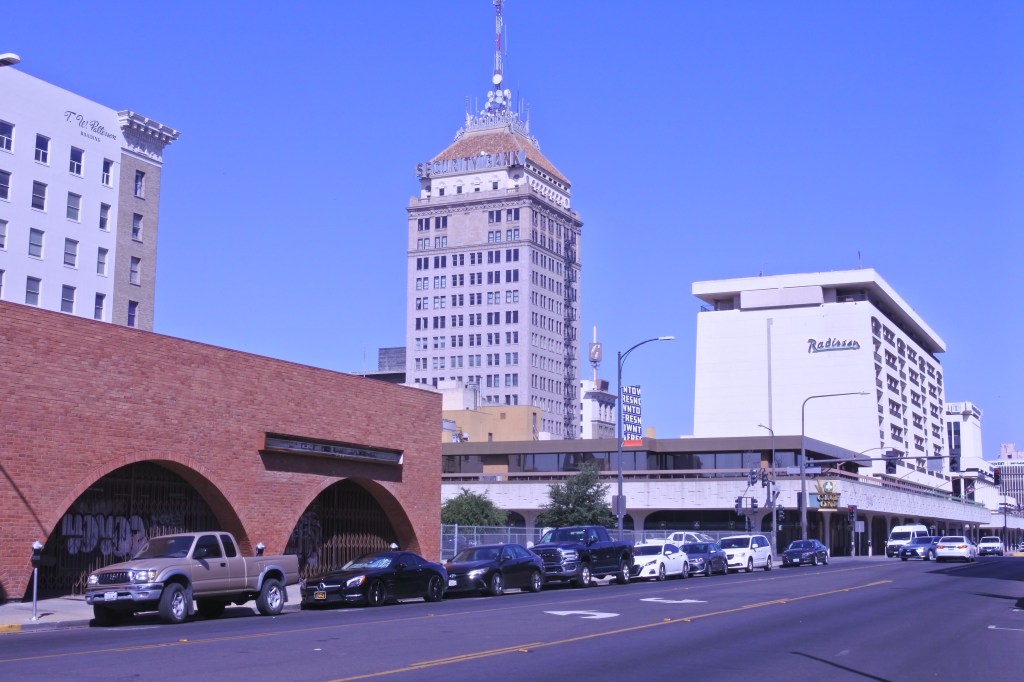
Downtown Fresno, CA

Downtown Fresno is historically quite large and well built in places. Between the 1880s and World War II, Downtown flourished, filled with extensive streetcar lines, several lavish buildings and a vibrant main street along Fulton Street. But Downtown Freson was hit hard with the twin enemies of suburban flight and urban renewal. A cool modernist Downtown complex was created in the 1960s but this was only after serious destruction of the Dwtn fabric, which exceeded well beyond the current footprint. The Fulton Mall was created in 1964 closing traffic as a way to compete with new suburban shopping malls. Sadly like most such attempts in American it failed and by the 1980s, most storefronts on the mall were empty. Cars were not reintroduced on Fulton until 2017  Interesting the public art and fountains built on the mall were kept and relocated to the sidewalks.

The area between Tuolumne Street and Divisadero St has been rebranded as the Mural District and is now the best residential area of Dwtn with significant infill development mostly concentrated on Broadway and Fulton.  The Arts side of the district is still very nascent. There is the Arte Americas and several murals but not much else. The Brewery District, which surrounds the Ballpark is an up and coming food & beverage district with most of the activities businesses lining Fulton. Some nice historic residential blocks near the modern City Hall Bldg and the Fresno Catholic Cathedral. Chinatown is technically part of Dwtn but I excluded it from this evaluation as its on the other side of the railroad tracks and largely abandonded. The rest of Downtown is mostly underutilized or dead space with parking lots, warehouse buildings, or government office buildings. Dwtn is starting to see some buzz and redevelopment interest. Thankfully it has some strong assets like Fulton St and many historic buildings to build momentum. The sky is the limit it seems for Downtown as there are so many surface parking lots, underutilized warehouses, and vacant historic buildings to revitalize.

Click here to view my Downtown Fresno Album on Flickr

URBAN STRENGTHS:

* Solid density for an urban area.
* Generally good sidewalks and ADA curbs but some ADA curb dead spots.
* Decent public transit in Fresno especially Dwtn and neighborhoods north of Dwtn and to a lesser extent east of it. Public transit access drops off quickly once you reach the suburbs.
* Generally a well connected grid dwtn but plenty of wide streets and serious inner-belt highways.
* No dedicated bike stations but a solid bike lane system Dwtn and especially across the City of Fresno.
* Good racial diversity living Dwtn.
* Good cultural & regional amenities including several museums, a minor league ballpark, a hockey arena and event center. Also a great concentration of governmental offices and a major dwtn public library.
* Decent but not great array of food & beverage amenities, several art galleries, live music venues, and night clubs, a couple gorgeous historic theaters and a modern performing arts theater.
* Good number of elementary and middle schools in the Dwtn and surrounding areas, mixed ratings however.
* So nice historic architecture especially concentrated along Fulton Street, the historic main street of Dwtn. Van Ness also hosts a good amount of historic fabric. This comes with the caveat that much of this fabric is pretty blighted and underinvested. Some historic residential area surrounding St. John’s Cathedral.
* Thanks to the City Government Complexes, decent pedestrian activity on Fulton and Civic heart of Dwtn.
* No data on # of workers in Dwtn Fresno, but it appears to be decent with all the governmental jobs.
* Decent retail Dwtn with a supermarket, a CVS, several banks, decent # of boutiques & clothing stores, the Mammoth Mall (collection of antique & resale shops), and unique stores mostly concentrated along Fulton. Also plenty of salons & barber shops, several dessert joints, a major hospital & lots of surrounding medical offices, and plenty of churches.

URBAN WEAKNESSES:

* 1/3 of the residents living Dwtn are in poverty. Some higher incomes but not enough to create meaningful economic diversity.
* I don’t consider Dwtn Fresno dangerous but I wouldn’t consider it safe either with its high vacancy rate, large dead spaces, and medium sized homeless population.
* Not the most vertical or concentrated skyline but some unique antique towers that make the skyline somewhat interesting.
* Pretty limited rental inventory and very cheap for a Dwtn. 1-beds lease for generally in the low 1Ks, 2-beds in the mid 1Ks, a handful of 3-beds leasing around 2K.
* For sale product is also rather limited and affordable. Most for sale housing is located in Villa Borgata Condos. Some 1 bed condos that sell in the 100Ks, 2-bed inventory sells in the 200Ks, limited 3 & 4 bed inventory sell in the 200Ks & 300Ks.
* College presence is very limited in Dwtn Fresno to maybe a couple hundred students. Closest college is Fresno City College located 2 miles north of Dwtn with an enrollment of 15K.
* Modern in-fill is a mixed bag. Some really interesting and relatively urban 60s infill in the City-Government complex and surrounding blocks but also plenty of unattractive rather autocentric infill. Some decent infill in the Mural District.
* Good urban form along Fulton and parts of Van Ness but lots of dead and semi-dead spaces and surface parking lots throughout Dwtn.
* Courthouse Park is an impressive Civic Heart and Government mall but not much else Parkwise in Dwtn Fresno.

Downtown Bakersfield, CA

My evaluation for Dwtn is smaller than Google Maps and other measures. I include only the areas btwn F St to the west, the river to the east, and Truxtun Ave and 24th st to the south and north, respectively. Blocks outside of this more constrained area lacked a cohesive Dwtn fabric in my estimation. 18th, 19th, Chester Ave contained the best urban form and best vibrancy Downtown. These are in the heart of Dwtn. Edge arterials such as F St, Truxtun, and the wide one way 23rd and 24th pairs are rather auto centric in character and move large amounts of traffic. As a way of trying to drum up interest in Downtown the City has created a couple of subdistricts that are somewhat based on reality. The Arts District  contains Dwtn’s concentrations of theaters and cultural amenities and is roughly bordered by 21st Street, Chester Avenue, 17th Street, and G Street. Civic Center  is the center of government for both the City of Bakersfield and the County of Kern. Mill Creek is along the eastern edge of Dwtn and is centered around  attractive green space lining Mill Creek, the famous Mexicali restaurant, and a handful of new mixed-use apartment buildings. Downtown has decent vibrancy, cultural amenities, and historic stock mostly concentrated in its core with rather autocentric and dead spaces on the edges of Dwtn. Dwtn also excels with quality local shopping and boutique options, decent streetscaping, and some regional amenities. Downtown Bakersfield simply needs more residents and mixed-use development. Other important areas of improvement include more parks, better cultural and regional amenities, larger college presence, and slower more pedestrian friendly streets.

Click here to view my Downtown Bakersfield Album on Flickr

URBAN STRENGTHS:

* Solid bike network throughout most of the Bakersfield City limits, even out to more suburban areas. A dockless bike program also exists serving mostly just the dwtn area.
* Strong street grid that is easy to navigate but roads are overbuilt and wide.
* Some nice pockets of historic architecture, which generally correspond with better urban streets.
* Generally a pretty safe Dwtn. Pretty low homeless for a CA downtown.
* Dwtn streetscaping is pretty decent, esp. the core of Dwtn.
* Bakersfield’s regional amenities include a decent sized convention center and arena, a dwtn post office & library, some museums, plenty of bars & restaurants, a couple live music venues, a couple local theaters, the gorgeous Fox Theater (now a local cinema).
* Some retail amenities including plenty of boutiques, clothing stores, gift shops, and antiques/furniture stores. Also several banks, a toy store, a couple book stores, a couple gyms & dessert stores, several churches and a major hospital is nearby.

URBAN WEAKNESSES:

* Pretty low population density for a dwtn.
* Not much income diversity of the population living Dwtn, but plenty of people of means who work and visit Dwtn.
* Some kid friendly activities Dwtn (Arena complex, Natural Historic Museum but really not a whole lot.
* Well rated Dwtn public elementary school but schools surrounding Dwtn are poorly rated.
* Not a ton of for sale options Dwtn but what does exist is pretty affordable. 1-beds & 2-beds sell for around 200K,  and 3 & 4 beds sell btwn 200K-300K.
* Rentals are also limited but a bit more plentiful. 1 beds lease in the 1Ks, 2-beds lease btwn 1.5K-2K. Larger rentals are largely absent.
* Decent # of nice mid-century buildings but also plenty of unattractive modern building without great urban form.
* Very autocentric and unattractive urban form along the edges of Dwtn.
* Tree canopy is pretty thin larger the result of the climate.
* Park space is limited to Mill creek park on the eastern edge of Dwtn and a couple unimpressive plazas.
* Central Park is the only plaza space with some semblance of a Civic Heart of Dwtn with some events.
* Other than a couple md-sized bldgs. not much of a skyline.
* Sidewalks are consistent but ADA curb cuts are spotty.
* Kern College Community Center is Dwtn but not much else.
* Missing several key amenities including hotels, court houses stadiums, art galleries, and major theaters.
* # of jobs Dwtn is pretty low. Likely btwn 5K-10K

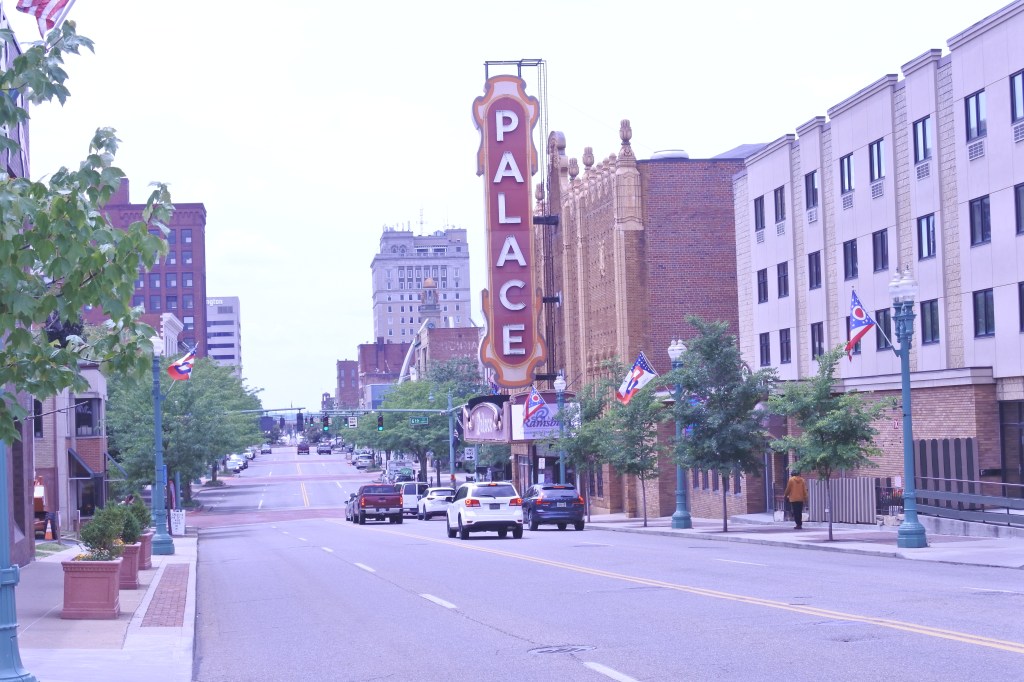
Downtown Canton, OH

I loosely define Downtown Canton to be between McKinley to the west, Cherry to east and between north and south 6th Streets. One could argue that the North Market district running from North 6th to 12th street is also part of Downtown as it includes the main library and Canton’s Art Center.

Downtown Canton’s also contains a couple notable subdistricts: 1) The Canton Arts District/Music block centered in the core of Dwtn along Cleveland Street where many 2-4 story historic mixed-use buildings still remain and are filled with retail and food & beverage/theater uses. This is where Canton’s historic building concentration is strongest. 2) The Warehouse District which runs between Market and Cherry Avenues where a scattering of historic warehouse remain standing yet most are underutilized. 3) Saxton Quarter is located south of Tuscarawas St. This is named after the Saxton McKinley House and feels like a marketing attempt to uplift a largely dead part of Downtown. Market Street is the main spine through Dwtn and contains its best architecture and the well designed and active Centennial Plaza. Tuscarawas  is the second main street Dwtn and runs east to west.

All in all for a midsized Midwestern Dwtn, Canton does pretty good thanks to the targeted investment in its core along Cleveland and Market Avenues north of Tuscarawas. Dwtn includes a decent # of local retail, solid cultural amenities, a well designed central plaza and even a semi-pedestrian street along the Court Street alleyway. To move to the next urban level, Canton needs a lot of Dwtn apartments and condos and new development south of Tuscarawas and on its edges to liven these dead areas. Targeted redevelopment of the warehouse district is probably the best place to start.

Click here to view my Dwtn Canton Album on Flickr

URBAN STRENGTHS:

* Good efforts have been made to stabilize dwtn with the focus on the arts, revitalization efforts along Cleveland and Market Avenues, an extensive semi-pedestrian alley along Court Street line with many businesses, and the well designed Centennial Plaza.
* Also decent mixed-use activity along N 6th Street and some along N. 2, 3, 4, and 5th Streets.
* Good cultural offerings including plenty of bars, restaurants, and cafes, a historic theater, several live music venues, many museums and historic sites, and a major cultural arts center.
* Generally good sidewalk and ADA curbs especially in the more invested parts of Dwtn.
* Good historic architecture and much of it is still preserved.
* Decent number of street trees.
* Decent retail amenities but no supermarket.

URBAN WEAKNESSES:

* Lots of dead spaces outside of the core of Dwtn especially the southern half south of Market.
* Tinken Steel’s career Campus on the western edge of Dwtn feels like a suburban community college artificially placed Dwtn.
* Only a handful of rentals and condos Dwtn.
* Only a couple of schools located dwtn and a small Stark County Community College presence.
* So so modern infill

Downtown Jackson, MS

There are no hard boundaries for Dwtn but my sense is that its western border is the railroad to the west, Court St to the south, Jefferson St to the east, and High/Monument St to the North with a couple additional blocks north of the Statehouse.

Capitol Street is by far Dwtn Jackson’s best street with decent urban form as a lot of historic buildings remains, great streetscaping and even some business, hotels, and office bldgs. Decent cohesion and sense of place surround State Capitol Building, Smith Park,  and the governor’s Mansion. The block west of here to Lamar street holds a decent array of modern and historic bldgs but not great urban form. Some efforts have been made to revitalize the historic African American Business District (Farish St) evidenced by several blocks of new streetscaping and a handful of renovated businesses. A nice block on State St also sits across from the old Capitol Building.

But outside of these aforementioned nodes Downtown Jackson is a mixture of sterile and dead office blocks, parking lots, and blight and vacancy lacking a sense of place and urban cohesion. One particularly poor urban design decision was made at the intersection of Amite and Farish Street where a large mid century parking garage literally dumps two massive car ramps onto where sidewalks should be. Jackson is sadly the worse major American City Downtown I have evaluated to date from an urban perspective. But there is even still hope here. Downtown can continue to invest and urbanize the nodes I mentioned before, especially Capitol Street, where revitalization could spill northward towards the Capitol Building and State Street and eventually westward to Farish Street. There could conceivably be a quality tight Downtown core framed by State, Capitol, Farish and High Streets. But this would require significant amount of political will, intentionality, and investment.

Click here to view my Dwtn Jackson Album on Flickr

URBAN STRENGTHS:

* Dwtn’s Street Connectivity is pretty decent with a good grid and few very wide 1-way streets. The Innerbelt is set pretty far to the east and south of Dwtn and didn’t result in major Dwtn urban renewal. The wide Court St blvd on Dwtn’s southern edge is pretty bad.
* Jackson was blessed with some quality historic architecture and it was quite extensive. While much of it has been demolished much remains especially along Capitol St and many Capitol bldgs.
* Good racial diversity Dwtn.
* ADA and sidewalk infrastructure is a really mixed bag in Dwtn Jackson. Some great streetscaping along Capitol St, parts of Farish, and the core of Dwtn but the more distressed areas of Dwtn have terrible ADA/sidewalk infrastructure.
* Decent cultural amenities including some restaurants & bars, several night clubs and live music options, a couple art galleries, a good collections of museums, and plenty of historic sites. Regional amenities include two  convention centers and the Jackson Volcano site that includes the State fair grounds and an arena.
* Dwtn hosts a lot of government offices and courthouses along with the main public library.
* Dwtn Jackson has a safety ambassador’s program.
* Solid # of employees in Dwtn at 22K. This is decent given Jackson’s metro size just shy of 600K.
* Some good City Beautiful planning with both statehouses terminating at the end of Congress and Capitol  Streets but much of Dwtn’s originally cohesion has been lost.

URBAN WEAKNESSES:

* Low density even for a Dwtn area.
* Public transit access is quite bad throughout Jackson and mediocre at best in its pre-war II area. Dwtn has better public transit than other neighborhoods just about the worst Dwtn public transit access of any major US City.
* Modern in-fill is generally not very exciting. Either bland mid century towers with poor urban form or auto centric low rise buildings.
* Bike infrastructure doesn’t existing in Dwtn Jackson and practically doesn’t exist in the entire Jackson metro with the one exception of the Natchez Trace Pkwy rec trail running a couple miles north of the city.
* Overall Dwtn’s population is pretty poor but some economic diversity.
* Mostly a younger population Dwtn and few activities for kids.
* Dwtn Jackson isn’t particularly dangerous its just dead and often blighted in places.
* No schools within Dwtn Jackson but some well rated elementary schools in adjacent neighborhoods.
* Hsg is limited dwtn but affordable. 1-bed apts lease for 800K- the low 1Ks. and 2-beds in the 1Ks.
* For sale hsg is practically non-existent Dwtn.
* About 500 students attend college in Dwtn Jackson but Jackson State (10K enrollment) is 1 mile SW of Dwtn.
* Not a ton of verticality nor cohesion to the Jackson skyline but some attractive boutique skyscrapers augmented by the two capitol buildings.
* Very limited pedestrian activity dwtn.
* Only two sizable parks Dwtn: the Statehouse lawn and Smith Park, Jackson’s best Civic plazas. A handful of other plazas dwtn but not much.
* Retail is limited to a couple boutiques & banks, a florist, a couple gift shops & music/book store, a bakery, a gym, a small post office and several churches.

Downtown Baton Rouge and Historic Spanish Town, LA

Most of my evaluation area for dwtn Baton Rouge is btwn North Avenue Blvd and the Capital Access Rd to the north. I included a small segment btwn North Ave and Government St. west of St. Louis St. This includes the historic Spanish Town district.

Spanish Town was commissioned in 1805 and is the oldest neighborhood in Baton Rouge. I believe Spanish town developed before most of Dwtn except along the waterfront. Baton Rouge only had a population of about 500 in 1810 even though the City was established as a fort and trading post in 1755 by the French. The creation of Spanish town allowed Baton Rouge to diversify beyond just a mainly Anglo and minority French City brining new Spanish citizens to the City. The American Civil War brought destruction to the area and left only a few homes and buildings standing in the Spanish town. At this time only 5,000 residents lived in Baton Rouge primarily in the Downtown, Spanish town and Beuregard Town.  After the Civil War, Spanish Town was mostly populated by African Americans. I believe the Downtown area began to take shape after the Civic War.

I view Downtown in 4 segments:


– Spanish town is between 5th Avenue east to the highway and north of North St.
– Capitol Area is between N 5th Ave and the River and South to North St.
– Heart of Downtown is south of North St to North Blvd/Federal St. There is where the majority of high rises are located, Arts activity, Dwtn’s historic street along 3rd Avenue and major civic plazas.
– Underutilized Dwtn- is east of N 5th Ave between North Avenue and North St. This is a mixture of historic low rise buildings, some mixed-use activity but lots of surface parking and dead spaces.

Dwtn desperately needs more residential and neighborhood amenities which can be achieved through significant mixed-use infill development especially east of N. 5th Ave.

Click here to view my Dwtn Flickr Album and here to view my Spanish Town Album

URBAN STRENGTHS:

* Very gridded and easy to navigate Dwtn street network
* Good dedicated bike sharing system Dwtn and spilling into Beuregard Town.
* Decent age diversity among adults living Dwtn.
* Solid park amenities including the Mississippi River front park, Galvez Plaza and North Blvd Town Square, the Downtown Greenway Blvd park, and the Capitol Gardens and Veteran’s Memorial Park surrounding the Capitol Complex. Several smaller plazas and parkettes too.
* North Blvd Town Square and Galvez Plaza and interconnected and form and solid Civic Plaza with lots of public events.
* Crime is pretty average for American Dwtn’s. Generally a safe place.
* Pretty good imageability with a distinct state house area, the Historic Spanish Town, Historic commercial district along 3rd St and well designed Dwtn plaza spaces. Put also plenty of soulless areas in the eastern half of Dwtn.
* Good architecture (both historic and infill) around Galvez Plaza and North Blvd Town Square. Great historic architecture in Spanish town.
* No hard data on Dwtn employment but assuming with all the State workers here its a decent # (40K-50K). COVID has certainly decreased this amount.
* Solid cultural amenities including plenty of restaurants, bars, & cafes. Decent # of live music venues, a handful of art galleries & performing arts theaters, and lots of museums.
* Major regional amenities including plenty of courthouses and gov’t bldg, a convention center, and Dwtn post office & library.

URBAN WEAKNESSES:

* Population density is low even for an American Dwtn.
* Decent public transit access Dwtn and decent access to the more historic neighborhoods east of Dwtn and to a less extend south of Dwtn. Outside of these areas public transit access drops off pretty quickly but at least some level of access within the City of Baton Rouge. Very limited public transit access outside of the City.
* Plenty of 2-3 lane one way roads. While this isn’t terrible egregious its pretty unnecessary given Dwtn Baton Rouge’s size and more of these roads should be made 1 way.
*Effectively no dedicated bike lanes within Dwtn. Very limited dedicated loans outside of Dwtn. Nice 2 mile dedicated lane running east of Dwtn along Government St and a waterfront line going south of Dwtn.
* No a very children’s friendly dwtn. No major sports area’s Dwtn. Along truly kids friendly museum is the Science Museum. Few kids living Dwtn.
* Greater Science focused high school Dwtn and a couple smaller schools. A handful of smaller schools on the edge of Dwtn.
* For sale options are limited to the Spanish town area. A handful of 1-bed options selling btwn 100K-200K, 2-beds sell btwn the high 100Ks to the low 300Ks, 3 & 4 beds btwn 200K-500K.
* Okay # of rentals with 1 beds ranging anywhere in the 1Ks, similar # of 2-beds and similar lease amount. Very limited 3-bed options.
* Poor ADA curb cuts in Spanish town and some missing sidewalks too. Eastern town generally has curb cuts but often outdated. Western Dwtn has good sidewalks and pretty consistant curb cuts.
* No University presence Dwtn. The closest college location is Baton Rouge Community .
* Other than the spectacular Art Deco tower not much to speak of with the Baton Rouge skyline other than a couple mid century 20-30 story towers and smaller gov’t bldgs.
* Lots of bland office towers throughout and auto centric infill in the eastern half of Dwtn.
* So so retail amenities including a pharmacy, a small market, a couple boutiques & gift stores, many banks, a couple gyms, and lots of churches.

Downtown Aurora, IL- A Downtown built over the Fox River including an Island

The Downtown Aurora District is confined to a smaller 1/4 mile area between Lake St to the west, 4th St to the east, Clark to the south, and Spring St to the north. This unique mid-sized City Downtown traverses both sides of the Fox River and includes Stolp Island. Because of its unique geography, several gorgeous antique skyscrapers, well know buildings by Louis Sullivan and  George Grant Elmslie, and several historic theaters, Downtown Aurora is a very iconic district. Fortunately most of Downtown’s fabric has been preserved and the district has made great strides especially since 2010 with the expansion of Waubonsee Community College Campus, a revitalization plan putting in parks and new walking paths, and major investments in the arts.

Downtown Aurora also excels with great ADA and sidewalk infrastructure, solid public transit and bike infrastructure, great economic diversity, a riverfront recreational path, great cultural and retail amenities, good urban form, and lots of pedestrian activity thanks to all the college students here. For Dwtn Aurora to become a great urban district it simply needs more residents. Dwtn hosts less than 5K residents per square mile. Dwtn could also use more trees and more urban infill to replace a fair amount of surface parking lots and the auto oriented Lake St.

Click here to view my Downtown Aurora album on Flickr

URBAN STRENGTHS:

* Excellent ADA and sidewalk infrastructure. 
* Solid public transit dwtn.
* Decent bike infrastructure including a dedicated bike path along the Fox River and 3 dedicated bike stations.
* Good diversity indicators, especially economic diversity.
* While few families w/ children live here good adult diversity.
* Solid school options including several elementary schools (mostly public) with generally good ratings.
* Several dedicated affordable housing buildings Dwtn.
* Decent park space including the lengthy Fox River recreational trail, McCarty Park, and the North River Street Park.
* Great cultural amenities in Dwtn Aurora including the Hollywood Casino, plenty of food & bev bizs, several breweries, lots of art galleries, several theaters including a mix of historic and modern, a couple live music venues, a couple local museums, and a local convention center.
* Pedestrian activity is pretty good here largely due to the sizable college population coming here.
* Solid retail amenities a Save a Lot, a couple Hispanic grocerias, lots of banks, several boutiques/clothing stores & Gift shops, a Campus bookstore, plenty of dessert joints, a couple gyms, a couple antique/home good stores, a dwtn library & post office, lots of government offices, a couple medical offices, and tons of churches especially in the eastern half of Dwtn.
* Excellent Historic architecture including some exquisite boutiques towers, a Louis Sullivan bldg, and historic theaters.
* Very distinct Dwtn built across the Fox River with an island in-between. Some bldgs are built right up to the River.
* Generally quality urban form and great streetscaping.

URBAN WEAKNESSES:

* Pretty low density for an urban area.
* 50 min drive and 1 hr. train ride from Aurora to Dwtn Chicago. But dwtn Elgin has some jobs itself and only a 30 min transit ride to Dwtn Naperville.
* Rentals are limited to most 1-beds leasing in the low-mid 1Ks.
* For sale housing is also limited and generally is pushed to the edges of Dwtn where there are SF homes. For sale prices are affordable-moderate.
* Not a ton of in-fill but some really quality recent infill. Some auto centric crud along the western edges of Dwtn.
* Tree canopy is so so.

Downtown Madison, WI

Madison’s Downtown comprises the State Capitol and the oldest residential neighborhoods of Madison. Collectively Downtown is also referred to as the Capitol Neighborhoods as it is in reality more of a quilt of several smaller districts that independently grew into a larger Downtown neighborhood. I expand the Capitol Neighborhoods District a bit for this evaluation to include almost everything between Blair and Park Avenue.  In the SE quadrant is the First Settlement, the oldest part of Madison first settled in 1837. The western half is call Miffland & Bassett, an area famous for its counter-cultural revolution in the 60s & 70s now an interesting mixed-use district. Abutting the University and along Lake Mendota is the State-Langdon District, home to many great historic mansions and many early 20th revival bldgs now owned by many fraternities & sororities. In the Northeast quadrant is the Mansion Hill District, which contains some wonderfully preserved mid-late 19th century housing but also feeds right to the Capitol Building.

Downtown Madison is perhaps the best mid-sized Downtown in American. This is mostly thanks to its great density, and mixed-use character that feeds seamlessly into the historic part of the University of Wisconsin via State Street, a vibrant pedestrian mall converted in 1974. The Dwtn is also designed with an elevated State House forming its heart with diagonal streets coming off its corners and cutting through Dwtn. Dwtn’s fabric is also unhindered by any freeways helping it to preserve most of its urban fabric and contains great retail, cultural, and recreational amenities. Dwtn  boasts a great array of housing diversity (esp. rental) while still being a major employment center. Some small areas that Downtown could improve upon include housing more walkable schools, which could attract more families. There are also some autocentric stretches/surface lots along Washington Blvd and the First Settlement subdistrict that could use better infill. These areas are also a bit sparse with retail amenities.

Click to view my Downtown album, my State-Langdon album and my Mansion Hill album on Flickr

URBAN STRENGTHS:

* This is one of the most dense and populated Downtown’s in America( only New York and Chicago have more dense Downtowns). Very impressive especially for a City of Madison’s size. It is twice as dense as the second most dense mid-sized metro (Lancaster).
* Thanks to several leafy residential pockets Downtown Madison has solid tree canopy for a Downtown.
* Madison has good public transit throughout Dwtn and the inner city neighborhood and decent access to the new parts of the City. Ok to poor service in the suburbs.
* Madison has no interstate highways that penetrated Dwtn and the inner City. Instead one must exist I-90 and I-94 and drive in for 15 minutes on the east side or take route 14-18 that loop south  of the Downtown. This is certainly the ideal in my opinion as it provides decent auto access to Dwtn but keeps it in tact.
* Well gridded Dwtn with the addition of 4 diagonals radiating from the capitol bldgs. Dwtn does well at avoiding wide streets but its maze of one-way streets can be rather confusing.
* Excellent bike infrastructure including great bike lane connectivity throughout most of the City and into the suburbs and dedicated bike stations within almost all of the pre WWII neighborhoods.
* Excellent racial and economic diversity from residents living here.
* Lots of rental supply and diversity. Tons of studios and 1-beds that lease btwn $800-2K, 2-beds lease btwn the low 1Ks-low 2Ks, lots of 3-beds leasing btwn the low 1Ks to mid 2Ks and even some 4 beds btwn the mid 1Ks to 4K. There also appears to be a fair amount of dedicated affordable hsg dwtn.
* Decent amount and diversity of for-sale housing too with 1-bed condos selling btwn 200K-500K, 2-beds sell btwn 300K-1M, and a good number of 3 & 4 beds for a dwtn selling btwn 400K- the low 1Ms.
* Solid park amenities including lots of lake front parks, several attractive plazas throughout dwtn, Alumni Park and Library mall near Dwtn, the UW recreational center, and the well activated Capitol Square, a strong civic heart.
* Excellent cultural amenities including tons of food beverage bizs, good # of art galleries, several live music venues, theaters, and night clubs, a indie theater, several quality museums, and all the University of Wisc. Cultural amenities.. For regional amenities the City has a decent convention center, a couple sports arenas (UW).
* Tons of government jobs dwtn with both city and state offices concentrated here. About 50K jobs in Dwtn Madison.
* Great retail amenities including a target, a couple supermarkets, a DGX, a couple drug stores, plenty of banks, plenty of clothing stores gift shops, and home good stores, a bookstore, a hardware store, tons of dessert joint & Gyms, Dwtn Library & post office.

URBAN WEAKNESSES:

* Generational diversity is rather poor due to the overwhelming college age/young adults living in the Capitol Neighborhoods District.
* Only one walkable elementary school within the Dwtn area. A couple good schools in neighboring districts but not really walkable to Dwtn.
* Retail amenities are a bit light in the First Settlement and Mansion Hill Districts.
* As nothing is taller than the State Capital building not a striking skyline in Madison, although I respect the City’s decision to do this. I actually don’t mind the mid-rise skyline this has created allowing the capital building to shine.
* Generally excellent form throughout Madison but a good amount of autocentric uses along Washington Avenue and some surface parking lots in the First Settlement area. Not surprisingly this is also where the dead spots are Dwtn.

Downtown Milwaukee

The Downtown District is broken up into 3 main sub-districts: the Old 3rd Ward- A rejuvenated warehouse district; East Town- home to some stunning turn of the century commercial bldgs esp. along Wisconsin Avenue but also lots of modern high rises along the lake forming Milwaukee’s mini Golden Coast. Also some very nice late 19th century residential/instructional development in East Town between Kilbourne and Knapp. Milwaukee is the most in-tact historic downtown street cutting across both West and East Towns.  West Town- this is the most underinvested part of Dwtn with lots of dead spots but some good nodes including the old Department store district on Wisconsin, the German themed block on Old Word 3rd St., the redeveloped Pabst complex at the Brewery District, and Civic Complex at McPherson Park.

Both West Town and East Town hosted more or less original settlements in Milwaukee established in the 1830s. East Town was historically called the Juneau Town and West Town was called Kilbourn Town. Along with being a major warehousing district in the City the Historic 3rd Ward was once home to Irish, and then, Italian immigrants.

From an urban perspective Downtown Milwaukee is very similar to Downtown Cleveland and Detroit with its broad streets, striking historic buildings, and warehouse district. But it also has Chicago influences with its expansive lakefront park feeding seamlessly into Downtown, river promenade, and great bike infrastructure. Downtown Milwaukee also has solid cultural amenities, decent retail amenities (although still missing a supermarket), diversity of housing types, stunning public buildings (City Hall, Public Library, and McArthur City complex), and many public plazas spread throughout. The biggest area of improvement needed in Dwtn Milwaukee is more urban in-fill especially in all the dead spots and surface parking lots in West Town but Dwtn could also use better tree canopy, better racial and generational diversity, better walkable schools, a more interesting skyline, and a narrowing of its many wide streets.

Click here to view my East Town Album, West Town Album, and Historic 3rd Ward

URBAN STRENGTHS:

* Excellent density for a downtown.
* Good dedicated bike coverage throughout most of the City and to many of the suburbs.
* Good dedicated bike coverage in Dwtn, Northside, inner west side, and limited to the southside. The urban suburbs of West Allis and Wauwatosa also have great dedicated bike station coverage.
* Excellent economic diversity living Dwtn.
* Solid for sale options with a wide range of price points. 1-bed condo sell btwn 100K-600K, 2-beds btwn 225K-900K but some high end product in the Millions. Good # of 3 & 4 bed selling btwn 400K-2 M.
* Pretty good rental options pretty inline pricewise with most Dwtns. Studios 1-beds lease btwn 1K-2K- 2-beds 1K-3K, and some 3-beds leasing btwn 3K-6K.
* Great park amenities especially the expansive lake front parks and the City Malls. Good amount of other smaller parks & plazas too. Cathedral Square is what I would consider the Civic plaza. Good layout but not centrally located and themed.
* Generally a pretty safe Dwtn but some pretty dead and sketchy felling places in West Town further from the river.
* Marquette University Students with its 11K students sits just west of Dwtn but its pretty insular. A several smaller colleges Dwtn including Milwaukee Area Technical College.
* Solid cultural amenities with a good array of food & beverage bizs, several night clubs & theaters, plenty of museums, and some art galleries especially in the 3rd Ward.. Dwtn also hosts the arena where the Milwaukee Bucks play and a smaller arena where the UWM and minor hocky team play.
* Wonderful Historic library Dtwn, which is a block away from the impressive McArthur Square surrounding by impressive Beau Arts Gov’t Bldgs and Museums.
* Dwtn certainly punches over its weight class with around 80K employees working in the CBD (at as of 2020).
* Good retail amenities include an active public market, tons of banks several butcher shops, a drug store, several boutiques & gift shops, a TJ Maxx, a couple book stores, some dessert joins and gyms and several churches. Large hospital on the western edge of West Town.
* Some good infill in East Town with several attractive high-rises near the lake and mixed-use infill.

URBAN WEAKNESSES:

* Generally good connectivity with the street grid but and good number of wide roads often 1-way.
* So so racial diversity living Dwtn.
*Very few children living Dwtn but good amount museums and child friendly destinations.
* Decent # of walkable schools within or near Dwtn but mixed ratings.
* There are a couple post offices on the edges of Dwtn but the historic post office is no longer active.
* Decent skyline with several landmark buildings but not enough cohesion to be a great skyline.
* Lots of surface parking lots in West Town and uninspiring auto centric structures in spots. Lots of surface parking lots on the eastern and southern edges of the 3rd Ward as well.
* Tree canopy is so so.
* Some good pedestrian activity is spots and plenty of dead spaces in between them especially the western half of West Town.