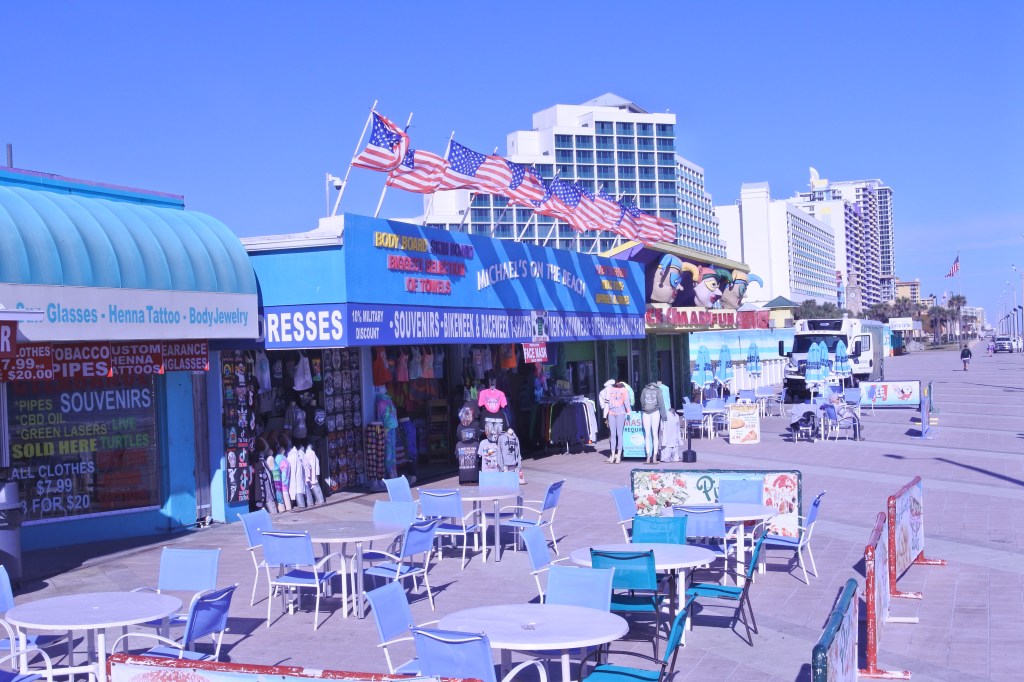
Daytona Beach FL, supposed home to the World’s “Most Famous” Beach

East Daytona is the historic beach portion of the City along the barrier island. This and Downtown Dayton, which runs along Beach Ave on the west side of the Halifax River, are probably the oldest parts of the City developed mainly in the early 20th century. I view the core of Historic East Daytona lying in between University Blvd to the north and the E International Speedway to the South.

The City was named in honor of  Mathias Day Jr. of Mansfield, Ohio, who purchased the former Orange Grove Plantation in 1871 on the westside of the Halifax River. He built a hotel spurring the creation of the town. By 1886 the St. Johns & Halifax River Railway arrived in Daytona but it wasn’t until the 1920s that development took off. By 1930s Daytona Beach had a population of 16K.  Daytona’s wide beachs of smooth, compacted sand attracted automobile and motorcycle races in the early 20th century. This led to many land record attempts and the first stock car races in 1936.  In 1958, William France Sr. and NASCAR created the Daytona International Speedway to replace the beach course and the rest is history! Population steadily continued to grow in Daytona Beach. The City reached 30K residents in 1950 and 64 K in 2000. Population dipped a bit in the 2000s but they seem to have rebounded.

East Daytona’s grid and general walkability make it by far the best urban area in Daytona Beach. But there are many areas for improvement including better neighborhood amenities, quality urban in-fill to replace auto centric strips and surface parking lots, and much more density. 
Click here to view my Daytona Beach album on Flickr

URBAN STRENGTHS:

* Quality transit service. Probably some of the best in the Daytona Beach region.
* Convenient access to many tourist jobs at Daytona Beach and only 2 miles to Dwtn Daytona. Convenient bike and bus access to Dwtn.
* Great economic diversity here.
* Decent array of rental product at moderate prices. 1-bedrooms rent in the low $1,000s. 2-bedrooms in the low to mid $1,000s.
* Nice variety of for sale options including 1-2 bedrooms condos selling around 100K, modest SF homes selling in the $100Ks, and larger homes selling in the 200Ks & 300ks.
* Park and recreational spaces are concentrated along the shoreline. This includes the beach, pier, Breakers, Ocean Park, and the amphitheater plaza. Really no parks within the neighborhood of East Daytona.
* Plenty of attractive early 20th century Florida homes. Much of commercial district is modern.
* Nice array of schools in East Ormond Beach.
* Pretty good urban form along Seabreeze Blvd and Main Street but pretty autocentric along Atlantic Ave. Unfortunately there are many surface parking lots west of Atlantic Ave.
* Culturally a good array of restaurants, bars, & cafes,  lots of live music venues, a cineplex. and a handful of historic museums. The cultural amenities of Dwtn Daytona are also only 2 miles away.

URBAN WEAKNESSES:

* Limited racial and especially generational diversity due to East Daytona’s concentration of retirees. Very few families living here.
* ADA and sidewalk infrastructure is a mixed bag. Generally consistent sidewalks throughout but update to date ADA curbs are 50-50.
* East Daytona generally feels pretty safe but still some abandonded lots and gritty areas. Much of the touristy waterfront has seen better days and needs some reinvestment.
* Modern infill in Daytona is hit or miss.
* Pretty low density in East Daytona.
* Good vibrancy on the beach and in the commercial districts but pretty dead in the rest of East Daytona.
* Much of East Daytona’s Beach’ infill has decent urban form, but the architecture styles can be very tacky.
* Its generally pretty safe in East Daytona but there are quite a few vacant lots and some vacant bldgs.
* East Daytona’ night life can be a liability sometimes with all the rowdy tourists that roll into town.
* Some neighborhood services amenities including a post office, a drug store, tons of touristy gift shops, a handful of boutiques, and the Ocean  Walks Shoppes (mostly just restaurants and gift shops).
* No walkable supermarket or library, 

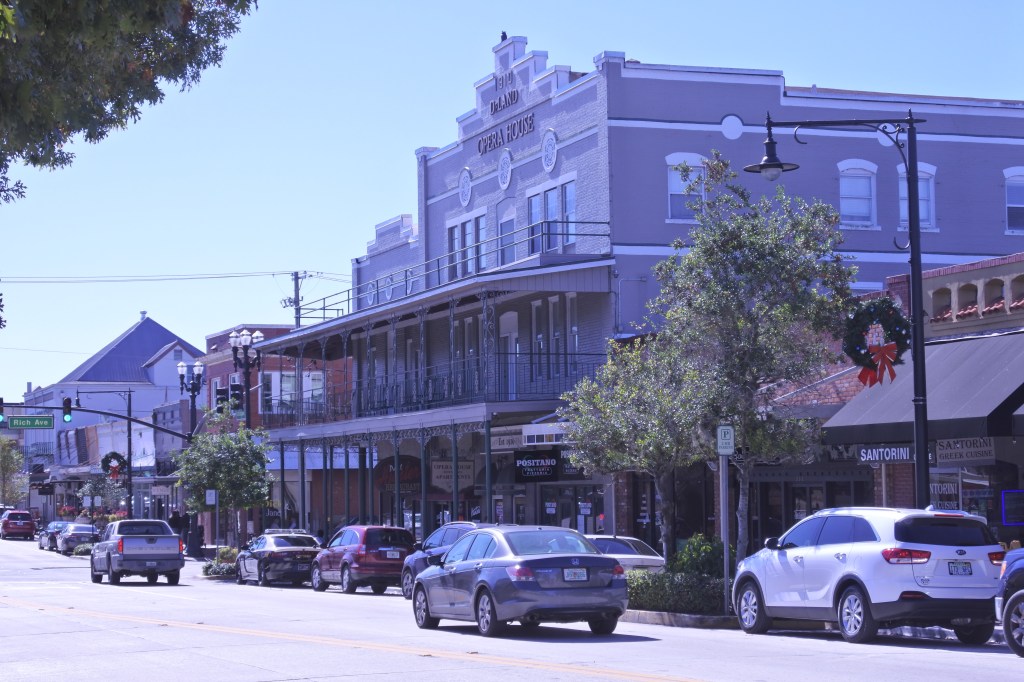
Deland, FL- Home to Florida’s oldest private college Stetson University

Deland was founded in 1876, and was named for its founder, Henry DeLand who also founded Stetson University, Florida’s oldest private college. After a killing freeze destroyed the central Florida’s orange crop, DeLand entrusted the academy to his friend John B. Stetson, a wealthy hat manufacturer from Philadelphia. The Town steadily grew and reached 7,000 residents by 1940. Deland hosts some great historic architecture, especially stucco Mediterranean Revival architecture often designed by native architect Medwin Peek.

Historic Deland has held up well even with rapid suburban growth on its fringes. The city now has over 30,000 souls. Much investment has gone into main street and downtown helping to create an attractive and vibrant core. Major areas for Deland to improve from an urban perspective include better density, public transit access, and converting transitioning its more auto centric commercial districts to be pedestrian friendly. 
Click here to view my Deland album on Flickr

URBAN STRENGTHS:

* Well invested Dwtn area complete with filled storefronts and great streetscaping.
* Great historic architecture especially Dwtn.
* Sidewalks and ADA Infrastructure is great  in Dwtn and Stetson University. Hit or miss in the historic residential streets where sidewalks are often missing and curb ramps are not up to ADA standards.
* Excellent street connectivity.
* Nice dedicated bike lane running the lengths of Historic Deland. No bike sharing system.
* Great generational diversity with around 60% family households. Excellent racial and economic diversity as well.
* Good supply of rentals with one-bedrooms leasing btwn $800-$1,000, 2-bedrooms in the low $1,000s, and 3-bedrooms in the high $1,000s.
* Great diversity of for-sale prices points starting around 50K all the way to 500K.
* Good mix of parks and amenities including several nice Downtown plazas, a major sports complex, Christholm Center, Painter Bond, the Bill Deggors Museum Complex, and the greenspaces of Stetson University.
* Culturally a great array of restaurants, cafes, and bars Dwtn, art galleries, the Athens historic theater and good array of local museums including Deland House Museum, Gillespie Science Museum, Museum of Art-Deland, African American Arts Museum, and the Bill” Dreggors Historic Site.
* Good array of neighborhood retails esp. Dwtn including a hardware store, several grocery stores and smaller ethnic grocers, public library, banks, a couple bookstores, and lots of boutiques and specialty stores.
* Mix of quality private and public schools within the historic core.
* Great tree canopy throughout Deland. 

URBAN WEAKNESSES:

* Pretty low density for an urban area, but this is pretty typical for the south.
* Outside of Downtown the commercial corridors are semi-auto centric. Amelia Street is primarily auto centric.
* Dwtn is vibrant but the rest of Deland is pretty quiet due to its low density
* Poor public transit.
* Decent amount of jobs in Deland as it is a county seat and hosts Stetson University. 30 minute drive (50 min bus ride) to Dayton Beach and 45 drive to Orland.
* Crime a bit above the National average and still plenty of blight throughout.

Sanford, FL Historic Orange Producing Capital of the World


I included only the Historic core of Sandford between the lake and 13th Street and French & Locust Streets.

Known as the “Historic Waterfront Gateway City,” Sanford sits on the southern shore of Lake Monroe at the head of navigation on the St. Johns River. The town started to grow in the late 1800s when the South Florida Railroad ran a line from Sanford to Tampa. This helped propel Sandford and the surrounding area into the largest shipper of oranges in the world. The City waxed and waned for many years but eventually found its footing. A City streetscaping project in 2004 helped breath new life into Downtown and many new stores and businesses opened.

Sanford has a well invested and extensive historic main street across several streets, along with great waterfront parks. South of here are many attractive historic streets with turn of the century architecture. To become a great urban core there are is significant in-fill and additional density needed here along with the remediation of a fair amount of blight. Plenty of vacant lots and surface parking surrounding the historic core of Downtown.
Click here to view my Sanford, FL album on Flickr

URBAN STRENGTHS:

* Excellent street grid and connectivity.
* Nice array of Bike lanes across Sanford.
* Excellent racial and economic diversity.
* Diverse array of for-sale housing starting around 100K to 400K.
* Wonderful array of waterfront parks including the Sanford Riverwalk, Veterans Memorial Park & Ft. Mellon Park. Also several nice neighborhood parks.
* Culturally lots of great restaurants, craft beer & bars,  several historic theaters, and many live music venues.
* Decent amount of neighborhood amenities including a drug store, supermarket, and lots of boutiques, and socially stores Dwtn. All a public library, post office.
* Several nice elementary schools and a public middle school just outside of Historic Sanford.
* ADA infrastructure is generally good but some areas with less than ideal sidewalks and curb cuts in the residential areas.
* Great urban massing in the blocks where the historic buildings are still in tact. 

URBAN WEAKNESSES:

* Sanford is only a 30 minute drive to dwtn Orlando but really no bus service.
* Family households are pretty limited.
* Rentals are limited especially 1-bedrooms. Price points are pretty average.
* Generally safe area but some blighted spots.
* Modern infill is mostly auto centric.
* Fair amount of surface parking, open space (not parks), and auto centric areas. 

Historic St. Augustine- America’s oldest City

Click here to view my full Historic St. Augustine Album on Flick
St. Augustine is America’s oldest City and not surprising has a ton of interesting History. It was founded in 1565 by the Spanish and served as the capital of Spanish Florida for over 200 years.  Eventually Florida was ceded to the US in 1819. After much stagnation, the City experienced a late 19th century renaissance when  Henry Flagler, a co-founder with John D. Rockefeller of the Standard Oil Company, spent the winter of 1883 in St. Augustine and found the city charming. He dedicated much effort to modernizing the City’s hotels and transportation systems to make St. Augustine a winter resort for wealthy Americans. This lead to the construction of two ornate hotels, many churches, and the incredible Flagler College. After a post WWII period of decline, the City doubled done on its historic architecture and preserved much of its architecture helping to create Historic St. Augustine as a major tourist destination.

Historic St. Augustine (especially between Cordova and the Matanzas River) is highly walkable lined with cute shops and lots of restaurants, bars, and historic sites. The City converted St. George St. into a pedestrian only way and invested heavily in public space including its waterfront and Plaza de la Constitution. What is still missing from an urban perspective is more neighborhoods serving retail (i.e. supermarket & large retail), bike infrastructure, quality public transit, and affordable housing. There is still room for modern in-fill along the northern edge and western half of St. George Street, which still hosts a fair amount of surface parking and auto centric uses.

URBAN STRENGTHS:

* While transit and bike infrastructure is poor, this is still a highly walkable neighborhood.
* Good economic and generational diversity.
* Park amenities include a modest but attractive waterfront, a great historic Spanish plaza (Plaza de la Constitution) and a large sports themed park. Also some nice quad space in Flagler College.
* Culturally lots of bars, restaurants & cafes, historic sites & museums, and live music venues. Flagler College also brings a lot of cultural activities especially in the performing arts. Because of the tourism the many annual festivals as well.
* Lots a typical tourist stores like boutiques, gift shops, clothing ,specialty and home good stores. .Some more traditional stores like banks, post office, and small gourmet grocerias. No larger retailors nor a supermarket or drug stores.
* Excellent ADA infrastructure bolstered by a dwtn pedestrian street (St. George St.).
* Strong sense of place with a combination of distinctive historic architecture, pedestrian paths and pretty good neighborhood boundaries.
* Overall great urban form, but still pockets of surface parking and more auto centric streets on the edges of the district.
* Great pedestrian activity in the historic district. Less so in the more residential portion of the neighborhood west of Cordova St.

URBAN WEAKNESSES:

* Dwtn Jacksonville is over a 45+ drive with poor transit access. Some jobs in dwtn St. Augustine with Flagler College and the tourist industry.
* Public transit is pretty limited.
* No dedicated bike lanes but there is a dockless system in the City.
* For sale housing rather expensive. 2-bedrooms start in the mid 200ks and 3-bedrooms sell generally btwn the 300Ks-500Ks. 4-bedrooms are 500k or higher. Really no 1-bedroom condo product. Rental product is pretty limited and a bit on the expensive side.
* Both a quality public and catholic elementary school within walking distance. But no middle or high schools.
* Modern architecture is limited.