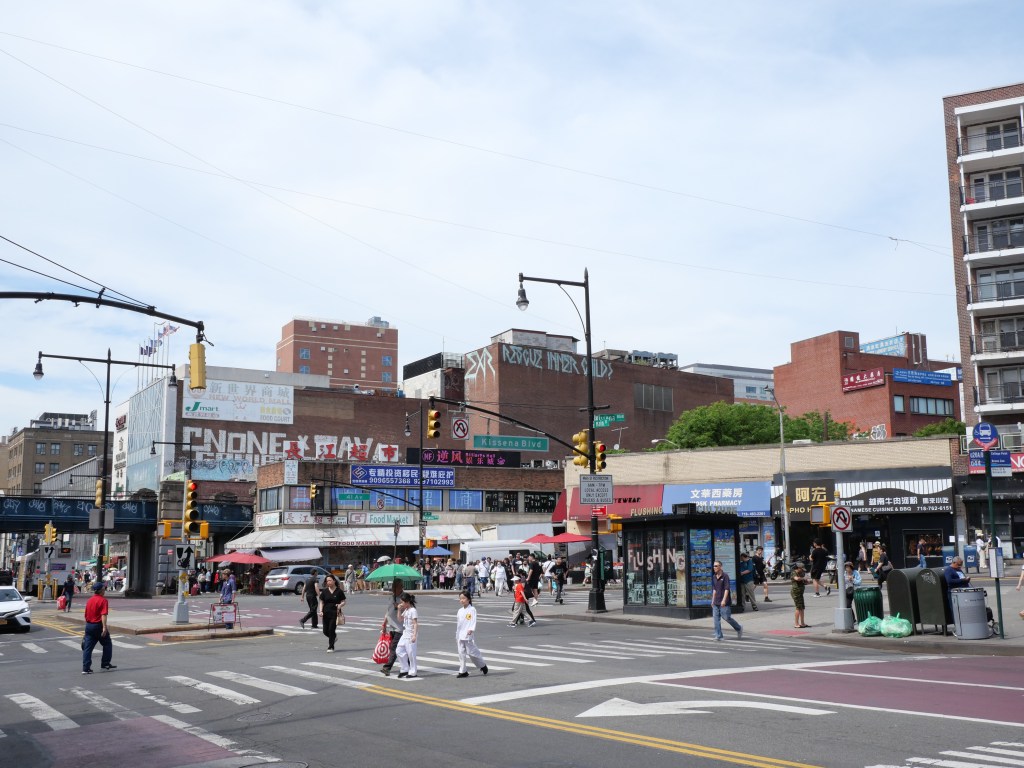
Flushing was mostly farm land until the 20th century. Development came to the neighborhood in the early 20th century with the construction of several bridges and subway and rail lines. Local farmland continued to be subdivided and developed through the 1910s-1930s transforming Flushing into a densely populated neighborhood and eventually the fourth or fifth largest central business district in New York City depending on how you measure the metrics. I ultimately decided not to review Flushing as a Downtown District as there are only about 30K jobs here and Flushing does not have the same verticality of Midtown, Lower Manhattan, Dwtn Brooklyn, and Long Island City, which boats 70-80K jobs. But Downtown Flushing is a major commercial and retail area, and the intersection of Main Street and Roosevelt Avenue, at its core, is the third-busiest in New York City, behind Times Square and Herald Square.
Present day Flushing is known for its great diversity, especially Asian population. The first wave of Asian immigrants came in the 1970s with immigrants from Taiwan and a small Japanese community. By the early 1990s and 2000s large numbers Indians, and Koreans began settling into Flushing with increasingly Chinese from the mainland. Flushing now rivals Manhattan’s Chinatown as NYC’s center of Chinese culture. Flushing also has several sub districts with their open ethnic make up outside of the Chinese/Asian dominated Dwtn Flushing. East Flushing for instance has immigrants from all over the globe. South of Franklin avenue hosts a large concentration of Indian American and other South Asian Americans and is one the oldest Little India neighborhoods in North America established in the late 1970s.
From an urban perspective Flushing excels at walkability given its excellent public transit access, convenient access to Midtown, incredible concentration of retail amenities (especially in Dwtn Flushing), diverse urban housing options, great schools, good park amenities, and high levels of safety. But it does lag behind some key urban indicators from better urban districts in Brooklyn and Queens. The Street grid is a bit irregular, Flushing lacks dedicated bike stations, and only has a handful of bike lines, its street canopy is spotty, and the neighborhood leans very elderly. There also isn’t a ton of attractive historic architecture as Flushing was developed after the era of gorgeous brownstones.
Click here to view my Flushing album on Flickr
URBAN STRENGTHS:
* Excellent density at just over 50K per square mile.
* Excellent sidewalk infrastructure throughout. About 60% of intersections of ADA standard curb cuts. Better along busy commercial streets and Blvds.
* Good street level pedestrian traffic but feels a bit too intense in parts of downtown Flush (aka Main St).
* Some autocentric modern in-fill but generally its pretty urban with solid urban design. Lots of interesting mid-century urban bldg missing from most US cities.
* Some nice 1920s & 1930s brick and tudor architecture but also a good amount of more bland pre WII styles.
* Some more autocentric spots on business districts and wide Blvds but overall urban massing is good.
* Great mixed-use fabric throughout much of the neighborhood. Dwtn Flushing feels like an Asian city with very flexible zoning.
* A major subway and rail line cut through Flushing and very good bus coverage.
* Flushing itself has a modest Dwtn area and hosts about 35K jobs. Good access to Midtown and Long Island City a 40 min subway ride away.
* Very large and diverse Asian population but also sizable Hispanic, and White minorities.
* Flushing is a fairly safe neighborhood with limited vacancy and blight.
* Lots of well rated public schools. Some private and charter schools but certainly less than other NYC neighborhoods.
* Several large parks ring the Flushing neighborhood (i.e. Corona, Queens Botanical, Kissena Corridor) but these are all on the southern edge of Flushing and small and medium sized parks are a bit limited. Several indoor pool options however.
* Good amount of rental options and moderately priced compared to much of NYC. Studios and 1-beds range btwn the upper 1Ks to 3.8Ks, 2 & 3 beds between 2K-4.3K. Dwtn Flushing commands more expensive studios and 1-beds. Also a significant amount of affordable and rent subsidized rental units. Apts below 2K are 6x more plentiful that apartments leasing above 2K.
* Lots of smaller more affordable condo options with a plethora of studios selling btwn 175K-500K, 1-beds btwn 250K-800K, 2-beds btwn 350K-2M, and 3 & 4 beds btwn 400K-2M.
* Good and beverage amenities and tons of Asian restaurants, bars, and karaoke joints. Not a ton of other cultural amenities but there is a downtown Flushing Cinema, plenty of dance studios, a couple historic sites, the Queens Botanical Gardens, and Corona Park just west of Flushing costs a couple museums, the Queens Zoo, and the US Tennis Open.
* Good retail amenities lots tons of Asian grocerias and several larger supermarkets, plenty of drug stores, a Target, a major mall which includes several departments stores, a couple other smaller shopping malls and a Macy’s, lots of discount stores, tons of clothing stores and boutiques (many brand name clothing stores), several hardware stores & a Home Depot, some book stores, many home goods and furniture stores, plenty of dessert joints and bakeries,, several gyms, several public libraries and post offices, tons of churches, and a couple major hospitals just on the edge of the neighborhood along with plenty of doctor’s offices and medical clinics.
URBAN WEAKNESSES
- Decent dedicated bike lanes but no dedicated bike stations.
- Connectivity is pretty good but the grid is pretty irregular.
- Good tree canopy in spots.
- Large household sizes (likely due to intergenerational households) but a very old median age.”
 Evaluating our Urban Communities [with a focus on America]