While railroad lines passthrough the area in the Civil War, development did not come to Forest Park SE until after it was annexed into St. Louis in 1876. It was at this time that the City’s limits shifted westward from Grand Boulevard to Skinker Boulevard. In the late 1800 multiple streetcar lines were extended westward and the neighborhood grew rapidly centered on the vibrant commercial district on Manchester Avenue. While its proximity to industry and railroads made it less desirable, Forest Park SE was ideal to house a diverse working-class population. By 1910 Forest Park SE was largely built and the neighborhood remained a stable working class enclave until the 1960s when the twin forces of deindustrialization and suburbanization resulted in severe disinvestment and depopulation. By the 1990s, Forest Park SE had high crime and 1/3 of its population in poverty. But this state of disinvestment thankfully did not fester the 1990s brought revitalization thanks to the arrival of many LGBT-oriented businesses along Manchester Avenue. By the end of that 20th century, local business owners began marketing the Manchester business district as “The Grove”. Thanks to its proximity to Central West End and the Washington University Medical Center the gentrification of Forest Park SE continued into the 21st century. The tireless work of the Washington University Medical Center Redevelopment Corporation (WUMCRC) also played a large roll in the neighborhood’s comeback as over 500 vacant properties, concentrated in the southern half of the neighborhood, were revitalized . Thanks to these efforts the community’s population finally rebounded between 2010-2020 gaining over 500 new residents. Sadly the racial demographics of the neighborhood have shifted tremendously since 2000 moving from a 77% Black population to around 25%. While many White households have moved in, the neighborhood’s Hispanic and Asian population has increased.
This is a solid neighborhood from an urban perspective with great food & beverage bizs along the Grove, decent retail amenities, and even some restaurants/bars sprinkled into residential blocks. The Forest Park SE housing market has stabilized offering a great variety of rentals and for sale 2-4 bedrooms ranging from 250K-550K. The Community also offers good public transit, convenient park access thanks to the close proximity of Forest Park, and a very artsy eclectic historic vibe creating a buzz for the neighborhood. However, for this to be a top tier urban district is needs more housing & density which will hopefully fill in needed retail amenities along with better schools and bike infrastructure.
Click here to view my Forest Park Southeast Album on Flickr
URBAN STRENGTHS:
* Good sidewalk infrastructure with about 65% of all ADA curb cuts are up to standard, very high for a St. Louis neighborhood.
* Solid public transit access thanks to the neighborhood’s close proximity to a train station. Dwtn is only 30-35 min via public transit and also close the Central West End which has a lot of medical jobs.
* Excellent racial and economic diversity. Not a ton of family households however.
*Good pedestrian access to the SE corner of Forest Park and Hudlin Park even with the Highway barrier. A couple small and medium parks within the neighborhood.
* Lots of rental options with 1-beds ranging in price anywhere from 850$-2K, 2-bed btwn the low 1Ks- the upper 2Ks, and 3-beds btwn 2-3.5K. This is more expensive than the majority of St. Louis neighborhoods but also a decent # dedicated affordable rentals.
* Nice mix of historic and new construction housing but mostly 3 & 4 bedrooms. Good # off 2-beds which sell btwn 250K-450K, 3 & 4 beds sell btwn 300K-550K.
* Solid cultural amenities including plenty of restaurants, bars & cafes, a couple breweries and art galleries, and plenty of night clubs and life music venues. Also decent access to the museums in Forest Park but generally about a 2 mile walk.
* Attractive mostly modest brick historic homes from the late 19th century. Very attractive historic commercial bldgs along Manchester Ave.
* Urban form is generally good along Manchester Ave and most residential streets but you get a fair amount of autocentric industrial uses along the edges of the neighborhood and lots of underutilized surface lots.
* Decent retail amenities including a couple grocerias (no supermarkets here), a couple of banks, a decent # of clothing stores & boutiques,/gift shops, several dessert joints & bakeries, a couple gyms, tons of salons & barbershops, several churches, a local post office, and a couple local health centers.
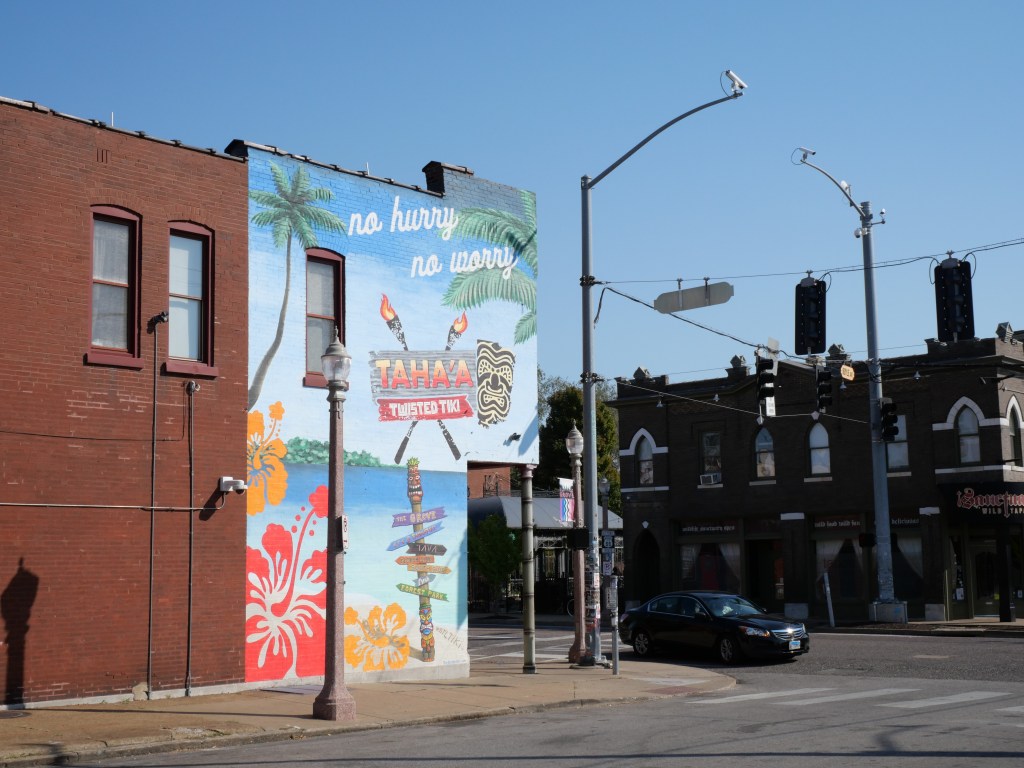
* Lots of murals and arts along the Grove.
* Good mix of uses throughout the district including several restaurants/cafes/bars mixed into the more residential streets.
URBAN WEAKNESSES:
- Poor bike infrastructure within Forest Park SE but good dedicated connections on the western and eastern borders allowing one to bike into Dwtn or out to the western edge of St. Louis.
- so so density.
- Generally a pretty safe area but definitively some grid on the edges of the neighborhood and lingering crime from 2 decades ago.
- Tree canopy is so so in the residential streets and non-existent in the industrial areas.
- The only schools located within Forest Park SE is a poorly rated Elementary School and large pre-K. Some schools on the periphery of the neighborhood but mixed ratings.
- Missing several key retail amenities including a supermarket, a local library, bookstores, hardware store, etc.”
 Evaluating our Urban Communities [with a focus on America]