Greenville’s North End- an emerging Urban District just north of Downtown

The Concept of the Greenville North End is pretty new  and rather fluid. But there is an emerging consensus that it includes the area North of Dwtn running along North Main extending all the way  North into more suburb development. For this evaluation I included  only the more urban areas and therefore used Ashley/Gallivan St as the northern border between Rutherford St and Church Street with Academy Blvd as the southern border.

There are a collection of smaller historic districts within the North End but there are all tiny and not  worth evaluating on their own. This includes Viola Street Historic District, Heritage Historic District, Colonial Elias Earle, and East Park. These istricts, however, collectively still make up the majority of the North End area that is included in this evaluation.

The North End has a lot of standard suburban amenities including good schools, safety, large #s of families, thick tree canopy, and quality parks. The district also has attractive early 20th century homes, excellent access to Dwtn given its proximity just to the north of Dwtn, a wide variety of housing options and price points, decent cultural and retail amenities, and pretty good economic and racial diversity.

To become a great urban district, the most important thing the North End needs is to densify. This is starting to occur with more apartments going up along Stone and Park Ave but the neighborhood is still closer to a suburban density. More density will help foster a much more vibrant neighborhood with better retail/cultural amenities and hopefully encourage the City to establish better public transit frequency.

Colonial Elias Earl Historic District and the Heritage Historic District

URBAN STRENGTHS:

* Stone street is starting to fill in with more mixed-use urban infill.
* Generally good ADA infrastructure but a couple streets without sidewalks and several without modern ADA curb cuts.
* Excellent access to Dwtn, esp driving but there is also a good dedicated bike station running north to south along Main St.
* Some Income diversity and racial here but def a solid upper middle class area.
* Lots of families here and generally generational diversity.
* Decent number of rentals. 1-beds lease btwn 1K-2K, 2-beds lease btwn 1.5K-2.7K and a handful of 3-beds.
*Good for-sale diversity but only  a handful of 1-beds. 2-beds sell anywhere from 150K-800K, 3 & 4 beds sell btwn 275K- to the low Millions.
* Several small-medium sized parks with McPherson as the largest most diverse park space and includes a small rec center.
* Decent schools with an excellent public elementary school,  Catholic school and several pre-schools.
* Cultural amenities include a decent # of restaurants, a brewery, several museums, a performing arts theater, and a couple escape rooms. Good access on the southern edge of the North End to the Dwtn amenities.
* Decent retail amenities as well including a supermarket, a couple drug stores, a record store, several salons, a florist, a couple gyms & churches.
* Attractive historic homes.
* Excellent tree canopy.

URBAN WEAKNESSES:

  • Mediocre public transit access esp for an inner-ring neighborhood.
  • Mediocre density for an urban area.
  • Connectivity is so so here.
  • A good amount of autocentric modern infill but more recent infill is decent mixed-use development.
  • Best urban form is at the intersection of Main and Stone Ave. Some quasi-urban form along Stone and Park but also plenty of autocentric stretches.
  • Not great pedestrian activity.

The Pettigru Historic District- Greenville’s Best Historic District

This small neighborhood is bound by North St, Washington St, Church and 276. In the end of the 19th century the neighborhood was subdivided, developed and became  Greenville’s first upscale suburb. By the 1970s, the elite neighborhood had transitioned into a commercial historic district, and the apartments and larger homes were converted into offices.

Nominated in 1981, the Pettigru Street Historic District was listed on the National Register of Historic Places making it the largest district in the city. The District is home to 88 structures built between 1890 and 1930.From an urban standpoint Pettigru’s best asset is its proximity to downtown and historic character, and the expansive Cleveland Park on the southern edge.The District also has some good retail concentrated at McBee Station, a decent amount of for-sale housing options, and good bike lanes.
.
But the District has no historic main street and the arterials it does have are wide and very autocentric. Density is more akin to a suburb, there are no schools located in the neighborhood, rentals are limited, there is lots of crummy post WW II commercial bldgs., and there is a Confederate Museum… unfortunately. But given Greenville’s explosive urban apartment growth I do believe Pettigru will continue to urbanize and fill in. Hopefully the urban design is of decent quality and North and Washington Streets can become more pedestrian friendly.

Click here to view my Pettigru Historic District on my Flickr

URBAN STRENGTHS:

  • Decent bike infrastructure wit h multiple bike lanes and easy access to the recreational trail along the reedy river which connects to Dwtn.
  • Great access to Dwtn Greenville sitting just to the east of it.
  • Excellent economic diversity and decent racial diversity.
  • Good for-housing diversity with a decent # of condos with 1-beds selling 200K-500, 2-bed selling btwn 250K-550K, 3 & 4 bed sell btwn 350K-600K.
  • Large metro park on the southern edge of the neighborhood (Cleveland Park), which includes a Zoo, ballparks, tennis courts, recreational trails, but no small parks or plazas within the neighborhood.
  • Generally a pretty safe neighborhood.
  • Lots of old mansions from the late 19th century. Homes are no mostly office but Historic district has preserved their original character from the exterior.
  • Retail amenities are concentrated mostly at the McBee Station shopping plaza located a block south of the neighborhood. The Mall has a supermarket, staples, several restaurants, and a couple other neighborhood retail. Other than that there’s a bank, a running store, tons of law offices, bed & breakfasts, a couple churches. Decent access to some amenities Dwtn.

URBAN WEAKNESSES:

* Density is pretty low for an urban neighborhood.
* Connectivity isn’t great.
* Mediocre public transit access esp for an inner-ring neighborhood.
* Excellent Income diversity
* Lots of preschools within Pettigru or Dwtn but no other walkable schools. Some well rated schools about 1-mile away but again not walkable.
* Rentals are pretty limited. A bit on the pricy side.
* Cultural amenities are limited to a several restaurants,  the Bon Secours Arena, a wedding venue, and the” Confederate Museum”  * cough * cough. But many Dwtn cultural amenities are walkable.
* Lots of crummy auto centric post WW II housing. Really no quality urban in-fill here.
* No cohesive urban commercial district. The main arteries North and Washington are both wide streets and very autocentric.

Greenville’s West End- the City’s best Urban District located right next to Downtown

The West End was originally known for hosting Furman University which was established in 1852. But unfortunately the university moved to a more suburban location several miles outside of Dwtn. This could have been a great asset to Dwtn given its close proximity to the West End. After the turn of the twentieth century, many textile mills moved into the area. The neighborhood feel into disrepair soon afterwards. But the West End benefited greatly from Civic Leader’s focus on renovating downtown and the Reedy Riverfront as much of this revitalization work occurred in the West End since the 1970s. The District is now Greenville’s best urban district (by a long shot) and the arts and entertainment center of the city.

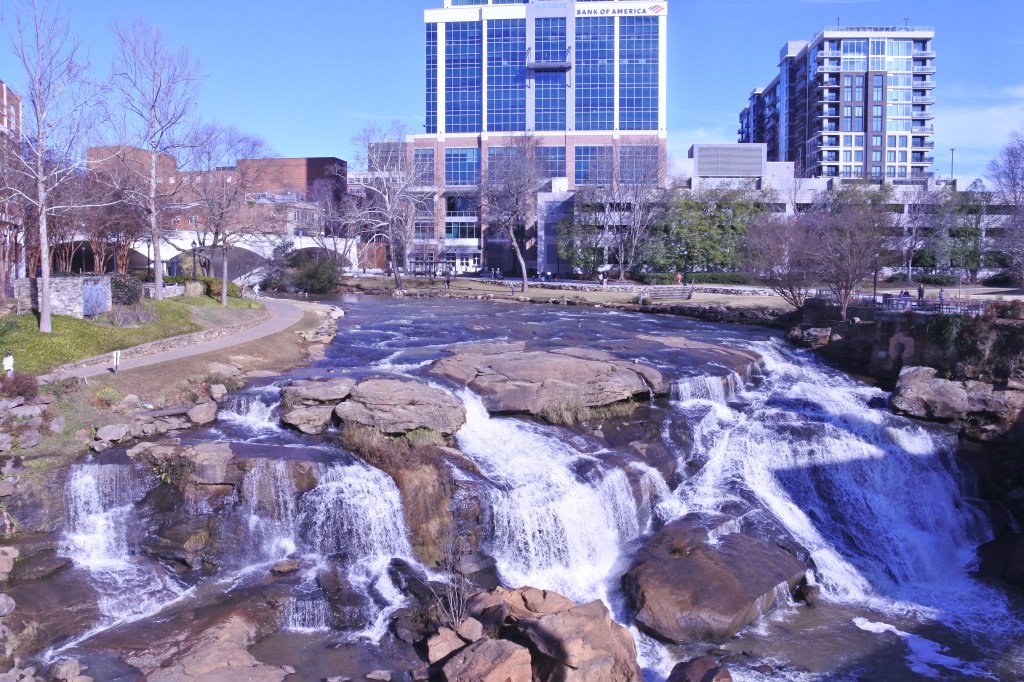
From an urban perspective, I most appreciated how well the West End ties in seamlessly to Dwtn thanks to the Reedy River Recreation trails and Falls Park, the short bridge between the two and the vibrant commercial districts along Main Street and Augusta that tie seemly to Dwtn. West End has great cultural and retail amenities and is ground zero for Greenville’s urban apartment boom. The neighborhood is also very safe, has great schools, and is buzzing with pedestrians and tourists. For the West End neighborhood to be truly a great urban district it still needs more density, better residential in-fill and development in its low-density streets, better bike infrastructure, and a full service supermarket.

Click here to view my West End Album on Flickr

URBAN STRENGTHS:

* Excellent Access to Dwtn being just to the west of it.
 * Generally good ADA infrastructure but plenty of intersections without modern ADA curb cuts.
* Good economic diversity but limited racial diversity as the neighborhood is 77% white.
* Several solid public schools representing all grades surround the edges of the West End. Also a Catholic grade school nearby.
* Lots of modern apartments. Studios and 1-beds lease in the low to high 1Ks. Tons of 2-beds as well that lease in the 2Ks.  Only a handful of 3-beds.
* Overall the neighborhood is very safe.
* Quality historic commercial but limited historic residential remains.
* Lots of modern apartment and mixed-use in-fill but of varying urban quality and design. This is the south so parking often takes the driver’s seat in terms of design and layout.
* Pretty good urban form along Augusta and Main, especially near dwtn. Still a good amount of surface parking. Overall good streetscaping.
* Good pedestrian activity especially along Main Street and the Falls park.
* Very popular district with a lot of buzz.
* Great access to the Falls Park on Reedy and river trail on the Reedy. But really not other parks in the neighborhood leaving the western edges of Payne-Logan about 1/2 mile from any parks.
* Excellent cultural amenities here including a wide array of food & bev businesses, several live music venues, a couple theaters, several art galleries, and a minor league ball park. Walkable access to many Downtown cultural amenities as well.
* Good retail amenities including lots of boutiques/clothing/gift stores, a drug store, several banks, plenty of dessert joints, a couple churches, and a major hospital is only 1/2 mile from Payne-Logan. 

URBAN WEAKNESSES:

  • lots a breaks and lack of connections for a typically urban neighborhood street grid.
  • Mediocre density for an urban neighborhood.
  • So so public transit access. A couple dedicated bike stares and small dedicated bike lane segments.
  • Few households with children here. Median age is pretty diverse however.
  • Other than a handful of the older SF homes that remain, for-sale housing is very expensive. 1-bed condos general sell in the 700Ks-800Ks. Lotso of 2-bed condos and townhouses but they sell between 650K-1.3M. 3 & 4 bed sell anywhere from 350K-1.5 M depending on size and age. Handful of affordable housing options in the West End.
  • Missing some key retail amenities (i.e. supermarket, post office, public library)”

Downtown Greenville, SC

Downtown is bound by Academy to the west and North, the river to the south and roughly David Francis to the east. Greenville was nothing special compared to other mid-sized American cities in the south for much of its history. It has a historic main street where all the City’s shopping was concentrated, industry and warehousing along the river closest to Dwtn, and major downtown decline and urban renewal projects in the 60s and 70s. But what separates Dwtn Greenville from many of its peers is the civic leadership in the 1980s & 1990s. The City made major investments in new streetscaping, especially along Main street, attracted a new Hyatt Regency, and redeveloped the Reedy Riverfront into trail and recreation space taking advance of the Reedy River Falls. At the same time the urban West End neighborhood on the other side of the river redeveloped creating a seamless urban connection to Dwtn. Local shops opened, antique skyscraper were renovated, and new urban infill buildings started to fill in.  Most recently the City has created a quality civic center and pedestrian zone with the creation of the One City Plaza and pedestrianizing Lauren St.

But I won’t say that Downtown Greenville is the best mid-sized City southern Downtown and there is certainly room for continued urban improvement. I place Dwtn Knoxville, Lexington, and Chattanooga ahead of it. The western, northern, and eastern edges of Dwtn are still plagued with surface parking lots, dead spaces and wide boulevards, dwtn’s residential population is below average, public transit access is sub-par, and the City’s main post office, convention center, and public library are located outside of Dwtn. But with Greenville’s continued explosive growth,  including inner city growth, I have hope that Dwtn Greenville will continue to urbanize in a positive way.

Click here to view my Downtown Greenville Album on Flickr

URBAN STRENGTHS:

* Main st is the north to south spine of Dwtn and is the beating heart of Dwtn many intact historic 2-3 story bldgs with active shops. Also contains Dwtn’s better antique skyscrapers. Washington St east to west also has good urban form and active store fronts. Laurens St hosts several semi-pedestrian blocks.
* Most of Dwtn (other than the outskirts) has modern ADA curb cuts.
* Good bike infrastructure within Dwtn branching out to some of inner city neighborhoods with a few suburban connections. Good bike share system Dwtn & in the West End with several other inner city neighborhood stations spread throughout.
* Good amount of rental hsg but on the price side. Studios are located mostly in the Westend. 1-beds lease anywhere btwn 1.2K-2.3K, 2-beds btwn 1.5K-3K, and some 3-beds btwn 4-7K.
* Good amount of for sale product and diversity. Studios are limited. 1-beds sell btwn 300K-700K, 2-beds btwn 350K-800K, and a decent # of expensive 3-beds selling btwn 650K and the low 1ms. Some affordable hsg dwtn.
* Several quality schools in and around Dwtn including a Catholic and public grade school, Arts High school, and the main high school is located less than 1 mile for Dwtn. All rated well.
* High level of safety in Dwtn Greenville.
* Good historic stock esp. along Main Street. Pretty impressive number of urban in-fill bldgs for a City of it’s size concentrated near the West End.
* Quality streetscaping on many Dwtn Streets even outside of Main St.
* Solid tree canopy esp. along Main St.
* Good pedestrian activity especially along Main St. Certainly plenty of dead areas on the edges of Dwtn.
* Really good buzz and vibe dwtn.
* Excellent park and recreational trail along the Reedy River and Falls. The One City Plaza is a well designed Civic Plaza with ample seating and uses spilling into the plaza. A couple other decent plazas and a historic cemetery exist Dwtn.
* Great cultural amenities with plenty of food & bev businesses, several small & medium theaters, several live music venues and art galleries & museums. Regional amenities include a sports arena and ballpark just south of Dwtn.
* Retail amenities include a Publix, a drug store, plenty of boutiques/clothing stores & gift shops, a bookstore, plenty of dessert joints & gyms, 

URBAN WEAKNESSES:

  • Plenty of surface parking on the western, northern, and eastern edges of Dwtn.
  • Urban density is below average for a Dwtn.
  • Public transit is pretty poor across Greenville and its suburbs. Dwtn has decent public transit but sub-par compared to almost any other American Dwtn.
  • Street network is a bit sinuous for a Dwtn. Roads are pretty wide especially on the edges of Dwtn.
  • Not a ton of generational diversity dwtn but decent # of museums including a children’s.
  • Only a handful of small satellite colleges in Dwtn. Larger colleges with 3-5K students are located 2-3 miles for Dwtn.
  • No large parks in Dwtn Greenville.
  • Convention center is a couple miles outside of Dwtn.
  • A couple 20K people work in Dwtn which is about average for a Metro of Greenville’s size.
  • Post office and public library are located just outside of Downtown. The closest hospital is a couple miles from dwtn and few medical offices.”