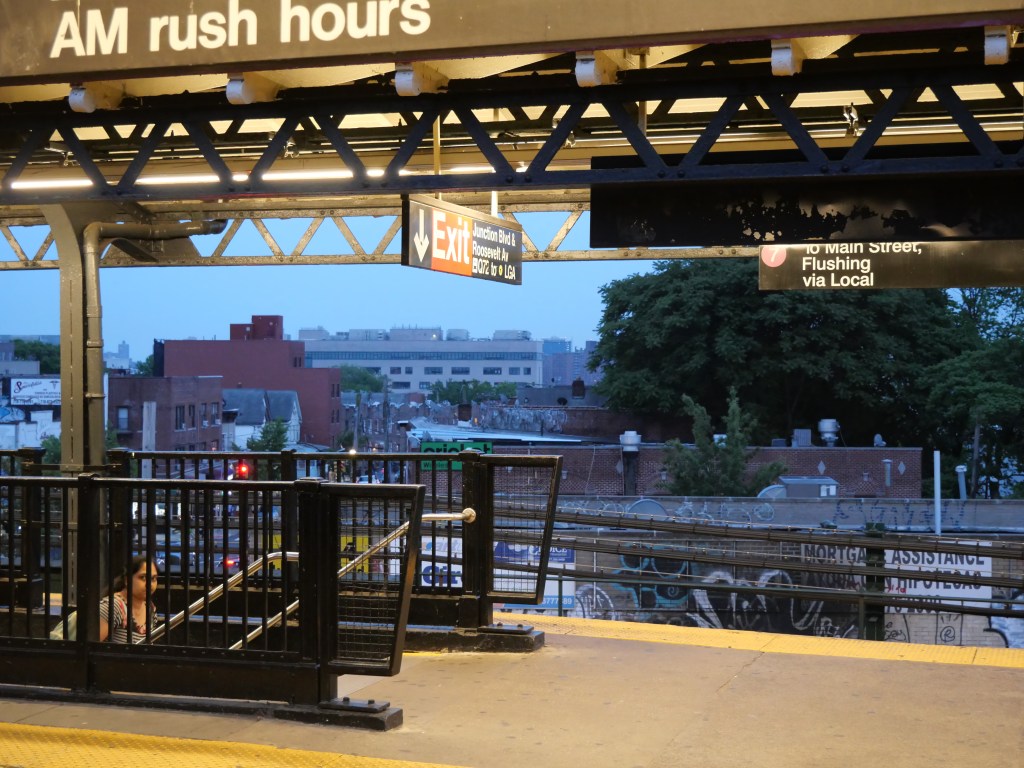
The site of Jackson Heights was a vast marsh named until 1909 when the Queensboro Corporation bought 325 acres of undeveloped land and farms. The Queensboro Corporation named the land Jackson Heights in honor of John C. Jackson, a descendant of one of the original Queens families. More direct access to the area came with the construction of the Queensboro Bridge in 1909 quickly followed by the elevated IRT Flushing Line in 1917. Development accelerated with the subway lines as large “garden apartments” built in imitation of the English Garden City concept were built by the Queensboro Corporation just south of Northern Avenue. While quite comfortable for the standards of the day, the apartments sadly contained racial covenants limiting residents to White Anglo-Saxon Protestants. White residents in Jackson Heights also resisted integration with the growing Black population west of Junction Boulevard in the neighboring Corona Neighborhood. But by the 1970s many of the Middle Class White families had already left the neighborhood for the Long Island suburbs. Large number of immigrants from Latin & South American and India/Pakistan/Bangladesh filled their place. By the late 1980s, Jackson Height’s past reputation for crime and Colombian cartel violence was subsiding and the neighborhood began a slow rise in value and interest. Currently Jackson Heights has a stable real estate market with a nice mix of middle class and ethnic communities. The neighborhood still has one of the most diverse populations in Queens as over half of its population are foreign born residents.
In addition to its attractive Garden Apartments with well maintained tree-lined streets, Jackson Heights has attractive vibrant business districts running along 37th St, Junction Boulevard, Roosevelt and the eastern half of Northern Blvd. The Western Half of Northern Blvd and especially Astoria Blvd are more autocentric/industrial in character. Jackson Heights also has great subway and public transit access being only a 30-40 min train ride to Long Island City and Midtown, excellent bike infrastructure with an outstanding bike lane system, solid public schools, good number of small & medium parks, and relatively affordable housing prices for NYC standards including many studios, 1-bed, & 2-bed condos selling btwn 150k-500K.
Click here to view my Jackson Heights Album on Flickr
URBAN STRENGTHS:
* Very high density at around 75K per square mile.
* Consistent sidewalks and generally decent condition but a majority of ADA curbs are not standard.
* Good access to Midtown and Long Island City, only 35-40 mins by metro. Lower Manhattan is more like 55 mins and Dwtn Brooklyn is more than an 1 hr. away.
* Great connected street grid with lots of smaller blocks. Only downside is the 2 freeways on the western and northern edge of the neighborhood.
*Solid access to public transit but much better in the southern half than the northern half of the neighborhood where the subway lines run.
* Excellent bike infrastructure including many bike lanes in all directions and great coverage by the City Dedicated bike share system.
* Great diversity indicators, especially economic diversity and to a lesser extent racial. Almost half of the population is Hispanic.
* Generally good rated public schools but no High Schools in the neighborhood. Only a handful of private and publics schools.
* Overall a pretty safe community and less grit than neighborhood Corona, but a very busy neighborhood.
* Pretty solid tree canopy throughout.
* Great pedestrian activity especially below the elevated trains.
* Lots of small and medium parks well spreadout throughout the neighborhood.
* Good amount of rental options and moderately priced compared to much of NYC. Studios and 1-beds range btwn the upper 1Ks and the mid 2Ks, 2 & 3 beds range btwn 2.7K-3.7K.
* Tons of smaller condos. Studio condos sell btwn 165K-350K, 1-beds btwn 200K-600K with a handful of more expensive newer product, 2-beds sell btwn 275K-1.2M, 3 & 4 beds btwn 400K-1.5M. 5-beds are only a bit more expensive. Lots of affordable and subsidized affordable units.
* Good cultural amenities including plenty of restaurants (mostly ethnic), plenty of bars & cafes, several art galleries and night clubs, a couple live music venues, a local movie theater, several event centers.
* Good retail amenities lots of small & medium grocery stores, and tons of Hispanic & Asian grocerias, Target, a couple smaller department stores, tons of clothing stores and boutiques (many brand name clothing stores), several drug stores, a couple hardware stores & a Home Depot, several clothing stores boutiques mostly concentrated along Junction Blvd, tons of discount stores, some book stores, several gift stores and many home goods and furniture stores, plenty of dessert joints and bakeries, some bike stores, several gyms, a public libraries and several post offices, tons of churches, a major hospital along with plenty of doctor’s offices and medical clinics.
URBAN WEAKNESSES:
- Not much urban in-fill and what does exist is pretty autocentric especially along Astoria Blvd and Northern Blvd.
- Large stretches of autocentric uses along Northern Ave. Same with Astoria Blvd but more unattractive industrial uses thanks to its close proximity to La Guardia Airport.
 Evaluating our Urban Communities [with a focus on America]