Allison Hill (also known as The Hill) was named after William Allison, an early Harrisburg landowner who owned farms on the bluff outside of the then-Borough. Allison Hill encompasses the Mount Pleasant Historic District located in the western half of the district including a diverse array of mostly rowhouse styles from the late 19th century. Allison Hill quickly transitioned into the booming industrial heart of the city in the late 19th century. Initially Allison Hill attracted immigrants from primarily European countries but this has diversified since the 70s to include a diverse melting pot with immigrant groups from West African, Vietnamese, Indonesian, several Latin American countries and a significant African-American population. Following its decline since the 70s The Hill has also become a hot bed of artists and social justice activists. Disinvestment in he community peaked in the early 1990s and the neighborhood has someone stabilized since then thanks largely to an influx of immigrant families. However, Allison Hill has never really gentrified and still contains a large number of vacant properties, contains a high level of families living in poverty, has a higher crime rate than most of Harrisburg and lacks crucial retail and cultural amenities.
Thanks to its dense late 19th century rowhouse fabric, South Allison Hill still has a lot of positive urban attributes despite several decades of disinvestment. The neighborhood has excellent public transit service, convenient access to dwtn, and very affordable housing. With some investment and increase in economic diversity South Allison Hill could become a premiere Harrisburg urban district and boast density levels higher than even Midtown.
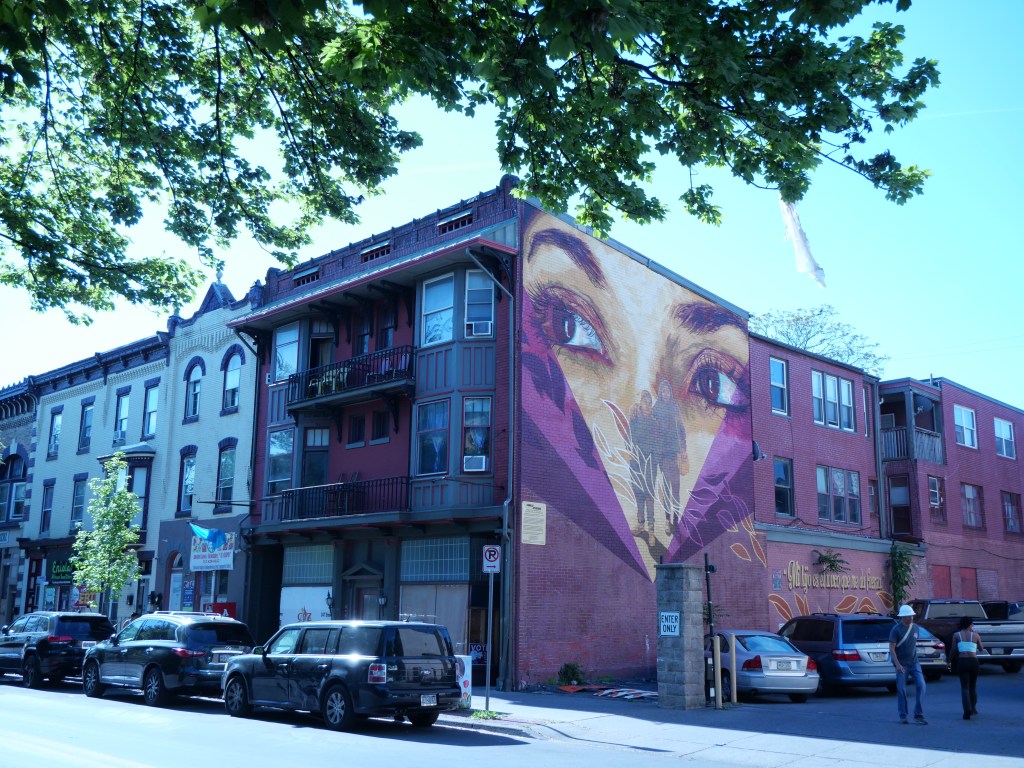
Click here to view my South Allison Hill District Flickr Album
URBAN STRENGTHS:
- Some of the best public transit access in all of Harrisburg and only a 5-10 min trip to Dwtn about 1-1.5 miles away.
- Sidewalks are consistent throughout the districts.
- Solid Density esp. for a community that has seen a lot of disinvestment since the 1970s.
- Decent poverty numbers at about 20% but also a good # of middle income households too. Large Hispanic and Black populations but limited White populations.
- Good array of late 19th century rowhouse architecture but not well maintained like Uptown & Midtown.
- The urban form of the biz districts (Market, 13th, 17th & Derry) actually isn’t that bad in South Allison Hill outside of several concentrations of vacant lots and underutilized land uses. Limited crummy autocentric uses and several good clusters of urban commercial blocks, albeit underinvested.
- Decent rental availability with lots of affordable options. 1-beds lease btwn 800K-1.1K, 2-beds btwn 800K-1.3K, and plenty of 3-beds leasing in the low-mid 1Ks.
- Decent retail amenities including a bank, plenty of small ethnic grocerias, a dollar store, a couple drug stores, a local bakery & cafe, tons of barbers and salons, a bike shop, a couple churches and a health center.
URBAN WEAKNESSES:
* Sidewalks while plentiful are also very dated as Allison Hill has not seen major streetscaping reinvestment. Only about 1/4 of all curb cuts have been updated.
* No dedicated bike infrastructure here.
* Parks are very limited in South Allision Hill but at least the expansive Reservoir Park is just outside of the neighborhood.
* Tree canopy is so so and very hit and miss.
* While crime is not off the charts here Allison Hill does hosts some of the most dangerous pockets of Harrisburg and has a lot of blighted and unkept bldgs. But there are strong community ties here esp. among the immigrant groups making it safer. Neighborhood still has a pretty negative perception among locals.
* Western and southern edges are very industrial with unattractive often autocentric uses.
* The only schools located within South Allison Hill are 3 public schools of mixed ratings located in the SE corner of the district.
* Decent for sale inventory but generally very inexpensive. A handful of 1-bed condos selling btwn 50K-100K, 2-beds btwn 50K-150K, 3 & 4 beds btwn 50K-250K. Decent amount of renovated product selling over 150K.
* Cultural amenities are limited to several restaurants and bars along with a brewery. Plenty of Dwtn cultural amenities located only about a mile away.


 Evaluating our Urban Communities [with a focus on America]