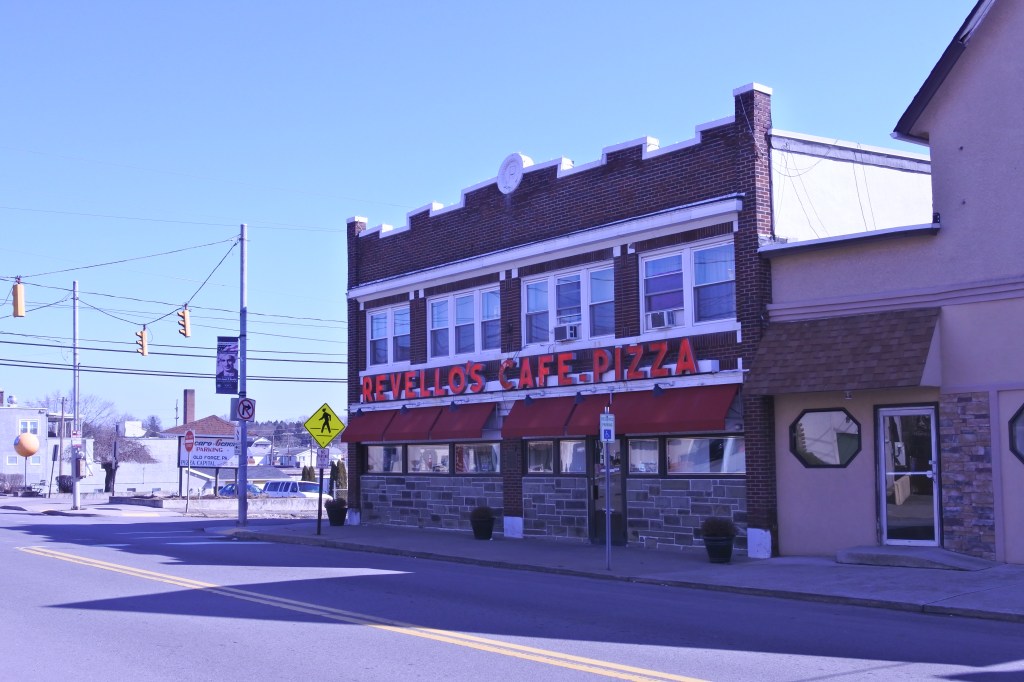
Old Forge like most boroughs in the Scranton area was settled in early 19th century. It received its name after an old iron forge along the Lackawanna River. Like much of Northeastern Pennsylvania, Old Forge’s development was strongly influenced by the ups and downs of coal mining industry. The town reached 5,500 residents in 1900 and quickly doubled to 11K in 1910 but after 1930 Old Forge went into a consistent decline until 2010 where the population bottomed out at 8,500 from a peak of 12,500 souls. For Northeastern Pennsylvania this level of decline isn’t that bad. Old Forge is also known for its unique style of pizza. The past couple of decades have generally been good to Old Forge as it has witnessed more economic diversity and opening of several new shops.
It will be difficult to make Old Forge a viable urban place as its main street lacks cohesion and is semi-autocentric in character and the population density is very low. Without a major population increase making new construction feasible I don’t see the urban form of Old Forge changing anytime soon.
* Only a 15 minute drive to dwtn but public transit is still 45 min- 1 hr. * Good walkable schools. ** Limited 1-bed options but lots of 2-bed rentals leasing anywhere btwn 1K and the low 2Ks. Some 3-bed options leasing around 3K. * For sale 2-beds sell btwn 70K-280K, 3 & 4 beds sell btwn 70K-400K. * Decent Park amenities. * So so retail amenities including a dollar store, butcher shop, a couple drug stores & banks, a couple dessert joints, a t-shirt store, several salons, a couple medical offices and plenty of churches. * Overall a very safe community.
URBAN WEAKNESSES:
No bike infrastructure.
Not great public transit access
Culturally there is a good # of restaurants & bars and a small performing arts theater, but not much else.
Limited density for an urban district.
No walkable supermarket, post office, or library.
Main street lacks cohesion is a really lengthy semi-autocentric corridor. Really no clear center of Old Forge.
Tree canopy is good in spots but on most streets is limited.”
Dunmore has a rich history dating back to its founding in 1835. It gets its name from the large number of Ireland immigrants who were attracted by the area’s coal mining opportunities. Dunmore is a village in County Galway. The borough was officially incorporated in 1862. Thanks to a coal mining boom in the area Dunmore quickly grew to 4,300 residents by 1870. In the late 19th and early 20th centuries, Dunmore continued to experience significant industrial growth and added new immigrants, particularly from Italy and Eastern Europe. Dunmore reached 12,500 residents in 1900 and peaked at 23K in 1930. The decline of the coal industry in the mid-20th century led to economic challenges and Dunmore dipped to 14K. Both thanks to its diversifying economy and convenient location on the edge of Scranton Dunmore’s population has stabilized recently.
Along with its strong sense of community Dunmore’s strength lies in typically suburban amenities of good parks, quality schools, and safety. Dunmore hosts a great array of economic diversity with an array of housing options and lots of affordable rentals. Dunmore’s economy has also been bolstered by Marywood University, a college of 3,500 students. While Dunmore has decent retail and cultural amenities the urban form of its two business districts (Blakely and Drinker) is fragmented with too many chunks being devoted to autocentric uses. I would particularly like more attention paid to building up the place making where these road meet as it is the heart of Dunmore. Dunmore also needs better tree cover, bike infrastructure, a central supermarket, and mixed-use infill along its main streets.
Excellent access to dwtn as with a 7 min drive and 10-15 minute bus ride.
Generally pretty good sidewalks and ADA infrastructure but several streets without sidewalks on the northeast corner in the 1960s & 1970s development.
Excellent economic diversity.
Overall a very safe community.
Some attractive historic homes on Green Ridge and surrounding streets but genially Dunmore has very working housing type aesthetics. Dwtn just doesn’t have enough historic fabric left.
Lots of walkable schools and well rated. Several Catholics schools as well.
Decent array of small and medium parks spread throughout Dunmore. Also a modest recreation center and a YMCA.
Rentals are pretty affordable but also plentiful.
Good for sale diversity with a handful of for sale 1-bed. 2-beds sell anywhere from 85K-275K. 3 & 4 beds sell between 90K-500K. Decent amount of dedicated affordable hsg as well.
Decent cultural amenities including a good # of restaurants & bars, several cafes and the performing arts at Marywood University a college of 3500 students.
Decent retail amenities include a couple ethnic groceries, a couple drug stores, several boutiques & consignment stores, a large religious store, a couple florists, a couple banks, a handful of dessert joints & a YMCA, and several churches. Also a walkable post office and public library.
URBAN WEAKNESSES:
Public transit is so so. Should be better as an inner ring suburb.
So so density
Literally no bike infrastructure here.
In fill consist of a fair amount of auto centric commercial uses in the biz districts and 1960/1970s suburban homes on the outskirts of Dunmore.
Okay tree cover overall.
Supermarket is located outside of the Dunmore core in a shopping mall across the highway with limited pedestrian access.
The urban form and streetscaping of Dunmore business districts (Blakely and Drinker) leaves much to be desired. Some assemblance of an urban sense of place where these streets cross but it both streets quickly become semi-autocentric corridors.
Olyphant’s history dates back to the early 19th century. It was the headquarters of the Lackawanna Coal Company but was also a center of the railroad industry . This mining boom attracted a wave of European immigrants, including Italians, Poles, and Eastern Europeans, who sought work in the coal mines and on the railroads. As the demand for coal diminished in the mid-20th century, Olyphant experienced economic challenges and decline and quickly went from nearly 11K residents in 1930 to just under 6K in 1960. Since then Olyphant has stabilized and transitioned into a more diverse economy while retaining most of its historic footprint and tight-knit community. Olyphant now hosts just over 5K residents.
Olyphant’s strengths lies in its historic walkable fabric where most buildings along its historic main street (Lackawanna Ave) remain hosting decent retail and cultural amenities. Olyphant also hosts good economic diversity, lots of affordable housing options, and is only a 15 minute drive to Dwtn Scranton. Olyphant recently made the top 10 list for safest cities in Pennsylvania, But for Olyphant to become a great urban suburb it needs mixed-use in-fill to fill in the surface lots along the main street and bolster the Borough’s population. I’d also like to see more walkable schools, better ADA infrastructure, and several dedicated bike lanes.
Decent access to Dwtn with only a 15 minute drive and 35 minute bus ride (only comes every hour however).
So so density.
Good economic diversity.
For sale homes are generally affordable but some diversity. 2-beds sell anywhere from 70K-180K, and 3 & 4 beds sell btwn 50K-300K. Decent amount of dedicated affordable housing.
Great historic business architecture but residential historic architecture is pretty plain.
Decent # of small and medium sized parks .
Olyphant is actually a very safe City across all metrics and appears on top 10 safest cities in Pennsylvania. The only safety metric is doesn’t score well in is a fair amount of blight.
Pretty good urban form and cohesion along Lackawanna, the urban biz district. Streetscaping however is pretty dated and several large parking lots in the dwtn area.
Central Olyphant has a decent # of restaurants, bars and a live music & event venue, and a couple local museums.
Decent retail amenities including a supermarket (just across the river), a butcher shop, family dollar, a couple pharmacies, several boutiques/clothing stores, a music store, a couple banks, a bakery, several churches, a post office (but not very walkable), and a couple doctor’s offices.
URBAN WEAKNESSES:
* ADA infrastructure is ok. Most streets have sidewalks and ADA standard curbs are restricted to the dwtn area. * Bike infrastructure is limited. * 80% White population but a growing Hispanic community (around 15%). * Only a handful of walkable schools. * Rentals are generally pretty affordable but limited product, esp. listings on Zillow. * Modern in-fill is pretty much non-existent.
Carbondale was founded in the early 19th century as part of the first regions in the US to exploit anthracite coal deposits. The discovery of coal in the region in the early 1820s marked the beginning of the town’s rapid growth. Carbondale was established as a city in 1851, and its economy continued to thrive until the early 20th century. Carbondale’s population maxed out in 1930 at around 20K. But as coal demand dwindled Carbondale’s industrial importance and population declined. Carbondale has lost over half of its peaked population and currently has 8,800 residents. Surprisingly Carbondale has limited vacancy and has maintained most of its historic business district footprint without widespread abandonment. The town has a wonderful array of historic commercial structures and decent number of restaurants and retail businesses. Downtown also hosts an attractive historic plaza creating a great center point for Carbondale.
But the town is a 25 minute drive and feels far removed from downtown Scranton. Unless the City sees a major influx of immigrants Carbondale seems destined to continue its slow decline and won’t be able to capitalize on its dense, walkable existing urban fabric.
Great historic stock especially in the commercial district.
Decent generational diversity.
So so parks in central Carbondale including a medium sized recreational park, a cemetery, and skate park.
Overall a pretty safe community and limited vacancy too.
Good number of restaurants, bars, and cafes but not much else culturally other than the Carbondale Historic Society and a historic house hosting classical concerts.
Decent retail amenities including a supermarket, several drug stores & banks, several boutiques & gift shops, a five below store, a couple antiques stores, a dwtn public library & post office, a couple dessert joints, a YMCA, several doctor offices, and plenty of churches.
Good main street and several secondary business districts (Church & Salem). Also a good downtown plaza creating a Civic Heart for Carbondale.
Pretty good urban fabric with limited surface parking lots and autocentric uses. Decent streetscaping too.
URBAN WEAKNESS:
Sidewalks are pretty consistent in the Carbondale but ADA curb cuts are mainly restricted to just the commercial areas.
Density is pretty poor for an urban area.
Pretty poor public transit access.
Not a terrible drive to Dwtn Scranton (25 mins) but a bus ride is over 1 hr.
Bike infrastructure is limited but there is at least a recreational trail on the northern edge of town.
A couple schools in quasi walking distance they have medium ratings.
A handful of rental options but all very affordable.
For sale housing is very affordable topping out at 250K for a large 4 bedroom.
I included most of Pittston but cut out the Upper Pittston north of Parsonage St as its lower-density and has a lot of newer development. In 1853, Pittston broke away from Pittston Township and officially became a borough. Pittson quickly grew to 3K by 1860 and quadrupled to 12K by 1900. Pittston became a vital center for coal mining in the 19th century, part of the larger Anthracite Coal Region of Pennsylvania. This era attracted a large influx of immigrants, mainly from Ireland, Italy, and Eastern Europe. By the mid 19th century the demand for anthracite coal declined and Pittston began to decline like many other rust belt towns in the area. Yet Pittston’s population had already peaked in 1920 at 18,500 souls. Even with the decline in coal mining Pittston’s economy remained strong from 1930 to the 1980s, as the town emerged as a national center for clothing manufacturing. But this dried up by the late 20th century as well and the town was faced with continued population decline, increased poverty, and vacancy. Yet civic leaders never gave up and in 2008, under the leadership of Mayor Joseph P. Keating, the City invested heavily in its Downtown area with a complete streetscape refresh. new street art through numerous sculpture pieces and colorful brick pavers, creation of a new riverfront park, and investment of many of its historic buildings and even in-fill urban development. Pittston now promotes itself as “The Quality Tomato Capital of the World.” as the region is a major tomatoes producing area especially for New York’s insatiable appetite for tomato imports. Fortunately Pittston population decline has slowed since 2000 and the City now sits at 7,600 residents.
The next stage for urban renewal is the revitalization of its residential areas. Much blight and disinvestment still exist in Pittston’s residential areas and there is a need for more economic diversity as nearly 30% of the town lives in poverty. I’d also like to see more bike infrastructure, immigration, rental housing variety and investment in Main Street outside of Dwtn (esp. north as this is a major blighted area in town).
* Decent Dwtn access as Pittston is located btwn Scranton & Wilkes-Barre; 20 min drive to each. But 1 Hr bus ride to Scranton and only 25 mins to Wilkes-Barre. * Nice recreational trail running along the Susquehanna River on the southern half of Dwtn. * Pretty good generational diversity as the medium age here is 35 (much lower than the state of PA). Also a good pct of families w/ children. *Good array of elementary and middle schoos in Pittston and pretty good rating. The high school, however, isn’t walkable to most residents sitting on the edge of town. * For sale housing is generally pretty affordable but some good medium range options too. 2-beds sell btwn 70K-350K. 3 & 4 beds sell btwn 50K-350K. * Decent # of affordable rentals provided by the Pittston Housing Authority. * Great Riverfront park located right next to the main street. Completement by a couple nice medium sized parks and a couple of smaller parklettes dwtn. * Highly in-tact and attractive dwtn main street. Several excellent historic churches near the main street as well. * Excellent urban form in the heart of Dwtn which runs about 5 blocks. Excellent streetscaping project along Main St Dwtn and running to the souther border. Urban form and streetscaping along Main street north of Dwtn is pretty poor. * Good cultural amenities several restaurants & bars, a distillery, several cafes, a couple art galleries and lots of public street art including an intential sculpture campaign, and several night clubs. * Also good retail amenities including a couple dollar & drug stores, several boutiques, clothing stores, and gift stores, plenty of banks, a dwtn public library & post office, a music store, a couple dessert shops, a YMCA and a couple gyms, several churches and a couple doctor’s offices.
URBAN WEAKNESSES:
Other than the river trail, there is no bike infrastructure here.
Sidewalk infrastructure is generally good but sometimes missing on the residential streets which almost never have up to date ADA curbs. Core of Main Street is solid.
So so public transit
Some economic diversity but poverty is high here, 27%.
80% White population but the Hispanic population appears to be growing.
Crime seems to be higher than average in Pittston and the town has a good amount of grit and blight. But it doesn’t feel unsafe walking the Main Street.
Decent # of rentals but not much variety as they are all pretty affordable. 1-beds lease around 1K. 2-beds btwn low 1Ks and a handful of 3-beds leasing for a bit more.
Historic residential housing is pretty gritty thanks to the working class styling.
Some decent in-fill bldg dwtn but a fair amount of autocentric crud on the southern end of Pittston.”
Hazleton was originally settled in the early 19th century, primarily by people of English and German descent. It was officially incorporated as a Borough in 1851 when it had 2,000 residents and later as a city in 1891. The discovery of anthracite coal in the surrounding areas in the early 19th century led to Hazleton becoming a bustling coal mining town. The coal mines attracted a large number of immigrants, particularly from Eastern Europe, Ireland, and Italy. Because of this influx of immigrants, Hazleton’s population drastically changed during the “boom period” starting in 1890 when the population w as 12K to 36K in 1920. The population peaked in 1940 at 38K. By the mid-20th century, the demand for anthracite coal declined, leading to the beginning of a period of decline in Hazleton. Fortunately a major influx of Hispanic immigrants primarily from Dominican Republic has stabilized the City. Hazelton’s population bottomed out at 23K in 2000 but thanks to a major influx of Hispanics the population grew to 30K, having grown by 20% in only a decade.
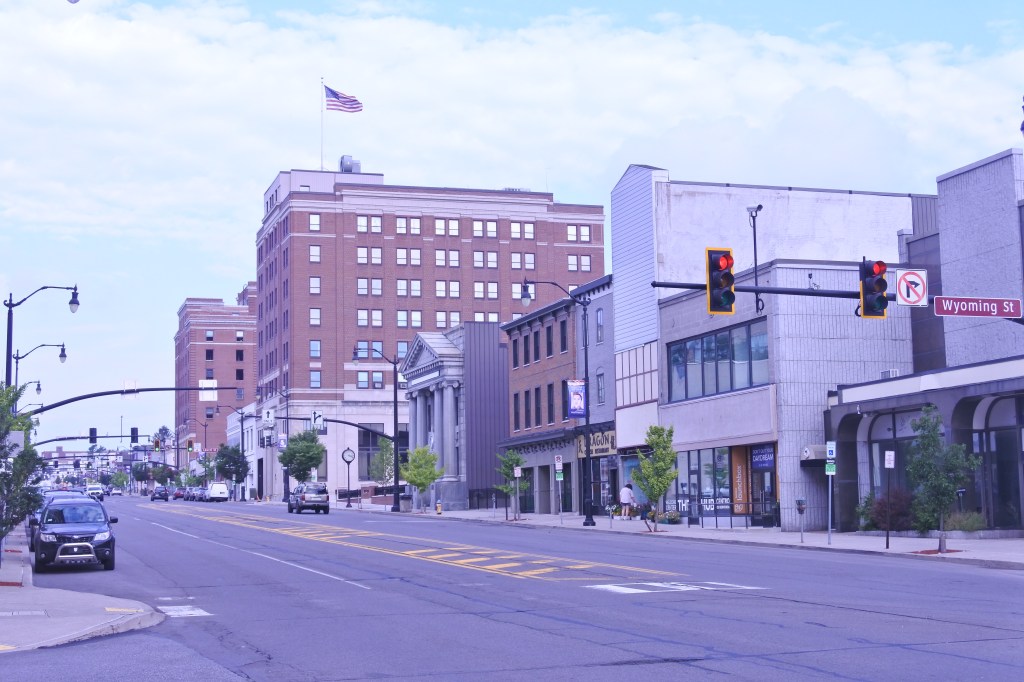
Hazelton has a solid urban fabric with good density and two in-tact business districts: Broad Street (the Historic Dwtn) and Wyoming St (a solid secondary urban biz district) perpendicular to Broad St. Some decent mixed-use fabric also along Diamond and Poplar St to the south. But Hazelwood is incredibly gritty, which makes sense as the town is literally surrounded and often constrained by old coal mines. While Hazelton has good retail amenities, its cultural options are limited. Sidewalks are often in poor condition and the town has no bike infrastructure but the City has lots of quality walkable schools and well dispersed park amenities. Housing, while affordable, is not diverse and limited to those with higher incomes.
Excellent gridded street fabric with short blocks.
Good density here
Good generational diversity with large number of households with children.
Good number of walkable schools throughout Hazelton generally with decent ratings. Large school campus just outside the City limits on the NW corner of town where the Public High School and middle/elementary School and Catholic High School are located. Just walkable to many Hazelton residents.
Good amount of housing authority run building providing lots of permanent affordability options.
Better retail amenities including several supermarkets and tons of Hispanic grocerias, plenty of drug stores, several boutiques and clothing stores, some gift shops, several banks, an Ollie’s Bargain store & lots of thrift shops, tons of salons, plenty of dessert joints and bakeries, plenty of gyms, a couple dollar generals, a dwtn library & post office, a major hospital and plenty of doctor’s offices, and several churches.
Decent amount of the quality historic commercial bldgs exist on Broad street. Residential is very worker housing and not terrible attractive.
Parks aren’t spectacular but a good number of small-medium sized parks that are well distributed throughout.
Decent pedestrian activity thanks to Hazelton’s density and high % of residents w/o cars.
Good mix of uses as there are lots of corner stores and restaurants/bars outside of the two main streets.
URBAN WEAKNESSES:
There is a local bus service with a fare number of lines but service is infrequent.
Sidewalks are consistent but often in poor condition and without modern ADA infrastructure on the residential streets. Better sidewalk and ADA infrastructure on the main streets.
While Hazelton has its own modest dwtn its far from Dwtn Wilkes-Barres and Scranton; 35 & 50 minutes respectively. 1 Hr by bus to Wilkes-Barres.
No bike infrastructure to speak of.
Very Hispanic City, so much so that I wouldn’t consider this a diverse City as Hispanics make up 70% of the population.
Limited economic diversity as well as 25% of the population is living in poverty.
Crime itself doesn’t seem to be a major problem in Hazelwood but a very gritty city with a fair amount of blight.
Zillow listed rentals are pretty limited although I suspect there are plenty of unlisted rentals available. Product is generally in the low-mid 1Ks with a decent # of 2 & 3 beds.
Decent array of for-sale product but generally pretty affordable and not a ton diversity. 2-beds sell btwn 50K-260K and 3 & 4 beds sell btwn 60K- low 300Ks.
Tree canopy is so so. Better tree cover on the edge of development.
Cultural amenities are limited to several Hispanic & Italian restaurants, several bars & lounges, a couple cafes and art galleries, a small local history museum.
Any modern in-fil that exists is very autocentric.”
Hyde Park is the most defined neighborhood in West Scranton due to the historic Borough that gave it its namesake but it is still difficult to nail down the boundaries. I choose to use Main Street as the eastern border, the railroad tracks as the western, Cathedral Cemetery as the northern border, and the Scranton Municipal line as the southern border. This seems to capture the core of Hyde Park and leave the area between Main Street and the Downtown as a separate neighborhood, which many would consider Bellevue.
Hyde Park is a tight-knit Scranton neighborhood, which developed rapidly during the turn of the 20th century. While the neighborhood’s rise was fueled by the coal mining industry, the neighborhood has also always had a strong middle class. Main Street is the neighborhood’s historic commercial street with the best concentration of businesses and urban fabric between Washburn and Lackawanna. The rest of Main Street is pretty mixed-use in character. While a decent number of businesses remain along Main Street, it is quite gritty and has lots of vacant storefronts. The residential areas of the neighborhood are generally intact thanks to new waves of Hispanic immigrants who are increasingly replacing the neighborhood’s strong Italian and Lebanese character.
Hyde Park is a fairly walkable community with convenient access to Dwtn and supports a wide array of affordable rental and for-sale housing options. Also great walkable schools remain here. For this to be a premiere urban district, Hyde Park needs to reinvest in its historic main street filing up vacancies and encouraging mixed-use in-fill development. The tree canopy and park amenities are limited, and bike infrastructure is non-existent.
Sidewalk infrastructure is consistent across the neighborhood but ADA standard curb cuts really only exist along Main Street. A decent amount of sidewalks have been paved over by asphalt.
Pretty good density
Excellent access to Dwtn only 1.5 miles away. 6 min drive and a 25 min bus ride.
Good street connectivity and grid although blocks can be long at points.
Good diversity metrics all around. Large Hispanic Population here as well accounting for about 25% of the population.
Overall a safe community with limited blight but plenty of grittiness.
Decent urban form along Main Street especially several blocks btwn Washburn and Lackawanna.
Good array of walkable schools including public schools covering all grades and a couple private Catholic grade schools. Public middle and high schools are rated 3 out of 10 however.
Decent array of rental options and generally pretty affordable. 1-beds lease for around 1K, 2-beds for btwn $900-1.6K, and lots of 3-bed options that lease in the 1Ks. Even some 4-beds. Also an affordable senior high rise.
Good retail amenities including a supermarket, several Hispanic & Italian grocerias, a drug store, a hardware store, a family dollar, a couple furniture stores, several salons, a couple bakeries & gyms, post office, several banks, and several churches.
URBAN WEAKNESSES:
Within Hyde Park the only parks really are cemeteries. The expansive McDade Park isn’t too far way however.
Very mediocre public transit access. Bike infrastructure is non-existent.
So so cultural amenities which includes several restaurants (mostly Lebanese, Hispanic, and Italian), and couple bars.
Tree canopy is pretty mediocre.
For sale housing is very affordable but not a ton of diversity. Limited 1-bed product. 2-beds sell btwn 50K-low 200Ks and 3 & 4 beds sell btwn 50K- low 300Ks.”
The boundaries of the Hill Section are a bit fuzzy but its pretty easy to carve out with Dwtn to the West (along Jefferson), Dunmore to the north, and the highway to the south and east. I included Scranton University in this evaluation. The Adam biz district just to the west of the Hill Section in Dwtn essentially functions as Scranton University’s biz district. Some business activity along Mulberry and a couple of mixed-use blocks at Ash St and Prescott.
The Hill Section was developed in the years following the Civil War as Scranton’s first suburb as coal barons who did not wish to live amidst the pollution in the Dwtn area and in the valleys built their homes high in the clean air of the Hill Section. Middle and working class Scrantonian’s increasingly moved to live in the Hill Section a couple decades later as they moved up in society. The Hill Section has also hosted many waves of immigrants including many Eastern Europeans in the turn of the 20th century, African Americas in the mid twentieth century, and in the present day immigrant groups from Latin America, and East and Central Asia. The University Of Scranton, which is the largest Hill Section institution was founded in 1888 as Thomas College but was renamed The University of Scranton and moved to its current location in 1940.
This is Scranton’s best urban area thanks to its density, seamless connection to Dwtn, large institutions, good walkability, and housing diversity and affordability. For this to be a premiere urban district I would start with further urbanizing Mulberry Street with mixed-income apartment buildings to fill in the many underutilized lots. Other important areas to improve is more frequent transit service, bike lanes, more walkable schools, and important retail amenities (i.e. supermarket, post office, and public library).
Click here to view my Hill Section album on Flickr
URBAN STRENGTHS:
* Great density for a middle-sized City neighborhood. * The Adam biz district just to the west of the Hill Section in Dwtn but essentially functions as Scranton University’s biz district. Some business activity along Mulberry and a couple mixed-use blocks where Prescott and Ash St. intersect. * Very consistent sidewalk infrastructure generally in good shape. ADA curb cuts consistent along the main streets but only exist on about 1/3 of residential intersections. * Excellent access to Dwtn being on its eastern edge and lots of employment opportunities within the Hill Section including Scranton University, Moses Taylor Hospital, and the Geisinger Community Medical Center. * Great street grid and connectivity. * Decent rental options especially 2-beds. 1-beds lease btwn $800-1.2K. 2-beds btwn $900-$1,800. Also a good # of 3 & 4 bed rentals leasing anywhere from the low 1Ks to mid 2Ks. * Pretty good for sale market albeit without any condo options. 2-beds sell btwn 85K-low 300s. 3 & 4 beds btwn 50K-low 400Ks. * Overall a safe community with limited blight. * Good array of historic homes. For Scranton standards properties are in pretty good condition. * Some urban in-fill especially near the university along Mulberry St. Some autocentric crud in spots but not too bad. * Good tree canopy throughout. * The neighborhood hosts the best park in the City: Nay Aug Park which is a planned park with great trails, a bandstand, outdoor pool, museum, iconic bridge, etc. Nearby are tons of ballfields, and Darcy park. However there are only a handful of smaller parks throughout the rest of the neighborhood although Scranton University has nice quads. Half of the residents aren’t within a 10 min walk of a park. * Decent cultural amenities including several restaurants & bars, the Scranton Art and Natural History Museums, cultural amenities of Scranton University, the Caitlin House Museum and convenient access to Dwtn cultural amenities especially all the bars and restaurants along Adam St. * Decent retail amenities including a pharmacy, some boutiques, a couple antique stores, a couple banks, the University bookstore, a couple dessert joints & gyms. a florist, two hospital, several medical offices, and convenient access to Dwtn retail amenities, which is pretty good.
URBAN WEAKNESSES:
Biking infrastructure is very limited.Transit is so so.
Student population dominate the demographics of the Hill Section but still some age diversity and a fair # of households with Children.
Only a handful of small elementary age schools. Public schools are located north of Dwtn. Not too far away, but also not walkable to Hill Section residents.
Missing retail amenities including a post office, community library, churches, and grocery store.”
Scranton’s South Side community is a classic working classic neighborhood that grew when German, Irish, Polish, Italian communities moved to the neighborhood to fill the mines and factories. The neighborhood hosts Scranton’s longest and most intact historic business along Pittston, which is complemented by a small business district (Cedar) a couple blocks away. Scranton’s withering economy at the turn of the 21th century hit the South Side neighborhood particularly hard and the neighborhood started to fall into decay with major drug and prostitutes issues. Thankfully the influx of Hispanics has turned the trajectory of the neighborhood around since the 2010s and new businesses are opening and the neighborhood has avoided large scale abandonment. This is no doubt still a very gritty neighborhood with lots of poorly constructed housing (as much of Scranton is), but there is energy and hope here.
Scranton’s South Side also hosts some of the best urbanity in the City thanks to its large business districts, accessibility to Dwtn, density and walkability, good walkable schools, and affordable housing. For the South side to really take off and be a premiere neighborhood it needs to clear up and invest in its business districts improving the streetscaping and making more storefronts available. There is also the need for more park amenities, bike infrastructure, better transit access, and a much better tree canopy.
Convenient access to Dwtn and Scranton University.
Excellent street grid and small block connectivity.
Good economic diversity although South Side skews pretty low-moderate income.
Very racially diverse community with large Hispanic populations in the northside half and more White populations in the southern half. Also good number of Asians and Blacks here.
Good age diversity thanks to the large Hispanic community with larger families.
Several walkable schools including two public grade schools, a Catholic grade school and public middle school. Decent ratings.
Few 1-beds but good # of 2 & 3 bed rentals. 2-beds lease in the low-mid 1Ks and 3-beds lease generally in the mid 1Ks. Even some 4-bed rentals.
Better retail amenities including a supermarket, many ethnic grocerias, a couple drug stores & family dollars, some boutiques, gift shops, and clothing stores, a hardware store, a couple banks, several dessert joints, a couple floral shops, a bike shop, tons of salons, several churches, and decent access to a Hospital in the next neighborhood.
Generally a pretty safe community just lots of grid and some blight.
Some nice homes and interest historic architecture on the main streets (Pittston & Cedar) but neighborhood overall is very gritty.
Pretty good urban form along Cedar and Pittston, a very long biz district.
URBAN WEAKNESSES:
* So so public transit access and no bike infrastructure. * For-sale housing is very affordable but not much diversity. The high end of the market is around 300K. * Connell Park on the southern edge of the neighborhood is the premier South Side park. Good size and lots of amenities including trails, a public pool, playground, and ball fields. Only a handful of other smaller parks in the neighborhood and a couple of cemeteries. * Tree canopy is so so. * Decent cultural amenities including several restaurants (often ethnic) and several bars. But not much else. Convenient access to all the Dwtn Cultural amenities less than a 5 drive and 20 minute bus ride. * Limited in-fill. A couple good urban buildings but some strip mall and autocentric development along Washington Ave. * Sidewalks existing on 85% of streets in the South Side but most residential streets don’t have ADA standard curb cuts although the main streets do. Also some sidewalks on the business districts (Pittson & cedar) are in terrible shape.
The area witnessed an influx of Scotch-Irish immigrants in the late 1770s but it wasn’t until the construction of several branch lines through the community in the early 1870s that the settlement took off. The community was incorporated as Scottdale Borough in 1874 and by 1880 it had 1275 residents. The economy quickly transitioned from agriculture to manufacturing and mining and became the center of Henry Clay Frick’s coke interest where The H. C. Frick Coke Company was headquartered. But like many other rustbelt boomtowns in the area, Scottdale quickly declined starting in the 1930s when it reached a peak of 6700 residents. Scottdale now sits at 4,400 residents and the only major factory that remains is Duraloy Technologies.
From an urban perspective Scottdale still retains a solid 2-block historic business district on Pittsburgh along with a semi-urban biz district running several blocks of Broadway. Even with its steep population decline Scottdale doesn’t have widespread vacancy and retains many attractive historic homes. The community is also safe and served well by many parks and decent retail amenities. Median household wealth runs about 55K, higher than many other rustbelt cities in the area. I don’t see Scottdale urbanizing/densifying anytime soon unless the Borough encounters a major influx of immigrants. At best it can hope to remain course, which apparently there are signs it is succeeded at as the population was flat between 2010 and 2020.
* Sidewalk infrastructure is so so with about 1/3 of streets without sidewalks and about half of all intersections with ADA curb cuts. * Public transit is pretty limited. * 45 min drive to Dwtn Pitt (no transit access) and 25 min drive to Dwtn Greensburg, which is a small county seat job center. 40 minute transit trip. * Good connectivity. * Bike infrastructure in the City but nice recreational trail connecting the City to Mt. Pleasant (Coal & Coke Trail). * Rental listings (at least listings) are very limited. * Housing is very affordable but not a ton of variety. Larger 4 & 5 bedrooms top out at around 300K. * Not much modern in-fill and what exist is generally autocentric crud along Broadway. * Streetscape along Broadway and Pittsburgh is functional but warn and outdated. * Some cultural amenities including several restaurants & bars, a couple cafes, a performing arts theater, a couple historic sites,
URBAN WEAKNESSES:
* Sidewalk infrastructure is so so with about 1/3 of streets without sidewalks and about half of all intersections with ADA curb cuts. * Public transit is pretty limited. * 45 min drive to Dwtn Pitt (no transit access) and 25 min drive to Dwtn Greensburg, which is a small county seat job center. 40 minute transit trip. * Good connectivity. * Bike infrastructure in the City but nice recreational trail connecting the City to Mt. Pleasant (Coal & Coke Trail). * Rental listings (at least listings) are very limited. * Housing is very affordable but not a ton of variety. Larger 4 & 5 bedrooms top out at around 300K. * Not much modern in-fill and what exist is generally autocentric crud along Broadway. * Streetscape along Broadway and Pittsburgh is functional but warn and outdated. * Some cultural amenities including several restaurants & bars, a couple cafes, a performing arts theater, a couple historic sites.