Sainte-Marie- a once distressed but not Revitalizing Urban District on Montreal’s Northeast Side

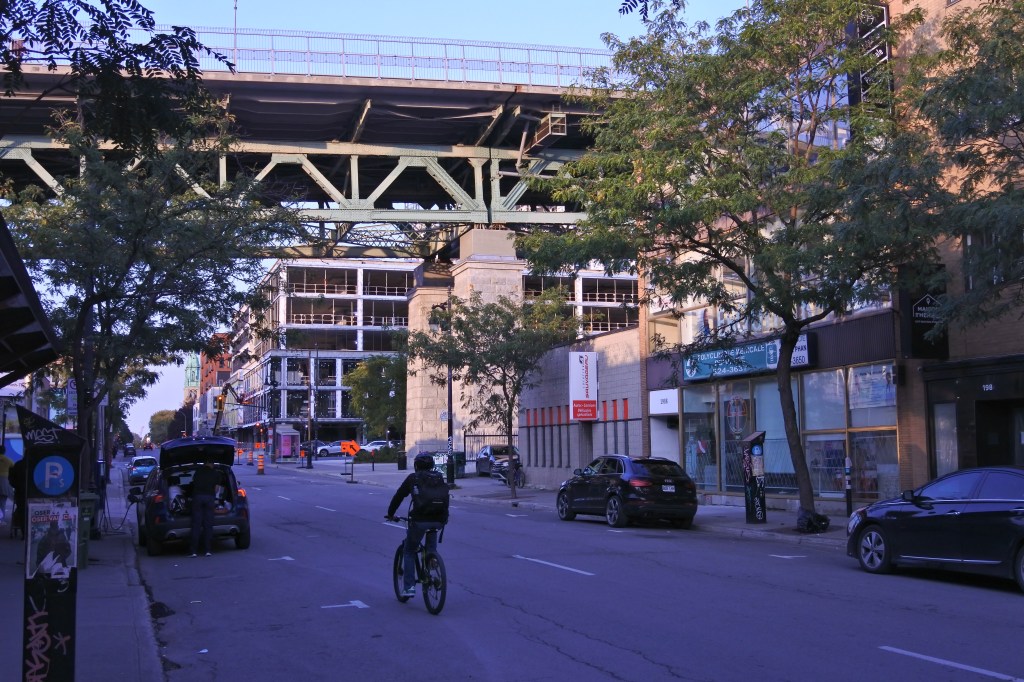
Sainte-Marie is a solid urban district mixing a lot of different styles from the 1910s-1960s with older blocks towards the southwestern edge of the neighborhood. Sainte-Marie, and the Centre-Sud more broadly, have a long held reputation for poverty, organized crime and prostitution. Because of this, much of Sainte-Marie was demolished for urban renewal in the 1950s and 1960s. Fortunately most of what was rebuilt had decent urban form.

Ontario Street is the best commercial district running the length of the neighborhood. Some good mixed-use stretches along St. Catherine as well and plenty of other mixed-use blocks throughout Sainte-Marie. As the district is still recovering from several decades of blight, crime, and prostitution from the 1950s even into the early 2000s, much of the neighborhood still has a gritty feel and some blocks are even blighted. But the neighborhood is clearly on an upward trajectory and this is certainly reflected in its real estate prices. Filling the main vacant or underutilized commercial spaces, especially along St. Catherine, is a priority in my opinion for improving Sainte-Marie and creating more vibrancy. 
Click here to view my Sainte-Marie neighborhood on Flickr

URBAN STRENGTHS:

  • Good commercial district along Ontario street, some good mixed-use stretches along St. Catherines.
  • Sherbrooke has a good urban feel with larger apt buildings lining a 5 lane streets. Get a bit too autocentric in the Northwestern edge.
  • Good number of small and medium sized parks but not as many as The Village.
  • Access to 3 metro stations. Also a good # of bike lanes and dedicated bike stations although not as many as other neighborhoods.
  • Pretty good tree canopy.
  • Decent amount of rentals and generally moderately priced. Good amount of 2 & 3 beds too.
  • Lots of for-sale options. Some more affordable 1 & 2 bedroom condos. 3 & 4 beds are plentiful but expensive.
  • Decent cultural amenities including lots of restaurants, bars, & cafes, and some night clubs.
  • Good retail amenities too including several supermarkets, some drug stores, several boutiques, a couple gyms, some bakeries & dessert shops, and other neighborhood shops.
  • About half of the ADA curb cuts are to modern standards, which is pretty good for Montreal.

URBAN WEAKNESSES:

  • Still a lot of grit and even some blight in parts. This was one of Montreal’s notorious crime and prostitution neighborhoods until the early 2000s but it has come a long way since then.
  • Not much beyond food & beverage businesses for cultural amenities.
  • Could be a lot more retail amenities especially unique and locally owned shops.
  • Architecture while good urban form is often lackluster and utilitarian.
  • Decent amount of dead spaces or underutilized spots in some of the commercial districts.

The Village- Montreal’s LBGT District

The Village (akak Centre-Sud) was originally a poor working-class rowhouse neighborhood given its close proximity to the Saint Lawrence Seaway. The Centre-Sud neighborhood became increasingly attractive to the gay and lesbian community (both anglophone and francophone) in the 1980s attracted by the neighborhood’s affordability after the migration of many LGBT businesses from other parts of the city. The name Le Village de l’Est (“the East Village”) was promoted by one the main Gay business owners modeled after his time living in New York City’s East Village. Eventually, the name was simplified to “The Village”.  The area has become considerably gentrified since the 1990s due in part to significant investment from all levels of all government.

While still hosting Montreal’s largest LGBT community, The Village is one on Montreal’s best urban districts outside of the Dwtn core thanks to its mixed-use character, 4 urban commercial districts, abundance of pocket parks and playgrounds, great retail & cultural amenities, excellent public transit and bike infrastructure, and solid urban form where modern in-fill mixes seemingly with historic rowhouses. The Village has also managed to squeeze in a ridiculous amount of trees inside the tight rowhouse blocks and the main commercial district (Saint Catherine) has largely been pedestrianized. The main improvement I would like to see of the district is more affordable 3 & 4 bedroom homes and apartments. This would make the district more appealing for families. There is also a fair amount of grit reminding one of the neighborhood’s sketchy history but for the true urbanist, this poses little issue. 

Click here to view “The Village” album on my Flickr Page

URBAN STRENGTHS:

* The Village hosts one of Montreal’s longest pedestrian streets along St. Catherine.
* One of Montreal’s most vibrant and mixed-use districts outside of Dwtn. Also a large office present especially along the district’s southwestern edge.
* Nice mixed of historic and quality urban in-fil.
* Four major commercial districts (Rue Ontario, Bd de Maisonneuve,  Atateken, and Saint Catherine St.).
* Lots of small pocket parks and plazas. Most blocks in The Village have their own neighborhood park. A couple medium sized parks located on the edge of the district, although the expansive Parc La Fountaine is only a couple blocks Northwest of the district. All the pocket parks  and very intentional tree planting in the small backyards creates a decent tree canopy.
* Excellent bike infrastructure including several dedicated lanes and many bike sharing stations. The neighborhood is also served by 4 subway stations and has great proximity to Dwtn and Vieux Montreal.
* Lots of studio, 1-bed & 2 bed rentals availably and moderately priced.
* Decent for sale options but generally on the expensive side. 1-bed condos start around 250K and 2-beds around 300K. Some 3 beds available too starting at around 400K. Price go above 1 M across all sizes.
* Excellent retail amenities including several supermarkets and drug stores. Solid all around cultural amenities especially, restaurants, bars, cafes

URBAN WEAKNESSES:

* Plenty of grit and underutilized buildings spread throughout The Village.
* Av. Papineau and René-Lévesque East are wider roads that line two of the Village edges and are have a more auto-centric feel.
*  Modern ADA curbs is hit or miss.
* 3 & 4 Bedroom apartments are pretty limited and expensive.

Vieux Montreal- One of North American’s Oldest Districts

Founded by French settlers in 1642 as Fort Ville-Marie, Old Montreal is home to many structures dating back to the era of New France and is one of the oldest districts in North America. The District’s original streets included the Rue Notre-Dame, the Rue Saint-Paul and Rue Saint-Jacques. The original fortifications of Montreal, erected in 1717 formed the boundaries of Montreal and didn’t expand for almost 100 years when the British authorities decided to tear them down and allow the City to expand. Montreal also enacted a wood ban in 1721, which is why almost all Vieux Montreal’s historic building are made of that iconic Quebec stone.  The 19th century witnessed the emergence of the English and Scottish bourgeoisie merchants. Their growing activity significant expanded the importance of the port , built new centers of banking, commerce & insurance concentrated along St. James St., and ultimately lead to a decline in Vieux Montreal’s residential base as the wealthy merchants built extravagant homes closer to Mount Royal (Golden Square Mile).  The Architecture also became distinctively  late-19th-century Victorian in styling, a significant departure from the stone masonry used during the French era. The district continued to grow until the Great Depression, which caused the relocation of port facilities and the heart of Downtown Montreal moved further west. Many abandoned warehouses and commercial building were left behind and mid-century planners considered urban renewal and highway proposals. Fortunately this galvanized public support to save Vieux Montreal and a Historic District was established for most of the neighborhood in 1964.

Since then Vieux Montreal steadily revitalizing bringing back residents, tourist, shops and night life to the neighborhood and becoming one of Montreal most dense and lively neighborhoods. Quality urban planning efforts also reclaimed the Vieux Port leading to a lengthy promenade, park space, and publicly accessibly piers with major regional destinations. Saint Paul’s and Place Jacque Cartier were converted into vibrant pedestrian streets and the district is served well be several metro stations running along its western edge and great bike infrastructure.

I believe Vieux Montreal could improve in a couple urban areas. First off, the pedestrian zone can be greatly expanded, especially during the weekend. Several blocks of Saint Paul’s are still open to traffic and many other blocks in the heart of the district didn’t feel they needed car access. Vieux Montreal also needs more neighborhood amenities such as a supermarkets, larger stores, public library, and even medical offices.

Click here to view my Vieux Montreal Album and here to for my Vieux Port Album

URBAN STRENGTHS:

* But far Montreal’s best collection of Historic architecture but a really interesting mix of eras generally starting with 18th century buildings closest to the seaway and ending up with early 20th century office bldgs along the western edge of Vieux Montreal.
* Several important landmarks here including: Notre-Dame Basilica of Montreal, Notre-Dame-de-Bon-Secours Chapel, Marché Bon Secours, Montreal City Hall, Tour de l’Horloge, La Grande Roue de Montréal, Nelson’s Column, Alfred Building, the Montreal Stock Exchange,  Saint-Sulpice Seminary,
* Vieux Port running along the Saint Lawrence Seaway is also wonderful and a lengthy pedestrian promenade, plentiful park space, and access to lots of attractions along its many piers.
* Very pedestrian scaled and lots of small blocks.
* Several break plaza spaces including Place d’Armes, Place de la Dauversière, Le Champ-de-Mars, Parc place d’Youville
* Excellent pedestrian only stretches along several blocks of Saint Paul’s and the Place Jacques Cartier
* Great bike infrastructure including many dedicated bike sharing stations and several dedicated bike lanes.
* Several metro stations run alongside the western edge of Vieux Montreal.
* Excellent cultural amenities especially food & bev business, art galleries, Museums, night clubs/live music, an Imax theater,  and performing arts theater.
* Great retail amenities including tons of boutiques/clothing stores, gift shops, creative stores, a couple book stores, plenty of bakeries & dessert shops, several gyms & churches,  and a post office.

URBAN WEAKNESSES:

  • Parts of the district would be difficult to live given the intense night life. Saint Paul’s and Place Jacques Cartier.
  • Missing a major supermarket, department store, drug store, public library, and medical offices. Fortunately these amenities are all located Downtown and in the International district only a 1/2 mile away.
  • Some sidewalks and narrow and this can be a bit difficult to navigate as a pedestrian when car traffic is high.

Downtown Montreal, Quebec


While Downtown encompasses the Quartier des Spectacles I didn’t include it in my Downtown review and kept it as  its own distinctive neighborhood. For the Downtown review I’m including everything south of City Councilors St. to Guy Street along with the Golden Square Mile neighborhood, considered by most standards to be part of Dwtn but also a bit autonomous . This stretches west to Mount Royal Park. The main spine of Downtown runs down Sherbrooke St. This formed the historic heart of Golden Square Mile where Montreal’s turn of the 19th century millionaires settled. Eventually all of the mansions on the northern stretch of Sherbrooke were replaced with post WWII skyscrapers creating a pretty bland and soulless American urban environment. But many mansions and historic structures were preserved in the southern half of Sherbrooke between Stanley and Guy street.

Saint-Catherine St is the great historic shopping district of Dwtn Montreal akin to Chicago’s Miracle Mile. It remains at a very human scaled with mostly historic commercial buildings remaining. Recent improvements have improved the urban form expanding the sidewalks and make the street even more human scaled. In the southern half of Dwtn Bishop, Rue de la Montagne, and especially Crescent, are three narrow east to west streets that preserve some of Montreal’s best late 19th century grand townhouse architecture. The northern half of Dwtn is mostly post WWII high-rises with the main exception of many historic buildings surrounding Phillips Square. West of Sherbrooke is a mostly residential neighborhood mixing historic and modern residences and institutional uses from McGill University.

Parts of Downtown are not the most exciting because of a large amount of bland high-rises, plenty of wide blocks, and a lack of premier park spaces. But because of its density, good urban planning, smart urban design decisions, good pedestrian activity and great remaining shopping  Downtown Montreal has been able to largely overcome these downsides. When adding the exciting Quartier des Spectacles I would still likely include Downtown Montreal as a top 10 Dwtn in North America. The height restriction creates an interesting uniformity to the highest skyscrapers in Montreal as none can exceed the height of Mount Royal (232 Meters). Overall I like this especially when viewed Dwtn from Mount Royal or from afar but it does create some blandness on the ground. Fortunately the new skyscrapers being  built are a lot more unique and creative.

Click here to view my Montreal Album on Flickr

URBAN STRENGTHS:

 * Some major Dwtn landmarks include Mary, Queen of the World Cathedral, Saint Patrick’s Cathedral. The Montreal Museum of Fine Arts, the Sun Life Bldg.,
* Several attractive parks and plazas including Phillips Square, Dorchester Square,  and Place du Canada. But not including Mount Royal.
* Excellent public transit access including 6 subway stops. Same with the dedicated bike lane network Dwtn where most are separated by barriers. Feeds into an incredible bike network across the City and Metro. The dedicated bike station system is also one of the best (if not best) in North America.
* Decent bike canopy.
* Generally solid pedestrian activity especially along Saint-Catherine (Canada’s business commercial avenue) and the more historic and mixed-use sections of Dwtn.
* Solid cultural amenities of a Dwtn but with several movie theaters including several indie theaters and a cineplex
* Very good retail amenities Dwtn including a couple supermarkets and lots of ethnic groceries, plenty of drug stores, a great array of clothing stores concentrated along St. Catherine St., several shopping malls including the extensive Eaton Mall and the underground City (the largest underground shopping mall in the world. This comes with many department stores. Other retail amenities are pretty standard for a Dwtn.
* Good pedestrian activity in much of Dwtn but still plenty of dead spaces.
* Lots of residential options Dwtn, generally expensive but not terrible. Solid density with about 20K per square mile living in the greater Dwtn area.
* Lots of universities studies thanks to McGill, the University of Quebec in Montreal and many other smaller colleges.

URBAN WEAKNESSES:

* Limited modern ADA curbs.
* Plenty of modern single use skyscrapers from the 1960s-2000 in the northern and eastern edges of Dwtn which creates some dead spaces.
* No extraordinary parks spaces in Dwtn Montreal as found in other great North American cities like Chicago, NYC, or  Boston.
* Several wide autocentric streets run through dwtn still. Thankfully the highway in the Center City Montreal is underground in Dwtn. 

Montreal’s Cite Multimedia District- a Former Industrial Area Repurposed into a Dense Mixed-use Neighborhood

The neighborhood’s name is derived from the name of the government-subsidized office complex built in its core. Cite Multimedia is the result of a vast real-estate project launched by the Quebec government in the late 1990s which redeveloped abandoned 19th century industrial buildings into a tech and design cluster. A decade later condos and apartment buildings became the main redevelopment use of the neighborhood as surface parking lots and light industrial buildings were repurposed. Cite Multimedia is similar to other American neighborhoods located close to the Downtown areas that gradually redevelopment old warehouses and industrial spaces. Some good examples include Pittsburgh’s Strip District or Denver’s Union Station neighborhood. Cite Multimedia doesn’t have the most sense of place as its a rather gradual and haphazard redevelopment of available warehouses and industrial space, but it is surrounded by some great neighborhoods including Vieux Montreal to the north, Downtown to the western and Griffintown to the south. Cite Multimedia is also a very mixed-use district in its own right with quality bike infrastructure and public transit access. The only real room for improvement is redeveloping the final surface parking lots that remain.

Click here to view my Cite Multimedi album on my Flickr Page

URBAN STRENGTHS:

* Great access to Vieux Montreal and Dwtn Montreal.
* Excellent Density.
* Infill is generally quality urban form.
* Lots of diverse condo and rental options.
* Goo access to the Square Victoria-OACI Subway station.
* Excellent Promenade park along Autoroute 10, the southern edge of the neighborhood. Also a wonderful promenade along the Vieux Port and seperated two-way bike path.
* Good array of food and beverage bizs especially along the northern border (McGill Ave). Not many other cultural amenities in the neighborhood but plenty in neighboring Vieaux Montreal.
* Good retail amenities here including lot of remaining warehouse type stores (camera store, wholesalers, office supply, computer stores, etc.), several specialty grocery stores, several gyms and dessert stores,.
* Good array of dedicated bike lanes.

URBAN WEAKNESSES:

* Not much sense of place. Cite Multimedia feels mostly like a place to live in a high density urban neighborhood to live or good to work close to Vieux Montreal.
* Crime is pretty low and limited blight.
* Decent amount of quality historic buildings remain in the neighborhood.
* Generally good sidewalks but half the curb cuts are not up to modern ADA standards.
* Still some surface parking lots.