Flushing Queens- A major New York Central Business District and Arguably NYC’s Center of Asian Culture

Flushing was mostly farm land until the 20th century. Development came to the neighborhood in the early 20th century with the construction of several bridges and subway and rail lines. Local farmland continued to be subdivided and developed through the 1910s-1930s transforming Flushing into a densely populated neighborhood and eventually the fourth or fifth largest central business district in New York City depending on how you measure the metrics. I ultimately decided not to review Flushing as a Downtown District as there are only about 30K jobs here and Flushing does not have the same verticality of Midtown, Lower Manhattan, Dwtn Brooklyn, and Long Island City, which boats 70-80K jobs. But Downtown Flushing is a major commercial and retail area, and the intersection of Main Street and Roosevelt Avenue, at its core, is the third-busiest in New York City, behind Times Square and Herald Square.

Present day Flushing is known for its great diversity, especially Asian population. The first wave of Asian immigrants came in the 1970s with immigrants from Taiwan and  a small Japanese community. By the early 1990s and 2000s large numbers  Indians, and Koreans began settling into Flushing with increasingly Chinese from the mainland.  Flushing now rivals Manhattan’s Chinatown as NYC’s center of Chinese culture.  Flushing also has several sub districts with their open ethnic make up outside of the Chinese/Asian dominated Dwtn Flushing. East Flushing for instance has immigrants from all over the globe. South of Franklin avenue hosts a large concentration of Indian American and other South Asian Americans and is one the oldest Little India neighborhoods in North America established in the late 1970s.

From an urban perspective Flushing excels at walkability given its excellent public transit access, convenient access to Midtown, incredible concentration of retail amenities (especially in Dwtn Flushing), diverse urban housing options, great schools, good park amenities, and high levels of safety. But it does lag behind some key urban indicators from better urban districts in Brooklyn and Queens. The Street grid is a bit irregular, Flushing lacks dedicated bike stations, and only has a handful of bike lines, its street canopy is spotty, and the neighborhood leans very elderly. There also isn’t a ton of attractive historic architecture as Flushing was developed after the era of gorgeous brownstones.
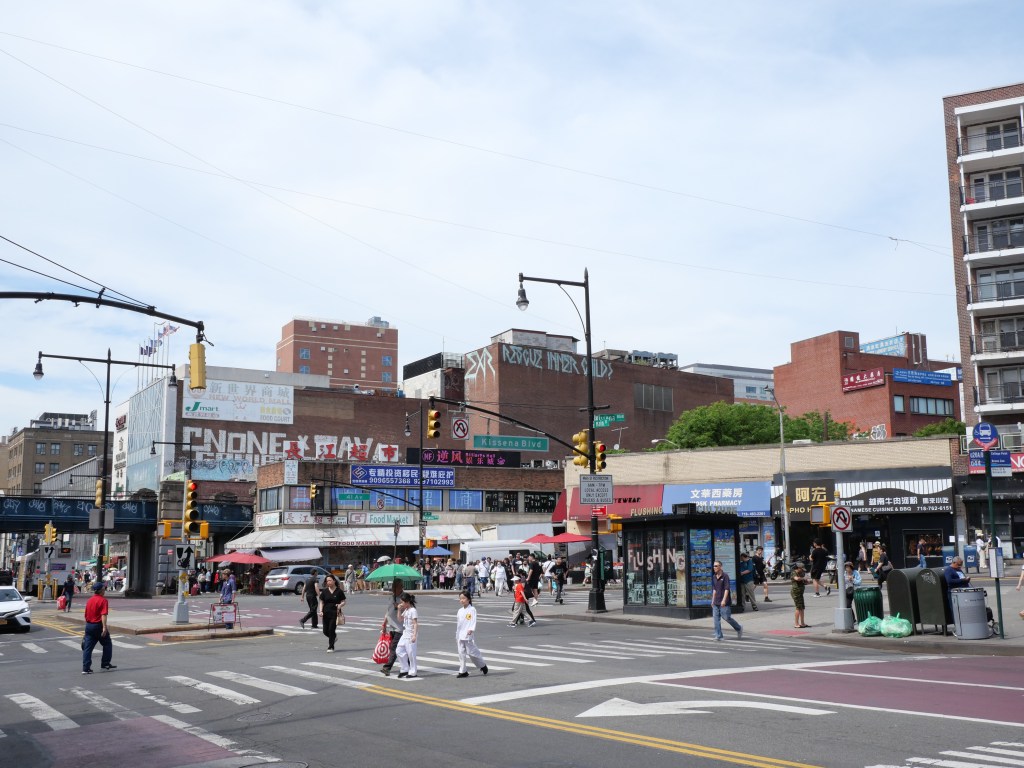
Click here to view my Flushing album on Flickr

URBAN STRENGTHS:

* Excellent density at just over 50K per square mile.
* Excellent sidewalk infrastructure throughout. About 60% of intersections of ADA standard curb cuts. Better along busy commercial streets and Blvds.
* Good street level pedestrian traffic but feels a bit too intense in parts of downtown Flush (aka Main St).
* Some autocentric modern in-fill but generally its pretty urban with solid urban design. Lots of interesting mid-century urban bldg missing from most US cities.
* Some nice 1920s & 1930s brick and tudor architecture but also a good amount of more bland pre WII styles.
* Some more autocentric spots on business districts and wide Blvds but overall urban massing is good.
* Great mixed-use fabric  throughout much of the neighborhood. Dwtn Flushing feels like an Asian city with very flexible zoning.
* A major subway and rail line cut through Flushing and very good bus coverage.
* Flushing itself has a modest Dwtn area and hosts about 35K jobs. Good access to Midtown and Long Island City a 40 min subway ride away.
* Very large and diverse Asian population but also sizable Hispanic, and White minorities.
* Flushing is a fairly safe neighborhood with limited vacancy and blight.
* Lots of well rated public schools. Some private and charter schools but certainly less than other NYC neighborhoods.
* Several large parks ring the Flushing neighborhood (i.e. Corona, Queens Botanical, Kissena Corridor) but these are all on the southern edge of Flushing and small and medium sized parks are a bit limited. Several indoor pool options however.
* Good amount of rental options and moderately priced compared to much of NYC. Studios and 1-beds range btwn the upper 1Ks to 3.8Ks, 2  & 3 beds between 2K-4.3K. Dwtn Flushing commands more expensive studios and 1-beds. Also a significant amount of affordable and rent subsidized rental units. Apts below 2K are 6x more plentiful that apartments leasing above 2K.
* Lots of smaller more affordable condo options with a plethora of studios selling btwn 175K-500K, 1-beds btwn 250K-800K, 2-beds btwn 350K-2M, and 3 & 4 beds btwn 400K-2M.
* Good  and beverage amenities and tons of Asian restaurants, bars, and karaoke joints. Not a ton of other cultural amenities but there is a downtown Flushing Cinema, plenty of dance studios, a couple historic sites, the Queens Botanical Gardens, and Corona Park just west of Flushing costs a couple museums, the Queens Zoo, and the US Tennis Open.
* Good retail amenities lots tons of Asian grocerias and several larger supermarkets, plenty of drug stores, a Target, a major mall which includes several departments stores, a couple other smaller shopping malls and a Macy’s, lots of discount stores, tons of clothing stores and boutiques (many brand name clothing stores), several hardware stores & a Home Depot, some book stores, many home goods and furniture stores, plenty of dessert joints and bakeries,, several gyms, several public libraries and post offices, tons of churches, and a couple major hospitals just on the edge of the neighborhood  along with plenty of doctor’s offices and medical clinics.

URBAN WEAKNESSES

  • Decent dedicated bike lanes but no dedicated bike stations.
  • Connectivity is pretty good but the grid is pretty irregular.
  • Good tree canopy in spots.
  • Large household sizes (likely due to intergenerational households) but a very old median age.”
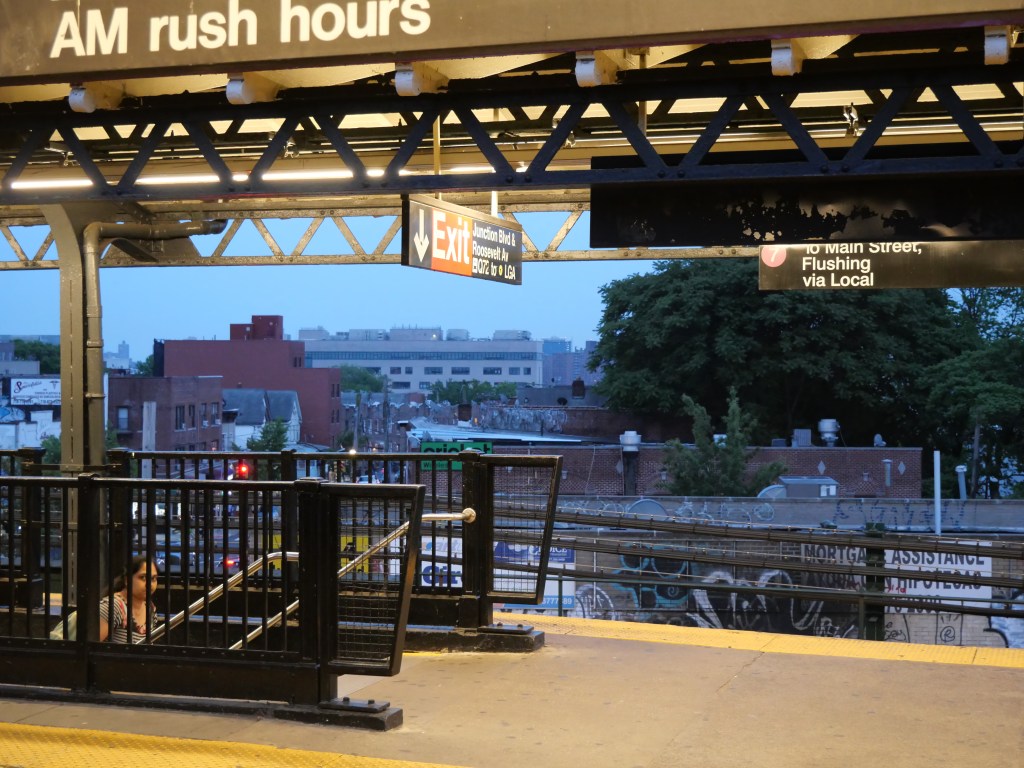
Jackson Heights- Arguably New York’s Most Diverse Neighborhood and one of Queen’s Densest Communities

The site of Jackson Heights was a vast marsh named until 1909 when the Queensboro Corporation bought 325 acres of undeveloped land and farms. The Queensboro Corporation named the land Jackson Heights in honor of John C. Jackson, a descendant of one of the original Queens families. More direct access to the area came with the construction of the Queensboro Bridge in 1909 quickly followed by the elevated IRT Flushing Line in 1917. Development accelerated with the subway lines as large “garden apartments” built in imitation of the English Garden City concept were built by the Queensboro Corporation just south of Northern Avenue.  While quite comfortable for the standards of the day, the apartments sadly contained racial covenants limiting residents to White Anglo-Saxon Protestants. White residents in Jackson Heights also resisted integration with the growing Black population west of Junction Boulevard in the neighboring Corona Neighborhood. But by the 1970s many of the Middle Class White families had already left the neighborhood for the Long Island suburbs. Large number of immigrants from Latin & South American and India/Pakistan/Bangladesh filled their place. By the late 1980s, Jackson Height’s past reputation for crime and  Colombian cartel violence was subsiding and the neighborhood began a slow rise in value and interest. Currently Jackson Heights has a stable real estate market with a nice mix of middle class and ethnic communities. The neighborhood still has one of the most diverse populations in Queens as over half of its population are foreign born residents.

In addition to its attractive Garden Apartments with well maintained tree-lined streets, Jackson Heights has attractive vibrant business districts running along 37th St, Junction Boulevard, Roosevelt and  the eastern half of Northern Blvd. The Western Half of Northern Blvd and especially Astoria Blvd are more autocentric/industrial in character. Jackson Heights also has great subway and public transit access being only a 30-40 min train ride to Long Island City and Midtown, excellent bike infrastructure with an outstanding bike lane system, solid public schools, good number of small & medium parks, and relatively affordable housing prices for NYC standards including many studios, 1-bed, & 2-bed condos selling btwn 150k-500K. 

Click here to view my Jackson Heights Album on Flickr

URBAN STRENGTHS:

* Very high density at around  75K per square mile.
* Consistent sidewalks and generally decent condition but a majority of ADA curbs are not standard.
* Good access to Midtown and Long Island City, only 35-40 mins by metro. Lower Manhattan is more like 55 mins and Dwtn Brooklyn is more than an 1 hr. away.
* Great connected street grid with lots of smaller blocks. Only downside is the 2 freeways on the western and northern edge of the neighborhood.
*Solid access to public transit but much better in the southern half than the northern half of the neighborhood where the subway lines run.
* Excellent bike infrastructure including many bike lanes in all directions and great coverage by the City Dedicated bike share system.
* Great diversity indicators, especially economic diversity and to a lesser extent racial. Almost half of the population is Hispanic.
* Generally good rated public schools but no High Schools in the neighborhood. Only a handful of private and publics schools.
* Overall a pretty safe community and less grit than neighborhood Corona, but a very busy neighborhood.
* Pretty solid tree canopy throughout.
* Great pedestrian activity especially below the elevated trains.
* Lots of small and medium parks well spreadout throughout the neighborhood.
* Good amount of rental options and moderately priced compared to much of NYC. Studios and 1-beds range btwn the upper 1Ks and the mid 2Ks, 2 & 3 beds range btwn 2.7K-3.7K.
* Tons of smaller condos. Studio condos sell btwn 165K-350K, 1-beds btwn 200K-600K with a handful of more expensive newer product, 2-beds sell btwn 275K-1.2M, 3 & 4 beds btwn 400K-1.5M. 5-beds are only a bit more expensive. Lots of affordable and subsidized affordable units.
* Good cultural amenities including plenty of restaurants (mostly ethnic), plenty of bars & cafes, several art galleries and night clubs, a couple live music venues, a local movie theater, several event centers.
* Good retail amenities lots of small & medium grocery stores, and tons of Hispanic & Asian grocerias, Target, a couple smaller department stores, tons of clothing stores and boutiques (many brand name clothing stores),  several drug stores, a couple hardware stores & a Home Depot, several clothing stores boutiques mostly concentrated along Junction Blvd, tons of discount stores, some book stores, several gift stores and many home goods and furniture stores, plenty of dessert joints and bakeries, some bike stores, several gyms, a public libraries and several post offices, tons of churches, a major hospital along with plenty of doctor’s offices and medical clinics.

URBAN WEAKNESSES:

  • Not much urban in-fill and what does exist is pretty autocentric especially along Astoria Blvd and Northern Blvd.
  • Large stretches of autocentric uses along Northern Ave. Same with Astoria Blvd but more unattractive industrial uses thanks to its close proximity to La Guardia Airport.

Corona- Hosts Queens’ Largest Hispanic Community and Louis Armstrong’s New York Home

Corona started with some limited development in the late 19th century with the New York and Flushing Railroad. Development come slow to the area and didn’t really pick up until the construction of the elevated L line in 1917.  The subway wasn’t extended to 111 St until 1925. Mostly of Corona’s housing was built in the 1920s & 1930s. After World War II, the majority of Corona’s  residents were mostly Italian and some other European ethnicities. Large numbers of middle-class African American families, especially musicians, civil rights leaders and athletes moved to the neighborhood  north of Roosevelt including Louis Armstrong. By the 1990s Corona saw a massive increase in Latino Immigrants from Mexico, Central America, and the DR. Given Corona’s close proximity to Flushing there is also a large Chinese population spilling over.

From an urban perspective Corona is not the flashiest of urban districts but it does have density on the same level as many Manhattan neighborhood’s and solid retail and cultural amenities (concentrated along Roosevelt & 103th St, Junction Blvd, 108th & Corona St., and Northern Blvd), good schools, and great park amenities thanks to its close proximity to Corona Park. The neighborhood is also very well served by public transit including a subway line and is only a 30-35 subway ride to Midtown. But Corona is not always pretty with a fair amount of autocentric and industrial uses along Northern Blvd and Roosevelt Blvd below the elevated line.  The tree canopy is also limited and there are not sufficient bike lanes.

Click here to view my Corona Album on Flickr

URBAN STREGNTHS:

* Very high density at around 85K per square mile.
* Good sidewalk infrastructure but ADA standard curb cuts are hit or miss including only half of all intersections.
* Good access to Midtown and Long Island City, only 30-35 mins by metro. Lower Manhattan is more like 50 mins and Dwtn Brooklyn is 1 hr. away.
* Generally good street grid and connectivity but a several curvilinear streets that disrupt the grid and a couple highways along the district’s borders.
* Great access to public transit.
* Great array of dedicated bike stations but bike lane coverage is so so here.
* Solid walk public schools generally well spread out through the neighborhood. Not a ton of private and charter school options.
* On appearance Corona feels pretty dirty and crowded but its really not a dangerous neighborhood. Most residents of hard working Hispanics and gang activity isn’t too bad.
* The expansive and multi-faceted Corona Park sits on the eastern edge of the Corona. Also many smaller parks well distributed throughout the neighborhood and a City Pool.
* Decent rental options but I imagine much of it is not listed. 1-beds range 2K, 2 lease btwn 2.5-3K and 3-beds in the 3Ks.
* Decent # of smaller condos. Studio and 1-bed condos sell btwn 150K-400K, 2-beds sell btwn 250K-950K., 3 & 4 beds btwn 400K-1.5M. 5-beds are only a bit more expensive. Lots of affordable and subsidized affordable units.
* Good cultural amenities including plenty of restaurants (although mostly Hispanic), plenty of bars & cafes, a couple art galleries and night clubs, and several cultural amenities in Corona Park including the Queen’s Zoo, Science Museum, and the Queens Museums. Also the Louis Armstrong museum and Center are here as he lived in Corona later in life.
* Good retail amenities lots of small & medium grocery stores, and tons of Hispanic & Asian grocerias, the Queens Center shopping mall is just west of the neighborhood containing lots of stores and Department Store, several drug stores, several hardware stores, several clothing stores boutiques mostly concentrated along Junction Blvd, tons of discount stores, several gift stores and tones of home goods and furniture stores, plenty of dessert joints and bakeries, lots of bike stores, several gyms, a couple public libraries and post offices, tons of churches, no major hospital in Corona but plenty of doctor’s offices and medical clinics.
* Very mixed-use fabric throughout the neighborhood even outside of the major commercial district along  Roosevelt & 103th st, Junction Blvd, 108th & Corona St., and Northern Blvd.

URBAN WEAKNESSES:

* Thanks to its very large Hispanic population (2/3s of the total population) this is not one of Queen’s most diverse communities, but there is also a pretty large Hispanic and Black populations here.
* Pre WWII architecture is pretty plain and not a ton of modern in-fill and  what does exist is concentrated along North Ave, which is a mix of good urban infill and autocentric uses. A fair amount of industrial uses along Roosevelt Ave.
* Tree canopy is pretty limited.

Forest Hills- Home to the Gorgeous Forest Hills Gardens Tudor Enclave and a Queens Neighborhood well Connected to the Subway

The development of adjacent Forest Park, a park on the southern end of Forest Hills, began in 1895 designed by the famous firm Olmsted Firm. The neighborhood began its development about 1910 and took its name from the new part to the south. The most well known part of the neighborhood, Forest Hills Garden was designed by the renewed architect  Grosvenor Atterbury. Forest Hills Garden was planned on the model of the garden communities of England resulting in many brick and  Tudor-style homes. The Long Island Rail Road opened  in 1911, and the Queens Boulevard trolley line two years later connecting the lines to Manhattan spurring the development of the neighborhood. The famous  Forest Hills Tennis Stadium which hosted the  U.S. Open until 1978 was built in the early 1920s.  By the late 1920s in anticipation of the arrival of the NYC subway, developers bought land surrounding the planned subway and Zoning laws were changed to allow fifteen-story apartment buildings. Queen Blvd was also widened at the time to make way for the expansion of the car in New York. With the increased density Forest Hills’ population  doubled from about 9K to 18K in 1930. The population doubled again by 1940, reaching 33K. During the 1970s and 1980s, Forest Hills began welcoming a significantly number of immigrants especially Hispanic, middle Eastern, and Asian moving to a minority majority neighborhood.

This is a great neighborhood from an urban perspective thanks to its great subway access and convenience to Manhattan and Long Island City, excellent school and park amenities, high levels of safety, gorgeous architecture especially in Forest Hills Gardens, and extensive retail amenities thanks to 3 distinct business districts. But there are still areas the neighborhood could improve as it lacks bike amenities and the 10-lane Queens Blvd should be tamed and receive a road diet. Some autocentric and surface parking lots exist along Queens Blvd. and Metropolitan Ave.

Click here to view my Forest Hills Album on Flickr

URBAN STRENGTHS:

* Solid density at 36K people per square mile but certainly less than most Brooklyn neighborhoods.
* Very good and consistent sidewalk infrastructure. While all intersections have curbs most have outdated ADA cuts.
* Good subway access to both Long Island City (dwtn Queens) and Midtown both about 30 min subway ride. About 50-1 Hr. subway ride to other major hubs (Lower Manhattan, Dwtn Brooklyn, and Flushing).
* Solid public transit access including access to 4 subway lines including Queens main trunk lines.
* Good diversity indicators esp. generational as there is a nice mix of families, young professionals, and empty nesters and good racial diversity here with large white, Hispanic, and Asian populations. Also pretty good economic diversity.
* Really solid walkable schools including a plethora of well rated public schools and 3 good sized high schools. Not a wide diversity of charter and private schools but some.
* Solid park amenities with several smaller parklettes, playgrounds, and medium sized parks pretty well spread throughout out. The expansive Corona Park and Forest Park sit on the eastern and southern edges of Forest Hills providing expansive recreational space to residents unfortunately they are seperated by highways from the neighborhood with only a handful of connection points.
* Forest Hills is one of Queen’s safest communities with very limited amounts of blight.
* Solid tree cover especially the more historic southern half of the neighborhood. Decent in other parts of the neighborhood too.
* Some incredible historic architecture especially the Forest Hills Gardens section laid out by Fredrick Olmsted’s Company. But also very lovely mix of SF and attached brick and tudor rowhouses from the 1920s & 1930s surround here. Plenty of larger 1920s & 1930s apartments along Queens Blvd.
* Great urban form along Austin St for several blocks hosting some of the most vibrant blocks of the neighborhood. Metropolitan Ave is more streetscape in feel w/ generally good massing but some gaps.
* Good cultural amenities esp. restaurants, bars, and cafes concentrated along Austin St., major concert venue at Forest Hills Stadium, a couple movie theaters, a couple performing arts theaters and dance schools.
* Excellent retail amenities including several supermarkets and smaller ethnic grocery stores, a plenty drug stores and hardware stores, several brand name clothing stores and a couple dept. stores, a target, decent # of boutiques/home goods/furniture stores, several florists,  several gyms and a ton of dessert joints, a couple bike shops, tons of salons & barber shops, a  public library and  post office, and plenty of churches. Also a major hospital and  plenty of doctor’s offices.
* Good # of rentals & modestly priced of NY standards. Studios & 1 beds, lease btwn 1.8K-3.2K, 2-beds all lease btwn 2.5K-4K, and a decent # of 3-bed rentals that lease btwn 3-5K. Decent amount dedicated affordable rentals or rent stabilized as 1/2 of rental product lease under 2K.
 * Lots of modestly priced smaller condos. Good # of studios and 1-beds that sell btwn  150K-700K,  2-beds condos range btwn  200K-1M with lots of condo options below 500K. 3-beds btwn 400K- 2M with a decent # of condos btwn 400K-700K, 4&5 beds range btwn 750K-2.8M.

URBAN WEAKNESSES:

  • Not a lot of modern infill. Some more suburban looking homes built in the 1950s-1970s in the Northeastern corner of Queens which are urban enough in form but kinda of bland.
  • Streetscaping is good but kinda dated and nothing special about it.
  • Bike infrastructure is very disappointing in Forest Hills. The massive Citibank system ends just north of the neighborhood and there are only a handful of dedicated bike lanes. A neighborhood this urban and dense deserves better.
    Queens Blvd, while having good massing is about 10 lanes and not very pedestrian friendly. 108st has good 1-story massed commercial bldgs but angled parking.
  • Generally good connectivity but plenty of curvilinear roads and odd alleyway parking configurations.”