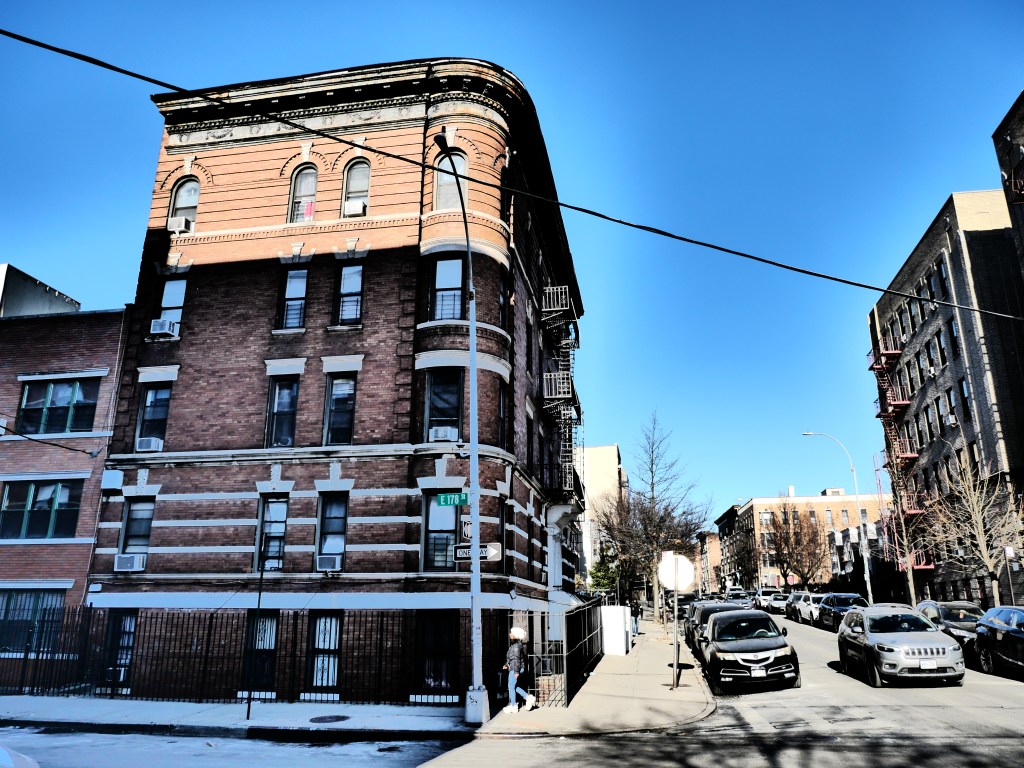
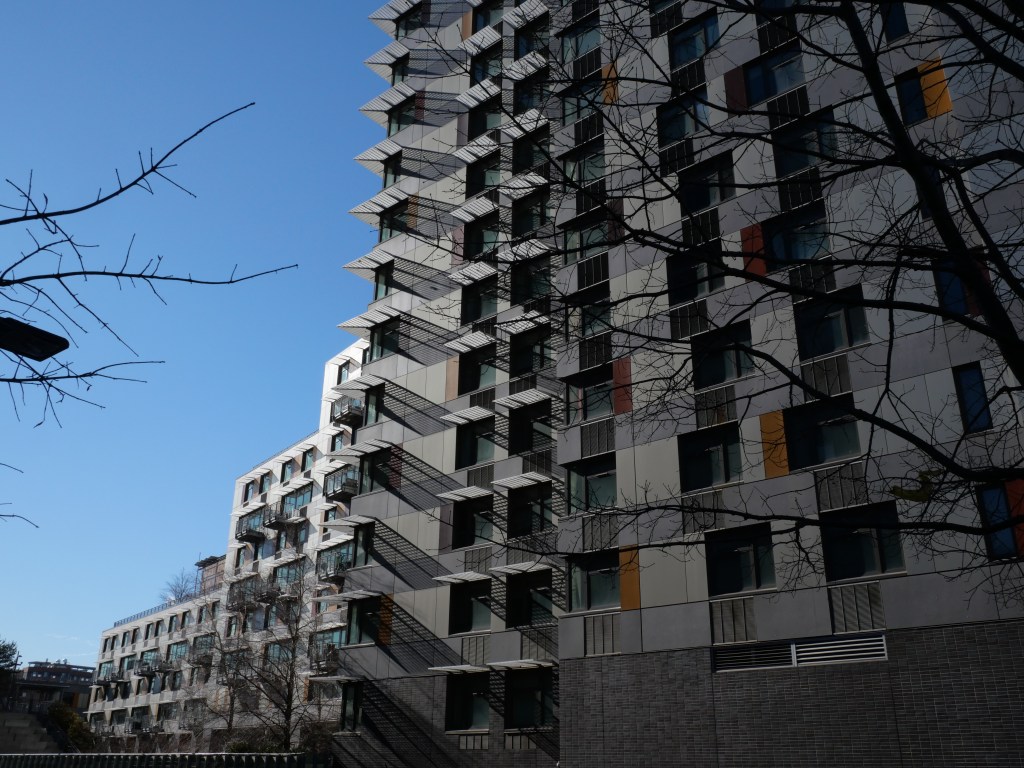
University Heights- Home to Bronx Community College and the Aqueduct Walk

The neighborhood takes its name from the hill on which New York University’s Bronx campus was built in 1894. The neighborhood, however, didn’t really fill in until 1917 with the opening of the IRT Jerome Avenue elevated Line. This lead to a rapid transition from a one-time farm community that had become a place where wealthy people had their mansions and suburban villas, to an urban neighborhood built almost entirely of low-rise apartment buildings housing mostly middle classes families. Like most of the South Bronx the neighborhood  lost its middle class base in the 1970s with white flight and a rise in crime and arson but University Heights has stayed more intact than most South Bronx Communities and has decent income diversity.

In the present day University Heights is a stable working class/middle class neighborhood with limited blight and disinvestment. The neighborhood does not have the same level of shopping districts as other South Bronx community but does hosts several smaller urban business districts along Knightsbridge, Burnside, University Blvd and is located close to the western edge of the Fordham Center Shopping District. For University Heights to be a top tier urban community it needs more higher income households to foster more racial diversity and better cultural & retail amenities. The neighborhood also needs better bike infrastructure and could use to high quality urban in-fill in spots.

Click here to view my University Heights Album on Flickr

URBAN STRENGTHS:

* Solid urban density for NY at 65K people per square mile
* Solid sidewalks but ADA curb cuts exist on about 55% of all intersections.
* Excellent public transit access.
* Decent income diversity of South Bronx as poverty is 1/4 of the population and decent # of middle income households.
* Pretty good age diversity thanks to the student population.
* Good array of pretty well rated public walkable schools but no high schools in University Heights. A handful of Catholic and charter schools.
* One of the safest communities in South Bronx with limits blight as well.
* Historic architecture while not stunning is generally in tact.
* Solid tree canopy partially thanks to the hills.
* Solid park amenities but not as good as most South Bronx communities. Several good medium sized parks but University Heights is missing the plethora of smaller parks and playgrounds common in most South Bronx Communities.
 *  Several supermarkets &  drug stores, a couple hardware stores, walkable access to all shopping options in Fordham Center just to the east of the neighborhood including tons of clothing stores, a target, and several small department stores, and boutiques. Other retail amenities in University Heights neighborhood include plenty of salons & barber shops, tons of dessert & bakeries, a  public libraries, several churches, a VA hospitals and several medical centers and doctor’s offices.
* University Heights has a lot of rental inventory but most of it is not market rate (5:1 lease below 2K). It does have a decent amount of market rentals as well. Decent # of studios and 1-bed rentals leasing btwn 1.5K-2.5K. 2-beds lease btwn 2K-3K., a good # of 3-beds leasing btwn 2.8-3.8K.

URBAN WEAKNESSES:

* Decent bike infrastructure but less bike sharing stations and bike lanes than most South Bronx neighborhoods.
* Access to Dwtn is worse than most South Bronx neighborhoods in University Heights. 45 mins to Midtown but an hour to Lower Manhattan.
* This is probably one the least diverse neighborhoods in the South Bronx with 65% Hispanic population.
* In-fill is limited to a handful of 1960s&1970s towers near Knightsbridge and the VA Hospital & Bronx Community College.
+ Other than large surface parking lots located outside of the VA Hospital and the Bronx Community College urban form is pretty good.
* So so cultural amenities including plenty of restaurants but only a handful of bars and cafes, and a salsa club.
* Missing some key retail amenities including a local post office, gyms, bookstores, and limited boutiques and gift shops outside of Fordham Center.
* For sale options are pretty limited but pretty affordable. Some 1 bed condos that sell in the 100K and 2-bed condos that sell btwn 150K-275Ks. Better 3 & 4 beds options selling btwn 300K-700K. 

East Tremont- A South Bronx Neighborhood Negatively Impacted by the Cross Bronx Expressway yet still Retains the Vibrant Tremont Commerical District

Like most South Bronx neighborhoods east Tremont became a destination for recently settled immigrant groups looking to escape the crowed Lower East Side slums in the mid to late 19th century. This first started with mostly German immigrants in the mid 19th century followed by the Irish a bit later and Italians by the end of the century who spilled over from Bronx’s Little Italy in nearby Belmont. The neighborhood also saw a fair amount of Jewish immigrants in the turn of the 20th century. East Tremont was negatively impacted by the construction of the Cross-Bronx Expressway in the 1960s which displaced thousands of residents and inflicted a scar in the neighborhood. This was followed up in the next decade by widespread arson, disinvestment, and White Flight.

Yet East Tremont seems to retain more of its historic stock than most Bronx neighborhoods and has a really intact commercial district running along Tremont Street. Perhaps this is the result of the neighborhood being adjacent to the more stable Belmont District? Regardless, East Tremont like most South Bronx neighborhoods has stabilized and has limited vacancy. Interesting it has signs of both continued issues of poverty and crime (likely higher than most South Bronx neighborhoods) yet also has a much strong housing market with a great diversity of for sale options from affordable smaller condos to larger single family homes selling between 500K-1M. For East Tremont to become a top tier New York neighborhood it needs more income diversity which would foster better retail amenities and much better cultural amenities, which are lacking. Also some spots for better urban in-fill along the more autocentric and industrial corridors of E 180th, Washington Ave, and 3rd Avenue.

Click here to view my East Tremont Album on Flickr

URBAN STRENGTHS:

* Solid Bronx Density at 60K residents per square mile.
* Good sidewalk infrastructure and ADA curbs are on about 55% of all intersections.
* Pretty good bike lanes and several dedicated bike stations.
* Great public transit access along with some express routes to midtown that takes about 30 mins. Access to lower Manhattan and Long Island City is ok at 50 minutes by train.
* Good connectivity especially for most Bronx neighborhoods.
* Lots of families with children. But not the best age diversity. Decent racial diversity with a larger African American population than most South Bronx neighborhoods. Still just over 50% Hispanic.
* Crotona Park East has a ton of rental inventory but most of it is not market rate (9:1 lease below 2K). A decent # of studios and 1-bed rentals leasing btwn 1.8K-2.5K. Some 2-beds lease btwn 2.5K-3K. Lots of # of 3-beds that lease btwn 3K-4K.
* Decent for sale product for a Bronx neighborhood. Some 1-bed condos that sell around 100K, more 2-bed condo options that sell btwn 100K-350K and a handful of SF homes that sell around 500K. Of  3 & 4 beds variety selling anywhere from 170K-1 M including condos, townhouses, attached and detached SF homes.
* Good school options including plenty of public schools that are generally rated btwn 3-6 (out of ten) across all grades. Only a handful of charter and private school options.
* Pretty good historic architecture still in tact.
* Generally good urban massing especially along the in-tact urban biz district along E Tremont.  Streetscaping is generally pretty good, esp. for the Bronx.
* Great pedestrian traffic especially thanks the East Tremont Street.
* Good park amenities including the medium sized Walter Gladwin Park, a public pool, and several smaller parks, and the expansive Bronx Park is just north of the neighborhood.
* Great retail amenities including several groceries & several drug stores, several furniture and home good stores, a couple hardware stores, tons of clothing stores and 99 center stores, several salons and barber shops, plenty of dessert & bakeries, a handful of churches & several doctors offices (but not hospitals). Also a local post office and public library and the plethora and retail and restaurant amenities of Belmont is a 5-10 minute walk to the north.

URBAN WEAKNESSES:

  • While crime is better than it was in the 90s East Tremont has some of the higher crime rates in NY. Definitively some grid here but vacancy isn’t terrible.
  • Some economic diversity but nearly 1/3 of the population is in poverty and large numbers or lower-moderate middle class.
  • Tree canopy isn’t great.
  • Some good large in-fill apartments but also plenty of autocentric and industrial in-fill.
  • Some cultural amenities but limited to several restaurants, a handful of bars and night clubs and decent access to the Bronx Zoo.”

West Farms- One of Bronx’s Original Railroad Suburbs but Present Day Dense South Bronx Community

West Farms was one of the first settlements in the Bronx located along an early rail line. By the mid 19th century it had 1000 resident and was developing into a railroad suburb like Yonkers. By the early 20th century West Farms was integrated into the rest of the South Bronx becoming a dense working class neighborhood for those looking to leave the slums of Lower Manhattan. By the 1970s it had one of the highest concentrations of Puerto Ricans in New York City. And like the rest of the South Bronx it experienced the destruction of the 1970s and resurrection in the 1980s and 1990s and is now mostly in-tact and rebuilt. West Farms however seems to have a slightly higher concentrated of poverty and Hispanics than other South Bronx neighborhoods and has seen limited recent revitalization. Its commercial district along Tremont is pretty gritty and somewhat abandonded and there are more vacant lots here than most parts of the South Bronx.

But West Farms has some great amenities starting with the expansive Bronx Park to the North and the Bronx Zoo, solid tree canopy and decent schools. It also has top notch transit access and decent retail amenities and is still walkable to larger centers of shopping in the Tremont and Crotona Park East neighborhoods. For West Farms to become a top notch urban district it needs more income diversity to drive better retail & cultural amenities and a more diverse housing market. 

Click here to view my West Farms Album on Flickr

URBAN STRENGTHS:

  • Excellent public transit served by two subway lines.
  • Solid density at 54K people per square mile and this includes some census blocks with limited populations.
  • Solid bike infrastructure including a couple dedicated bike lanes and several bike rental stations.
  • Good sidewalks and ADA standard curbs on 65% of intersections
  • Good Tree Canopy for the Bronx
  • Good access to Manhattan but not as good as other South Bronx neighborhoods. Midtown is 45 mins and Lower Manhattan and Long Island City are 50-55 minutes by subway.
  • Good connectivity in the core of the neighborhood but it gets pretty chopped up on the eastern edge.
  • Good urban form other than some industrial/autocentric spots on the eastern edge of the district.
  • Pretty good historic architecture on the western half of West Farms mixing 1920s brick apartment buildings and rowhouses. The eastern edge however is very gritty unattractive rowhouses. Generally Post WWII in fill is pretty urban form.
  • Decent number of schools within West Farm and to the west in the Tremont neighborhood but less options than most South Bronx district. Public schools are generally rated pretty well but limited private and charter schools.
  • Great access to park amenities thanks to the expansive Bronx Park which includes the Zoo, Botanical Garden, and lots of other amenities. Also a handful of small to medium parks spread throughout.
  • Decent retail amenities but more limited than most South Bronx neighborhoods due to it size a limited number of commercial district. Retail amenities include a couple full sized groceries & several drug stores and smaller groceries, a couple furniture stores, discount clothing stores and 99 center stores, several salons and barber shops, a handful of churches & several doctors offices (but not hospitals). Also a local post office and public library. Many other shopping amenities are still walkable in the neighboring Tremont and Crotona Park neighborhoods

URBAN WEAKNESSES:

  • Crime is still higher here than NYC and the Bronx on average but significantly down from its peak in the 1990s. A decent # of vacant lots here, more so than other South Bronx Neighborhoods.
  • Generally not great diversity indicators as this is a 70% Hispanic neighborhood with nearly 40% of residents living in poverty. But better generational diversity than most South Bronx neighborhoods.
  • Streetscaping is fine but dated.
  • Not a ton of for sale product. Very limited # of market rate studio and 1-bed condos. Some 2-beds condos that sell btwn 150K-365K. 3 & 4 bedroom product is very limited. Some market rate 5-bed condos that sell for around 750K. Older townhouses sell for less but limited product.
  • West Farms has a ton of rental inventory but most of it is not market rate (7:1 lease below 2K). Very limited for sale rentals that are listed on traditional platforms like Zillow.
  • Decent cultural amenities including several restaurants, a handful of bars & cafes, a local art gallery and the Bronx Zoo is just north of the neighborhood.”

Crotona Park East- South Bronx Neighborhodo that is the Childhood Home of Bachata Singer Romeo Santos

Crotona Park is another standard South Bronx neighborhood that filled up with 1st & 2nd generation immigrants in the early 20th century looking to escape the Manhattan slums, became predominately Black by the late 1960s and emptied out by the late 70s due to a wave of arsons and white flight. The neighborhood was uplifted like the rest of the Bronx by several determined local CDCs in the 1980s and 1990s. In Crotona Park East the main CDC player is the Mid-Bronx Desperadoes who helped created over 5,000 units of housing since their creation. One of the most iconic redevelopment sites is along Charlotte Street, which was a bombed out street visited by both President Carter and Regan. It was redeveloped in the late 80s as single family ranch style homes and is the only ranch housing in all of the South Bronx. To me it looks pretty odd stuck in the middle of this dense community.  But these homes has certainly maintained their value as they now sell btwn 500K-800K.

Crotona Park East is very walkable like all other South Bronx neighborhoods thanks to its great subway access, bike in structure, density and good retail amenities. The neighborhood really excels with great park amenities and a solid tree canopy thanks to the expansive and multi-functional Cortona Park. But the neighborhood has less walkable retail than most South Bronx neighborhoods, is very limited with cultural amenities, and has some poor urban form in spots including the Charlotte Gardens, New Horizons Shopping Mall and gritter more industrial uses under both its elevated train lines running along Southern and Boston Avenues. For Crotona Park to become a top tier urban district it needs more income diversity and for sale housing which will improve the neighborhood’s retail and cultural amenities and fill in its more autocentric areas.

Click here to review my Crotona Park East Album on Flickr

URBAN STRENGTHS:

* Good sidewalks and 65% of curb cuts are ADA compliant
* Great public transit access. Crotona is served by  2 subway lines and tons of bus lines.
* A couple dedicated bike lanes but great array of dedicated bike stations
* Good access to Midtown, Long Island City and Lower Manhattan all about 45 mins by subway. Decent bike lane infrastructure but tons of dedicated bike stations.
* Great density at just over 60K per square mile.
* Lots of families with children. But not the best age diversity. Decent racial diversity with a larger African American population than most South Bronx neighborhoods. Still just over 50% Hispanic.
* More intact Historic stock than most South Bronx neighborhoods with a significant amount of rowhouses.
* Decent tree canopy. Better than most South Bronx districts.
* Excellent park amenities including the expansive and multi-functional Crotona Park East which has a public pool, the attractive riverfront park along the Bronx River and several small parks & playgrounds well dispersed throughout the neighborhood.
* Urban massing is generally good but some autocentric/industrial spots below the elevated rail along Boston & Southern Blvd and a large shopping center along E 174th.
* Lots of walkable schools but ratings are subpar even for South Bronx’s ratings. High Schools are particularly rated low. Only a handful of private and charter schools.
* Crotona Park East has a ton of rental inventory but most of it is not market rate (8:1 lease below 2K). A handful of market rate studios and 1-beds lease in the 2Ks. Some 2-beds for around 3K. A decent # of 3-beds that lease in the 3Ks.
* Decent retail amenities including several full sized groceries & drug stores, a couple furniture stores, a TJ Maxx & Rainbow, several consignment stores, tons of salons and barber shops, a hardware store, a couple banks, a couple gift stores, a couple bakeries & gyms, several discount stores, a couple churches & several doctors offices (but not hospitals). Less retail amenities than most South Bronx neighborhoods.

URBAN WEAKNESSES:

* Some economic diversity but nearly 1/3 of the population is in poverty and large numbers or lower-moderate middle class.
* Infill in Crotona Park is a mixture of decent urban design urban rowhouses, suburban ranch homes in Charlotte Gardens, unattractive industrial bldgs below the elevated lines, and suburban strip malls. Modern urban in-fill projects are concentrated along West Farms Rd.
* Crime rates have significantly dropped since the 90s but still remain higher than Bronx and the City of New York overall. Crotona Park East  still has a decent amount of blight but limited vacancy.
* Streetscaping is fine but generally pretty tired and outdated.
* Not a ton of for sale product. Very limited # of market rate studio and 1-bed condos. A few 2-beds that sell btwn 100K-400K. A lot more 3 bed product that sells anywhere from 300K-800K including a decent # of SF homes.  Not much 4 bedroom product.
* Cultural amenities a limited to some restaurants (generally not high end) and cafes. Not much else honestly.
 * Missing some key retail amenities including a  post office & public library and very few local creative retail stores. 

Longwood- Home to one of New York’s Largest Puerto Rican Populations and Successful South Bronx Revitalizaiton Story

Early in this construction boom, Longwood was one of the most dense and developed Bronx neighborhoods. For much of the first half of the 20th century, the Bronx was mostly home to a diverse mix of middle-class Caucasians and Jews. The neighborhood began experiencing disinvestment thanks to the construction of the Cross Bronx Expressway in the 1950s displacing thousands of residents, white flight to the suburbs and new developers like Co-op City in the northeast Bronx, and the growth of poverty and blight from the South Bronx moving northwards in the 1960s and 70s. By the late 1970s, much of the neighborhood was destroyed due to fire or neglect. But thanks to the tireless efforts of Community Development Corporations, most notably  Banana Kelly CIA, Inc. and SEBCO (South East Bronx Community Organization), vacant apartment buildings began to be renovated in the 1980s and new construction by the 1990s. Local, state, and federal government worked alongside the local CDCs to repopulate the neighborhood and Longwood now has limited vacancies. After the displacement of many African American families in the fires of the 1970s large waves of Dominicans and especially Puerto Ricans moved into the neighborhood making Longwood one of the highest concentrations of Puerto Ricans in New York City. Longwood managed to preserved the several blocks of late 19th century brownstones along several residential streets south of Longwood Avenue.

From an urban perspective Longwood is a solid urban district with plenty of strengths but still some major areas for improvement. It has great walkability thanks to several fairly vibrant biz districts (i.e. Longwood Ave, Prospect, Southern Blvd, and Westchester), great subway access, solid bike infrastructure, and convenience to Manhattan. Longwood also has lots of pretty well rated schools, good park amenities, and lots of walkable retail amenities. But for Longwood to become a top tier urban district in NYC it needs more racial and economic diversity, which will bring more cultural amenities and additional shopping options. Crime rates are improved from the 1990s but still much higher than the rest of NYC, and market rate rentals are pretty limited. Given Longwood’s significant number of protected affordable rentals, I’d be comfortable seeing more market rate housing and some gentrification as the benefits seem to outweigh the downsides.

Click here to view my Longwood album on Flickr

URBAN STRENGTHS:

  • Generally good sidewalk infrastructure but ADA curb cuts are hit or miss on less than half of all intersections.
  • Great density at 70K residents per square mile.
  • Great access to Manhattan being only 35 mins to Midtown and 45 min to Lower Manhattan by subway. Also only 45 mins to Long Island City in Queens as well.
  • Longwood’s connectivity is good but a bit chaotic for most New York City neighborhoods as the streets are often angled with an irregular grid.
  • A highly walkable neighborhood with 3 subway lines cutting through it, good bike lane infrastructure and tons of dedicated bike stations. Plenty of walkable biz districts as well along Prospect, Westchester/West Farms, Southern Blvd.
  • Lots of families with children. But not the best age diversity.
  • Good historic architecture in spots esp. the commercial districts of Prospect and the southern edge of Southern Blvd and the brownstones in the small Longwood Historic District. Otherwise architecture is a mix of working class rowhouses, plain 1920s apartment buildings and lots of in-fill from the late 80s to the present date with generally good urban form. Also lots of 1980s townhouses with parking out-front.
  • Solid park amenities with a nice mix of playgrounds, basketball courts, and medium sized well dispersed throughout Longwood. No spectacular parks here like St. Mary’s Park Crotona Park.
  • Lots of walkable school options but mixed ratings. Elementary and middle schools are generally rated average but public high schools are rated poorly unless its a charter high school. Only a handful of Catholic private schools.
  • Longwood has a ton of rental inventory but most of it is not market rate (15:1 lease below 2K). Few studios and 1-beds that are market rate. Some 2-beds that lease btwn 2K-2K. 3 beds lease btwn 3-4Ks.
  • Solid retail amenities including several full sized groceries & drug stores, some home good and furniture stores, plenty of clothing & boutiques stores esp. along Southern Blvd., a couple hardware stores, a couple gift stores, a several bakeries & gyms, a local post office & public library, tons of discount stores, several churches & doctors offices (but not hospitals), plenty of salons & barber shops”

URBAN WEAKNESSES:

* A mostly Hispanic neighborhood with a sizable Black population.
* Some economic diversity but nearly 1/3 of the population is in poverty and large numbers or lower-moderate middle class.
* Crime rates have significantly dropped since the 90s but still remain higher than Bronx and the City of New York overall. Longwood has a similar amount of blight to Mott Haven but vacancy is pretty limited.
* Fair amount of autocentric/industrial spots especially along parts of Southern Ave & Westchester (both host elevated subways), and  the southern half of Southern Blvd.
* Generally sidewalks are plenty wide but just gritty and warn down with few recent streetscaping projects.
* Not a ton of for sale product. A handful of 1-bed conds that sell around 175K. More 2-beds that sell btwn 175K-400K. Some 3-bed townhouses (musty from the 60s that sell btwn 500K-600K. Some 3 bed condos that sell around 150K. More 5 beds that sell btwn 500K-800K.
* Cultural amenities are limited to several restaurants and a couple bars and cafes. Not much else. 

Melrose- Ground Zero for Jimmy Carner’s Infamous 1977 Bronx Visit and a Great Community Lead Rivitalization Success Story

Melrose was originally built as a dense working-class neighborhood in the early 20th century mainly for working class German  immigrants looking to escape the slums of lower Manhattan. After WWII the neighborhood transitioned to mostly Irish and Italian immigrants. But by the late 1960s as the slums of Mott Haven expanded northwards, Melrose became a place of concentrated poverty and transitioned to mostly Puerto Rican, Dominican immigrants, and African Americans. President Carter infamously visited the neighborhood in 1977 as part of his tour assessing the damage in the Bronx during the period of mass arsons and destruction.  But this is fortunately a happy story. Melrose had a particularly strong community lead rebuilding effort lead by Nos Quedamos starting in the 1980s and most of the vacant buildings have been renovated or rebuilt. Nos Quedamos operates 20 buildings (1400 units) with a mix of affordable rentals and homeownership opportunities. Many attached townhouses were built too, which now sell for 600K-900K allowing working class residents to move into housing stability. Melrose still contains one of the highest concentrations of NYCHA projects in the Bronx but this is a pretty stable community now with much lower rates of crime than the 1990s and limited vacant. Even if the neighborhood gentrified likely half of the housing would remain protected for affordability.

Melrose also contains the HUB shopping district on its southern border where 3rd Ave and Melrose come together providing the district with great retail amenities. Melrose is not surprisingly a very walkable neighborhood thanks to its great subway and bike infrastructure access. It also has solid schools and park amenities. For Melrose to become a top tier urban district it does need to gentrify a bit allowing more retail and especially cultural amenities to flourish. I just hope it can make this transition while preserving its affordable housing. Melrose could certainly use some more economic and racial diversity as it is a 70% Hispanic neighborhood with mostly lower-moderate income households.

Click here to view my Melrose Album on Flickr

URBAN STRENGTHS:

  • Generally good sidewalk infrastructure but ADA curb cuts are hit or miss on about half of all intersections.
  • Great density at just over 60K residents per square mile.
  • Excellent public transit access as 3 subway lines run through the district. Midtown is only a 45 min subway ride.
  • Solid bike infrastructure include great dedicated bike stations and a good system of bike lanes.
  • There is a decent amount of historic architecture remaining from the turn of the 20th century but its often pretty gritty. Some good rowhouse stock in the eastern half of Melrose historic commercial along Melrose, 3rd , St. Anne, and Prospect.
  • Lots of 1960s-1980s infill that’s not particularly beautiful but generally has good form. Also plenty of project mid century high rises. Some more recent in-fill that looks nicer.
  • Great pedestrian traffic along the commercial corridors and pretty average for NYC along the residential streets.
  • Generally solid urban form throughout Melrose with the except of a handful of surface parking lots and industrial uses.
  • Streetscaping is a mixed of tired outdated sidewalks and more recently updated.
  • Generally goods schools and nice mix of public, private, and charter schools across all grades. Some poorly rated public schools mixed in.
  • Melrose plenty rental inventory but most of it is not market rate (6:1 lease below 2K). Few studios that are market rate. Some 1-beds that lease btwn 1.8K-2.8K. 2 & 3 beds lease btwn 2-3Ks.
  • Solid parks amenities with a good array of small and medium sized parks well dispersed throughout. The expansive St. Mary’s Park sits on the southern edge of Melrose.
  • Solid retail amenities including plenty of supermarkets, several drug stores & hardware stores, tons of boutiques/clothing stores and some departments stores along the Melrose & 3rd Ave corridors, some furniture stores, several gyms. some dessert joints, a couple bike shops, a couple public libraries & post offices, several churches, tons of discount stores, plenty of doctor’s office & medical offices but no hospitals.

URBAN WEAKNESSES:

  • Less economic diversity than Mott Haven as I suspect there are less young professionals living here. Most of the population is a mix of households in poverty or lower-middle class.
  • Large Hispanic Majority at 75%. 25% of the population is Black. Very small Asian and White populations.
  • Like most of the South Bronx Melrose is much safer than it was in the 90s and 2000s. That being said there does still seem to be some crime in the neighborhood but nothing like it used to be. Not a ton of blight in Melrose but still very gritty.
  • Tree canopy is better than most South Bronx neighborhoods but still not great.
  • While crime is higher than most parts of NYC Melrose’s crime rate has dropped by 60% since 1990.
  • Not a ton of for sale product. A handful of 1-bed conds that sell btwn 175K-325K. More 2-beds that sell btwn 150K-400K. Some 3-bed townhouses (musty from the 60s that sell btwn 300K-750K. A handful of 4 & 5 beds that sell for upwards of 1M.
  • Okay cultural amenities but pretty underwhelming for NYC including plenty of restaurants, several art galleries and a couple art galleries, a handful of bars & cafes, and a couple night clubs.”