The South End has long been home to Springfield’s Italian community since the late 19th century and continues to hosts numerous Italian restaurants and pastry shops, most famously the La Fiorentina Pastry Shop. More recently it has become famous for housing the National Basketball Hall of Fame. From an urban perspective the South End is a solid neighborhood with a great sense of community, a fairly vibrant Main Street, and walkable access to the heart of Downtown Springfield. For this to become a top tier urban district it needs a lot of quality urban in-fill along Main Street and filling in vacant parcels along the eastern edge of the district, better schools and ideally the abandonment of I-91 so the neighborhood can connect much more seamlessly to the Connecticut River.
Walkable access to Dwtn and plenty of restaurants (esp Italian), bars, smaller ethnic groceries, boutiques located along Main Street.
generally a solid business district along Main St with pretty good urban form and a variety of businesses. Becomes more autocentric towards the southern end of the neighborhood.
Pretty affordable place to buy a home generally btwn 200K-350K. Decent # of rentals as well.
URBAN WEAKNESSES:
Other than the recreation trail running along the river, really not bike infrastructure.
The historic residential isn’t very attractive as its mostly turn of the century worker housing.
So so density for an urban neighborhood but a bit underwhelming for an inner City East Coast City. Same thing with public transit access.
Some walkable schools located here but generally not well rated.
Highway 91 unfortunately is a major barrier between the neighborhood and the Connecticut River.”
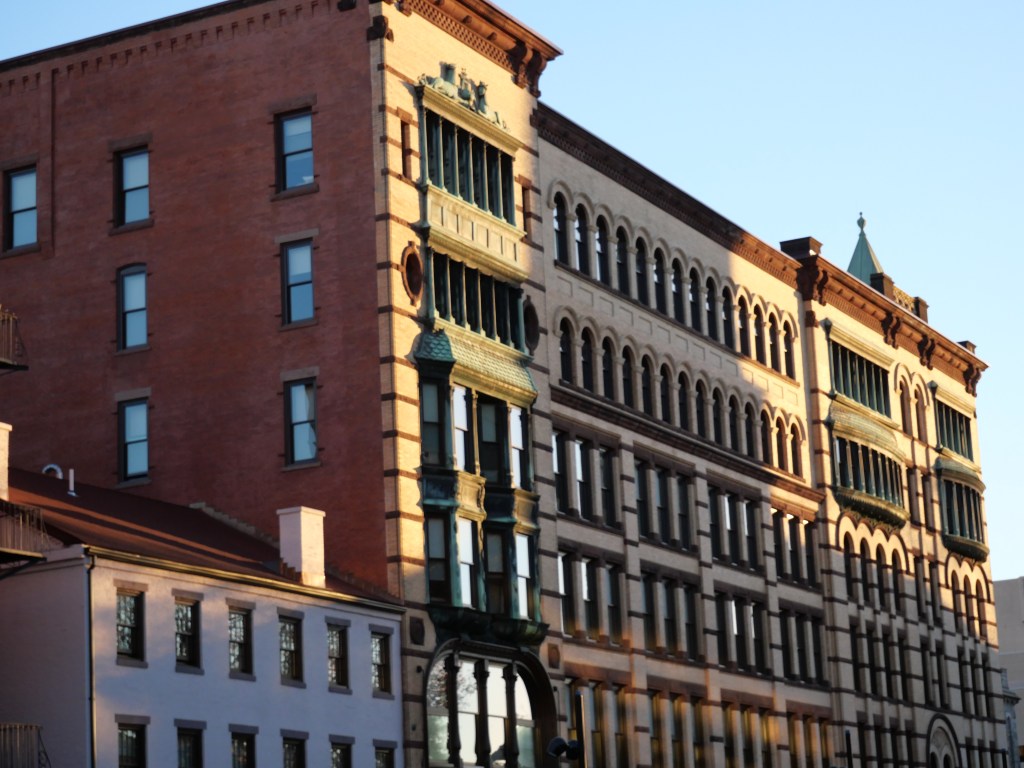
Main street is the heart of Dwtn running north to south throughout its entire duration. I consider where Main Street and Court House Place Square meet as the heart of Dwtn as this is the convergence of the Springfield Convention Center, several vibrant blocks of Main Street, the Civic Heart of Springfield with many historic Civic Buildings and the MGM Casino (technically in the South End). East of Dwight Street the urban form starts to break down with more parking lots, modern bldgs with poor urban form, and less vibrancy. A couple blocks just west of the Armory host the Armory Quadrangle Historic District a collection of attractive Boston looking apartment bldgs with bay turrets and other historic institutional buildings. Downtown connects most seamlessness with the South End neighborhood to the south especially via Main Street as quality urban cohesive blocks continue for several blocks south through the neighborhood. For Downtown Springfield to become a great Downtown it primarily needs much more population and density to help support more neighborhood retail amenities and much better vibrancy especially north of the railroad tracks and east of Dwight Street. Downtown has strong bones along Main Street and several surrounding blocks to build from and expand to the less developed parts of Downtown.
Click here to view my Downtown Springfield album on Flickr
URBAN STRENGTHS:
* Lovely set of intact historic commercial buildings from the 19th to early 20th century. * Really like the historic center of Dwtn at Court House Place with the City’s most prominent Civic and Historic Gov’t Bldgs surrounding it. * Main Street south of the Train Station is very in-tact with many mid to late 19th century commercial bldgs btwn 4-8 stories. Worthing St is also making a comeback with many revitalized historic bldgs, new pedestrian friendly streetscaping and light crossing over the Street. * Nicely renovated Historic Union Station which was restored in 2019 moving the Amtrack Station back to the station after many years of disrepair. * Excellent cultural amenities dwtn including tons of food & beverage businesses, plenty of theaters & live music venues, a cineplex and plenty of Museums and art galleries especially within or near the Springfield Museums Complex.
URBAN WEAKNESSES:
* North of the railroad tracks and east of Dwight Street has lost much of its urban form and lacks a sense of place and vibrancy. * So so density for an Dwtn area. * Not a ton of condo options but some options along Dwight Street and very affordable. Not a ton of rental options either dwtn. * Not a lot of solid urban infill in Downtown. This is largely due to Dwtn’s lacking of housing options. * Good smaller retail amenities like boutiques, clothing stores, and gift stores but Dwtn lacks a major supermarket and other important neighborhood retail amenities. * Other than a recreational trail only the river, bike infrastructure is limited. * Several small plazas and parks dwtn but the recreational trail along the river is really the only large park dwtn.
Established in 1869, Springfield experienced its greatest growth from the early 1880s through the 1920s. It became Jacksonville’s first inner city neighborhood and its growth was fueled by the great Jacksonville fire of the early 20th century. The neighborhood also became a place for many of the City’s elite to settle with the majority of the houses built in wood frame vernacular structures. Springfield, like so many other inner city neighborhoods in Jacksonville declined in the Post WWII area thanks to suburbanization and it being surrounded by predominately African American and red-lined neighborhoods. The result of its decline was the removal of much of the historic commercial fabric along Main Street (Jacksonville longest historic main street) and 8th Street. Fortunately most of the grand historic homes survived and Springfield has been revitalizing since the 2000s.
The most intact portion of Springfield is south of 10th Street and generally closer to Main St. Although neighborhood streets north of 10th street are generally not bombed out, just more distressed and with more missing teeth. There are also efforts to create Jacksonville’s own version of Miami’s Wynwood with the Phoenix Arts District centered at 14th and Liberty Avenue where there are many underutilized or abandonded warehouses located. This is still in the nascent stages, but hopefully it takes off. Springfield also has solid public transit access, convenient access to dwtn, good housing diversity with a lot of affordability remaining, decent park and walkable school access, and lots of food & beverage amenities. Retail amenities are also pretty good but the neighborhood lacks a supermarket and other key amenities. As with other Jacksonville neighborhoods, Springfield needs more density to become a top-tier urban district. This starts with upzoning Main Street and 8th turning these corridors into true mixed-use districts. The neighborhood also needs better bike infrastructure and more park amenities in its northern half where they are non-existent.
* Excellent sidewalk and ADA infrastructure across nearly all of Springfield. * Solid tree canopy throughout most of Springfield. * Other than Downtown and Brooklyn, Springfield has the best public transit access in the City. * Excellent access to Dwtn. Only a 5 minute drive and 10-15 transit trip. Sadly not bike paths connecting directly to Dwtn although there is a nice dedicated bike lanes going east-west on 8th St. * Excellent connectivity as well with one of the City’s best neighborhood grid networks. * Good racial diversity. breaking down to around 30% Black, 50% White, and 9% Hispanic. * Poverty is still a bit high, but excellent economic diversity. * Two quality public schools (elementary & middle school) sit within the neighborhood. A couple well rated high schools sit on the edges of Springfield and are walkable to some residents. * Excellent historic housing stock containing Jacksonville’s best collection of late 19th century styles. * Good for sale diversity (other than 1-beds) 2-beds sell anywhere from 50K-400K. 3 & 4 beds sell anywhere btwn 75K-600K. Still affordable product available on the edges of Springfield. * Decent rental availability and some affordable options. 1-beds lease btwn $600-low1Ks, 2-beds btwn $800- high 1Ks, and go array of 3-bed rentals ranging btwn 1K-3K. * Good park amenities mainly due to Henry J. Klutho Park running several blocks along a creek hosting lots of diversity amenities. Also a public pool and couple other parks. * Solid food & bev amenities, a couple night clubs, a couple local museums and convenient access to arts amenities dwtn. * Decent retail amenities including a couple drug stores, accouple groceries, some boutiques & gift shops, a couple banks, a handful of gyms and dessert joints, a major hospital, a skateboard shop, a music store, plenty of churches, and a post office. * Good recent streetscaping projects along Main and to a less extend, 8th Street.
URBAN WEAKESSES:
* Median age of a Springfield resident is pretty old (around 45) but a decent number of kids live here. * urban In-fill is pretty limited here. * Limited one-bed for sale product. Price point is in the 100KS. * Limited park access in the northern half of Springfield. * Missing some key retail amenities including a supermarket, post office and hardware store. Also not a ton of boutiques or creative stores. * Safety has certainly improved recently in Springfield but a decent amount of it still occurs especially on the edges of Springfield. Still a good amount of blight as well. * Main Street is the longest historic commercial street in Jacksonville much of it has sadly been demolished. South of 8th Street is the most in-tact with many new business filling vacancies. North of 8th St has mostly been replaced with autocentric buildings. *E 8th Street is also a historic biz district but most of it has been demolished. * Pedestrian activity was pretty limited. * Density is pretty low for an urban district.

 Evaluating our Urban Communities [with a focus on America]