Dutchtown- South St. Louis’ Historic German Community now one of its most Diverse Neighborhoods

Dutchtown gets its name as it was the  southern center of German-American settlement in St. Louis with rapid development beginning here in the 1870s with the development of the Commons. Dutchtown continued to fill in all the way until about WWII. Post War Dutchtown, like most older inner city St. Louis neighborhoods, began to loose population. It wasn’t until the 90s that African American families began to fill the void and resettle in the neighborhood as Black families from north of Chippewa were displaced by gentrification. By the 2000s significant numbers of Latinos and Asians relocated to Dutchtown and helped slow down the neighborhood’s population loss and helped the neighborhood keep more of its structures intact than other St. Louis’ communities. Dutchtown saw a drop of only 18K-15K from 1990 to 2020. But the influx of new residents has been mainly working class families and Dutchtown still struggles with high commercial vacancies and some residential vacancies, which an influx of higher income families would certainly help stabilize.

Dutchtown is also home to several long standing dessert joints well known in St. Louis (i.e.  Ted Drewes frozen custard stand,  Merb’s Candies, and Dad’s Cookies). Downtown Dutchtown is located along Meramec Street between South Grand Boulevard and Compton Avenue. Some commercial activity extend northward along Grand Boulevard and along Chippewa but there are a lot of autocentric spots along these blocks. Dutchtown is still an incredible affordable place to rent or buy. One can purchase a nice home here for 200K and rent a nice 2-bed apt for around 1 K. What the district needs is an influx of more households with income to help fill out many of the vacant retail spaces along with quality urban in-fill along Grand Avenue (north of Meramec) and Chippewa St. Hopefully this can be done with an anti-displacement model of encouraging homeownership for existing residents and allow more density in the community for newcomers to arrive.

Click here to view my Dutchtown neighborhood on Flickr

URBAN STRENGTHS:

* Solid density at just under 11K residents per square mile.
* While most of the housing is working class housing, a very interesting mix of typology spanning from the 1880s-1930s from late 19th century Italianate styles, early 20th century 1-story shotguns in a unique brick St. Louis Style, larger vict A frame homes from the 1910s but in brick, many different types of apt bldgs,  1920s-1930s bungalows and tudors from the , and even some 1940s brick range homes.
* Sidewalk infrastructure is fine but ADA curb cuts only include about 40% of all intersections.
* Solid public transit access.
* Solid park amenities starting with Marquette Park which includes an outdoor pool, playground, and recreation center. Several other small-medium parks concentrated in the northern half of the district.
* Excellent diversity  indicators esp. racial and economic. The district is about 45% Black but large White, Hispanic, and Asian populations.
* Decent schools including a couple public elementary schools with a 5 rating and several smaller private schools and a large Catholic HS.
* Decent retail amenities including an Asian grocery store, a dollar store, a couple drug stores, several clothing & consignment stores, a couple home good stores, several dessert joins, a couple banks, a book store, a public rec center, a local post office, and a couple churches.

URBAN WEAKNESSES:

* Limited bike lanes within Dutchtown but there are two lengthy bike lanes on the western and eastern edges of the neighborhood that connect all the way to dwtn.
* Lots of rentals and very affordable. Some studios that lease btwn $500-$800, 1-beds lease btwn $600 to the low 1Ks, 2-beds btwn $800 to the low 1Ks, and 3-beds in the 1Ks.
* While its block by block crime is pretty high in Dutchtown still, especially for south St. Louis.  Some abandonment and grid, especially in the commercial areas, but limited abandonment with residential structures.
* Modern in-fill is pretty much non-existent other than autocentric crab concentrated along the northern extent of Grand Blvd.
* Good urban form and streetscaping is concentrated along a couple blocks of Meramec a couple blocks east of Grand Blvd. Grand Ave is hit or miss but becomes very autocentric and blighted near Chippewa. Chippewa is very hit or miss.
* Cultural amenities are not inspiring but a decent number of restaurants (several ethnic ones), some bars but very divy, and a handful of cafes. Not much else.
* For-sale options are affordable but limited diversity. 1-beds are very limited. 2-beds sell btwn 75K-175K, 3 & 4 beds btwn 100K-225K.
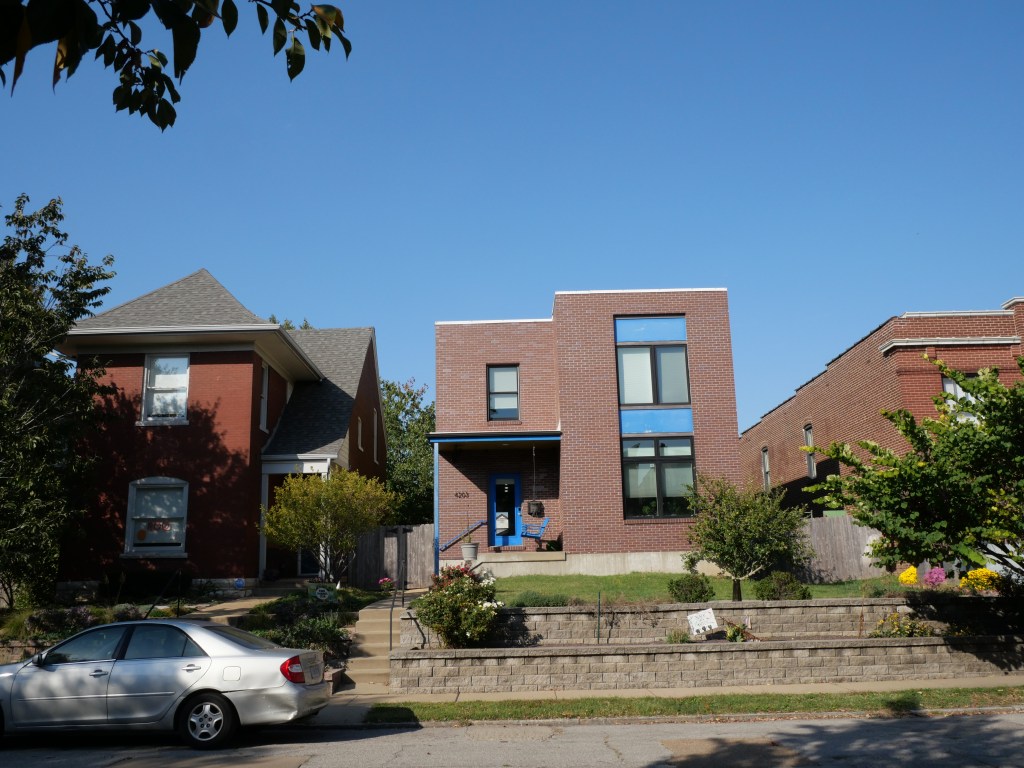
Botanical Heights- Successfull Revitalization Story of a South St. Louis Neighborhood ravaged by the I-44 Freeway and Crime & Drugs Issues

The area, originally referred to as McRee Town, was developed as a working-class neighborhood in the late 19th century with a mix of single-family and multi-family homes. But the neighborhood faced many challenges in the post War era including the construction of Interstate 44, and by the 80s and 90s major crime and drug issues leading to a concentration of low income African American Households. By 2000 over 50% of remaining structures in the neighborhood were vacant and in disrepair. But the community responded and by 2007 the local CDC, the Garden District Commission, took an aggressive approach buying out blocks of housing and restabilizing them or building new construction. 

Botanical Heights received its rebranding in the early 2000s as the community sought a fresh start. From an urban perspective, this is a solid district but still has missing pieces before it becomes a top tier neighborhood (i.e. more density, better parks, more rental diversity, better schools, and more amenities in the business district). Tower Grove Avenue is an attractive two-block biz node but largely contains food and beverage businesses. But the core revitalization strategy of the Garden District Commission has been successful and now for sale homes sell anywhere from the 200s, topping out at around 500K.  Given the neighborhood proximity to Dwtn, the Central West End, and other stable and attractive South St. Louis neighborhoods, the trajectory of the neighborhood seems good. I just hope it can retain its economic and racial diversity.

Click here to view my Botanical Heights Neighborhoo on Flickr

URBAN STRENGTHS:

  • Solid public transit access thanks to decent access to the light rail just north of the neighborhood. Thanks to good transit access and several dedicated bike lanes, there is good access to Dwtn among all modes.
  • Good sidewalk infrastructure and about 50% of all curbs are ADA compliant.
  • This was previously a pretty poor and Black dominate neighborhood. Since 2000 Botanical Heights has moved from 88% Black to 50% Black welcoming more white households with means. Many would call this gentrification but having concentrated Black poverty in a community isn’t a positive outcome either. The neighborhood is also pretty family friendly as well.
  • Nice mix of historic and new construction housing but mostly 3 & 4 bedrooms. The handful of 2-bed sell in the 200Ks and 300Ks 3 & 4 beds sell btwn 250K-500K.
  • Solid historic fabric in the residential and commercial areas. Also lots of residential in-fill housing including a mix of more traditional brick homes and modern infill.
  • Decent cultural amenities including a fair number of restaurants, bars & cafes concentrated along Tower Grove Ave. Missouri Botanical Gardens is also located just south of the neighborhood.

URBAN STRENGTHS:

  • only a handful of parks within the neighborhood but pretty close proximity to Missouri Botanical Gardens and Compton Hill to the south but I-44 separates them.
  • So so urban density.
  • There is a history of high crime in Botanical Heights but this is much improved since the 2010s. Still some blight especially along the industrial edges.
  • Tree canopy is a bit sparse in spots but improving thanks to the stabilization of the neighborhood.
  • Rental options are pretty limited. Some 1 & 2 beds. 1-bed lease in the low 1Ks and 2-beds in the 1Ks. More 3-bed options that lease from the mid 1Ks to the mid 2Ks.
  • School options are so so. A couple of private elementary schools within Botanical Heights. Several mixed-rated public schools on the edges of the neighborhood and also a really well rated public high school just east of it.
  • Urban form is mixed. Decent urban form along the two block biz district on Tower Grove Ave. Not as nice along Father Biondi ( the eastern edge). Along plenty of industrial uses along the edges of the district.
  • Beyond food & beverage businesses, retail amenities are pretty limited. There are a handful of boutiques, a running store, a couple bakeries/desert joints, several doctor’s offices and a major hospital on the eastern edge of the neighborhood. The extensive Forest Park SE biz district is only a 1-15 min walk from Botanical Heights.”

Shaw- A comfortable urban St. Louis neighborhood surrounded by some of the City’s best Parks

The Shaw neighborhood was named after Henry Shaw, the founder of Missouri Botanical Garden and major landowner in the area. Most of the homes in Shaw were built in the late 19th century and early 20th century as Saint Louis expanded westward. Shaw remained a stable middle-upper middle class neighborhood until the 70s when the overall decline of Saint Louis lead to disinvestment. Shaw, however, never saw widespread decline and managed to retain most of its built environment thanks to the tireless effort of grass roots efforts lead by  the Shaw Neighborhood Housing Corporation (SNHC), an outgrowth of the St. Louis Catholic Diocese. Shaw further stabilized with its designation as a Historic District in 1985.

From an urban perspective Shaw is a pleasant, relatively walkable neighborhood with a tidy urban grid lined with a nice mix of brick single family homes, duplexes, triplexes, and smaller apartment buildings. Shaw is surrounded by 3 large parks (Tower Grove, Missouri Botanical Garden, and Compton Hill Reservoir), and has a nice array of corner restaurants, bars, and cafe’s mixed throughout the district. Shaw’s biggest missing piece is retail amenities, as  there is no concentrated business district here. Shaw also has mediocre public transit access, limited walkable schools, and a lack of a dedicated bike share system like the rest of Saint Louis. For Shaw to really thrive it needs more mixed-use apartment buildings. Permitting more apartment buildings along Grand Avenue, Shaw Blvd, and Tower Grove Avenue would go a long way towards increasing the neighborhood’s density and adding much needed retail amenities.

Click here to view my Flickr Album of Shaw

URBAN STRENGTHS:

* Decent density at Shaw.
* Two dedicated bike lanes run through the neighborhood and mixed-use streets along Grand Ave and Shaw Blvd. So a pretty walkable neighborhood.
* Solid diversity indicators with decent racial diversity, better economic diversity, and excellent generational diversity. Good mix of families and young professionals here.
* Good side walk infrastructure but ADA curbs are generally concentrated only along arterials and mixed-use streets.
* Lots of commercial on the corner of residential streets creating a solid mixed use neighborhood.
* Excellent park amenities with the expansive Tower Grove Park to the south, Missouri Botanical Garden to the west, and Compton Hill Reservoir Park to the east. Just limited smaller parks within the Shaw neighborhood.
* Solid tree canopy.
* Some petty crime in the neighborhood but overall pretty safe.
* Attractive historic architecture especially along the boulevard streets.
* Good # of rentals with  1-bed range btwn 8000-1.3K, 2-bed btwn in the 1Ks, 3-bed btwn 1.5-2.5K. Also a decent # of subsidized rentals.
* For sale homes are higher than most St. Louis neighborhoods with 2-bed selling in the 200Ks & 300Ks, and a good variety of 3 & 4 bed options selling anywhere from  btwn 275K-725K. Limited 1-bed options.
* Decent cultural amenities including a good # of food & beverage businesses well spread out, a couple art galleries, the Missouri Cultural gardens, and the historic Tower Grove Park.
* In fill is limited to a mix of auto centric and quality urban uses along Grand Ave. Pretty solid urban massing through Shaw.

URBAN WEAKNESSES:

* Public transit is not great for an urban district.
* Some walkable schools within Shaw or nearby. Schools ratings is mixed.
* Retail amenities within Shaw are pretty lacking as there is no dedicated business district. Retail amenities include a  supermarket, a couple salons, a couple dessert joints including Damn Fine Hand Pies, a couple medical offices, and several churches. Still walking distance the Grand Avenue biz district to the southeast and smaller biz node in Botanical heights on Tower Grove.