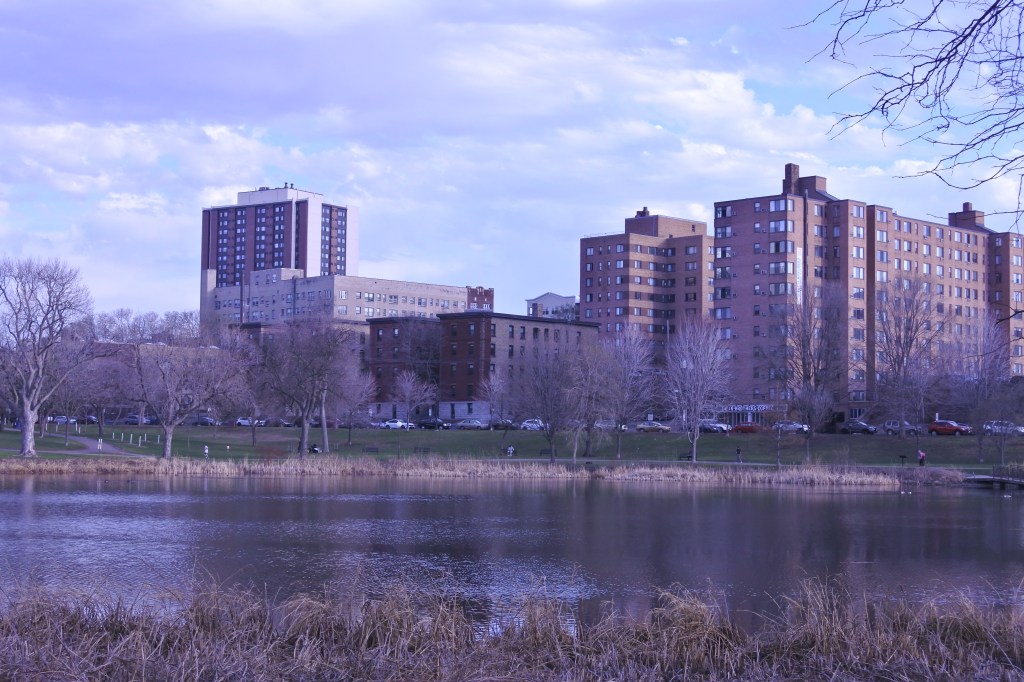
South St. Anthony Park- A Neighborhood in Transition located on St. Paul’s western edge along the Green Line

South Saint Anthony Park is centered around Raymond Avenue and University Avenue, and was built mostly as workers’ housing for people employed on the many nearby railroads. Saint Anthony Park is considered a seperated neighborhood located to the north of the railroads and historically was a much more affluent area that was established as a separate railroad suburb in the late 19th century. Although the two areas have very different histories and housing stock, they have grown more similar during the turn of the 21st century due to their convenience to both downtowns and to the University of Minnesota. S. Saint Anthony Park became increasingly industrial into the 20th century. Its housing stock likely experienced more disinvestment in the post war area than the rest of Saint Anthony Park.

From an urban perspective S. Saint Anthony Park, due to its great location along a ralline and significant historic industrial development, is seeing a lot of new multi-family buildings going up of pretty good quality. It remains a great location pretty equi-distance to both Twin City downtowns and very close to the University of Minnesota. The district also has solid bike infrastructure, good economic & racial diversity, solid retail & cultural amenities, and a good array of rental options. While there is good urban form along the western half of University Avenue and a nice historic pocket of homes north of University Ave, the eastern half of University Avenue has plenty of strip malls, autocentric and industrial uses. The eastern half and southern edge of the districts is still mostly industrial reducing neighborhood tree canopy, park space, quality sidewalk infrastructure, and density. But I foresee the neighborhood continuing to fill in with more and more dense mixed-use housing leading to a gradual urban improvement to the district.

Click here to view my South St. Anthony Park Album on my Flickr Page

URBAN STRENGTHS:

* Great public transit thanks to a ralline that runs through the neighborhood.
* Very convenient access both to Dwtn St. Paul and Minneapolis. About a 15 min drive and 30 min train ride. About a 25 min bike ride.
* Decent bike lane network but Saint Paul only has a dockless bike share system.
* Great economic diversity and decent racial.
* Generally a safe neighborhood but a good amount of industrial space.
* Good # of rentals. Studios and 1-bedrooms generally rent anywhere in the low-mid 1Ks, 2-beds lease any where from the low 1Ks to the low 2Ks. Only a handful of 3-beds.
* Solid architecture (both historic and modern).
* Pretty good cultural amenities including several restaurants, bars, and cafes, plenty of art galleries, a Irish Bar w/ live music, several breweries, a railroad museum, and a couple local theaters.
* Decent retail amenities including a Co-op, a pharmacy, a hardware store, several boutiques/clothing stores, a couple antique/furniture stores, a couple banks & salons, a couple bakeries & gyms, a bike store, a couple of pet stores, a handful of churches & medical offices, and a local post office.
* Good urban form along the western half of University Avenue (the many drag). The eastern half has more strip malls and industrial space but is improving with more and more infill. Raymond Ave is the secondary biz district and extends a couple blocks off University Ave with a decent urban note at Hampden. 

URBAN WEAKNESSES:

* Very low density for an urban district thanks to all the highways, railroads, and industrial parks the chop the neighborhood up.
* ADA and sidewalk infrastructure is a bit spotty due to all the industrial land use.
* Streets generally connect but poor grid and connectivity due to all the industrial land use and highways /railroads chopping up the grid.
* So so walkable schools.
*  Decent number of 1-bed condos that generally sell in the 200Ks, some 2-beds but not a ton selling in the 200Ks & 300Ks, 3 & 4 beds sell btwn 200Ks-400K and are mostly SF detached homes.
* Tree canopy is ok in the SF residential streets but more than half of Saint Anthony Park is current. Former industrial space with few trees.
* South St. Anthony Park is really the only recreational space in the district. Good park with decent amenities but pretty small.
* Missing a local public library although there is one just north of here in Saint Anthony Park. Could also use a supermarket and more creative retail.
Lots of Industrial space in the southern edge and eastern half of the district which often has poor urban form and streetscaping.

Whittier- the Heart of Minneapolis’ Asian Community

Similar to Uptown, the Whittier neighborhood mostly developed in the late 1800s and early 1900s and maintained a dense population and high rental occupancy into WWII. Whittier is a classic case of missing middle housing where any residential block can see medium density apartment buildings sitting next to single family homes. But like most inner-city Minneapolis neighborhood’s the post War era was not kind to Whittier as middle class white families moved out and left behind struggling business districts and disinvested residential properties. Fortunately the residents of Whittier organized in the late 70s creating several  Community Development Corporations to combat the neighborhood’s decline. By the 1980s Whittier became home to many in the counter cultural Bohemian movement and large Chinese and Vietnamese communities moved into the neighborhood opening many food based businesses along Nicollet. Thanks to their investments to the biz district, neighborhood leaders rebranded Nicollet Street as “Eat Street”. Mexican businesses too opened but later in the 1980s and 1990s further diversifying the community. By the 2000s major private housing  investments began with three major condominium projects along Nicollet Avenue. Whittier’s housing and business district market have continued to stabilize and many would say that the neighborhood is on a gentrification trajectory.

Fortunately, there remains a significant of affordable rental and condo supply for middle income families. Whittier is also one of Minneapolis’ more walkable neighborhoods thanks to three business districts (Nicollet, Lyndale, and Lake), hosts three museums including the Minneapolis Institute of Art, has great transit and bike infrastructure, and a surprisingly full tree canopy. For Whittier to be a premiere urban district it needs to continue promoting dense in-fill development along its commercial corridors as  they still host a fair amount of autocentric development, improve its ADA infrastructure, and build more park and school amenities.

Click here to view my Whittier album on Flickr

URBAN STRENGTHS:

* Solid urban density. Nice mixture of SF and middle apartments buildings on residential streets. Lots of Missing Middle housing here.
* Very convenient access to Dwtn. Only 10 minutes by bike, 5 by car, and 20 by bus.
* Good sidewalk infrastructure but modern ADA curb cuts only fill about 40% of all intersections.
* Generally good urban form along the biz districts (Lake, Lyndale, & Nicollet)  but sizable autocentric stretches especially along Lyndale & Lake.
* Solid historic and in-fill architecture but generally not spectacular.
* Solid tree canopy.
* Generally a safe community with a couple pockets of sketchy areas.
* Excellent bike infrastructure including several separate lanes, the Midtown Greenway running along an old railroad ROW, and plenty of dedicated bike stations.
* Great economic and racially diversity. Also pretty good generational diversity.
* Great rental diversity w/ tons of studios leasing btwn 750K-1.3K, 1-beds btwn $850-1.5K, 2-beds lease btwn 1K-2.5K, and good # of 3-beds leasing btwn 1.5K-2.5K.
* Great sidewalks amenities but modern ADA curb cuts cover maybe 60% of all intersections.
* Good diversity of 1-bed condo selling anywhere btwn 75K-320K, great diverse 2-bed options ranging for dated condos to modern condos, townhomes, and SF home selling btwn 150K-500K. Good diversity for 3 & 4 beds selling between 200K-900K .
* Good cultural amenities including plenty of restaurants, bars & cafes, the Minneapolis Institute of Art & Hennepin History Museum, Children’s Theater company, several Asian Markets along Hennepin, a couple live music venues & a performing arts & Improve theater.
* Solid retail amenities as well including 4 supermarkets & 3 drug stores, decent # of boutiques/clothing stores, a bookstore, several salons, several dessert shops & gyms, a couple floral shops, several record stores, a post office, a medium sized hospital & plenty of medical offices.

URBAN WEAKNESSES:

  • Some missing /limited retail amenities including public library, churches, hardware store, and larger department stores.
  • Really on two parks in Whittier: Washburn Fair Oaks & Whittier Park which also has a recreation center. At these they are decent sized parks with good amenities.
  • Some walkable schools and but well rated.
  • Several autocentric spots along Lyndale and Lake Avenue.

Ventura Village- Inner City Neighborhood just South of Central Minneapolis and Home to Many Somolian & African Immigrants

Ventura Village historically was considered part of the larger Phillips neighborhood which stretches down southwards from the highway all the way to Lake St. This changed in the early 2000s when a  group of residents in what was then District 2 of Phillips, decided the best way forward for the northern area around Franklin Avenue, was to separate from the rest of Phillips.  Local residents seem to be embracing this overall and additional sub-neighborhoods of the larger Phillips district have formed (i.e. West Phillip, Midtown Phillips, East Phillips). Ventura Square however feels to me the most distinct and deserving to be evaluated as a separate neighborhood given its proximity to Central Minneapolis and distinct commercial district along Franklin Avenue. For the purposes of this evaluation I consider the southern boundary of Ventura Square to be 24th St, the other boundaries are the highways.

Phillips as a whole is very diverse and is the heart of the immigrant community in Minneapolis. It is not surprising that the Midtown Global Market was built here. In Ventura Village the overwhelming immigrant communities are Somalian and other African nations. The influx of immigration in Ventura Village has helped reverse decades of urban decline and white flight that came here in the post WW II area. Immigrants are also likely the driver to lowered crime which plagued the neighborhood in the 1990s and early 2000s. Likely because of this influx of immigrants Ventura Village is much more intact and stable than many African-American concentrated districts in Northern Minneapolis. From an urban perspective Ventura District does well with high density, great diversity, a good # of walkable schools, good housing diversity, and decent park and retail amenities. For it to become a top tier Minneapolis urban district it needs more households with higher incomes who can help drive necessary in-fill housing (esp. along Franklin), needed retail and cultural amenities, and a better urban form along Ventura Village’s main commercial district, Franklin. This trend of higher incomes moving to the community seems to already be in motion. I just hope that the neighborhood can accommodate this while still holding on to its diversity.

Click here to view my Ventura Village Album on Flickr

URBAN STRENGTHS:

* Solid urban density.
* Excellent public transit access and great access to Dwtn being just south of the Central Minneapolis District. Good multi-model access overall. Several bike lanes in Ventura Village along with plenty of dedicated bike stations.
* Pretty diverse neighborhood with large Hispanic and Black populations and modest White households.
* Good # of walkable schools but most are smaller private schools and the few public schools are rated poorly. Coverage of all ages though.
* Decent # of rentals but much less than neighboring Stevens Square. Studios & 1 beds lease btwn $800-1K, 2-beds lease btwn 1K-2K. Good # of 3 beds generally leasing in the mid-high 1Ks. Good amount of affordable rentals in Ventura Village.
* Only a handful of 1-bed condos leasing in the mid-100Ks.  Slightly more 2-beds selling btwn 80K-270K, and lot of 3 & 4 beds sell btwn 100K-450K. Lots of house type diversity among 3-beds.
* Good park amenities including two medium sized parks with lots of amenities, two community centers, and an indoor pool.
* Decent retail amenities including an ALDI’s, several ethnic groceries, a couple drug stores, a Dollar General, a hardware store, a couple banks, a bakery, a couple churches, and two major hospitals (Children’s & Abbots) that sit a couple blocks south of the neighborhood.

URBAN WEAKNESSES:

  • Not a lot of income diversity as there is a high % of household in poverty or lower-middle class.
  • Good sidewalk infrastructure but ADA curbs are not very consistent.
  • Crime is much less than the 1990s and 2000s but still present and a good amount of blight & vacancy remains in the community. This seems to be changing quickly though with lots of new investment.
  • Pedestrian activity is a bit lacking.
  • Very eclectic architecture styles and areas. But a lot of bland historic homes and unattractive mid-century buildings and cheap more modern apartment buildings. Also a good amount of autocentric development along Franklin Ave.
  • So so cultural amenities including several restaurants (many ethnic) and a couple cafes. Also a couple art galleries and a performing arts theater,”

Loring Park- Great Inner City Minneapolis Neighborhood with Excellent Access to Park Space

Loring Park was established in 1883 after the passage of the Park Act, which first created the Minneapolis Park and Recreation Board. The neighborhood filled in shortly afterwards with most of the neighborhood built out by the early 20th century. Loring Park received a significant amount of urban renewal and rebuilding of its fabric thanks to the passage of the 1972 Loring Park Development  increment financing district. While this removed a lot of historic mixed-use buildings and retail spaces, it increased the neighborhood’s residential density and created some additional office and hotel uses.  Current day Loring Park is a real hodge podge of old and newer uses and the population has been increasing since the 1970s and has doubled in last 50 years.

Loring Park has great access to Downtown and is one of Minneapolis’ most walkable districts. Loring Park and Loring Greenway give residents excellent access to green space and the District also hosts a great array of cultural amenities. For Loring Park to be a top tier urban district  it needs more retail amenities within its boundaries. To achieve this retail space needs to be intentionally created to counter act the legacy of the neighborhood’s urban renewal efforts which created mostly single use buildings. 

Click here to view my Loring Park Album on Flickr

URBAN STRENGTHS:

* Solid urban density.
* Excellent public transit access and bike access as well. Overall a very walkable neighborhood.
* Great racial and economic diversity.
* Lots of rental options including a good array of price points. Plenty of studios leasing anywhere btwn $700-1.7K, 1-beds btwn $900-1.8K, 2-beds btwn 1K-2.2K. Only a handful of 3-beds. Decent number of affordable housing as well.
* Good condo options with most 1-beds selling btwn 100K-300K and some luxury condos selling around 600K. Lots of 2-bed condos ranging anywhere from 150K-800K.  Good amount of 3-beds selling btwn 150K-600K. Really no 4-beds.
* Excellent park amenities starting with the spectacular Historic Loring Park with diverse amenities. Loring Greenway branches out  of Loring Park cutting through the heart of Loring Park. Minneapolis Sculpture Park is located just across the highway in Lowry Park.
* Nice mix of historic and modern urban in-fill. The 60s 70s balcony apartments are also pretty nice as they mostly face the Loring Greenway.
* Some homeless issues but overall a very safe neighborhood.
* Good cultural amenities including a decent amount of food & beverage bizs, a couple smaller performing arts venues, the Loris Park Community Arts Center, and walkable access to several theaters on Hennepin and several museums nearby and plenty of other Dwtn cultural amenities.
* Generally good urban massing. Not too many surface parking lots. Most buildings have a good urban orientation but a fair amount of 1960s/1970s building that don’t have great human scale.

URBAN WEAKNESSES:

  • Limited generational diversity. Few children reside in Loring Park.
  • Retail amenities within Loring Park are pretty underwhelming given the neighborhood’s density and Center city Location. Amenities include a supermarket, a game store, a couple gyms, several churches, the Minneapolis Convention Center, several salons, a bridal store, and pretty good access to a major hospital in Elliot Park. Good access to a decent # of retail amenities in Downtown Minneapolis.