Shoreditch really got its start as an important centre of Elizabethan theatre in the 16th given its location just outside of the rather Puritanical laws of the City of London. Shoreditch has continued to be an important entertainment centre since that time. The east–west course of Old Street–Hackney Road, which runs along the north border of Shoreditch, was originally an important Roman Road connecting London to the countryside. During the 17th century, Shoreditch started to develop with wealthy traders and French Huguenot silk weavers moving into the area establishing a textile industry. By the 19th century, Shoreditch transitioned into a hub for the furniture industry. These industries, however, declined in the late 19th century.
During the turn of the 19th century, Shoreditch was a centre of entertainment to rival the West End and had many theatres and music halls. However this was not to last as Shoreditch was heavily bombed during the Second World War loosing much of its historic housing stock and the neighborhood faced significant decline in the post War era as both its textile and furniture industries declined. Shoreditch remained an underinvested community until the 1990s when the area became fashionable again with a strong association with the creative industries. Since the 2000s Shoreditch and Old Street have become popular with London-based web technology companies centered around the East London Tech City district near the Old Street tube station.
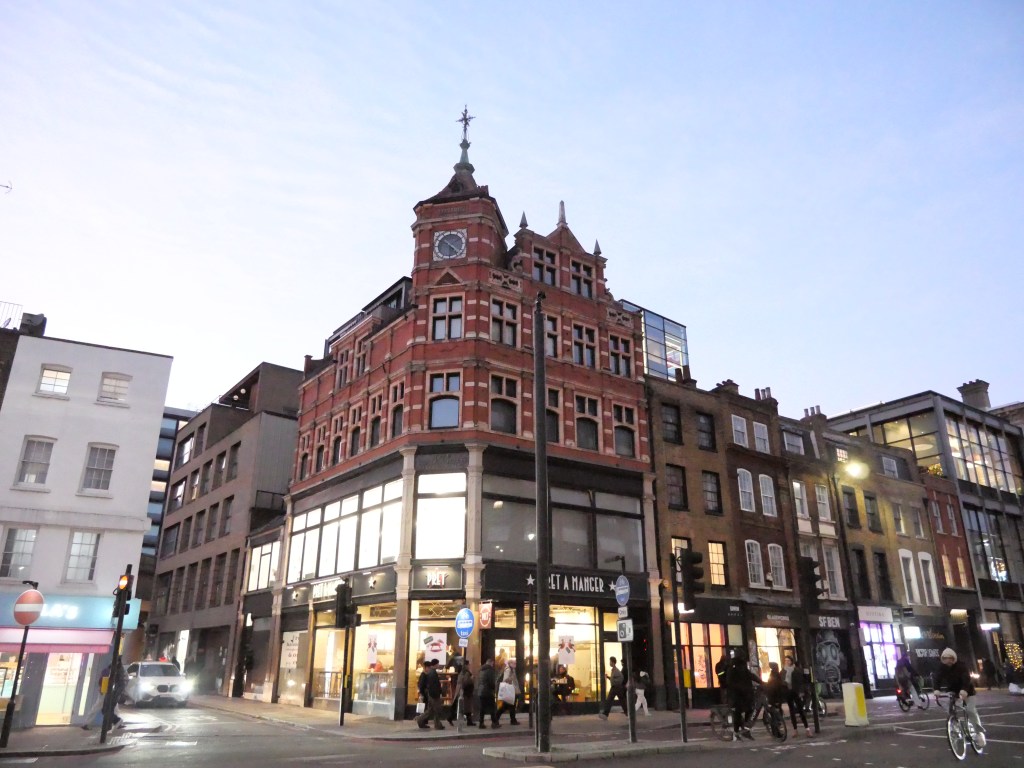
From an urban perspective Shoreditch is a lovely, heavily mixed-use area with an interesting mix of smaller scale historic blocks and larger modern infill. The area has great access to the Tube system and is located just north of the City of London. Shoreditch has great access to all the market destinations of Spitalfields while avoiding the crowds. The Old Street Corridor continues just west of Shoreditch and hosts a solid commercial district and several more intimated mixed use lanes.
Click here to view my Shoreditch Album on Flickr
URBAN STRENGTHS:
* Good biz districts along Curtain and some excellent narrow mixed use streets perpendicular to it (Rivington & Charlotte Rd)
*Very eclectic neighborhood. More Dwtn feel on the southern edge. Mix of mid century, modern infill and traditional East London rowhouses. Most of the district has a strong mixed-use feel.
* Some cool commercial uses along Great Eastern/ Old St and Whitecross Street.
* Several nice mixed-use streets in the western edge of Shoreditch (i.e. Leonard and Paul)
* Boundary Gardens is great urban park with attractive brick terrace housing surrounding it and surrounding blocks. The development was built in the late 19th century as part of a slum clearing effort.
* Much less touristy than adjacent Spitalfields.
* Several subway lines serve the neighborhood at Shoreditch High St Station. Old Street also has a tube stop along Black Line.
* Solid density around 40K residents per square mile.
URBAN WEAKNESSES:
- Better park space and tree canopy than Spitalfields but still not great.
- Seems to be a lot of biking activity even though dedicated bike lanes are in short supply.

 Evaluating our Urban Communities [with a focus on America]