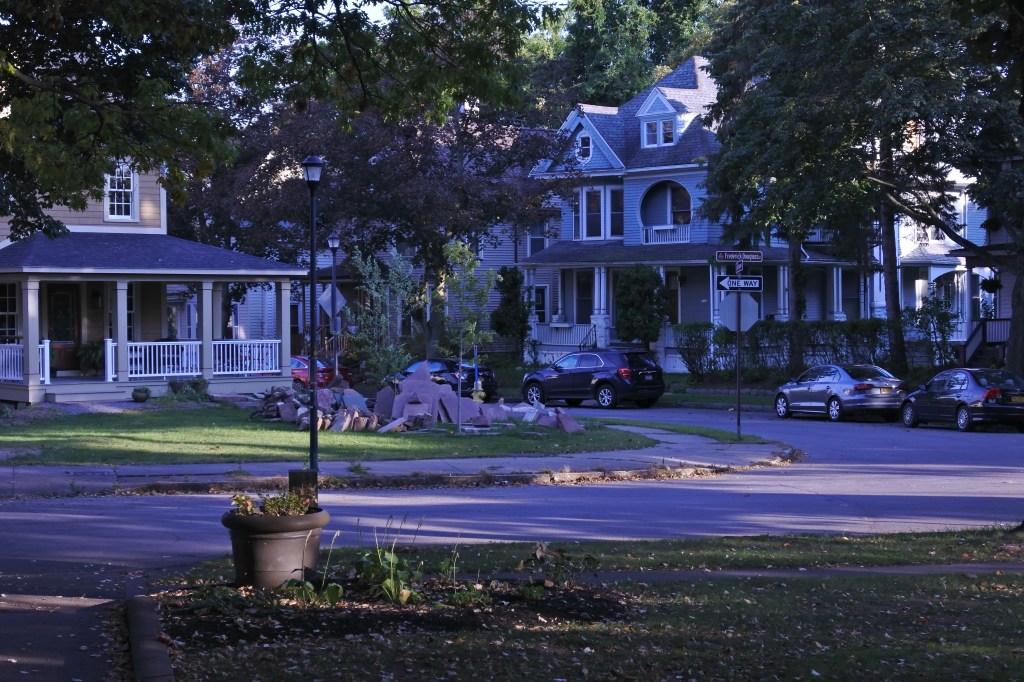
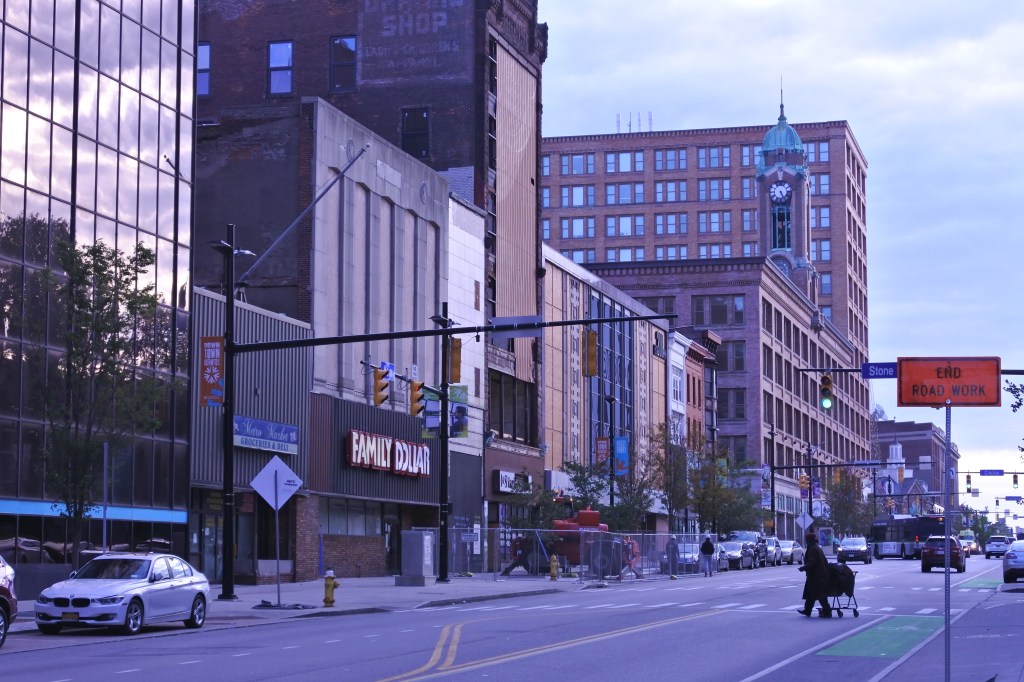
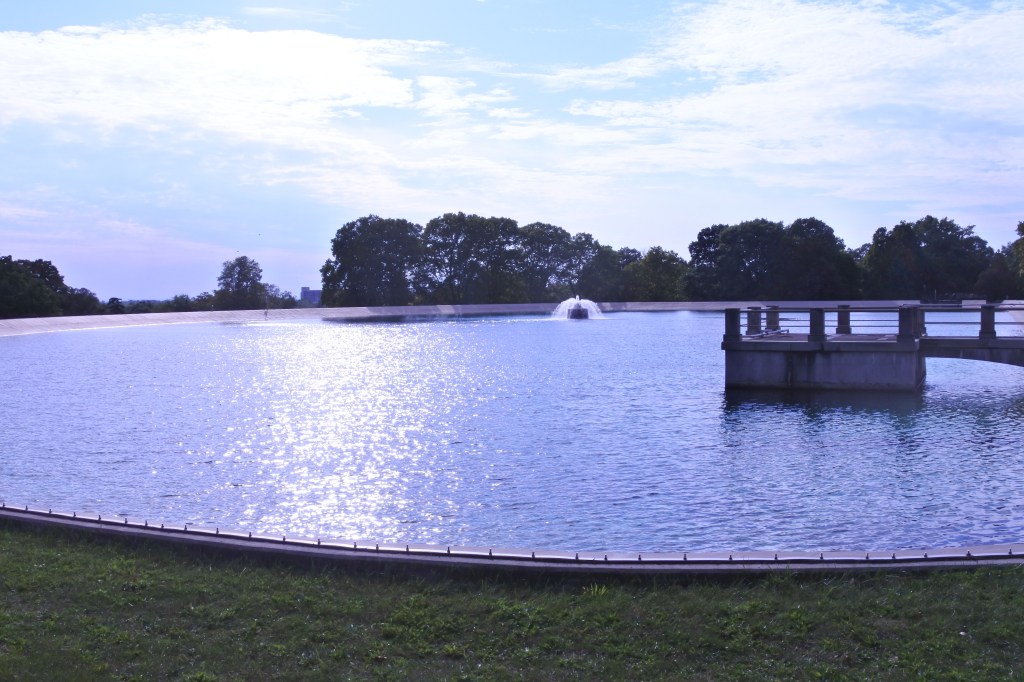
Shaker Square- A Transit Rich, Walkable, and Diverse Cleveland Community

Shaker Square is technically in Cleveland’s Buckeye-Shaker neighborhood but I carved out what is more considered the Shaker Square/Larchmere district. This includes the most stable portion of the Buckeye-Shaker neighborhood and even a sliver of Shaker Heights. It is the area between the western border of Shaker Heights and Moreland Blvd (in the southern half) and the area between Shaker Square-Fairfield Hill Drive and MLK Dr and Coventry Rd in the northern half. Shaker Square has lived on the edge of some of Cleveland’s most impoverished and blighted communities (i.e. Buckeye, Mt. Pleasant and Woodland Homes) since the 1960s. What has kept it stable is the success of the Larchmere and Shaker Square biz districts and the stability of the Shaker School district present in the eastern half of the neighborhood.

Development of Shaker Square as a American Colonial-Georgian Shopping Center began 1927. At completion, it was the second planned shopping Center in the US after the Country Club Plaza in Kansas City. Many attractive restaurants, shops, bars, art galleries, and unique shops line Shaker Square and Larchmere. The neighborhood is also anchored by a cinema & Dave’s Supermarket. Other urban amenities include great transit access, stable but affordable housing, a high level of walkability, great tree canopy, and attractive architecture especially the 1920s Tudor Apartment buildings. Shaker Square still suffers from perceived crime problems and this has really held the neighborhood back and kept it highly undervalued from a real estate perceptive. Most of this concern is mis-placed due to Shaker Square’s close proximity to poorer parts of Cleveland. The neighborhood also needs better park amenities, bike infrastructure, and better performing schools in the Cleveland School District portion of the community. There is certainly also room for more density which would increase neighborhood vibrancy and amenities.

Click here to view my Shaker Square Album on Flickr

URBAN STRENGTHS:

* Excellent transit access thanks to many bus lines and a dedicated rail line. This helps give Shaker Square solid access to Dwtn and University Circle.
* Great diversity across racial, economic, and generational lines. Over 50% of households are family households.
* Housing is generally affordable or moderately priced. Some 1-bedroom condos available mainly around Shaker Square selling in the low-mid 100Ks. 2-bedrooms condos, homes and townhouses sell from anywhere btwn 50K- low 200KS deepening on size and condition. Single Family 3-5 bedrooms sell anywhere between 50K-200K.
* Rentals are also very affordable. 1-beds lease for anywhere btwn 600K- the low 1Ks, 2-beds around $1,000s,  and 3 beds in the low $1,000s.
* There is also a decent amount of dedicated affordable housing.
* Great Tree canopy.
* Shaker Square hosts some good cultural amenities including many diverse restaurants, plenty of bars, cafes, and several art galleries. There is also a Cinema and dance studio.
* Retail amenities include a Dave’s Supermarket, Drug Store, a wonderful book store, nice array of boutiques, antiques, creative stores, and home good stores. There are also several dessert spots, a local post office & library, several gym, a specialty hospital, and indoor ice rink.
* Quality historic architecture, especially considering the Tudor apartments. Modern in-fill is generally quality too.
* Urban massing and streetscape is generally quite good other than a couple auto centric spots on Larchmere.

URBAN WEAKNESSES:

* Decent but not great density. A bit surprising considering all the apartment buildings in the neighborhood.
* Bike infrastructure is limited to only the dedicated bike lanes on MLK Boulevard.
* If anything there is not enough higher end luxury product in Shaker Square since the market is so soft.
* Schools are a mix of well performing schools in Shaker that some residents have access to and the poor performing schools in Cleveland. Fortunately in Cleveland there are a couple well performing charter schools and a good Catholic High School and Grade School.
* The neighborhood is generally safe, especially the areas next to Shaker Heights, Larchmere, and Shaker Square itself. Areas around Moreland and MLK Blvds can be a bit dodgy.
* Other than Ambler and Rockefeller park on the north edge, park space is pretty limited.
* Shaker Square sadly still suffers from perspective issue. This is mostly unjustified due to its close proximity to rougher parts of Cleveland. This largely holds the neighborhood’s potential back.
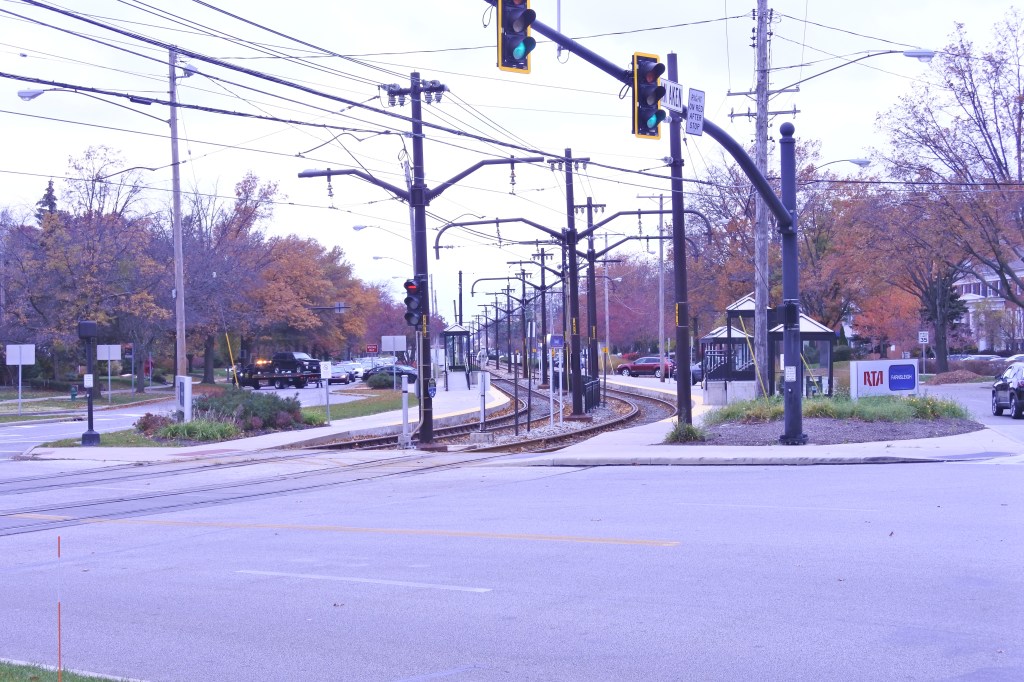
Shaker Heights- A well planned Cleveland inner Ring Suburb

In July 1911, a petition by property owners successfully detached Shaker Heights from Cleveland Heights. But Shaker Heights has a history that goes back almost 100 years before this. The community was originally established as the North Union Shaker Settlement in 1822 with just over 80 individuals of the infamous Unity Society of Believes “aka the Shakers”. The community peaked in the mid 1800s but fizzed out by the late 1800s. Modern day Shaker Heights was a planned community developed by the Van Sweringen brothers, railroad moguls who envisioned the community as a suburban retreat from the industrial inner city of Cleveland with a direct rail connection to Terminal Towner in Downtown. Development really picked up in the 1920s and Shaker filled in by about 1950.


Shaker Square was originally supposed to be within the Shaker Heights boundaries, but due to the founders’ wish to keep retail out of their community, it was given over to the city of Cleveland. This agreement also led to this portion of Cleveland remaining within the Shaker School District. Shaker Heights has been an attractive, amenity rich inner ring suburb since its founding characterized by stringent building codes/zoning laws, great park amenities, well rated schools, quality transit access, and good urban business districts. Like Cleveland Heights, Shaker made conscious efforts toward Black-White integration starting in the late 1950s. As a result, Shaker Heights avoided many of the problems created from practices such as blockbusting and white flight and now is a very integrated community, albeit still facing significant economic white-black disparities. To become a great urban community Shaker needs to relax its zoning and permit more density and mixed use development. It especially needs better urban development at the Van Aiken District and Lee & Van Aiken. This is also need for more bike infrastructure and cultural amenities.

Click here to view my Shaker Heights

URBAN STRENGTHS:

  • Excellent family diversity (65% Family households) and racial diversity.
  • Great transit access helped by have two light rail lines running through.
  • Very safe community overall.
  • Up to date ADA infrastructure was very consistant.
  • Excellent array of walkable public and private schools. Really impressed with the sheer number of elementary schools providing a walkable options to most residents of the City. Shaker is also home to a large concentration of expensive private high schools.
  • A decent # of rentals. 1-bedrooms are concentrated around Shaker Square and the Van Aiken District and lease for btwn $700 and the low $1,000s. 2-beds a bit more broadly distributed lease in the law $1,000s, and 3 bedrooms btwn the low 1Ks and low 2Ks.
  • Good for sale diversity. Cluster of 1-bed condos along Van Aiken selling btwn 30K-100K, 2-beds sell for anywhere btwn 30K-300K and can be a condo, small house or townhouse. 3-bed homes sell anywhere btwn 85K-400K. 4 & 5 beds is a bit more expensive but with the additional of mansions selling btwn 500K-1 M.
  • Excellent recreational amenities including a whole system of trails, woods, and lakes along Shaker’s natural streams. Instead of burying them (like most cities) Shaker made them assets. Also plenty of playgrounds, ballfields, and a swimming poor spreader throughout.
  • Culturally a decent amount of restaurants, bars, and cafes in Shakers 4 Commercial nodes (Shaker Square/Larchmere, Lee & Van Aiken, the Van Aiken District, and Fairmount Circle), several art galleries, the Shaker Square Cinema, and Shaker Historical Museum.
  • Retail amenities are good including 2 supermarkets, several drug stores, a wonderful bookstore, hardware store, lots of general retail, great array of boutiques and creative retail at Larchmere and the Van Aiken district, plenty of banks, dessert spots and gyms.
  • Excellent tree canopy.
  • Many gorgeous mansions but also lots of more modest mid century architecture.

URBAN WEAKNESSES:

* Poor urban density. Closer to that of an autocentric suburb than urban district.
* Street connectivity works in Shaker Heights but intentionally confusion. This certainly hurts Shaker’s imageability.
* A couple recreational/bike lanes but no dedicated bike lanes are strongly connected routes.
* Medium household income but still some decent diversity. 8.5% of population is under the poverty line.
* No community theaters, museums, or live music venues in Shaker.
* Mixed bag in terms of urban form with Shaker’s Biz district. Shaker Square (just outside of Shaker) is great and so is Larchmere. Lee & Van Aiken is mostly strip malls with parking in front, the Van Aiken District is quasi urban but a nice semi-lifestyle center, and Fairmount Circle is small but walkable.
* Having lots of auto centric biz districts obviously leads to some crummy modern in-fill. Good mixed-use infill at the Van Aiken District however.
* Outside of the business district, pedestrian activity is pretty sparse. 

Cleveland Heights [West]- An Affluent but Urban Cleveland Suburb

For evaluation purposes I divided Cleveland Heights around Superior Road. Southwest of Superior Road is what I consider to be West Cleveland Heights. This is the more affluent, urban, and amenity rich portion of Cleveland Heights that contains its best housing and the business districts of Cedar-Lee, Coventry, Cedar Fairmount, and Cedar Taylor.

Rockefeller was one of the first to come to Cleveland Heights at present day Forest Hills Park. More consequential development began with the Euclid Heights development in 1892. By the end of 1899 the streetcar reached Cleveland Heights along Mayfield Road to the old village of Fairmount. In 1910 Cleveland Heights had a population about 5,000 people and 15,400 by 1920, This tripled in the next decade and by 1960 the City hit its highwater mark of 61,813. Cleveland Heights is one of Cleveland’s most diverse urban areas. This first began in the 50s when the City saw a large influx of many Jewish people leaving Cleveland, particularly the Hough and Glenville neighborhoods. The City also dismantled its restrict covenants in the 1960s and encourage many African American families to move to the City helping the City move from only 1% Black population to its current representation around 40%.,

From an urban perspective West Cleveland Heights excels at having multiple concentrated urban business districts well distributed across its borders. It also has gorgeous historic architecture, high levels of cultural and retail amenities, convenient access to University Circle, excellent housing diversity, and is safe. Surprisingly Cleveland Heights has very low density. These leads to vibrant activity being concentrated in its biz nodes. There is also need for better schools, more bike infrastructure, and several autocentric areas along Mayfield Rd.

Click Here to view my Cleveland Heights [West] Album on Flickr

URBAN STRENGTHS:

* Generally very good ADA infrastructure minus some intersections without modern ADA infrastructure.
* Access to Dwtn Cleveland is pretty good but excellent access to University Circle an employment center of around 30K jobs.
* Excellent economic diversity but also racial and family diversity.
* Excellent diversity of for-sale housing. A good # of 1-bedroom condos selling anywhere btwn 80K to the low 200Ks; 2-bedrooms are either older condos selling in the 100Ks/low 200Ks or new townhomes selling in the 300Ks & 400Ks. Most 3 bedrooms sell between 75K-300K but some larger and newer townhouses sell around 400K & 500K.  4 & 5 bedrooms also have a great range. The large mansions sell btwn 500K and 1 M.
* Rentals are generally very moderately priced. 1 beds lease anywhere btwn &700 to low $1,000s, 2 beds btwn 800K and mid $1,000s, 3-beds in the low-mid $1,000s. 4 beds a bit more.
* Solid park spaces ring west Cleveland Heights including  Doan’s Broke (aka Shaker Lakes), Lake View Cemetery, Forest Hill Park, and Cumberland Park, and Cain Park/
* Culturally a good number of ethnic restaurants, bars, cafes, and breweries. Also a historic cinema that still operates, several local theaters and art galleries, and convenient access to all the museums and other cultural amenities of University Circle and Little Italy.
* Solid retail amenities as well including  3 full service supermarkets, drug store,  several book stores, a hardware store, banks, dessert joins, and plenty of boutiques and unique retail dispersed among Cleveland Heights several solid commercial nodes. There is also a public library, several top notch hospitals located 2-3 miles away in University Circle and many big box stores in Several & brand name retail in Severance Town Center 1 mile away.
* Excellent tree canopy.
* Great historic architecture and generally urban in-fill is good except for some auto centric bldgs here and there.

URBAN WEAKNESSES:

* Nice dedicated bike lane along the Shaker Lakes and a small one along Lee road but no dedicated bike stations.
* Poor density at just over 5,000 per square mile.
* Good pedestrian activity in the commercial nodes. Pretty dead in the residential streets, especially where the larger homes are located.
* Good array of walkable schools but rating are only okay.
* Generally a safe City but some rough spots, more in east Cleveland Heights however.

Corn Hill- Rochester’s oldest neighborhood

Corn Hill is the oldest residential neighborhood in Rochester built just southwest of Downtown and still has homes standing from the 1830s and 1840s. Fortunately much of the neighborhood’s historic residential architecture has been preserved. Its unclear if Corn Hill ever had a vibrant business district. The Southeast quadrant of the neighborhood was redeveloped in the early 2000s with generally historic looking and contextual development. A decent but auto centric mixed-use shopping plaza and apartment development was built in 2008 called Corn Hill Landing. At least this development brought much needed retail to the community.

Additional population and commercial amenities is the biggest need for Corn Hill. Other areas in which it could improve include more walkable schools, better cultural amenities, and better ADA infrastructure. 

Click here to view my Corn Hill album on Flickr

URBAN STRENGTHS:

* Good public transit access and very convenient to Dwtn Rochester.
* Nice dedicated bike lane along the River front.
* Excellent racial and economic diversity. Average family diversity with about 31% of households as families.
* For sales homes are generally pretty affordable. Because of the newer townhouse development there are is a good # of 1-bedrooms selling in the 100Ks. 2-beds sell in the 100Ks and 200Ks 3-beds sell btwn 150K-300K and 4-beds with the same + some larger homes selling in the 300Ks.
* Significant % of the new housing was preserved for affordability.
* Park amenities are pretty good including a couple playfields, basketball courts, playgrounds, a rec center, waterfront trail, and the historic Lunsford Circle Park.
* Solid tree canopy.
*Good number of churches and a local public library branch.
* Generally a safe district but still some rough/dead spots.
* Excellent set of historic homes. The urban form of the in-fill housing is pretty good but architecture a bit tacky. The shopping center is very tacky and rather auto centric.

URBAN WEAKNESSES:

*An ok grade school is located in the neighborhood. Several other schools in surrounding neighborhoods but not really walkable.
* Rentals are limited. What is listed is generally moderately priced.
* A handful of restaurants, bars, and shops thanks to the Corn Hill Landing shopping center. Major retail amenities missing include a supermarket, pharmacy, banks, and post office.
* Other than several restaurants & bars a couple art galleries limited cultural options. At least you are a 5 minute car ride to Dwtn though.
* Sidewalks are generally in tact but current ADA curbs hit or miss.
* Really no biz districts to speak of. The main arteries Ford St. and Exchange Blvd. function more like Blvds in the suburbs.
* Very quite neighborhood. Not a lot of vibrancy.

Rochester’s Brown Square- Home to Kodak’s World Headquarters

Brown Square is one of Rochester’s oldest neighborhoods and home to much of Rochester’s early industrial development of the 1830s. Widespread development occurred in the mid-late 1800s as Brown Square was settled by Italian, German, Irish, and  most recently Puerto Rican immigrants. Along the Genesse River near High Falls many warehouses and industrial uses were constructed. Historically State Street was a major north-south arterial in the City, and Kodak built their headquarters here in 1915. Sadly like many Rochester neighborhoods, Brown Square has not recovered since its post WW-II fall and is considered part of Rochester’s ” Crescent of Poverty”, a cluster of neighborhoods centered around the northern border of Downtown Rochester characterized by extreme poverty and crime.

Some revitalization has come to Brown Square including the repurposing of the Kodak Campus, renovating many warehouse buildings overlooking High Falls into lofts, restaurants, and creative stores, and two new stadiums. The stadiums unfortunately led to the demolition of large swaths of the district thanks no only to the stadium’s footprint but also to the ample amount of parking that surrounds them. Fortunately the neighborhood has held on to two attractive parks spaces (i.e. Brown Square Park and Jones Square Park).

What Brown Square needs is the intentional purchasing and redevelopment of the majority of the neighborhood. That is the type of intervention really needed to bring this neighborhood back. As so much of its fabric has been demolished, it can’t be affectively redeveloped piecemeal.

Click here to view my Browns Square Album on Flickr

URBAN STRENGTHS:

* Excellent public transit access. One of the best served neighborhoods in Rochester.
* Very convenient access to Dwtn as it sits just north of the western half of Dwtn.
* Several disjointed bike lanes in the neighborhood.
* Excellent racial diversity and average generational spread.
* Decent park amenities with the medium size Jones and Brown Square Parks and the outdoor Edgartown Rec Center.
*Some good cultural amenities including the Minor League ball park, a soccer stadium, a major artist center, several restaurants, a handful of bars& cafes, and a couple historic sites along the falls.
* Some nice warehouse buildings remain along the Falls and the old Kodak Highrise is great. Some decent in-fil apartments along the Falls as well.

URBAN WEAKNESSES:

* Very poor district as the medium household income is around 15K.
*A decent grade school is located in the neighborhood. Several other schools in surrounding neighborhoods but not really walkable.
* Housing is very limited. Not many rentals on the open market here.
* What for sale housing exists is very affordable. For sale product sells anywhere btwn 25k-100K. A couple loft conversions along the river sell in the 100Ks and 200Ks but very limited product.
* Other than the river front and Jones Square and Brown Square Parks trees are pretty limited.
* Because of the High Falls redevelopment there are several boutiques, home goods, and creative stores near the river. There is also two banks. But overall neighborhood retail options aren’t great. No pharmacy, supermarket, library, photo office, etc.
* Sidewalks are generally in tact but current ADA curbs hit or miss.
* Not sure Brown Square is unsafely but its very blighted and abandoned.
* Urban massing is pretty bad. Large surface parking lots surround the stadiums and the urban fabric along the historic biz district of State and Lyell is pretty bad.

Downtown Rochester, NY

After the opening of the Erie Canal in the early 1820s, Dwtn Rochester boomed. By 1834, some 20 flour mills were producing 500,000 barrels annually, and the City’s population reached 13,500. Following the Civil War, many post-war industrial companies were founded including the likes of Kodak, Bausch & Lomb, Western Union, and Gleason Works. This led to the construction of many mid-sized skyscrapers in the late 19th century. Many of these buildings are still preserved along West Main Street in what is now called the Four Corners neighborhood. A subway was opened in 1927 on the old Erie Canal bed that ran through downtown but this was closed in the 1950s as public transit systems were replaced with cars and buses.

In the 60s Rochester, still a very corporate town, witnessed several ambitious urban renewals projects. This resulted in the Midtown Plaza mall, one of the first shinning new urban malls trying to compete with suburban malls. And new modern towners for Xerox, Bausch & Lomb, and several banks. Kodak actually built their major high rise and complex in 1915 just outside of Dwtn in the Brown Square district. Sadly these ambitious urban renewal projects sucked the vibrancy and energy out of Dwtn creating several nodes of activity (West Main Steet, the Saint Paul Quarter [a warehouse district], East End [where Eastman School of Music is located], Grove Place [an attractive residential area], and East Main Street) that are quite disconnected from each other.  After many years of stagnation, Midtown Plaza mall closed in the 2007. The tower still remains and is now a mixed used bldg, and the mall was converted to a pretty attractive park. The 2010s have been a good decade for Dwtn Rochester as businesses, people, and entertainment are starting to return to downtown. The East Inner belt was converted to a street in 2018 resulting in many new apartments and townhomes and the restoration of a seamless connection to the attractive East Rochester neighborhoods.

But there is still much work to do as many parts of Downtown Rochester remain either dead or blighted. The best untapped potential for Dwtn lies in the Four Corners district where an amazing concentration of gorgeous unspoiled late 1800s buildings lie waiting to be renovated. North of East Main street around the St. Paul Quarter district is a sea of parking lots and underutilized buildings. South of Broad street has almost all been cleared by urban renewal and is generally pretty dead. Plenty of East Main St. bldgs that could be repurposed as well.

Click here to view my Downtown Rochester album on Flickr

URBAN STRENGTHS:

* Good dwtn population here.
* Good number of dedicated bike lanes within Dwtn. Ok access to Rochester neighborhoods and suburbs. No dedicated bike stations yet in Rochester.
* Residential population is one of the most diverse in Rochester. Good economic diversity esp. when you consider the incomes that work Dwtn. About 25% of those living Dwtn are below the poverty line.
* Within Dwtn a large okay rate high school. Several pretty well rated schools located with 1 mile of Dwtn.
* An okay number of rentals dwtn and a mix of affordable and moderately priced ones. Studios around 750K, 1-beds lease btwn 900K and $1,600. and 2-beds in the $1,000s. Really no 3-bedrooms.
* Some for sale units Dwtn but very few 1-bedrooms. 1 bed condos sell in the 200Ks & 300Ks. 2-bedrooms anywhere in between 200Ks-500Ks depending on size  and condition. 3 & 4 beds selling for anywhere btwn 300K-700K. These are mostly town homes.
* A fair # affordable rents Dwtn. Medium rent is only $868.
* A good number of small and medium sized plazas and parks but no great stand out parks. MLK Plaza and now Midtown Commons are the best recreational spaces with some programming.
* Several nice smaller colleges dwtn including the Eastman School of Music, Monroe Community College, and Brockport Dwtn amount to about 3K students.
* An overall solid skyline due to Dwtn Rochester’s spreadout modern high rises.
* Great historic architecture Dwtn. Some much potential for wonderful bldg conversions.
* Culturally Dwtn has a decent # of restaurants, bars, cafes, and a few breweries, several art galleries, many performing arts, music, and cabaret theaters (both historic & modern), an indie cinema, several museums (auto, children’s, Modern. Art, etc.). Dwtn also host the convention center, a hockey/basketball arena and minor league ballpark, and a good # of gov’t bldgs on the west side.
* Almost 50K employees work Dwtn. Pretty good for a metro its size. Office vacancy is around 8%.

URBAN WEAKNESSES:

* Public transit is only so  within the City. Even poorer transit outside the City limits. Only Brighton has decent public transit as a suburb.
* Dwtn has a lot of wide Blvds but also plenty of intimate narrow streets.
* Only 10% of households are families. This is low even for Dwtn standards. Some adult diversity with Dwtn host a lot of young professionals and empty nesters.
* Safety is generally ok but certainly some very dead spots in Dwtn Rochester and plenty of vacant buildings.
* Modern in-fill is a tough one evaluate in Dwtn. Lots of corporate modern high, which to some are quite interest, but too many very ugly. Some more recent modern in-fill especially along Union Ave where the inner belt once stood.
* Some good blocks of urban form but plenty of surface parking lots and poor urban form due largely to the expensive urban renewal efforts Dwtn.
* Overall vibrancy is great but good with some spots Dwtn.
* Parts of the Eastern half of Dwtn are gaining positive momentum and buzz but the western half is very dead.
* Retail amenities are not great. No dwtn supermarket nor pharmacy. Shopping limited to a handful of boutiques, plenty of banks, a bookstore, some salons a family dollar, and the main public library and post office.

Highland Park- a comfortable middle-class neighborhood and home to a Fredrick Law Olmstead park

The neighborhood is named after Highland Park, an expansive park located on the neighborhood’s southern border that is one of several in Rochester originally designed by Frederick Law Olmsted,

Highland Park was developed mostly between the 1980s and 1930s and is a comfortable historic middle class streetcar neighborhood friendly to families but also very economically diverse. The district shares a border with South Wedge along South Avenue giving it convenient access to the main retail amenities located there. Clinton Ave is another urban biz district running along the northern edge of Highland Park. This is a decent urban biz district with a good amount of services but quite a lot of auto centric development too. Other urban areas that could improve in Highland Park include better public transit access, more intersections with ADA compliance ramps, more dedicated bike lanes, several schools located within the neighborhood, more cultural amenities and more rental housing options.

Click here to view my Highland Park Album on Flickr

URBAN STRENGTHS:

* Very convenient access to Downtown.
* Excellent diversity esp. economic.
* Nice diversity of affordability & moderately priced for sale housing. 1-bed homes sell in the 100Ks, 2-beds in the 100Ks & mid 200Ks, 3 & 4 bedrooms anywhere between the 100Ks and mid 300Ks depending on size & condition.
* The expansive Highland Park sits squarely within the southern portion of the neighborhood’s boundaries. Also a nice but small neighborhood park called Ellwanger and Berry Park.
* Culturally there is a good array of restaurants, bars, and cafes. There is also the Lamberton Conservatory Warner Castle within Highland Park.
* Retail amenities include a small local Grocery store, a Pharmacy, a butcher, a decent # of boutiques, several dessert joints, and local stores.. There is also a local public library and a major hospital.
* Good urban massing along South Ave but its more residential here than in South Edge. Clinton is a mix of urban and auto centric massing. 

URBAN WEAKESSES:

* Public transit access is so  here.
* Good sidewalk coverage but most intersections don’t have current ADA ramps.
* Only on dedicated bike lane and not dedicated bike stations in Rochester.
* Rental housing is very limited but generally moderately priced.
* No schools within Highland Park but a couple goods schools in adjacent districts that are quasi walkable.
* No art galleries, live music venues, theaters, and few museum sites here.
* Modern in-fill is limited mostly to crummy auto-centric buildings.

South Wedge- Rochester’s Oldest Neighborhood


South Wedge is one of Rochester’s oldest neighborhoods outside of Downtown and began in the 1820s as a series of small houses owned by families tied to the Erie Canal trade. By the time Frederick Douglass moved to South Wedge along South Ave in the 1860s, the area was bustling and hosted the city’s first street railway.

After World War II the Wedge began a slow decline as residents moved to the suburbs. Businesses closed until the Wedge hit rock bottom in the 1970s. At this time around 25% of all housing units were vacant and crime was high along on South Avenue. But the fortunes of South Wedge really started to rise in the 2000s. Neighborhood groups worked hard to remove crime hot spots on South Ave and bring businesses back. Today South Avenue is one of the most interesting business districts in Rochester with lots of creative and locally owned shops. Architecturally the neighborhood has a nice variety of homes built between the 1840s and 1920s. Many handsome mixed-use buildings line South Avenue as well some decent urban in-fill development.

Main areas for South Wedge to improve upon include more rental housing options (something that is partially being helped with the new infill development along the River), better walkable schools, better cultural amenities, improved urban form along Mt. Hope Avenue, and a full service grocery store.

Click here to view my South Wedge album on Flickr

URBAN STRENGTHS:

* Very convenient access to Downtown.
* 2 nice north to south dedicated bike lanes but no dedicated bike stations in Rochester.
* Nice diversity of affordability & moderately priced for sale housing. 1-bed homes sell in the 100Ks, 2-beds in the 100Ks & low 200Ks, 3 & 4 bedrooms anywhere between the 100Ks and mid 200Ks depending on size & condition.
* Several affordable housing buildings in the neighborhood..
* Great park amenities including the Genesse Riverway Trail/Gateway Park, Highland Park to the south, and a couple smaller parks within the neighborhood. Solid tree canopy as well.
* Culturally there is a good array of restaurants, bars, cafes, and a brewery. There is also the Lamberton Conservatory, Warner Castle, Sunken Garden within Highland Park along with walkable access to some cultural amenities Downtown.
* Retail amenities include a Co-Op and local small Grocery store, a Pharmacy, a bookstore, a butcher, a decent # of boutiques, several dessert joints, local stores, and home good stores. There is also a local public library and a major hospital.
* Some decent infill with several new mixed-use buildings along South Ave and new MF housing along the river.
* Generally good urban massing along the main biz district (South Avenue). Much less so along Mt. Hope and Clinton Avenue which often have a mix of auto centric and industrial uses.

URBAN WEAKNESSES:

* Rental housing is very limited but generally moderately priced.
* A couple walkable schools within or nearby but generally not great ratings.
* Only 1 art gallery, live music venues, theaters, and few museum sites here.
* Retail wise only a couple banks and no chain supermarket, nor local post office.

Park Avenue- One of Rochester’s best Urban Neighborhoods

Park Avenue itself was first laid out in 1852 but did not assume its current form until 1875. Park Avenue became one of downtown’s earliest suburbs, filling out by the early 20th century. Decline began in the neighborhood as early as the Great Depression when many of the larger homes were subdivided into apartments. Revitalization efforts took off in 1969 with the creation of the Avenue Neighborhood Association in 1969 to focus on codes, preservation, and revival. Park Avenue, however, never experienced the same amount of decline as other Rochester neighborhoods and by and large retained its urban fabric and buildings.

Now Park Avenue is one of the most urban desirable neighborhoods in Rochester and especially caters to college or young professional. I would argue that the division of many large homes into apartments boosted its urbanity allowing more density and diverse housing options. Park Avenue hosts two attractive biz districts along Park Avenue (a collection of many urban nodes mixed with residential) and Monroe Street. Park Avenue also hosts decent schools, great cultural and retail amenities, great access to Dwtn , and is generally very safe.

Main areas where Park Avenue could improve include more park space. Yes, Cobb Hill Park is large and within a mile of the neighborhood, but there are really no other parks within the neighborhood. Racial and generational diversity is also very limited as this is a very white and young district. Public transit should also be much better considering how close Park Avenue is to Downtown and Monroe Street should have an overlay district to promote more urban and mixed use development to replace auto centric uses.

Click here to view my Park Avenue Album on Flickr

URBAN STRENGTHS:

.* Decent # of schools ranked moderately well. Several large specialty high schools here.
* Solid tree canopy and very safe district overall.
* Generally quality sidewalk and ADA infrastructure.
* Gorgeous historic architecture.
* Generally quality urban form in biz district. Monroe does have some auto centric spots but overall is pretty good. Park Avenue is great!
* Pretty vibrant district, especially for a midwestern City.
* Public transit is ok but pretty sub-par for an inner ring neighborhood.
* A couple north-south bike lanes but no bike share yet in the City.
* Excellent economic diversity.
* Even for a higher end district medium rent is quite affordable hovering around $1,000. A moderate amount of dedicated afford. units here.
* Only a handful of condos available. They sell in the 100Ks. 2 & 3 beds sell for anywhere btwn 200K-400K depending on size and condition. 3& 4-beds 200K-500K. 4 & 5 beds are a bit more expensive but top out at 500K.
* 1 bedroom rentals are a bit limited. 1-beds lease around 900K, 2-beds in the low-mid $1,000s, 3 beds in the mid to high $1,000s.
* Very good cultural amenities in Park Ave including many restaurants, bars, & cafes. Also many art galleries, a couple community theaters and convenient access to many museums in neighboring East Ave and Downtown.
* Retail amenities include 2 supermarkets, a couple drug stores, There are also several gyms, a rock claiming wall, tons of boutiques, home good stores, and dessert shops.

URBAN WEAKNESSES:

* The expansive Cobb’s Hill sits on the SE border of district. This an excellent park with lots of amenities but virtually no other parks exist within Park Avenue. For most residents this isn’t walkable.
* About 85% of the population is white so pretty poor racial diversity here. Not very many family households either.
* Public transit access is so . Very underwhelming for an neighborhood so close to downtown.
* Limited in-fill housing, and what exists is mainly auto centric.
* Okay racial diversity. Limited family households here.

East Avenue- Home to the George Eastman Estate and Many of Rochester’s Cultural Treasures

East Avenue is home to the City’s best collection of large 19th and early 20th century homes,  historic churches, and museums. This is the neighborhood where George Eastman constructed his mansion and estate in the early 1900s. It also is located just east of Downtown and has several nice urban biz districts (i.e. Park Avenue, East Avenue & Union, and University & Atlantic Ave.). The district also hosts a vibrant food and beverage scene, quality retail amenities, and a diverse array of often moderately priced housing options.

But there are also several areas that the East Avenue neighborhood does not excel at from an urban perspective. Its urban density of around 8,000 people per square mile creating many dead spots, its public transit service is wanting, there are several very autocentric stretches along University Avenue, and it has a very low percentage of family households. An ambitious densification plan and urban form overlay along University Avenue could go a long way towards improving the urbanity of this neighborhood.

Click here to view my East Avenue album on Flick

URBAN STREGNTHS:

* Quality sidewalk infrastructure, but plenty of intersections without ADA compliant ramps.
* Excellent access to dwtn.
* Excellent economic diversity.
* Even for a higher end district medium rent is quite affordable hovering around $1,000. A moderate amount of dedicated afford. units here.
* Very diverse array of for sale price points. Several condo buildings selling 1 bedroom units in the 100Ks. 2-beds sell for anywhere btwn 150K-400K depending on size and condition. 3& 4-beds 200K-500K. The large historic mansions sell btwn 500K-800K.
* Rentals are a bit limited but moderately priced. 1-beds lease around 1K, 2-beds in the low-mid $1,000s, 3 beds in the 2Ks.
* Decent # of schools ranked moderately well. Several large specialty high schools here.
* Excellent Tree canopy.
* Very good cultural amenities in East Ave including many restaurants, bars, & cafes. Also several theaters & live music venues, a handful of art galleries, and a concentration of the best museums in Rochester.
* Retail amenities include 2 supermarkets, a couple drug stores, a mix of chain and local retail. Chain retail is mostly along auto centric biz district and local retail in more urban biz districts. There are also several gyms, a rock claiming wall, and home good stores.
* Very safe district.
* Gorgeous historic architecture.

URBAN WEAKNESSES:

* Transit is only so . Rather disappointing for a neighborhood adjacent to Dwtn.
* A couple north-south dedicated bike lanes but not bike share yet. Apparently this will come soon.
* This is a very young and childless district. Very few families reside here. Racial diversity isn’t’ much better as around 80-85% of all households are white.
* The expansive Cobb’s Hill sits on the SE border of district. This an excellent park with lots of amenities but virtually no other parks exist within East Avenue. For most residents this isn’t walkable.
* Mix of quality urban form and auto centric form in the biz districts.
* Most in fill is auto centric buildings. But new MF apartments replacing the inner belt along Union (district’s western edge), and these are of some urban quality.
* Vibrancy along Park Avenue and East & Union but rest of neighborhood is pretty dead.