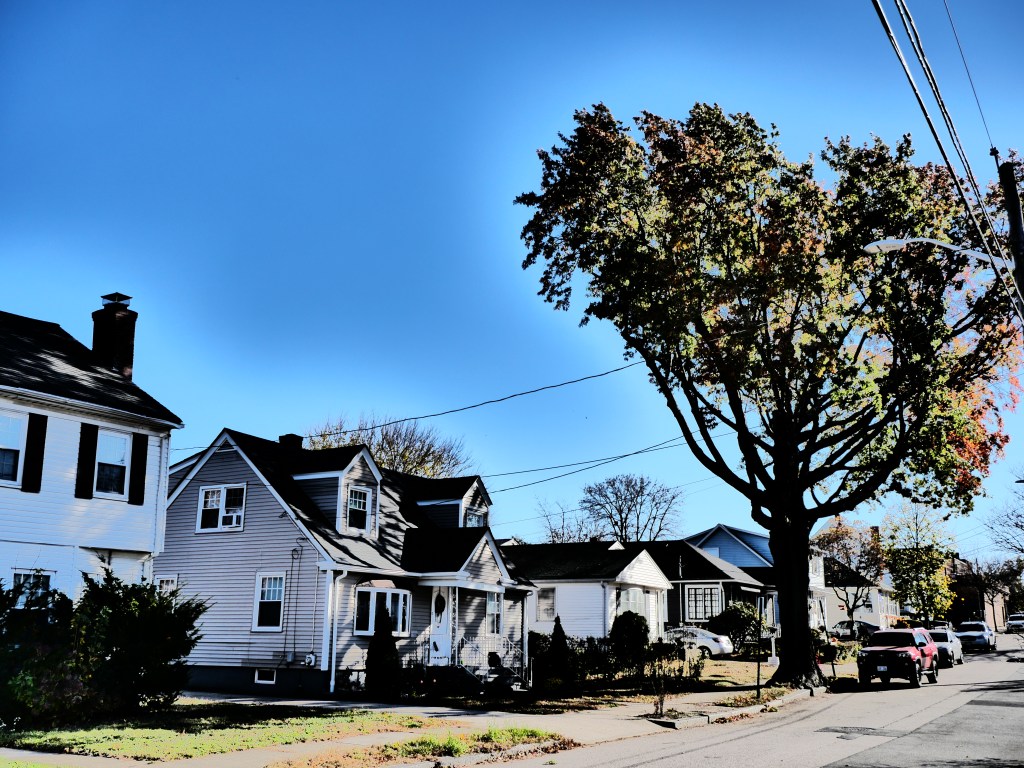
The neighborhood remained sparsely settled for most of the nineteenth century. This began to change when a streetcar opened in 1882 connecting Elmhurst to Downtown. In 1909, the City acquired a piece of land on either side of a stream flowing parallel to Chalkstone, and created Pleasant Valley Parkway, a landscaped boulevard. The design was similar to Blackstone Boulevard over in East Providence but it never quiet attracted the more desirable upper middle class residents as in Blackstone Blvd. Regardless, the Parkway is still a major neighborhood amenity with attractive homes from the 1920s-1940s. In the early 1900s, Irish and Italian immigrants made their way out to Elmhurst leaving behind the more crowded inner City Providence neighborhoods. This really solidified Elmhurst as a solid middle and working class neighborhood. Elmhurst was also one of the few Providence neighborhoods with room to grow in the post War years concentrated in the northwestern part of the neighborhood.
From an urban perspective Elmhurst contains most suburban amenities with enough urban amenities to be a solid urban district. It has good parks, schools and high levels of safety but also high density levels, decent retail amenities, convenient access to Dwtn and lots of 2 & 3 bedroom rentals. For Elmhurst to become a top tier urban district it needs better public transit and bike infrastructure and major mixed-use development building up the business districts running along Chalkstone, Smith, and Admiral which would foster more retail and cultural amenities in the community.
Click here to view my Elmhurst album on Flickr
URBAN STRENGTHS:
- Overall good sidewalk infrastructure. Most commercial intersections have modern curb cuts. Less than 50% of residential intersections have them.
- Convenient access to Dwtn only 2-3 miles away. 10 min drive and 20 min transit or bike trip.
- Nice array of home styles from the 1910s-1940s including a variety of single family styles with many duplexes and triplexes mixed-in.
- Good diversity indicators especially economic. Slight majority white neighborhood with a large Hispanic population and decent Black and Asian #s.
- Decent pretty well rated public schools but not a ton. Decent # of public & private schools in nearby Mt. Pleasant.
- Overall a safe community with limited amounts of blight.
- Limited 1-beds but plenty of 2 & 3 beds the lease btwn 2K-3K.
- Really no 1-beds but for sale housing is pretty reasonable compared to more gentrified areas. 2-bed sell btwn 200K-450K, and 3 & 4 beds sell btwn 250K-650K.
- Pretty good tree canopy.
- Decent parks especially plentiful sport fields. Also a splash pad and the Providence College green space.
- Solid density.
- Decent retail amenities including an Aldi’s a couple Hispanic groceries, a drug store, a couple clothing/boutique stores, a florist, a couple banks, a hardware store, plenty of salons & barber shops, several bakeries & dessert joints, a university book store, several churches, two major hospitals with plenty of accompanying doctor’s offices, and a local public library.
URBAN WEAKNESSES:
* So so public transit access.
* Bike infrastructure is limited.
* Modern in-fill is limited but much of what does exist is auto centric junk.
* Urban form is mixed along the commercial corridors. Nothing special about the streetscaping.
* So so cultural amenities including some restaurants, a couple bars & cafes, a dinner theater and local art museum and Performing arts at Providence College.
* Missing major brand name supermarkets, a local post office, and limited locally owned boutiques and creative stores.



 Evaluating our Urban Communities [with a focus on America]