Marylebone- In Demand London Westend District and Historic Home to many famous (real and fictitious) Celebrities

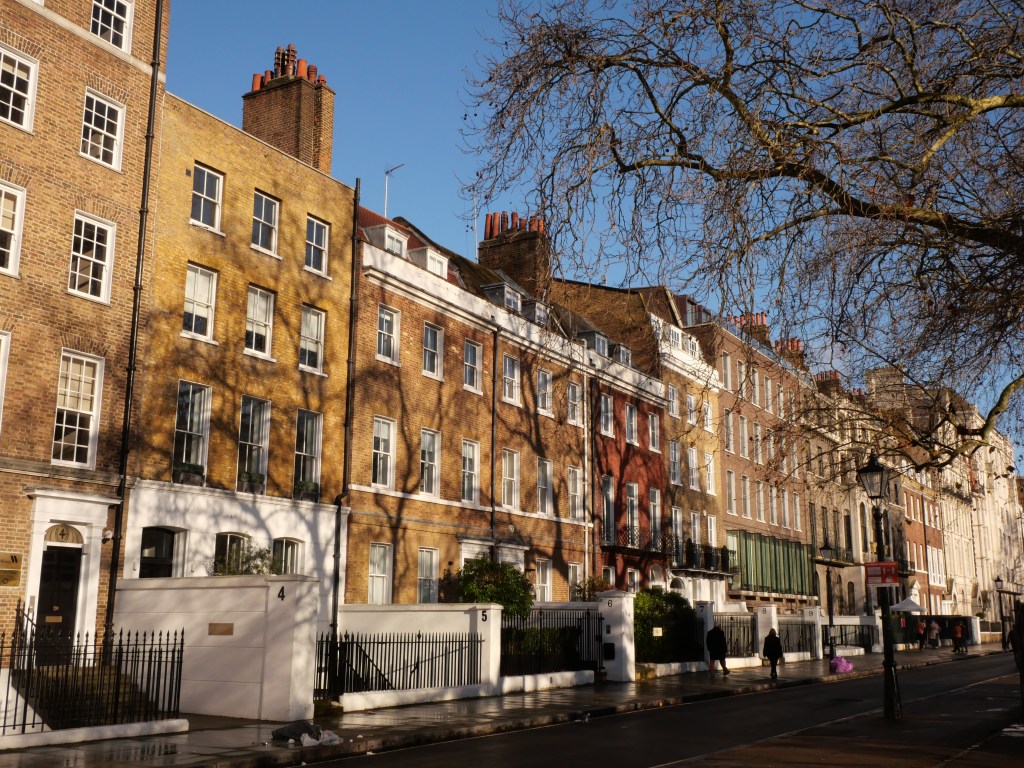
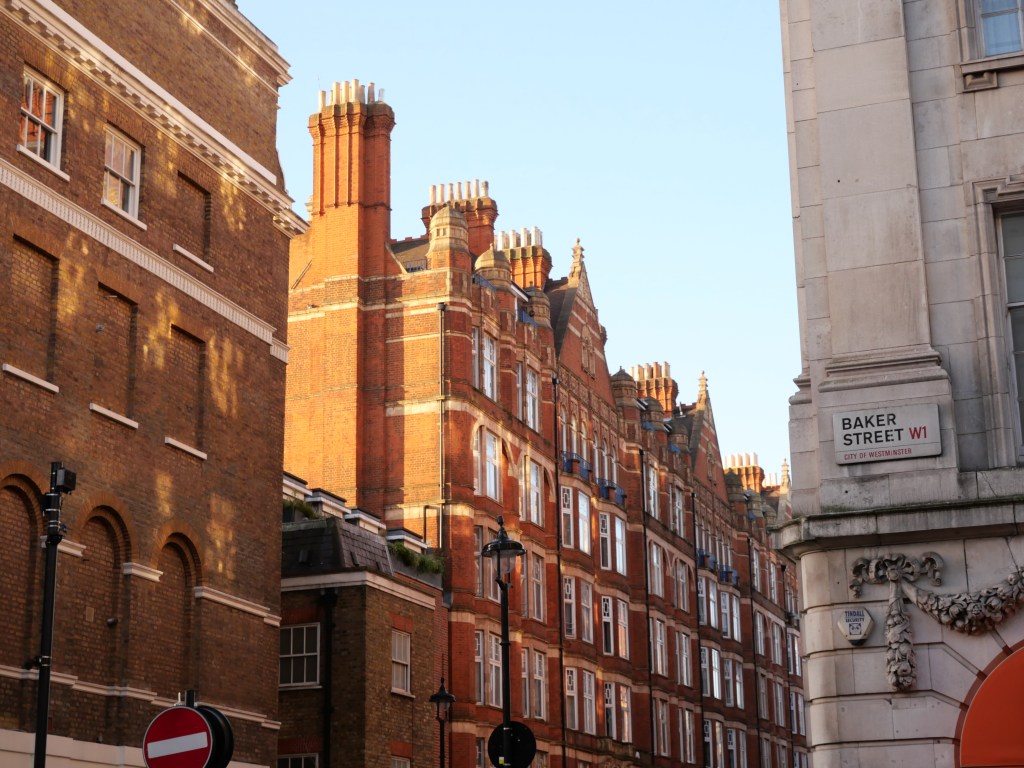
Development began in Marylebone in the early 18th century as the Dukes of the Portland Family, realizing the need for fashionable housing north of the Oxford St (near Oxford Circus) created Cavendish Square within a rational grid system of streets and laid down high end terraced housing of the era. Marylebone developed slowly moving from its southeastern corner (Oxford Circus) with much more ornate stone & terra cotta terraced homes to more modest  bricked terraces and rowhouses moving northwest to Regent’s Canal and filling in by the mid-19th century with the Lisson Grove subdistrict being the last area to develop. Much of modern day Marylebone remains owned  by aristocratic antecedents who first developed them. Many people of note have lived in Marylebone over the years from Charles Dickens, to J.M.W. turner to the fictional Sherlock Homes Character living at 221 B Baker Street to even Paul McCartney for a brief time.

Present day Marylebone is a bustling and in demand West London District sitting between arguably London’s two best urban parks (Hyde Park & Regent’s Park) and hosting a mix of heavily touristy streets filled with high end shopping (Oxford and Regent St). balanced by many more intimate business districts and mixed-use area. Marylebone also has incredible connection with the London Tube including 8 metro stations and access to 10 subway lines, excellent cultural amenities, and plenty of retail amenities suitable for year round residents as well. The district host a large number of London’s infamous Mew Streets housing more modest rowhouses sitting behind grand terraced housing. My biggest complaint with the district is that many of its wonderful historic squares are private and inaccessible to the general public (likely a vestige of exclusive land covenants) along with limited connected bike lanes.
Click here to view my Album on Flickr

URBAN STRENGTHS:

* Nice mix of upper middle class and more modest middle class terraces ranging from the late 18th century to the early 20th century. Lisson Grove in the NW section of the district is more smaller scale rowhouses with a mix of historic and modern.
* Nice boulevard along Portland while Marylebone Rd (while technically a Blvd) feels more like a Stroad.
* Oxford St is London’s most famous shopping district. This is on the Southern edge of the district. Regent St is a great shopping street as well. More continental historic architecture. Other business commercial district run along Edgware Rd, Baker St. But I prefer the more intimate biz districts running along Thayer/Marylebone High St, James St., Wigmore St., and Paddington St/Crawford St.
* Significant amount of mix uses areas outside of these commercial streets which a bar/restaurant or retail use will occupancy the corner of a residential street.
* Lots of interesting Mew Streets which is a row or courtyard of stables and carriage houses with living quarters above them, built behind large city houses typically in affluent neighborhoods.
* Lots of great historic square with grand terraces and flats around them (Portman Sq., Manchester Sq., Montagu Square, Montagu,  Bryanston, Paddington Street Gardens, Park Square, and Dorset Square) but many of them are sadly private. Great access to large park space as Marylebone is located between both Hyde Park and Regent’s Park.
* Excellent access to public transit including 8 metro stations and 10 subway lines.
* Great cultural amenities including a ton of restaurants, bars & cafes, several indie theaters, a couple performing art theaters, and several smaller museums.
* Solid retail amenities thanks to a concentration of clothing and department stores running along Oxford St. and wonderful concentration of high end boutiques along Marylebone. Also plenty of bakeries, supermarkets and other standard amenities.
* Solid density at around 31K residents per square mile which is slightly above average for central London. But the district feels much more vibrant than this due to its large day time population.

URBAN WEAKNESSES:

  • Tree canopy isn’t great but better than most London Inner city districts due to all the small squares and newer apartments in Lisson Grove that have a decent amount of open space.
  • Bike lane infrastructure is limited to a couple of small disconnected segments.
  • Can get crowded and touristy in spots.
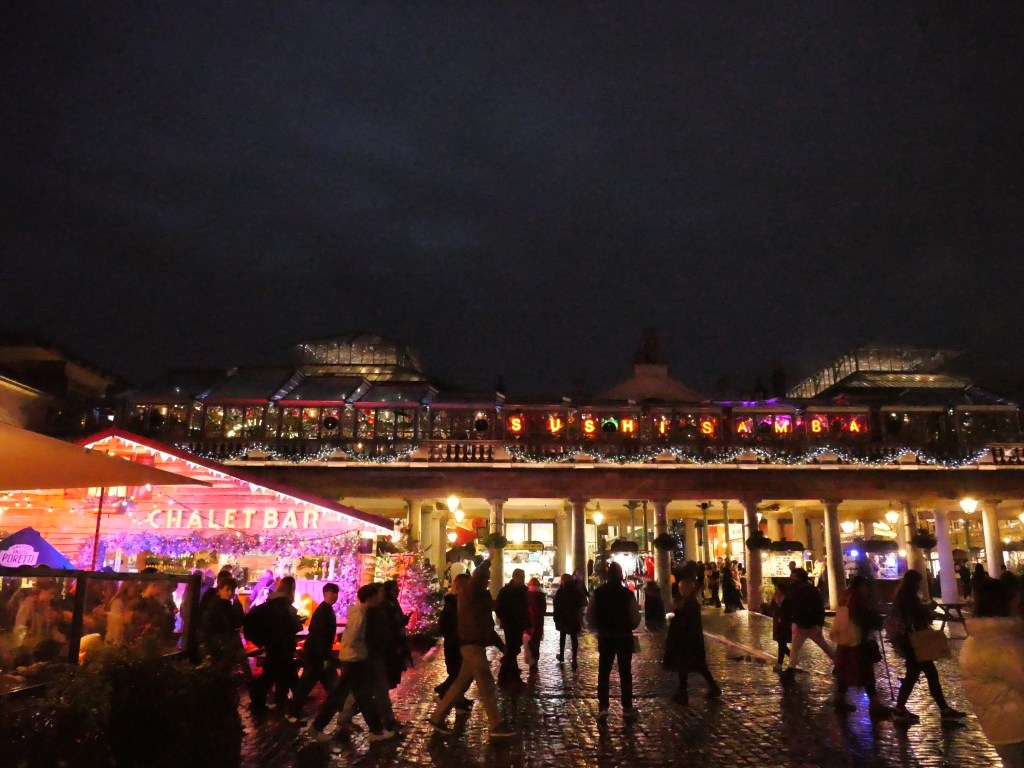
Covet Garden- London’s first “Suburb” developed outside of the Historic Roman Walls and one of the City’s Most Bustling Districts

By 1200 part of it had been walled off by the Abbot of Westminster Abbey for use as arable land and orchards, helping eventually give the neighborhood the name “the Convent Garden”. Covet Garden and parts of Holborn were the first London “suburbs” built outside of the original Roman Walls of what is mostly the City of London. The neighborhood was mostly built up by the mid 16th century but likely densified after the Great Fire of 1666, which did not touch the district. The Covent Garden Pizza was laid out in 1630, creating London’s first modern square surrounding by many private residents of note. But this honeymoon for the wealthy and powerful did not last long and by 1654, a small open-air fruit-and-vegetable market had developed on the south side of the fashionable square. Gradually, both the market and the surrounding area fell into disrepute, as taverns, theatres, coffee houses and brothels opened up. By the 18th century Covet Garden had become notorious slum with a concentration of brothels. But by the 1800s urban renewal efforts were afoot first with the creation the modern day neo-classical market building. The market grew and buildings were added: the Floral Hall, Charter Market, and in 1904 the Jubilee Market. The central neo-classical market building re-opened as a shopping centre in 1980 and became a major tourist destination in Central London.

The district is divided by the main thoroughfare of Long Acre, north of which is given over to independent shops centered on Neal’s Yard and Seven Dials, while the south contains the central square with its street performers and most of the historical buildings, theatres and entertainment facilities. From an urban perspective, while Covet Garden is very touristy, it still has managed to retain a large residential base and is one of Central London’s most dense districts. This convergence helps create an incredibly mixed-use environment filled with wonderful narrow streets with lots of small business activity outside of the central Covet Garden Market. Covet Garden is also the site of many of London’s top historic sites, numerous theaters considered part of the Westend and great cultural scene. The major downsides of the district is a real lack of  tree canopy limited park spaces, and fragmented bike infrastructure. 

Click here to view my Covet Garden Album on Flickr

URBAN STRENGTHS:

* Gorgeous historic landmark properties (i.e. National Gallery, Caring Cross Station, St. Martin in the Fields, St Giles in the Fields, St Paul’s Church Covent Garden, Covet Garden, Theatre Royal Drury Lane, the Royal Ballet & Opera ) and many historic theaters comprising many theaters considered part of the Westend. In additional to many museums, historic sites and theaters also a great array of live music venues, bars & restaurants.
* Also great retail amenities including Covent Garden Market, great array of clothing stores, plenty of supermarkets and grocerias, and plenty of neighborhood serving stores.
* The famous Leicester and Trafalgar Squares are here.
* Whitehall Gardens & Victoria Garden Embankments are very nice and run along the Thames
* Other famous sites like 17 Downing Street and Admiralty Gate are hear.
* Major biz districts include Charing Cross, New Oxford, and the Strand but are very busy and touristy.
* The entire neighborhood of Covet Garden is mixed use and there are some wonderful narrow streets with lots of biz activity (i.e. St. Martin’s Ln, New row, King St., Maiden Ln, Tavistock, Floral, Long Acre, Short’s Garden, Neal St & Neal’s Yard, Endel, James St  and a couple really interesting historic nodes like the Seven Dials and where Martin’s Lane & Cranbourn St come together).
* Lots of very narrow pedestrian Lanes without any storefronts. This is a classic feature of old London where buildings where historically built right to the lot lines.
* Population density is one of the highest for London at around 40K residents per sq mile.
* Well served by public transit with 6 metros on 6 lines. 

URBAN WEAKNESSES:

* Very touristy district.
* Bike lane infrastructure is limited and what does exist is very fragmented.
* Other than the Victoria Garden Embankments, there are only a handful of parks in Covet Garden. A couple good ones however (i.e. Diamond Jubilee Garden, the Phoenix Garden, & Drury Lane Gardens). Tree canopy is very limited in Covent Garden. 

Fitzrovia- Historic Bohemian Central London District

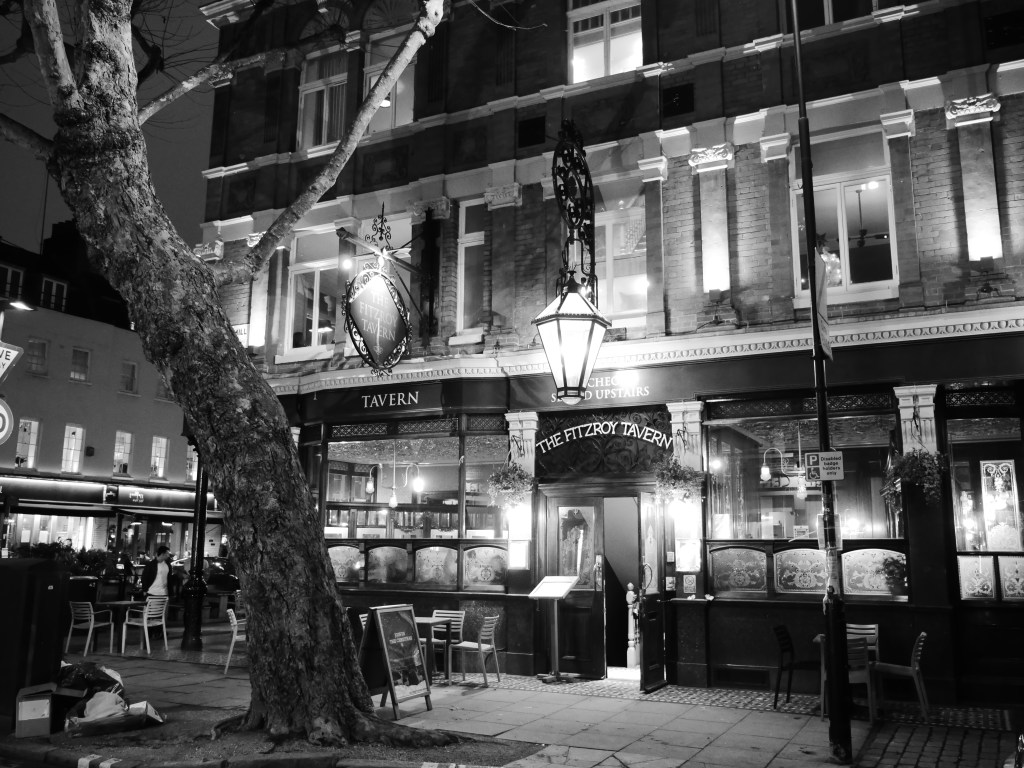
Development came to the Fitzrovia neighborhood starting along Oxford Road and Oxford Circle where more regal mid to late 18th century architecture was built for the noble classes. But the bulk of Fitzrovia’s development occurred during the late 18th and early century lined with middle class Georgian Terrace Housing lacking the more elegant square garden housing widespread in neighboring Bloomsbury and Soho (with the exception of Fitzroy Square). The name “Fitzrovia” came into use in the late 1930s among an artistic, bohemian circle that gathered at Fitzroy Tavern. The neighborhood was a cheaper alternative to surrounding West End neighborhoods.  The neighborhood was home to writers such as Virginia Woolf and George Bernard Shaw. Fitzrovia became even more disinvested in the 60s & 70s and had a good amount of vacancy in this era. But this did not last as reinvestment came to the area starting in the 90s moving it more inline economically with surrounding Central London Districts. Yet Fitzrovia has managed to maintain a good amount of economic diversity as many buildings have been maintained as low-moderate income housing association. Fitzrovia’s most prominent feature is the BT Tower on Cleveland Street which towers over the rest of the neighborhood. Fitzrovia also has a large daytime population (around 50K) and historically was a known for its fashion and advertising industries concentrated along Charlotte St.

From an urbanist perspective Fitzrovia’s is a very comfortable and walkable district with several small scaled business district, lots of mixed-use areas and convenient access to the West End, Oxford Circle and Central London thanks to its excellent subway connectivity. Outside of the Oxford Corridor Fitzrovia lacks the tourist buzz of many Central London Districts yet still manages to maintain a very vibrant restaurant, bar, and cultural scene. The two biggest issues I have with Fitzrovia is a lack of connected bike lanes and the stroad like Euston Rd forming its northern border. The population should also be higher (currently at around 25K souls per square mile) as it is a center city European neighborhood that is in high demand. 

Click here to view my Fitzrovia Album on Flickr

URBAN STRENGTHS:

  • Oxford Street is a major shopping district filled with several department stores. One of London’s most famous streets.
  • Tottenham Cour, Mortimer/Goodge St and Great Portland are all solid medium sized biz districts. Charlotte St/Rathbone is very active more intimate commercial street.
  • Great mix-use fabric and most blocks in Fitzrovia including plenty of universities and colleges. Jane Jacobs would love this district. About 50K people work in this small district.
  • Major TOD nodes with lots of modern office along
  • Mix of historic and infill. Generally at 3-7 stories.
  • BT tower should have a great view of the city.
  • Other than Oxford Street, Fitzrovia is not overwhelmingly touristy.
  • Great subway access including 7 metro stops served by 7 transit lines.
  • While parks within Fitzrovia are small and limited, the expansive Regent’s Park is located just to the northwest of the neighborhood.
  • Great night life here including tons of restaurants, bars, & cafes, plenty of live music venues and several cinemas and performing arts venues. Also a great array of museums and art galleries.
  • Decent urban density at around 25K people per square mile.

URBAN STRENGTHS:

* Some well designed and vibrant urban squares and parks but just not enough of them. These include Crabtree Fields, Pearson Square, Whitfield Gardens, the Warren Park. Fitzroy Square Garden is an excellent park surrounding by elegant surrounding terrace housing but the park is unfortunately private.
* Tree canopy is also not surprisingly, limited.
* Some dedicated bike lane segments but not a great network.
* Euston Rd is a busy 6 lane arterial framing the northern edge of Fitzrovia. 

Bloomsbury- Central London District known for its Terraced Housing, Gorgeous Urban Squares, and Wonderful Concentration of Museums, Universities, and Institutions.

The boundaries for Bloomsbury are a bit vague. For the purposes of my Bloomsbury neighborhood review I consider the district to be bounded by Bloomsbury/Great Ormond to the South, Grays Inn to the East, Tottenham Ct Rd to the west, and Euston Rd to the north.

Development really got started in the district with the construction of Bloomsbury square and surrounding terrace housing by the 4th Earl of Southampton right after the Great Fire in the 1660s. This was one of London’s first square developments. Development slowly continued in the 18th century but it wasn’t until the early 19th century that Bloomsbury filled in as the Duke of Bedford financed many affluent Georgian style terrace housing developed by the famous James Burton responsible for building around 3 thousand Georgian style terrace housing typically surrounding Parks and Square. Much of Bloomsbury is still owned by the Bedford Estate. Because of this concentration of elegant Georgian style terrace housing Bloomsbury has one of the highest proportions of historically listed buildings and monuments per square meter of any conservation district in London.

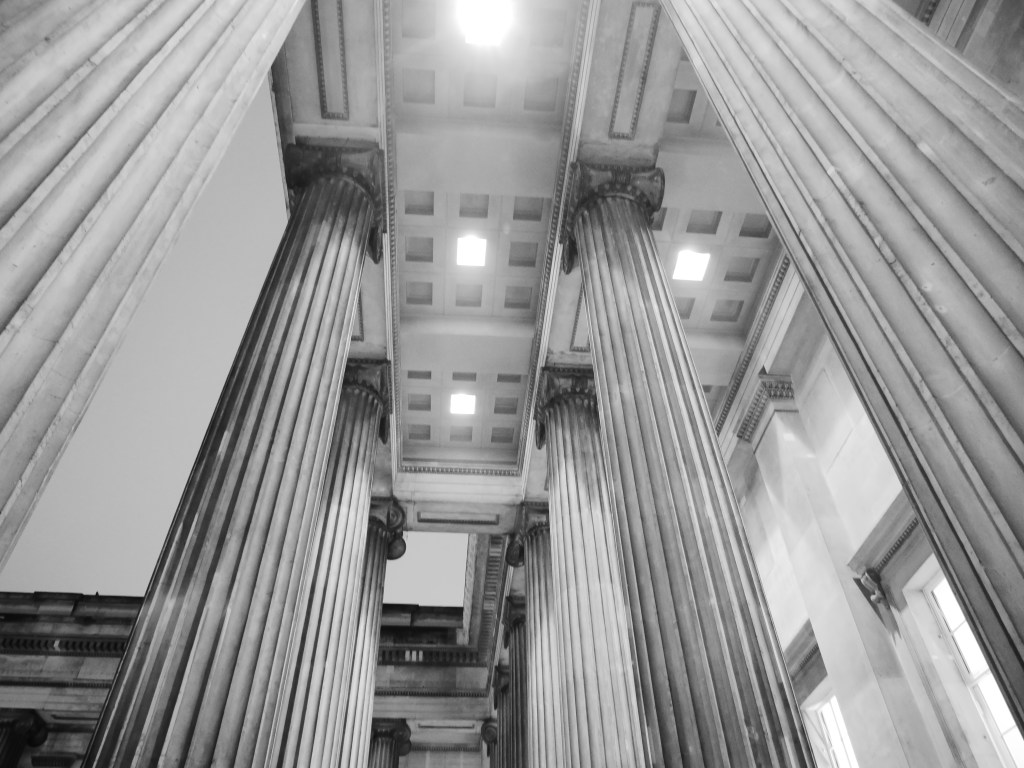
Modern Day Bloomsbury is an interesting mix of large institutional uses and museums (i.e. University of London & the British Museum), many historic Terrace housing developments with pockets of mid-century infill and more modern infill due to the district’s gentrification. There are also a number of the classic Mews lanes (compact rowhouses lined along dead-end narrow streets behind more prominent terrace housing). A good example of this is the Gower Mews. Overall Bloomsbury is a great urban district with solid density, wonderful cultural institutions & museums, vibrant streets, world class subway access providing convenient access to all of Central London, and a great array of urban parks and plazas, which are mostly open to the public. If I’m being nit-picky I’d like to see a bit more density in Bloomsbury, but this would need to be carefully done not to destroy some of the district’s monumental and gorgeous terrace housing. Bloomsbury could also use more extensive bike lane infrastructure and better tree canopy. 

Click here to view my Bloomsbury Album on Flickr

URBAN STRENGTHS:

*  Euston is a very busy and car heavy east-west street. Tottenham Cut and Bloomsbury Way are other very active streets with all modes of transportation and much more human scale than Euston.
* Nice narrow/quasi pedestrian streets at Museum St & Little Russel. Nice two block biz district along Southampton Row. Good amount of mixed-use blocks on mostly residential streets but less so than neighboring Holborn.
* Great Gardens and parks in Bloomsburg and most of the are open to the public. Bloomsburg Square Garden, Russel Square, Montague Street Gardens, Tavistock Square, Gordan Square,  Woburn Square, Brunswick Square Gardens, Mecklenburgh Square, St. George’s Garden,  Regent Square Garden, Bramber Green, Argyle Square, Cartwright Gardens. Many of these squares are  lined with gorgeous 18th and 19th century flats.
* Several well known destinations and landmarks including St. Pancras Station, King’s Cross, Euston Station, the British Library, The British Museum, the University of London (which includes many great historic landmarks of its own), the Charles Dickens Museum, the Wellcome Collection, Grant Museum of Zoology, St. Pancreas Church, St. George’s Church. Many other smaller museums and cultural sites.
* Other than Museums great array of restaurants, bars, cafes, live music venues and theaters. Solid retail amenities as well including the Brunswick Centre is an interesting modern Brutalist development including a residential building with a shopping centre at ground floor and a major plaza space.
* Better density than most central city London Districts of nearly 30K residents per square mile. Given all the space dedicated to institutional uses this is likely due to the large University of London population.
* Very vibrant district thanks to all the college students and institutional uses.
* Great subway access and 8 metro stops and 8 lines.
* Better bike lane infrastructure than most Central London districts including two bike lanes that span the district.

URBAN WEAKNESSES:

* Decent amount of biking occurs here, but any bike lanes are very short segments.
* A bit on the touristy side but not overwhelming.
* Other than the park space tree canopy is pretty limited.
* Decent density  (25K per square mile) and bit better than Farrington to the east but pretty low compared to most European central cities.
* Better tree cover than most Central London district but still underwhelming compared to a City like Parks. 

Holborn- Central London Neighborhood located on the Western Edge of the City of London

Holborn is a Central City neighborhood with sitting just west of the City of London. The neighborhood has roots in the ancient parish of Holborn, which lay on the west bank of the now buried River Fleet. The westward growth of London beyond the City Wall, and towards the seat of government in Westminster, took place along the banks of the River Thames and along the roads leading from Ludgate (Fleet Street and The Strand) and Newgate (Holborn/High Holborn). The westward growth towards Westminster accelerated in the 16th century(the Tudor Era) and the Fire of London in 1666 pushed growth in Holborn further northward away from the Thames River. The northern fringe of Holborn filled in during the 18th century. 

Modern day Holborn is a highly walkable district with convenient access to the plethora of professional jobs in the City of London along with the West end, Covet Garden, and the major train stations of King Cross & St. Pancras. The built environment of Holborn is mostly 4-7 story mixed use buildings built between the 17th-20th centuries with more monumental buildings along its southern edge (i.e. Fleet St., and the Strand). Holborn really excels at creating the type of mixed-use environment that Jane Jacobs so desired as most streets have some level of non-residential uses. This givens Holborn much more of a medieval feel where use types were much more flexible than even a turn of the 20th century NYC Manhattan neighborhood which tended to concentrate commercial uses on busy linear streets. This lends helps create a district with a vibrant retail, office, and cultural scene having a level of street activity far exceeding its 25K residents (per square mile) would typically justify. There are still some areas for improvement as bike infrastructure is limited to short segments, the tree canopy is concentrated only in parks, and a density of 25K people per square mile feels pretty underwhelming for a Inner City European neighborhood.

Click here to view my Holborn neighborhood on Flickr

URBAN STRENGTHS:


* Holborn is the major west-east corridor and is very active with pedestrian and bike activity. Bloomsbury & Kingsway are similar streets but with less activity and commercial uses.
* Red Lion/Lamb’s Conduit is a nice quasi intimate pedestrian street.
* Other good urban biz streets include Grays Inn, the Strand, and lots of other mixed-use blocks especially along the western edge. 
* Major landmarks here include Temple Church, Kings College, Somerset House, Waterhouse Square. Sir John Soane’s Museum,
* Several great parks as well including: Lincoln’s Inn Field North Lawn Garden, B, Red Square Gardens, & Grey’s Inn Square.
*  Even outside of the major landmarks architecture is comprised of largely gorgeous styles from the late 17th century-early 20th century with some more modern infill sprinkled throughout the district.
* Well connected to the Tube with 4 stations and 6 lines serving the district.
* Excellent cultural amenities here including tons of restaurants, bars, cares, museums, theaters, & cinemas. Great retail amenities as well. Everything is very convenient here. Great mixed-use fabric that would make Jane Jacobs proud. 

URBAN WEAKNESSES:

* Decent amount of bike occurs here, but any bike lanes are very short segments.
* A bit on the touristy side but not overwhelming.
* Other than the park space tree canopy is pretty limited.
* Decent density  (25K per square mile) and bit better than Farrington to the east but pretty low compared to most European central cities.

Farringdon- Central London District located north of Smithfield Market & Scene of several of Charles Dicken’s Novels

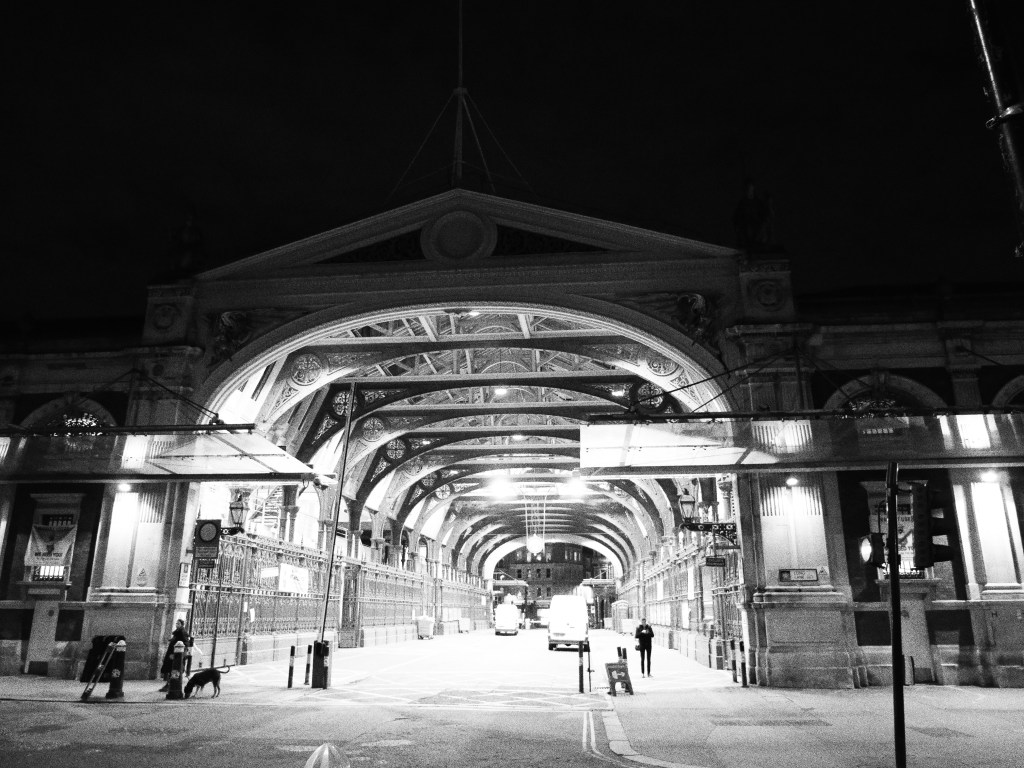
Farringdon is located in the London Borough of Islington located just north of the City of London with Smithfield Market being its southern border. The Smithfield Market dates back to 1133 and has been continually operating ever since, even escaping destruction from the London Fire of 1666. However, the City of London has sealed the fate of this storied market with plans to close it in 2028. The Farrington neighborhood grew up north from the Smithfield Market after the Great Fire along the Great North Road, which traces the modern day streets of St John & Islington High Streets. The Great Fire of London prompted the expansion of London beyond the traditional City of London boundaries north of the Roman Walls. By the early 1810s Farringdon was fully developed. However much of the northern half of Farrington was considered a slum in the first half of the 19th century and featured frequently in Charles Dicken’s Oliver Twist and David Copperfield novels.

The Smithfield market was reconstructed in the 1860s in a stunning new Victorian era building. This era also included  the construction of a road over the River Fleet which served as the northeastern terminus of the world’s first underground subway, the Metropolitan Railway, Several urban renewal projects in this time period also helped lift Farrington out of poverty and into a more “respectable” working class neighborhood specializing in  printing, brewing, and watchmaking. However after WWII Farrington experienced another period of decline. The neighborhood slowly emerged out of several decades of decline by the 1980s as Farringdon became a desirable place for artists desiring cheap loft space. By the late 1990s, gentrification was in full swing and Farrington became a desirable area for white collar works. In the early 2020s transit improvements to Farringdon station and the creation of the Elizabeth line have further spurred development  and increased real estate values.

From an urban perspective Farrington is an attractive highly walkable mixed-use district with excellent public transit and access to central London with decent bike infrastructure and comfortable human scale design. Major amenities include Smithfield Market, Exmouth Market, the St. John’s Biz District, and several attractive urban parks. Given its medium density of around 15K residents per square mile (very low for a Central European City) I’d like to see more intensive development especially around Farringdon Metro Station. There is new construction here but its mostly 4-5 stories and I believe this area should have more residential high-rises to take advantage of its TOD access and Farringdon’s Central London location.

Click here to view my Farringdon Album on Flickr

URBAN STRENGTHS:

* Excellent pedestrian scaled biz district on Exmouth Market. Also nice biz district on St. John’s St.
* Leather Lane is a very interesting compact biz district. More on the gritty side but has markets sometimes. Parts of it have been pedestrianized.  Hatton garden is only a block over from Leather lane and is a historic jewelry district.
* Good biz district along Clerkenwell Rd and Farringdon but wider streets than St. John’s St so not as intimate.
*  Nice mix of more historic Eastend Central London 18th & 19th century architecture on narrow medieval streets mixed with more spacious modern styles. 
* St. Peter’s Italian Catholic Church is a very interesting 19th century church tucked into the urban fabric. S]
* Three subway stations (i.e. Chancery Lane Station, Farringdon & Barbican) serve the neighborhood which includes 4 different subway lines.
* Not a terribly touristy area. Seems very livable.
* Very mixed use and amenity rich district.

URBAN WEAKNESSES:

  • Better park spaces than most Central London neighborhoods (i.e. St. James’ Garden, Spa Fields & Chaterhouse Square, St. John’s Garden) but still kinda limited. Tree canopy is so so.
  • Decent bike lane infrastructure but still some gaps in the two main lanes along Clerkenwell & Farringdon.
  • So so density for a central European neighborhood at around 15K-20K people per square mile.


The City of London- London’s Historic and Commercial Heart

Established by the Romans around 47 AD as Londinium, the City of London forms the historic core of the wider London metropolis. Given its history as a walled City for 1700 years, the City of London has retained its unique local authority led by the Lord Mayor of London. The City of London contained what was considered all of London until the late 17th century when the Great Fire prompted the great expansion of the City (esp. to the west).  As railroads prompted the rapid expansion across London’s vast suburbs during the 19th century, the City’s population fell rapidly. Many residential buildings were demolished to make way for office blocks as the City of London established itself as one of the great commercial & financial centers of the world. The City of London’s population  rapidly declined from 132K in 1850 to 32K in 1900.

The City transformed again during WW II with the highly destructive Blitz bombing of 1940. Large swathes of the City were destroyed leading to a major rebuilding program in the decades following the war and creating large block developments like the Barbican complex. However, many of the smaller historic buildings of London survived and are still in tact today. The 2000s brought another wave of large commercial developments leading to many high-rises like the Gherkin and the Walkie Talkie Bldg concentrated in the northern and eastern parts of the City.  By  2020 the City’s office population had reached nearly 550K and since the pandemic has increased to almost 700K. The City  has also seen a modest increase in residents. Since it’s historic low of 4K in 1990 the City of London reached nearly 15K residents in 2023. 

From an urban perspective the City of London is a strange combination of an European medieval street network and an American hodgepodge of historic and modern buildings plus a sprinkling of pre 19th century buildings of all London’s remaining landmarks. The City has a curious mix of very narrow historic streets with small commercial buildings and large modern blocks and skyscrapers.  The key area for improvement in the City of London include more permanent residents to complement its great concentration of daytime workers. I’d also like to see improvements to the City’s walkability & livability with the creation of more pedestrian streets on par with most European cities, more consistent bike lanes, park expansions, and more restaurants & bars.

Click here to view my City of London Album on Flickr

URBAN STRENGTHS:

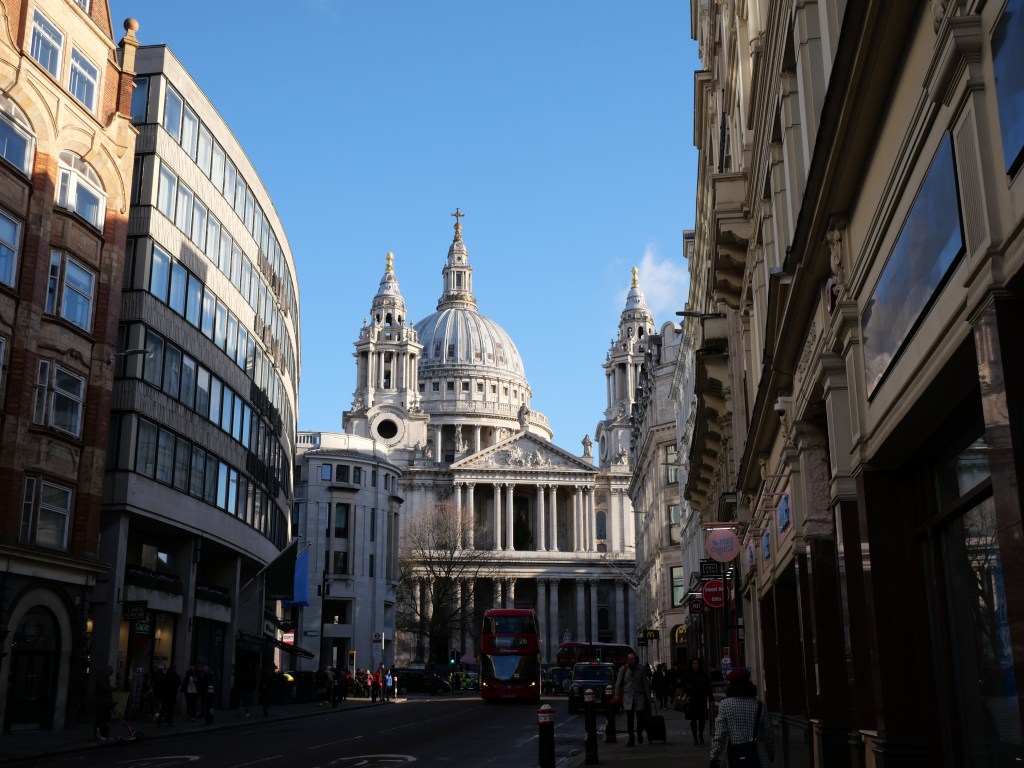
* Includes incredible landmarks such as St. Paul’s Cathedral, the Temple Church Complex, Bank Junction, Leadenhall Market, the Walkie Talkie Bldg, The Gherkin, the Lloyd’s Building, Tower of London, Monument to the Great Fire of London, Barbican Complex, the St Bartholomew’s Complex, Smithfield Market, Finsbury Circus Gardens, Liverpool Street Station, Guild Hall, Smithfield Market, small remaining segments of the London Wall, and countless saved or constructed historic churches since the Great Fire of 1666.
* Very mixed fabric of historic and in-fill. I particularly liked the plentiful small flat iron bldgs created by all the diagonal streets.
* Lots of intimate and narrow streets which is very different than most American dwtn’s filled with wide arterials.
* Several extensive shopping malls. (i.e. One New Change, New Street Square, the Royal Exchange, Broad Gate Circle.
* Lots of small parks and plazas tucked into hidden spaces or located at historic sites.
* Incredible employment hub hosting roughly 700K jobs. This has grown by over 100K since the pandemic. 

URBAN WEAKNESSES:

* Some pedestrian or semi-pedestrian streets but underwhelming compared to other European Center Centers.
* This is also a very 9-5 Downtown esp. for a European Historic Center. Much less vibrant than adjacent London Inner City neighborhoods.
* While the streets are still very medieval in lay out,  much of the historic (post WW-II) buildings have been replaced by modern buildings and many blocks went through urban renewal or had to be replaced after the London Bombing of 1940. This is very different than most European cities and feels much more American with lots of dead and cold parts of Dwtn.
* Lacks medium to large park spaces and economic civic gathering spaces that can really mark a Center City area.
* Better bike lane coverage than most inner London neighborhoods but segments are small and broken up and rarely protected bike lanes. Regardless still a good amount of cycling occurs in Central London.
* Tree canopy is pretty limited.
* Not great population for a Central City European area at around 8-9K residents for just over a square mile.

Shoreditch- Historic Entertainment District, now Gentrified East London Neighborhood

Shoreditch really got its start as an important centre of Elizabethan theatre in  the 16th given its location just outside of the rather Puritanical laws of the City of London. Shoreditch has continued to be an  important entertainment centre since that time. The east–west course of Old Street–Hackney Road, which runs along the north border of Shoreditch, was  originally an important Roman Road connecting London to the countryside. During the 17th century, Shoreditch started to develop with wealthy traders and French Huguenot silk weavers moving into the area establishing a textile industry. By the 19th century, Shoreditch transitioned into a hub for the furniture industry. These industries, however, declined in the late 19th century.

During the turn of the 19th century, Shoreditch was a centre of entertainment to rival the West End and had many theatres and music halls. However this was not to last as Shoreditch was heavily bombed during the Second World War loosing much of its historic housing stock and the neighborhood faced significant decline in the post War era as both its textile and furniture industries declined. Shoreditch remained an underinvested community until the 1990s when the area became fashionable again with a strong association with the creative industries. Since the 2000s Shoreditch and Old Street have become popular with London-based web technology companies centered around the East London Tech City district near the Old Street tube station.

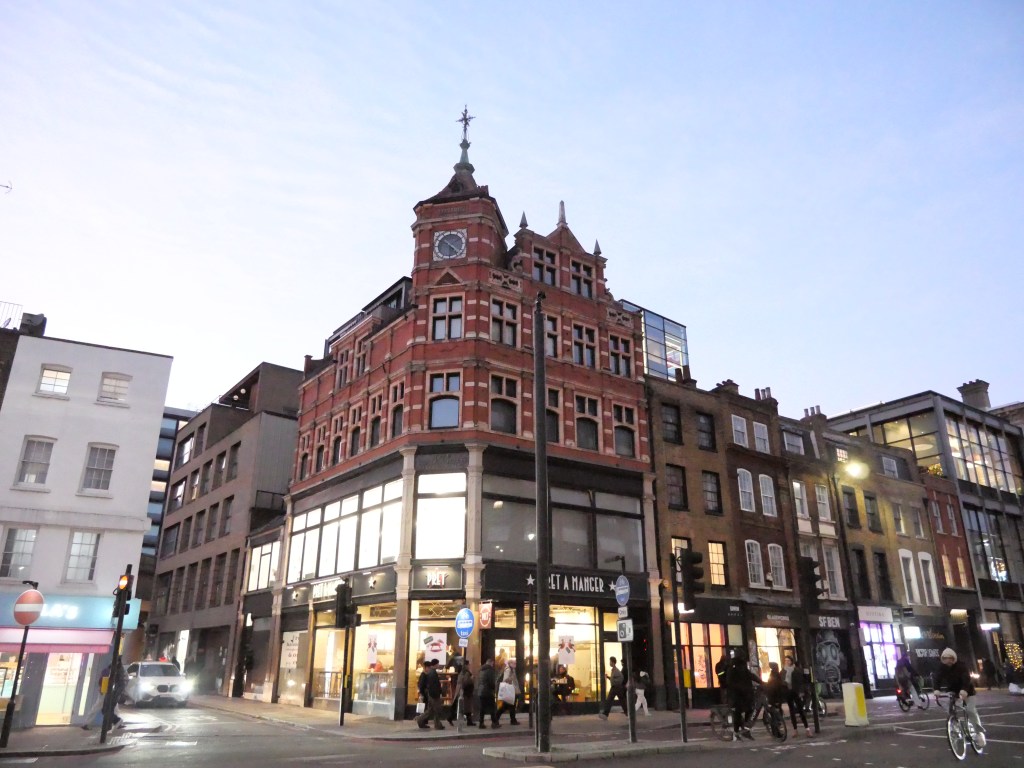
From an urban perspective Shoreditch is a lovely, heavily mixed-use area with an interesting mix of smaller scale historic blocks and larger modern infill. The area has great access to the Tube system and is located just north of the City of London. Shoreditch has great access to all the market destinations of Spitalfields while avoiding the crowds. The Old Street Corridor continues just west of Shoreditch and hosts a solid commercial district and several more intimated mixed use lanes. 

Click here to view my Shoreditch Album on Flickr

URBAN STRENGTHS:

* Good biz districts along Curtain and some excellent narrow mixed use streets perpendicular to it (Rivington & Charlotte Rd)
*Very eclectic neighborhood. More Dwtn feel on the southern edge. Mix of mid century, modern infill and traditional East London rowhouses. Most of the district has a strong mixed-use feel.
* Some cool commercial  uses along  Great Eastern/ Old St and Whitecross Street.
* Several nice mixed-use streets in the western edge of Shoreditch (i.e. Leonard and Paul)
* Boundary Gardens is great urban park with attractive brick terrace housing surrounding it and surrounding blocks. The development was built in the late 19th century as part of a slum clearing effort.
* Much less touristy than adjacent Spitalfields.
* Several subway lines serve the neighborhood at Shoreditch High St Station. Old Street also has a tube stop along Black Line.
* Solid density around 40K residents per square mile.

URBAN WEAKNESSES:

  • Better park space and tree canopy than Spitalfields but still not great.
  • Seems to be a lot of biking activity even though dedicated bike lanes are in short supply.

Spitalfields- Historic East London Neighborhood Filled with Historic and Modern Markets and Layers of History

Historic Spitalfields, or at least the earliest connection to its current name,  was the St Mary Spital, a priory/ hospital (a lodging for travelers run by a religious order) erected on the east side of the Bishopsgate thoroughfare in 1197. Spitalfields consisted mainly of fields and nursery gardens until its development in the late 17th century. The infamous and still active Spitalfields Market was established in 1638 by Charles 1. Development came to Spitalfields in the late 17th century with the arrival of French Huguenots fleeing religious oppression in France. The Huguenots came with expertise in the silk industry quickly establishing a vibrant industry in the neighborhood. Shortly after Spitalfields became an independent parish in 1729 located just outside the City of London. By the Victorian era, the silk industry entered a long period of decline and the old Huguenot merchant dwellings degenerated into multi-occupied slums. Spitalfields became a by-word for urban deprivation and hosted several of the Jack the Ripper murders. But life in Spitalfields continued on and welcomed new immigrants including large numbers as Eastern European Jews in the 1800s who specialized in furniture making and tailoring and repopulated many of the large Huguenot houses. By the mid 20th century mainly Bangladeshi immigrants moved into the neighborhood also picking up work in the local textile industry and made Brick Lane the curry capital of London. Spitalfields continued to attract large numbers of immigrants throughout the 20th century and by 1981 at least 60% of households were of minority ethnic origin.

Spitalfields’s regeneration was really seeded in the 1970s with a local campaign to save the housing stock of old merchant terraces west of Brick Lane from demolition. Many have been conserved by the Spitalfields Historic Buildings Trust. Spitalfields continued to gentrify into the early 21st century welcoming several new large office blocks built near Bishopsgate, Aldgate, and Spitalfields Market and a reemergence of the strength of its historic markets (i.e. Spitalfields, Petticoat Lane) complimented with newer markets and modern makers & creators. Spitalfields has become the top destination in East London, attracting thousands of visitors every day, but still retains much of its historic charm of busy markets, gritty streets, and narrow lanes filled with layers and layers of history. Most of the newer apartments and office towers have remained on the edges of the district, not taking too much away from its charm and historic scale.

Click here to view my Spitalfields Album on Flickr

URBAN STRENGTHS:

* Dense district for London standards at about 42K people per square mile.
* Very active mixed-use district which draws large numbers of tourist and Londoners from outside the neighborhood.
* Several great markets located here starting with the historic Spitalfields Market. The Truman Brewery Markets is a weekly outdoor market place. Petticoat Lane is historic market going back to the 1650s spanning Middlesex Street, Wentworth Street, and all of the lanes in between.  Backyard Market is a newer community-driven platform that provides a dedicated space for emerging artists and entrepreneurs.
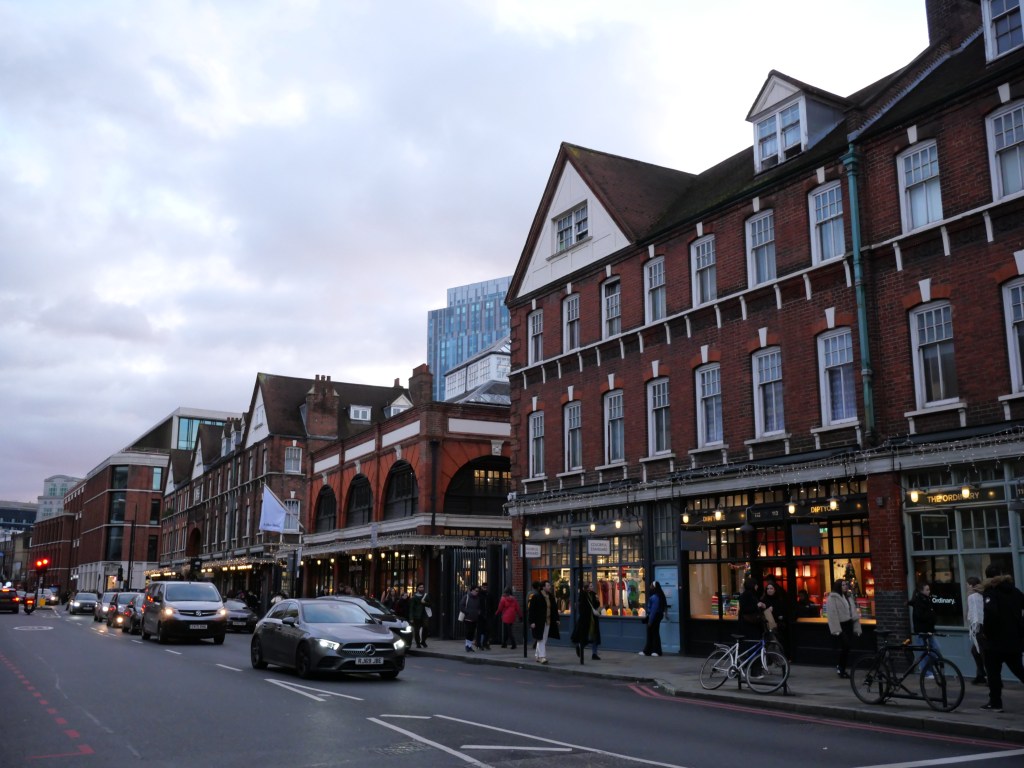
* Commercial street is really interesting and includings mostly intact 18th & 19th century brick East End commercial bldgs.
* Princelet St is a very gritty narrow commercial street/Brick Lane. Very interesting. Lots of Indian/Bangladeshi restaurants. Lots of interesting and gritty streets that come off of this.
* Lots of cool and intimate mixed-use alleys (i.e.  Artillery Psge, Widegate St
Some really cool landmarks including: Christ Church Spitalfields.
* Great graffit art along Grey Eagle St.
* While there are no subways stops within Spitalfields, there are plenty of stops on all sides of the district connecting the neighborhood well to the rest of London.

URBAN WEAKNESSES:

  • A real hodgepodge of architectural styles. Not a terrible thing as most buildings have good urban form (even the uglier mid-century bldgs).
  • A bit too gritty for some. Spitalfields market can get incredibly congested which isn’t everyone’s pace.
  • A tree canopy is pretty much non existent.
  • Several nice smaller plazas spread throughout (Aldgate plaza, Bishop Square, Elder Gardens) but really no medium to large sized parks.
  • Bike shares are plentiful but dedicated bike lanes are very limited.”