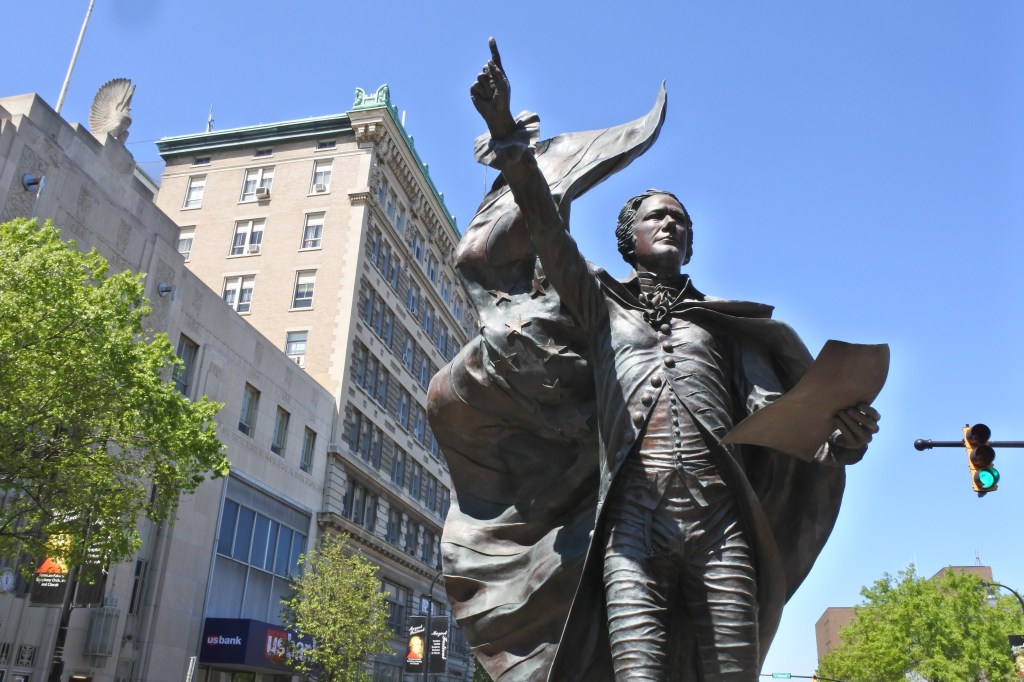
Downtown Hamilton- The City of Sculpture

I included the district between the Miami River and MLK Boulevard and all of German village and dwtn south to Sycamore Street.

Hamilton started as Fort Hamilton in. 1791. It was the first of several built north from Fort Washington into Indian territory. A settlement grew up around the fort and was platted. It was officially incorporated in 1810. By the mid-19th century, Hamilton had developed as a significant manufacturing city and by 1950 it had around 57,000 residents. This has resulted in a fairly large urban neighborhood surrounding Dwtn and fortunately much of it is still in-tact especially on the West Side.

Dwtn Hamilton held onto much of its fabric of low to medium rise buildings helping fuel its recent renovation the past 10 years. Along with new shops, restaurants, and small businesses, Hamilton created a new multi-faceted downtown park surrounded by new apartment buildings. North of Dwtn, German Village connects pretty seamlessly with gorgeous mid-late 19th Italianate architecture and a nice mix-used district along 3rd Street. Hopefully Dwtn Hamilton continues to fill in all the underutilized lots especially south of High Street. Great progress has been made, but certainly room to improve.   
Click here to view the full Downtown Hamilton Album.

URBAN STRENGTHS:

*Highly walkable district in small 0.25 square mile.
* Great historic architecture both in along High Street, Hamilton’s main dwtn corridor, and German Village.
* The Dwtn/German Village population has historically been very low, but this is changing with increased dwtn population and historic renovations in Germantown.
* Nice set of parks including the riverfront park along the Great Miami, Symmes Park Playground, and the downtown jewel Marcum Park, complete with a fountain, significant programming, an outdoor stage, etc.
* Nice array of cultural amenities including several local museums & theaters, Artspace lofts, many restaurants & bars, and some live music venues.
* There has been a wonderful resurgence of locally owned shops, boutiques, cafes Dwtn and across the river in nearby Rossville. The main post office and library are also located here. No large retail stores or grocery stores however.
* High level of ADA infrastructure. Very comfortable to walk here. 

URBAN WEAKNESSES

* Not great public transit. Some shuttles run by Butler County but the system is not really tied into the Cincinnati public system.
* Generally very affordable for-sale and rental product. Nice homes in German Village selling btwn 75K-100K. Larger mansions in the 200Ks. Not a ton of rental product listed dwtn, but higher end product slowly coming starting with the Marcum apts.
* Limited ethnic and household diversity dwtn.
* There is a public elementary school and Catholic grade school located just south of Dwtn.
* Very low density. This partially is to be expected as this is a mid-sized dwtn. 

Historic Annapolis

I generally used the block groups as boundaries but feel like Cathedral street is the appropriate western boundary between Historic Annapolis and Murray Hill. I also used Washington Street as the NW boundary. The Naval Academy Forms the Eastern Boundary. St. John’s College included. The Civil war era is general the cut off as to what I included in Historic Annapolis. 

Historic Annapolis contains a great stock of late 18th and early 19th century Georgian architecture.  But many other great attractions including the Maryland statehouse, a wonderful main street, historic market square, the Naval Academy, and lots of great cultural amenities. Obviously this is a not your typical urban neighborhood as it hosts the statehouse and is a major tourist attraction. But there are a fair amount of locals that create enough urban authenticity to make this an interesting environment. 
Click here to view the full Historic Annapolis Album on Flickr

URBAN STRENGTHS:

* Gorgeous Georgian architecture. Some of the best in the country.
* Walkable access to many State jobs.
* Great walkable and mixed-use fabric. Main Street/Market Place hosts an incredible main street. Good urban commercial also along Dock St. and Maryland Ave.
* Ok racial diversity but lots of family households in Historic Annapolis.
* Culturally several community theaters, tons of restaurants and bars (many of them host live music), a plethora of museums and historic museums, and the cultural activities of both the Naval Academy and St. John’s College.
* Neighborhood retail includes tons of diverse independently owned shops including several book stores, craft clothing stores, antique stores, and more traditional amenities like a post office, rid aid, library.
* Generally comfortable sidewalks, but the brick makes it harder for those with disabilities. 

URBAN WEAKNESS:

* Limited dedicated bike lanes. A bike share program was active for 2 years but was shut down due to Covid.
* For Sale housing is very expensive. Small 2 bedrooms start at around 450K. Most homes are selling near or above 1 Million (albeit large homes).
* Rentals also expensive but a bit more affordable. 1-bedrooms start in the low $1,000s and 2-bedrooms generally in the $2,000s.
* Park space is limited to the Statehouse lawn and St. John College quad, and a small board walk. Not bad, but still pretty underwhelming for such a quality urban district.
* No supermarkets nor larger retail stores.
* Really not modern in-fill but for historic lovers this isn’t a huge deal.
* Density not great, but makes sense given this highly touristy nature of the district. 

Maine’s Victorian Jewel… the West End of Portland

The neighborhood is home to many historic homes  from all decades of the 19th century. Its considered one of the best preserved Victorian neighborhoods in the country.  Other great qualities to Portland’s West End include its convenient access to Downtown and Old Port, strong walkability, safety, mixed use and dense character, and expansive Western Promenade Park hugging its western edge.

The major downside to the neighborhood is its expensive housing where for-sale options start at 200K for a modest condo and generally exceed 400K for a SF home. Surprisingly the neighborhood manages to have great economic diversity likely indicating a large cost burdened population. This is certainly not a great district for modern architecture lovers as its almost non-existent. 
Click here to view my entire West End Album on my Flickr Page

URBAN STRENGTHS

* Very convenient access to Downtown.
* Expansive bike system connect the district to downtown and other adjacent areas.
* Great economic diversity.
* Nice array of smaller diverse parks and the expansive Western Promenade
* Great Tree Canopy.
* Gorgeous brick sidewalks fill most of the neighborhoods.
* Very safe district.
* Culturally many historic houses, convenient access to several Dwtn museums, music venues and cinemas; also many restaurants and some cafes and bars.
* Neighborhood amenities includes a couple smaller groceries, several drug stores, and a good amount of boutiques, and several book stores. The Congress Biz District is nearby and contains a good amount of retail amenities as well.
* North Light Mercy Hospital located here.
* Gorgeous historic architecture from all decades of the 19th century.
* Urban massing is generally good throughout except the Commercial St. on the West End’s southern border. 

URBAN WEAKNESSES

* Public transit is decent but not great.
* Limited racial and generational diversity.
* Rentals are plentiful but generally expensive. One-bedrooms range in the $1,000s. 2-bedrooms in the high $1,000s and low $2,000s.
* 1-bedroom condos generally sell in the $200ks, 2-bedroom condos often in the $200s but plenty of product in the 300ks. 3-bedrooms homes anywhere from 300Ks-600Ks. Larger homes are easily over 600K.
* Curbs cuts at all intersections but generally not ADA standard.
* No art galleries in the district
* Modern architecture is very limited here. 

Portland Maine’s East End, an Upper Class Community with Great Access to the Sea.

 The East End was developed in the late 19th century with a mix of wood frame SF and small apartment buildings. Historically the neighborhood had a large Irish and Italian American population. This is a stable upper middle class district with convenient access to downtown without significant traffic, beautiful bayfront parks, several attractive urban business districts, and attractive historic architecture. The waterfront park,  Eastern Promenade, was designed by the Olmsted Brothers as well as Baxter Boulevard, which rings part of Back Cove.

The district however lacks significant racial diversity, is very expensive to reside, and contains only a mediocre elementary school. Public Transit is also average. 
Click here to view my Full EastEnd Album on Flickr.

URBAN STRENGTHS

* Very convenient access to Downtown.
* Expansive bike system connect the district to downtown and other adjacent areas.
* Great economic diversity and decent generational diversity.
* Lovely Historic architecture mostly wood frame housing from the late 19th century.
* Good amount of tree canopy and street trees.
* Generally high quality sidewalks with ADA ramps.
* The East End is well endowed with recreational spaces including its extensive waterfront parks and many small and medium sized parks throughout offering most types of amenities.
* Culturally a good # of restaurants, bars, and cafes, several theaters and music venues and art galleries. No museums but several historic sites.
* Amenity wise there are several smaller groceries but Wholefoods nearby, a Walgreens and a good offering of retail and boutiques along Congress St. and Washington Ave.

URBAN WEAKNESSES

* Public transit is decent but not great.
* Very Caucasian neighborhood with limited racial diversity.
* For Sale housing is very expensive starting at around 300K for a 1-2 bedroom condos. Most 3 & 4 bedroom SF homes selling between 500K-800K. Rentals are expensive too with studios starting around $1,000 and most 1-bedrooms in the mid to high $1,00s. 2-bedrooms rent in the high $1,000s and $2,000s.
* A decent grade school sits within the East End and the well rated Portland HS is about a mile away. 

Old Port, Portland- Maine’s greatest port, now tourist destination.

This is the City’s oldest district between Commercial Street and  Spring-Federal Street. East to West, Old Port runs from Franklin St. to York and Maple. After Portland was largely destroyed by the British in the Revolutionary war, Old Port was rebuilt with 19th century brick buildings and fishing piers becoming Maine’s leading port and economic center. Old Port was revitalized in the 1970s when real estate developers transformed derelict warehouses into apartments, condos, offices and retail space. Old Port emerged as a popular urban district filled with boutiques, restaurants, bars, cafes, and night life. 

As much of Old Port’s historic fabric remains, it scores well in many urban categories including walkability, urban form, a wonderful streetscape, and beautiful historic architecture. Due to a plethora of local businesses and boutiques, Old Port contains most neighborhood retail amenities as well. Yet Old Port lacks amble access to green space (largely due to a privately controlled waterfront), expensive real estate, and mediocre public transit. There is still room for significantly more density to create a more well rounded district not so reliant on tourist and downtown workers.  
Click here to view my Old Port Album on Flickr

URBAN STRENGTHS

* Pretty great bike system citywide and to many suburbs. Limited bike lanes within Old Port and dwtn, but easy access to them on the edge of the neighborhoods.
* Very economically diverse population.
* Great cultural amenities with tons of restaurants, bars, and cafes, live music venues, and easy access to a cineplex and theaters.
* Lots of neighborhood amenities with tons of boutiques and locally owned stores, drug stores, bookstores, and easy access to several grocery stores in nearby districts.
* Very safe district.
* Convenient access to a great high school and a solid middle school is about 1 mile away.
* Great ADA infrastructure, attractive sidewalks, and consistent street trees.

URBAN WEAKNESSES

* Even with great access to Downtown, mediocre transit access.
* No bike sharing but this seems to be on the way.
* No great racial or generational diversity.
* For sale housing is very expensive. 1 bedrooms condos selling in the 300s & 400Ks. 2-bedrooms above 500K.
* Rentals also expensive. Studios start around $1,000 and 1-bedrooms in the $1,000s. 2-bedrooms in generally in the high $1,000s and $2,000s.
* Recreation amenities a bit limited. Several plazas and parks but one needs to walk a mile to a large park. Unfortunately no waterfront park along the harbor. 

Observatory Hill- Pittsburgh’s Highest Point

Observatory Hill or Perry Hilltop was named both in honor of Commodore Perry and the Historic Allegheny Observatory, the City’s first astronomy building gracing the top of Riverview Park. The district also hosts the highest elevation in the City of Pittsburgh at 1,370 feet at the Brashear Reservoir and WPNT-FM  Radio Tower.

This North Hills district has remained a middle class strong hold in the northside and thus retained much of its historic housing and fabric. Riverview Park was a large factor in the neighborhood’s success. Observatory’s urban business district along Perrysville Ave has not fared as well and is littered with vacancies and limited retail amenities. Cultural amenities are also very limited. Building up the Perrysville Avenue business district should be the # 1 revitalization priority for the neighborhood. Secondary priorities include installing bike infrastructure, permanent affordable housing, opening new high quality schools, and improving pedestrian and ADA infrastructure.
Click here to view the full Observatory Hill Album on Flicker

URBAN STRENGTHS:

* Convenient access to downtown especially via the car but decent transit and biking routes.
* This is a very diverse neighborhood among all measures.
* Very diverse for-sale price points starting at around 50K for a modest fixture upper to the 200Ks for a large historic home and everything in-between.
* Riverview Park is accessible to all in the neighborhood and holds almost any recreational amenity one needs.
* Overall pretty safe district, although some blight still remains.
* Lots of high quality historic architecture.
* The urban form of the business district is good but very small.
* Great tree cover.

URBAN WEAKNESSES

* Streets generally connect but are very curvilinear due to the district’s extreme terrain.
* Other than bike lanes in Riverview, Bike infrastructure is non-existent.
 * Not a ton of rental product but generally affordable. 1-bedrroms run between $500-$700, 2-bedrooms btwn $700-$1,100, and 3-bedrooms to the low to mid $1,000s.
* One deli and no restaurants or bars.
* Cultural amenities are basically non-existent. One needs to travel several miles south to the Allegheny Commons district and Downtown.
* Low-Medium density.
* Other than a couple convenience stores there is a bank, hair salon, thrift store, but not much else in the way of retail here.
* Perry High School is located here but rated poorly. No other schools within Observatory Hill.
* Most roads host sidewalks and ramps but ADA infrastructure is often missing.

Marshall-Shadeland, a Northside Pittsburgh Community with great Urban Potential

Marshall-Shadeland is a largely residential area that was annexed by Allegheny City in 1870. Growth followed and the neighborhood filled in by the early 20th century. Most housing was constructed for workers but some larger homes reside along Brighton and Woodland along with 1920s and 1930s in-fill in the north edge of the district. Decline probably began shortly after WWII and accelerated in the 70s and 80s.

Fortunately much of the urban fabric remains and there is hope that the district will once again become a thriving urban community given its convenient access to downtown and proximity to other stable districts (i.e. Brighton Heights, Mexicantown, West Allegheny, and increasingly Manchester). Recent renovations have occurred resulting in home sales in the 100Ks. Yet much blight remains and there is a lack of neighborhood retail and cultural amenities.

Click here to view the entire Marshal-Shadeland Album on my Flickr Page.

URBAN STRENGTHS

* Good access to downtown vial all modes of transportation.
* While there are no bike stations here dedicated bike lanes run down Brighton Rd and along the river.
* Great generational and ethnic diversity here.
* Fair amount of rental product at moderate prices. 1-bedrooms go for around $600-$800 and 2 & 3-bedrooms between $900-$1,100.
*For sale housing is very affordable with prices ranging anywhere from 30K to 180K depending on size and quality.
* Decent park amenities including two ballfields, a parkette, several cemeteries, and decent access to Riverview Park.
* Because of the hills and ravines there is overall great tree canopy. The neighborhood could use more street trees however.
* What does exist of Marshall-Shadeland’s business district (node at Marshall and Woods Run) is pretty urban. But its rough and there the streetscape is lackluster.

URBAN WEAKNESSES

* Some economic diversity, but pretty low-income area.
* Lots of vacancies throughout district.
* There is still a perception of crime here.
* Some retail amenities including a Kuhn’s Supermarket, Dollar Store, Wine & Spirits, a Café-restaurant, and several low key restaurants and bars.
* Very little nightlife in the district other than a couple restaurants and bars but Marshall-Shadeland does have convenient access to other vibrant areas such in the northside (Mexican War Street, West Allegheny, etc.).
* Even with some recent revitalization successes Marshall-Shadeland still retains a pretty negative perception.
* ADA is a mixed-bag here. The main streets and flat areas are well served by ADA infrastructure. Hilly and more obscure streets often have limited ADA or no sidewalks.
* A couple specialty schools within the district but nothing else. Several schools lie in adjacent districts but generally not well rated.
* Really no cultural amenities within Marshall-Shadeland but convenient access to what lies in West Allegheny and Mexicantown districts.

Spring Hill- One of Pittsburgh’s Great “View” Neighborhoods

Spring Hill was named for the abundance of springs near the site. Germans immigrated there from 1850 to 1920, giving the neighborhood a very Bavarian atmosphere reflected in its local streets (i.e. Rhine, Woessner, Haslage, Zoller and Goehring). The population of Spring Hill peak in 1940 around 8,000 and has stabilized down to around 2,500. Spring Hill Garden used to host around 4,000 and now is just under 1,000.

This is a very typical hillside Pittsburgh community, which has seem a drastic population loss but has managed to “right size” through losing population often in the most steep terrain and maintaining generations of families. Spring Hill and Spring Garden are beginning to see modest real estate interest given its close proximity to downtown and other revitalizing communities such as Deutchtown and Mexican War Streets. The old warehouses of Spring Garden are beginning to see new life through modern craft outfits, distilleries, and fitness centers. To elevate this district to a viable urban community continued real estate investment, new bike paths, improved public transit connections, and a walkable neighborhood amenities are needed. But this is certainly possible given the neighborhood’s good urban bones, proximity to downtown, and beautiful views and generous yards.
View the full Flick Albums for Spring Hill and Spring Gardens

URBAN STRENGTHS

* Good access to downtown especially by car, but decent public transit access. One could even walk to downtown in 30-45 minutes if they can handle the terrain. Getting to Oakland is much harder by transit by easy by car.
* All around great diversity in Spring Hill.
* For sale housing is very affordable with prices ranging anywhere from 25K to 150K depending on size and quality.
* Great tree cover thanks to all the steep terrain and hillsides.

URBAN WEAKNESSES

* Very low density for an urban district due to the extreme topography and steep population decline.
* No bike infrastructure across the district.
* Not much rental product in the neighborhood and what exist is very modest.
* There are a couple parks hosting ballfields, playgrounds, and the Lutheran cemetery.
* Sidewalks are often missing and very steep terrain, so ADA infrastructure isn’t great.
* Commercial is very limited (a brewery within the Spring Hill district but some neighborhood amenities existing on Spring Garden Road (i.e. pharmacy, family dollar, some light manufacturing, a cider house, and a couple of bars and restaurants.
* Very limited cultural amenities within the district, but the rich cultural of the northside and downtown is only 2 miles away.
* There is a poorly rated elementary school but not much else. 

Pittsburgh’s Troy- the Plateau that looks over the City

Originally called the village of New Troy, the neighborhood was originally settled by German immigrants who worked in the mills, tanneries, breweries and railroads that lined the Allegheny river (including the Heinz Ketchup factory). Migration up to Troy Hill began when a Catholic church opened a small cemetery in 1842. Gradually the neighborhood filled in by the early 20th century and remained a stable working class community to the present day.

While Troy Hill lost a significant amount of its historic population, dropping from a historic high of 7,000 to around 2,000, it has retained much of its urban fabric due to the removal of many hillside dwellings and smaller families. The neighborhood has stabilized and seen recent investment with many younger families renovating modest rowhouses. Given the districts incredible access to downtown, the Strip District, and Allegheny Commons, it is a surprise the market has not taken off even more here. Hopefully more and more amenities move to Troy Hill without it becoming too expensive for its current population. The neighborhood is one of the most economically diverse in the City of Pittsburgh.

Click here to view my full Troy Hill album on Flickr

URBAN STRENGTHS

* Pretty easy access to downtown especially for cars, but decent public transit access. Due to the hikes, bike commuting is challenging.
* Housing is pretty affordable here. Most homes selling in the $100s but some outdated product selling between 50-100K and larger resent renovations selling in the 200Ks. 1-bedroom rentals going anywhere between $700-$1,200 and 2-3 bedrooms in the low to mid $1,000s.
* Good recreational amenities with several ballfields, a few playgrounds, and a spray park.
* Streetscape and urban form pretty solid in the heart of Troy Hill along Lowrie St, but pretty weak along Spring Garden Rd. (the district’s northern edge).
* Good tree cover due to the many dense groves along the hill sides. 

URBAN WEAKNESSES
* No bike lanes through the hard of Troy Hill nor any bike stations, but a dedicated lane along 28.
* Culture amenities are decent but not great in Troy Hill. The neighborhood hosts a couple of restaurants, a café, two breweries, and several bars. This is also the home of St. Anthony (the largest collection of relics.
* Some neighborhood retail including several delis, a drug store, a fitness center, and several banks.
* Three schools within or in adjacent districts, but overall low ratings. 

Lincoln-Lemington- Pittsburgh’s “forgotten” East End Neighborhood

Lincoln-Lemington-Belmar is a predominantly black neighborhood that was majority Caucasian from the 1920s until the 1970s.Sadly the neighborhood fell into decline after its racial transition. What was once a comfortable early 20th century bedroom community with an intact main street now is a half empty with most of its main street erased.

Yet there still are several assets worth mentioning including its attractive early 20th century architecture, good public transit access, short commute to downtown,  quality park amenities, and thick tree canopy. There is much revitalization work needed to make this a viable urban community once more. Given its high home ownership, and the ability to build African-American wealth, this seems like a worth endeavor. 
Click here to view my Lincoln-Lemington album on Flickr.

URBAN STRENGTHS

* Decent public transit access and easy drive to Downtown.
* Good historic architecture. Just not always well maintained.
* Decent park recreation’s with several playgrounds, ballfields, and a recreational center.

URBAN WEAKNESSES

* Not great racial nor economic diversity. Still a high rate of poverty here.
* For-sale housing is depressed but some quality product selling between 50K-75K. Not a ton of rental product but generally a mix of affordable and moderate rental.
* Retail and stores limited to a couple convenience stores, car repair stores, and churches.
* Mediocre ADA infrastructure.
* Very limited cultural amenities.
* Some assemblance remains of the historic urban streetscape along Lincoln Ave but not much is left.
* No walkable schools in Lincoln-Lemington a couple in adjacent districts but not highly rated.