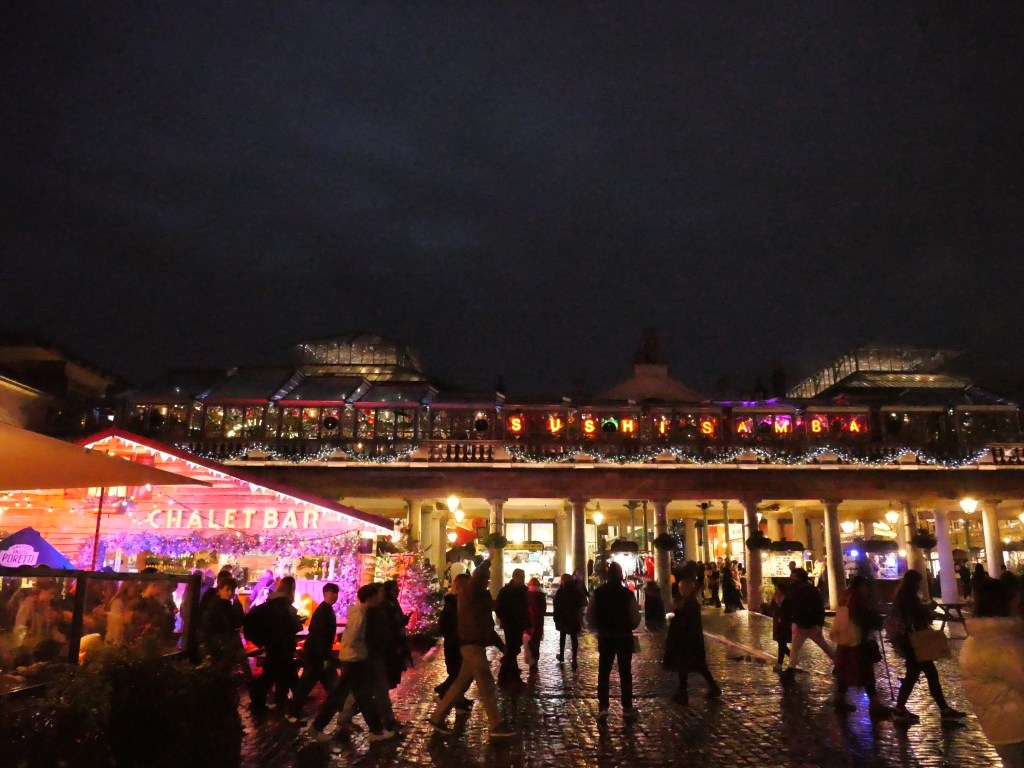
By 1200 part of it had been walled off by the Abbot of Westminster Abbey for use as arable land and orchards, helping eventually give the neighborhood the name “the Convent Garden”. Covet Garden and parts of Holborn were the first London “suburbs” built outside of the original Roman Walls of what is mostly the City of London. The neighborhood was mostly built up by the mid 16th century but likely densified after the Great Fire of 1666, which did not touch the district. The Covent Garden Pizza was laid out in 1630, creating London’s first modern square surrounding by many private residents of note. But this honeymoon for the wealthy and powerful did not last long and by 1654, a small open-air fruit-and-vegetable market had developed on the south side of the fashionable square. Gradually, both the market and the surrounding area fell into disrepute, as taverns, theatres, coffee houses and brothels opened up. By the 18th century Covet Garden had become notorious slum with a concentration of brothels. But by the 1800s urban renewal efforts were afoot first with the creation the modern day neo-classical market building. The market grew and buildings were added: the Floral Hall, Charter Market, and in 1904 the Jubilee Market. The central neo-classical market building re-opened as a shopping centre in 1980 and became a major tourist destination in Central London.
The district is divided by the main thoroughfare of Long Acre, north of which is given over to independent shops centered on Neal’s Yard and Seven Dials, while the south contains the central square with its street performers and most of the historical buildings, theatres and entertainment facilities. From an urban perspective, while Covet Garden is very touristy, it still has managed to retain a large residential base and is one of Central London’s most dense districts. This convergence helps create an incredibly mixed-use environment filled with wonderful narrow streets with lots of small business activity outside of the central Covet Garden Market. Covet Garden is also the site of many of London’s top historic sites, numerous theaters considered part of the Westend and great cultural scene. The major downsides of the district is a real lack of tree canopy limited park spaces, and fragmented bike infrastructure.
Click here to view my Covet Garden Album on Flickr
URBAN STRENGTHS:
* Gorgeous historic landmark properties (i.e. National Gallery, Caring Cross Station, St. Martin in the Fields, St Giles in the Fields, St Paul’s Church Covent Garden, Covet Garden, Theatre Royal Drury Lane, the Royal Ballet & Opera ) and many historic theaters comprising many theaters considered part of the Westend. In additional to many museums, historic sites and theaters also a great array of live music venues, bars & restaurants.
* Also great retail amenities including Covent Garden Market, great array of clothing stores, plenty of supermarkets and grocerias, and plenty of neighborhood serving stores.
* The famous Leicester and Trafalgar Squares are here.
* Whitehall Gardens & Victoria Garden Embankments are very nice and run along the Thames
* Other famous sites like 17 Downing Street and Admiralty Gate are hear.
* Major biz districts include Charing Cross, New Oxford, and the Strand but are very busy and touristy.
* The entire neighborhood of Covet Garden is mixed use and there are some wonderful narrow streets with lots of biz activity (i.e. St. Martin’s Ln, New row, King St., Maiden Ln, Tavistock, Floral, Long Acre, Short’s Garden, Neal St & Neal’s Yard, Endel, James St and a couple really interesting historic nodes like the Seven Dials and where Martin’s Lane & Cranbourn St come together).
* Lots of very narrow pedestrian Lanes without any storefronts. This is a classic feature of old London where buildings where historically built right to the lot lines.
* Population density is one of the highest for London at around 40K residents per sq mile.
* Well served by public transit with 6 metros on 6 lines.
URBAN WEAKNESSES:
* Very touristy district.
* Bike lane infrastructure is limited and what does exist is very fragmented.
* Other than the Victoria Garden Embankments, there are only a handful of parks in Covet Garden. A couple good ones however (i.e. Diamond Jubilee Garden, the Phoenix Garden, & Drury Lane Gardens). Tree canopy is very limited in Covent Garden.
 Evaluating our Urban Communities [with a focus on America]