Old North Columbus- A quality historic community north of Ohio State University

Old North Columbus was founded in 1847 as a stand-alone city. North Columbus in its early years was a major stage coach stop between Columbus and Worthington to the north and had a history of thriving saloon and speakeasy scene. North Columbus was also the site of a large  factory and a mill along the banks of the Olentangy River. The establishment of Ohio State in 1871 brought a major boom to the neighborhood and helped fill it in by the 1920s.

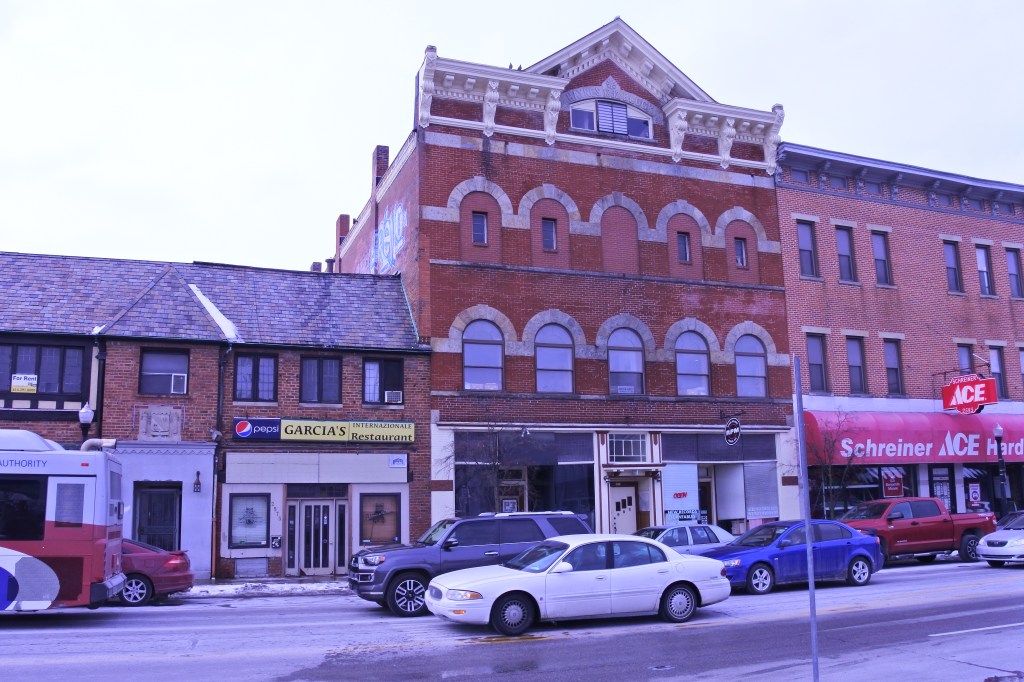
Old North Columbus never saw the level of disinvestment as places like Weinland park after WWII nor wholesale take over of students as occurred in the University District to the south. While students comprise a large portion of the neighborhood, there is still a sizable homeownership community here. High Street has also held on to much of its late 19th century commercial architecture and hosts a great array of ethnic restaurants and decent amount of neighborhood serving businesses. Also a quality urban node at Summit and Hudson and a pair of attractive boulevard streets and ravines north of here. Neighborhood branding signs were installed in the early 2000s along High Street to bolster the community’s identity. The biggest area for improvement is new quality urban in-fill along High street and Lane Ave. redeveloping surface parking lots and low-rise auto centric uses. Given the development pressures nearby in OSU, I’m confident this will come soon. The neighborhood also desperately needs walkable schools within the community to attract more generational diversity and long term homeowners. 
Click here to view my Old North Columbus Album on Flickr

URBAN STRENTHS:

* Solid multi-model access with good transit and public infrastructure access.
* Good economic diversity and only decent racial diversity.
* Great array of rental options generally renting at moderate rates.
* A lot more for sale housing here than other districts surrounding OSU.
* Pretty safe district with only a little bit of blight.
* Great park amenities including the extensive Tuttle Park which includes extensive woods, a swimming pool, recreational center. Glen Echo Park follows the Glenn Echo Stream with recreational trails and bike trail along the Olentangy River.
* Good tree canopy thanks to the large amount of park space here.
* Culturally a great array of ethnic restaurants, plenty of bars & cafes, lots of live music venues, and convenient access to cultural amenities of OSU.
* Decent retail amenities, especially along High Street, a drug store, hardware store, bike shop, several record stores, and some other neighborhood retail. Supermarkets located on the edges of the neighborhood along with a Lowes Improvement Store and Target.
* Quality historic commercial along High Street with good historic residential helped with a fair amount of late 19th century architecture.
* High street and Lane Ave’s urban form is a mixed bag. Another nice urban node at Summit and Hudson.

URBAN WEAKNESSES:

* Limited generational diversity but more family households than other student heavy districts around OSU.
* Modern in-fill is a mixed bag. Some nice dense mixed-use infill along High, with plenty of auto centric buildings remaining. Plenty of blah post WWII apartments throughout.
* No schools within Old North Columbus but some in surrounding neighborhoods.

Columbus’ University District- home to the City’s largest off-campus student haven

For the purposes of this evaluation I define the University District/Indianola Terrace as the area between Lane/Northwood and 11th street and between High Street and the railroad tracks. University District is actually a much broader area by most standards encompassing North Old Columbus and South Campus. Indianola Terrace is east of Summit Street.

Like much of north Columbus, the University District grew on a similar track with Ohio State, which opened in 1870 but didn’t really start to expand until the early 20th century. To people’s surprise the neighborhood was a fashionable “suburb” in the first half of the 20th century with a mix of brick rowhouses and large SF homes. Several curved roads and ravines lie between 16th and Lane Ave. The influx of servicemen into the neighborhood after WWII seeking housing lead to a population boom and the construction of new apartments and conversion of many SF homes to MF.  Perceived problems of vehicular congestion, crime, and litter resulted from this quick rise in density and the University Area Commission was created in 1972 to address them.

Its difficult for me to say whether I view the change of University District post WWII as necessarily an urban “negative”. On the one hand it most certainly rapidly altered the neighborhood creating a more transient less cared after place. On the other hand, it created a density level helpful in fostering vibrancy, mixed-use, and significant retail on Hight Street. In hindsight it probably would have been wise to rezone parts of the neighborhood closest to campus for high density apartments, and try to preserve homeownership heavy pockets east of Summit Street. Fortunately the University District feels more invested in than before, less gritty, attracting more homeownership, and hosts a dense mixed-use corridor along High Street. Hopefully the neighborhood can continue to attract a more diverse demographic (non-students) and become the vibrant and diverse place it could always become. I see many parallels to the University District with Pittsburgh’s Oakland or Cincinnati’s CUF and Corryville.
Click here to view my University District album on Flickr

URBAN STRENGTHS:

* Good but not great transit access. Overall convenient access to lots of jobs with OSU and Dwtn.
* Great bike infrastructure with several dedicated bike lanes and good bike station coverage. 
* Quality historic architecture, but would be even better if the bldgs didn’t take a beating as student housing.
* Great ADA and sidewalks infrastructure.
* Not much modern in-fill within the neighborhood but lots of quality urban mixed-use infill along High Street.
* Decent racial diversity thanks to OSU diverse student body.
* A high level of density thanks to students being packed into rental housing.
* Not surprisingly tons of rents here and generally at pretty modest prices.
* High Street has very good urban massing and streetscape especially with its recent extensive urban in fill.  
* Cultural amenities include a great array of ethnic restaurants, lots of college bars & cafes, several live music venues, and the OSU cultural activities.
* The University District hosts a full service target,  2 CVS, several chain retailers, lots of banks, a handful of boutiques, and a cineplex and Barnes & Nobles on its southern border. 

URBAN WEAKNESSES:

* Lots of students living here which greatly reduces the University district’s economic and generational diversity.
* For sale housing is mostly limited to student rental. But some SF and duplexes in good shape selling in the 200Ks & 300Ks. You certainly get a lot of house for your money here.
* Park space is limited here to the nice but modest Luka Ravine park and the ballfields behind the Indianola Middle School. But park asset is probably OSU quads and green space.
* The neighborhood is a bit rough in spots (especially in Indianola Terrace and has a fair amount of grid but by no means a dangerous place.
* The neighborhood only hosts a small privet grade-middle schools. A couple others in adjacent districts. 

Weinland Park- A Revitalizing Neighborhood in between Columbus’ Short North and Ohio State

Weinland Park mainly developed in the early 20th century as a street car suburb fueled by jobs in several factories, such as Columbus Coated Fabrics and the Jeffrey Manufacturing Company (now a large redevelopment site). Like many  inner city American neighborhoods, Weinland Park experienced decline starting in the 60s and was plagued by drug problems in the 1980s. Fortunately with its location between the Short North and OSU, reinvestment and development eventually came starting in the mid-2000s with the Gateway South Development and affordable single family construction. Now quality homes easily sell in the 300Ks and new construction is fetching prices around 1/2 Million. High street has also seen many quality urban in-fill projects replacing auto centric uses and 1 story commercial. Pretty soon the entire High Street corridor will be filled in. The once rough 5th Ave is also seeing significant mixed-use renovations and new construction.

Main urban deficiencies in Weinland Park include limited economic and generation diversity thanks to its large student population, limited park amenities, a lack of quality walkable schools, and lingering blight issues. But many other these deficiencies will be alleviated as the neighborhood continues to improve. What will become more of a lasting issue is the district’s high home sales prices.
Click here to view my Weinland Park Album on Flickr

URBAN STRENGTHS:

* Good Density at around 12K residents per square mile.
* Very convenient access to Downtown via all modes of transportation.
* Great racial diversity.
* Large supply of rental housing priced modestly. Much of it is geared towards students.
* For sale market has increased drastically in the past 5 years. Right now its a healthy mix of modest homes selling in the 200s, and larger new or updated homes selling btwn 300K-500K. I can see the neighborhood gentrifying rapidly however.
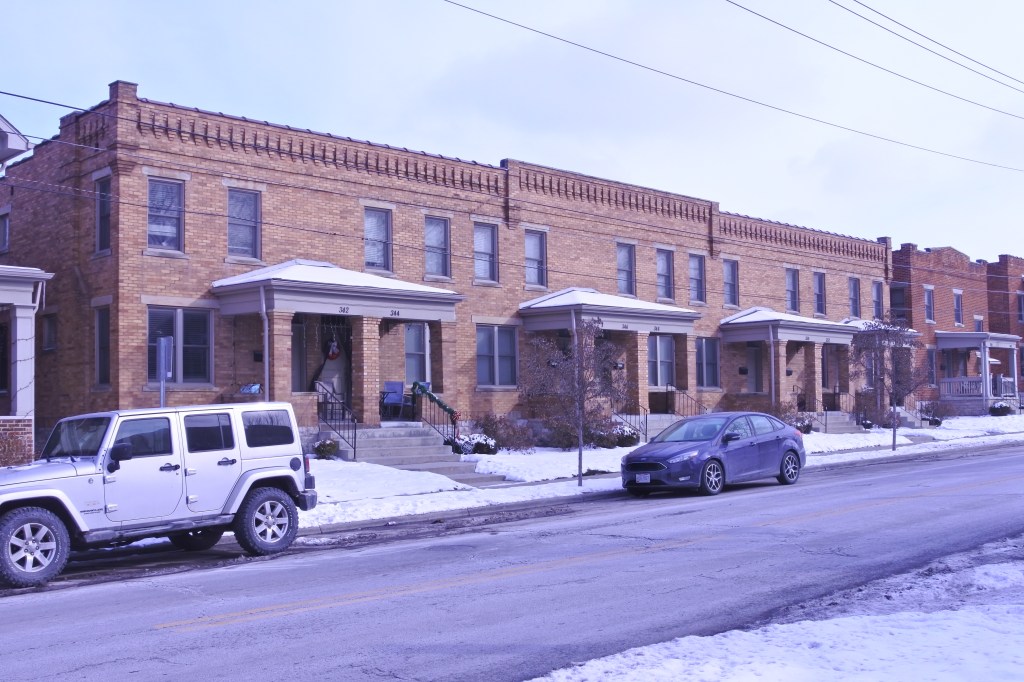
* Solid but not spectacular architecture. The highlights being the historic rowhouse courts and quality SF in-fill throughout the neighborhood and mixed-use in-fill along High St, especially at South Gateway.
* Excellent current ADA infrastructure and good sidewalk infrastructure throughout.
* Much of High Streets recent parking lots and auto centric uses have been developed into quality urban infill. The Streetscape on High also received an infrastructure overhaul.
* Solid cultural amenities including a good array of restaurants, bars, breweries & cafes. Also some art galleries, a community theater, cineplex, and convenient access to OSU’s and the Short North’s cultural amenities.
* Neighborhood retail amenities include a supermarket, several drug stores, public library, post office, a Barnes & Nobles, and some retail & boutiques.

URBAN WEAKNESSES:

* Lots of students living here which greatly reduces Weinland Park’s economic and generational diversity.
* Weinland Park is nice providing good amenities, but limited park space outside of this. South Gateway has some nice plaza space.
* Crime and blight were major issues for Weinland Park for many years, but both have dropped precipitously in the past decade.
* Schools are pretty limited but the neighborhood does hosts Weinland Elementary, along with a private middle school and a couple small specialty schools nearby.

Youngstown’s Pleasant Grove and Boardman’s Forest Grove Historic District

I combined this small Youngstown neighborhood on its southern border with the Forest Glen historic district and portion of Boardman north of Shields Rd/Indianola Rd as they tie into one another well with a shared commercial district along Market Street. The other reason being that Pleasant Grove is too small to evaluate on its own and I wanted to include most of Boardman’s pre-WWII development. Boundaries used here Euclid/Grover Dr to the east, Midlothian Blvd to the north, Mill Creek to the west, and Mill Creek Dr. and Shields Rd/Indianola Rd to the south.

Pleasant Grove is a “pleasant” 1920s-1940s neighborhood with suburban like density but decent connectivity and nice historic homes. Commercial districts along Market and Midlothian Blvd are pretty auto centric but at least still have sidewalks. The Forest Glen Historic District in North Boardman hosts an excellent array of 1920s-1950s mansions and modest homes set curvilinear forested streets. Very pretty.

The main area for improvement in the neighborhood is retrofitting Market Street into an urban commercial district. This is at least possible with the neighborhood’s connectivity and grid but given the economics of Youngstown, I don’t anticipate this happening anytime soon. 
Click here to view my Pleasant Grove Album and here to view my Forest Glen Album on Flickr

URBAN STRENGTHS:

* Great economic and generational diversity.
* For sale housing is pretty cheap but some decent diversity. Product ranging anyway from 25K-240K. Most housing selling between 50K-100K. The majority of homes selling over 100K is in the Forest Glen Historic District.
* Mill Creek Metro Park provides a great park amenity for along the western edge of this district with extensive trails, bike paths, golf courses, meadows, and pavilion space. 
* Great tree canopy especially in the Forest Glen section of the neighborhood. Only a couple modest parks outside of Mill Creek Park.
* Generally a safe neighborhood  besides some blight along Market St.
* Sidewalk infrastructure generally pretty good. Some missing sidewalks on the newer streets. Curbs are rarely ADA compliant though.
* Great 1920s-1950s historic architecture especially in the Forest Glen Historic District.

URBAN WEAKNESSES:

* Public transit access is fair. Bike infrastructure limited to a dedicated trail along Mill Creek Park.
* Racial diversity is pretty limited.
* Rental product limited to only a couple single family homes.
* Cultural amenities limited to a handful of restaurants and bars.
* Retail amenities better but generally auto centric. Include a couple drug stores, a family dollar, Middle Eastern grocery store, a couple banks, antiques & boutiques, a florist, salons, and a public library.
* Some good schools including Valley Christian School and several private and public elementary schools nearby.
* Modern in fill pretty much limited to strip malls.

Idora- historic home of Youngstown’S favorite amusement park.

The Idora neighborhood gets its name from the urban amusement park, Idora Park, previously  located in the north-western portion of the neighborhood. The amusement park is what fueled the growth of the neighborhood in the early 20th century. Sadly Idora Park closed in 1984 and was the dealt knell to the Glenwood commercial district serving the neighborhood. Idora Park was eventually converted into a large greenspace connected to Mill Creek Park.

After the past decade local philanthropy stepped in to stabilize the housing market through demos and renovations. Plenty of vacant lots remain. Glenwood Avenue has a long way to go before becoming a viable urban district as most of its fabric has been wiped away. I’d also like to see dedicated bike lanes built within the neighborhood.
Click here to view my Idora album on Flickr

URBAN STRENGTHS:

* Nice Historic architecture
* Great Tree Canopy.
* Well served with park amenities with Mill Creek Metro park wrapping around the neighborhood’s western edge.
* Generally good sidewalk infrastructure but limited up to date ADA curbs.

URBAN WEAKNESSES:

* Limited in-fill and what does exist is auto centric commercial along Glenwood.
* Good access to Dwtn.
* High percentage of family households.
* Most of blight is along Glenwood but certainly some missing teeth in the neighborhood. Local leaders seem to have at least stabilized Idora with lots of demos and renovations.
* Public Transit access isn’t great. Limited bike infrastructure although there is a nice bike path along Mill Creek parkway.
* Pretty low income neighborhood with some middle class households. Not great racial diversity either. Black majority district.
* Generally a pretty cheap neighborhood. Some housing in the 100Ks and low 200Ks near Mill Creek. These are larger homes. Rentals options are very limited.
* Other than the Lanterns Mill Historic site really not cultural amenities here. Hopefully the Historic Foster Theater gets converted to a live music theater as planned.
* Retail amenities limited to some pretty typically low income stores like a gas station, family dollar, dry cleaners, and car mechanics.
* No schools within Idora. Closest ones are 2 miles away. 

North Heights- One of Youngstown’s most stable pre-WW II neighborhoods

North Heights is a comprised of mostly modest and large single family, wood frame homes built up in the 1920s & 1930s. The neighborhood was built up in response to middle-class housing demand fueled by Youngstown’s growing industrial base. Ethnic make up of the residents include African Americans, Italian Americans, Irish Americans, and Jewish Americans .

Mansions with large set backs line 5th Avenue. East of here is a more blighted lower income neighborhood. West of 5th Avenue is a solid middle class district. Commercial corridors are either auto centric or blighted but some auto centric retail. Other than having sidewalks and good street grid, North Heights functions more effectively like a moderately dense post WWII suburb. But that could change if the commercial districts are ever urbanized and more residential in-fill occurs. Unfortunately given Youngstown’s economy, I don’t anticipate that happening in my life time.
Click here to view my North Heights Album on Flickr

URBAN STRENGTHS:

* Great tree canopy.
* Very convenient access to Dwtn with just an 8 minute drive.
* Great racial and economic diversity in North Heights
* Park amenities consist of Crandall Park and several cemeteries. Crandall Park is a good one, centrally located, diverse amenities and runs several blocks along a stream.
* Consistent sidewalk infrastructure but very few ADA compliant curb cuts.

URBAN WEAKNESSES:

* Very low density. More like a suburb.
* Poor Public transit and no bike infrastructure.
* Housing is still very cheap but some diversity. East of Ohio is mostly under 50K. West of Ohio street between 50K-100K. Larger mansions along 5th Ave generally selling in the 100Ks. Top of the market in in the low 200Ks.
* As this is a SF dominant neighborhood, rentals are very limited.
* Cultural amenities limited to a handful of restaurants and bars.
* Commercial corridors generally both blighted and auto centric. Not much positive to say here.
* Some retail amenities but all auto centric including a supermarket, drug store, a couple dollar stores, a post office and other low income stores.
* Schools include a public elementary and a catholic school just west of the neighborhood boundaries. 

Youngtown’s Wick Park- Historic Home to Youngstown’s Elite

Wick Park is bordered by Belmont Ave to the west, Andrews to the east, Fairgreen to the north, and route 422  to the south.

Wick Park during the first half of the 20th century included some of the city’s most affluent residents. Youngstown’s wealthiest business leaders and professionals migrated here away from downtown and the noisy activity of the City’s steel mills to this wooded  neighborhood areas near the city’s northern border. The largest homes historically lined Wick Park, Elm & Wick Avenues. Many of these homes have been torn down or are occupied by YSU and other institutional. But some remain as single family residential, especially surrounding Wick Park. 

The neighborhood’s other great assets include its convenient access to YSU/Downtown and Wick Park itself, an expansive and multi-functional park. Still lots of blight remain in the neighborhood including several blocks of urban prairie east of Wick Ave. My hope is that given its location and historic architecture, civic leaders will focus on revitalizing the neighborhood.  There is a nice but modest commercial node at Elm Street and Baldin where this could start along with stabilizing streets surrounding the park. 
Click here to view my Wick Park Album on Flickr

URBAN STRENGTHS:

* Generally good sidewalk and ADA infrastructure. Not as good on streets with few houses.
* Very convenient access to Dwtn. Only a 6 minute drive and 1.5 miles away. YSU is a good job hub as well and only 5 minutes away.
* Good connectivity and street ride in Wick Park.
* Decent racial diversity. Family households is also high, generally around 50%.
* Wick park is an expansive central located park in the neighborhood provide lost of green space, playgrounds, tennis court, golf disco course, tennis courts, a modest recreational center, and woods.
* Great tree canopy. 
* Decent school access with the neighborhood hosting a Catholic High School. College Prep HS located nearby at YSU’s campus and an elementary school about a mile north. 

URBAN WEAKNESSES:

* Transit Service isn’t great. No Bike Infrastructure either.
* High poverty here but some income diversity.
* Housing market is very depressed. Rentals of all sized seem to rent around $600. Most in shape homes sell for 50K. Not sure what top of the market might be for one of the large mansions in the neighborhood. Guessing its just sky of 100K.
* Nice cluster of retail amenities at Elm and Baldwin (i.e. coffeehouse, food-coop, florist, a Kitchen incubator, and a diner. Large hospital along Belmont.
* Cultural amenities are also limited but residents have convenient access to YSU performing arts and performances at the Stambaugh Auditorium.
* Neighborhood doesn’t feel unsafe but plenty of blight. Urban prairie in the eastern portion of the neighborhood east of Wick Ave. 

Youngstown State University, OH- Youngstown’s economic enginee

For this evaluation I also include the historic Smoky Hollow neighborhood to the east of Youngstown State (YSU) between Wick Ave and Crab Creek. The neighborhood’s name derives from smoke saturated air commonplace in the neighborhood due to the Mahoning Valley Iron Company. Immigrants arrived starting in the late 1800s and until the 1960s it was a thriving working class neighborhood. Sadly white flight, suburban sprawl, and the City’s industrial collapse were not kind to the neighborhood. Most of the neighborhood is now vacated other than a few houses, Cassese’s MVR restaurant (been around since the 1920s!) and some expansion from YSU. I hope that one day the University and City leaders commit themselves to rebuilding this neighborhood given its proximity to Downtown.

YSU was founded in 1908 but mostly developed since the 60s when it became a state university. While this is mostly a commuter college, it provided a much needed economic lifeline to Downtown Youngstown and surrounding neighborhoods. YSU also helps provide a decent streetscape along Wick Ave, good greenspace with several quads, cultural activities, and some restaurants and bars. City planning efforts are in the works to better connect YSU to Downtown, and already several apartment buildings have sprung up serving its students.
Click here to view my Youngstown State Album on Flickr

URBAN STRENGTHS:

* Good ADA and sidewalk infrastructure at YSU but not so great in the depopulation parts of Smokey Hollow. 
* Decent pubic transit access, or at least good for Youngstown standards.
* Great access to jobs with around 10K at YSU and over 30K Dwtn.
* Good racial diversity in YSU.
* Decent park amenities with the expansive Wick Park just north of the neighborhood, green space in the YSU quads and Harrison Field.
* Some good cultural amenities including several restaurants and bars, both a modern and contemporary art museum, a live music venue, the cultural amenities of YSU and walkable access to Dwtn’s amenities.

URBAN WEAKNESSES:

* Very low density
* Limited bike infrastructure but YSU’s campus is at least bike friendly.
* Income diversity is low here as there are mostly students living here.
* For sale product is very limited here. Some rental product.
* Retail amenities are limited to the University bookstore and walkable amenities Dwtn.
* Schools are limited although the neighborhood hosts a small college prep school and an ok elementary school is located about a mile north.

Yellow Spring, OH- A liberal oasis in the middle of red Southwest Ohio

I roughly used the following boundaries in my evaluation to capture the pre-WWII portion of Yellow Springs: Allen St. to the south, High to the west, Yellow spring-Fairfield road to the North, and the Little Miami Scenic Trail to the east.

In 1825, Yellow Spring’s Village was founded by approximately 100 families hoping to establish the utopian community at New Harmony, Indiana. The community disbanded and it took the completion of the Little Miami Railroad in 1846 to increase development to the town.  The village was named after a nearby natural springs with waters high in iron content.  Antioch College was founded in 1850 with the distinguished scholar Horace Mann as its first president. The town always had a strong progressive bend, even being targeted by the government in the 1950s for its leftist communist leanings and not surprisingly was a major center for the Civil Rights and Anti-War movement of the 60s&70s. This cultural bent has created a liberal oasis set in the middle of a very conservative rural area in SW Ohio. Yet the  village’s population has remained small hovering around 4,000 residents since WWII.

The town’s main attraction is its vibrant color downtown setting at the crossroads of Dayton and Xenia Avenue. Great concentrations of art galleries, local craft stores, boutiques, great restaurants, bars, and cafes attract tourists from the entire Southwestern Ohio region. Yellow spring’s major downsides from an urban perspective  are its very low density, lack of any public transit, and few rental properties. But I guess in Yellow Springs this dynamic seems to work. 
Click here to view my Yellow Springs album on Flickr

URBAN STRENGTHS:

* The Little Miami Scenic Trail is an excellent north to south bike path traveling throughout town.
* Solid racial and economic diversity.
* Over 50% are family households but a high median age likely due to a lot of retirees living here.
* Good mix of for sale housing options ranging from 50K all the way to 400K depending on size and condition.
* Excellent tree canopy.
* Great natural parks with the Little Miami Scenic Trail, and expansive Glen Helen Nature Preserve just east of Dwtn. Gaunt Park hosts a public pool and several ballfields.
* Dwtn is really a regional destination hosting a great array of local creative shops, boutiques, art galleries, a toy store, bookstores,. this helps creative a colorful, liberal vibe and lots of people in the summer months.  More typical neighborhood amenities located in Yellow Spring include a wine cellar a pharmacy, hardware store, public library, post office, a local grocery store, and a couple banks.
* Other cultural amenities include a great array of restaurants, bars, & cafes, a couple breweries, some live music venues, a local movie theater, the Antioch Foundry Theater, and the trailside nature center.
* The Public elementary school is located close to Dwtn. The middle and high school are located on the western edge but still walkable to most students.
* ADA curbs and sidewalks are good Dwtn but hit or miss in the residential areas. 

URBAN WEAKNESSES:

* Very low density . 
* Virtually no public transit here. Making car travel the only commuting option to Dwtn Dayton. Not a terrible option as its only about a 30 minute drive.
* Rental product is very limited. Surprising for a college town, but the college is tiny (about 150 students). 

Dayton’s Inner East- A neighborhood with great urban fabric and potential

The Inner East is comprised of two small city designated historic districts.. St. Ann’s Hill and Huffman. Both have wonderfully preserved architecture from the late 1800s, some of the best architecture in Dayton. The rest of Inner East is pretty blighted and underinvested especially 5th Ave, the eastern half of 3rd Ave, and the Southern quadrant of the district.

St. Ann’s is adjacent to the Oregon District and was platted in 1802 by German immigrants. Homes were erected in the neighborhood starting after the Civil War. William Huffman who was a local banker, real estate developer, and a producer of Huffman bicycles spurred development by building railway on Third Street northeast of St. Ann’s Hill creating the Huffman district. The neighborhood was built up between 1870 and 1890. St. Ann’s and Huffman were designated historic districts in 1974 and 1982, respectively.

Restoration of the historic homes has been occurring since then but redevelopment hasn’t spilled over into adjacent parts of the Inner East. A couple food & beverage businesses and some general retail is just popping up on 3rd Ave in St. Ann’s. Sadly, Dayton’s economy and limited urban culture prevents this urban area with great bones from getting the investment and retail amenities it needs to become a thriving urban area. Hopefully city leaders will realize the great potential of this neighborhood and put appropriate investment into it. 
Click here to view my St. Ann’s album on Flickr

URBAN STRENTHS:

* Good sidewalk and ADA infrastructure throughout the neighborhood.
* While public transit access is only okay, the Inner East is still very convenient to Dwtn. 10 minute drive and 15 minute bike and bus ride.
* Excellent street grid and connectivity.
* Decent bike infrastructure including a dedicated east to west bike lane and a couple bike share stations.
* Lots of family households (around 60%) and good age diversity.
* Good diverse of price points with for sale housing. Housing in the Southeastern quadrant of Inner East is under 50K. Fair amount of homes selling between 50K-100. Most homes in the historic districts sell in the 100Ks and 200Ks. Higher prices in St. Ann’s than Huffman.
* Good tree canopy overall.
* Well ranked Strivers high school for the arts is located within Inner East several other decent schools located within walking distance in adjacent districts. 

URBAN WEAKNESSES:

* Lots of blight along 3rd Ave and the eastern half of 5th along with the Southeastern quarter of the Inner East. Quite the difference between this and the Historic District of St. Ann and Huffman.
* Transit access is okay. Underwhelming for being 2 miles from dwtn.
* While racial diversity it okay good economic diversity mixing middle and upper middle class households with those below the poverty line.
* Rental housing is a bit limited and generally inexpensive.
* Bomberger Park is the neighborhood’s only park amenity. Nice park but not located on the district’s western edge.
* Pretty low density for an urban district so close to Dwtn.
* Some cultural amenities but not a ton… a handful of restaurants, a couple nice cafes, a couple dive bars, and a couple art galleries. Cultural amenities of the Oregon District and Webster Station only a 10-20 minute walk.
* Retail amenities are also pretty limited and include a couple Hispanic grocerias, a bakery, several thrift stores, and an antique shop.