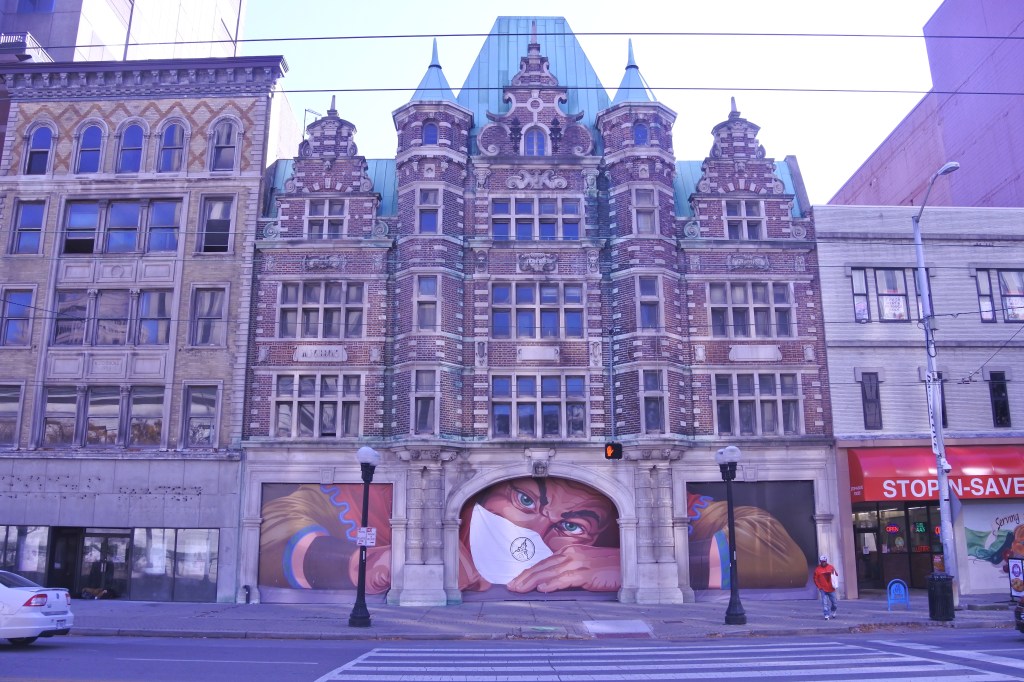
Downtown Dayton, OH

Downtown Dayton is probably one of the better mid-sized American Downtowns thanks to its extensive remaining historic fabric, good transit network, great bike infrastructure, and quality parks. Downtown also holds a large college population attending school at Sinclair Community College (18,000 students) and is a major employment hub for the Dayton Region, even with the departures of several major fortunate 500 companies to the south.

I find that its easiest to divide Downtown Dayton into two halves. West and East of Ludlow Street. West of  Ludlow is  where the majority of Downtown’s urban renewal efforts occurred. It includes Sinclair Community College, the Montgomery jail and court complexes, some bland modern office towers, and a lot of surface parking lots. Not a lot of life and vitality on this side of Downtown. East of Ludlow  holds the bulk of Dayton’s historic fabric and architecture along with its better modern high raises, theaters, bus hub, public library, Riverscape Park, and the Courthouse Square. It is the more interesting and vibrant half of Downtown, seeing the bulk of new housing and development. Main Street forms the main spine of Downtown Dayton where the convention center, historic arcade, Courthouse Square, several theaters, and Dwtn’s best skyscrapers  are all locate.

My hope for Downtown Dayton is continued civic focus and investment as this could be a very special urban environment. Blight and dead space is what is holding Downtown back the most. It will be interesting to see if the opening of the renovated Dayton Arcade is the spark needed to set this all in motion. 
Click here to view my Downtown Dayton album on Flickr

URBAN STRENGTHS:

* Dwtn has a good public transit itself. But transit service is a bit disappointing across the City of Dayton. Decent  service to many of the Dayton  suburbs depending on their age.
* Great bike infrastructure including a bike share system dwtn and to surrounding inner city neighborhoods and wonderful bike lane coverage within Dwtn and connecting to Dwtn throughout the City and region.
* Generally good racial and economic diversity dwtn both represented in its residential and daytime population.
* For sale product is a bit  limited and concentrated along the eastern edge of Dwtn near Webster Station. Good diversity of price points. 1-bedrooms range from 100K-350K. More 2-bedrooms available ranging from 125K-400K. 3-bedroom condos go between 400K-650K.
* Great of array of quality historic architecture.
* Over quality parks in Dwtn Dayton including the new Riverscape Metro Park, Courthouse Square (a decent well programmed civic plaza), and several other decent plazas spread throughout.
* Excellent ADA infrastructure throughout Dwtn.
* Good array of public & private elementary and high schools in and around Dwtn.
* Great college population dwtn with 18K students enrolled at Sinclair. 
* Pretty good streetscaping especially along the more investment parts of Dwtn. Helps that the City has streetscape guides for Dwtn.
* Pretty impressive employment hub with around 50K jobs. Generally positive outlook for Downtown with recent job growth but still low rents and high office vacancy rates.
* Cultural amenities include: a modern &  historic theater, two specialty movie theaters, several local museums (and the art museum across the river), a couple live music venues and nightclubs, and cultural amenities of Sinclair College.
* Other important amenities dwtn include the Dayton Convention Center, concentration of courthouses, City hall, Dwtn post office & library. 

URBAN WEAKNESSES:

* Dwtn rentals are a bit limited but modest price point. 1-bedrooms lease in the low $1,000s and 2-bedrooms anywhere in the $1,000s.
* Decent skyline but certainly nothing spectacular.
 * The majority of infill is ugly 60s-80s bldgs on Sinclair College. Some decent modern skyscrapers and newer apartment in-fill.
* The western half of Dwtn where Sinclair College is located was part of a pretty extensive urban renewal campaign. This part of Dwtn is pretty lifeless, uninspiring, and filled with lots of surface parking lots.
* Tree canopy is ok. Dwtn could use more street trees.
* Dwtn residential density is pretty low. Plenty of room for an expanded Dwtn population.
* Downtown Dayton still seems to have an image problem even with its quality form and decent amenities. This should continue to get better especially with the opening of the renovated Dayton Arcade.
* Some bars, restaurants and cafes dwtn but pretty limited for a Downtown. Only a handful of art galleries. The only major sports arena is the minor league ballpark in adjacent Webster Square district.
* While dwtn hosts a small discount grocery store and CVS pharmacy retail is pretty limited to a handful of boutiques, a couple bookstores, and neighborhood retail. 

Dayton Ohio’s Oregon District- the city’s premier urban neighborhood

The Oregon District lies to the east of Downtown and is Dayton’s most complete neighborhood. It is know for two things: excellent architecture protected through a local historic district and a lively commercial district along 5th Ave that can be rowdy at times. The Oregon Historic District includes one of the earliest surviving combinations of commercial and residential architecture in Dayton ranging from 1820 to 1915. Many streets are also the original red brick.

Yet there are still many areas the neighborhood needs to improve upon before it becomes a premiere district in the same category of other great Ohio urban neighborhoods like Ohio City, the Short North, and Over-the-Rhine. It needs a better variety of retail amenities especially a grocery store, more market rate rental housing, more population in general, and in-fill development along its north and eastern edges where there is still a fair amount of blighted or auto centric uses. 
Click here to view my Oregon District album on Flickr

URBAN STRENGTHS:

* Pretty good bike infrastructure including several bike stations and a dedicated bike lane.
* Great access to dwtn being just southeast of it.
* Good racial diversity and pretty good economic diversity although high poverty rates around 40% live alongside upper middle class households.
* Also good generational diversity with 45% family households and a nice mix of young adults, and boomers.
* Good mix of for sale housing product with 2 & 3-bedrooms selling btwn 150K-350K. 4 bedrooms generally selling in the 300Ks.
* Several public housing developments located in the Oregon District provided affordable housing in a good neighborhood.
* Tree canopy is great in the residential portion of Oregon but pretty terrible in the north and eastern edges with most industrial uses.
* Newcome Park is a nice historic park located in the heart of the Oregon District. Bomberger Park is located on the eastern edge of the district. Not much else park amenity wise.
* Culturally the Oregon District has a nice array of restaurants, bars, cafes, several night clubs, a comedy club, walkable access to the Neon Indie Theater & Black Box Improv Theater in nearby districts. Many of Downtown’s cultural amenities are also walkable to the Oregon District.
* Retail wise lots of boutiques and creative stores, a bookstore, post office, and walkable access to Dwtn’s retail amenities like the public library, drug store and banks.
* Generally a pretty safe area but still blighted areas in the north and eastern edges.
* No schools within the Oregon District but two excellent high schools within walking distance. Also several elementary schools in Downtown Dayton. 

URBAN WEAKNESSES:

* Urban form not great in the eastern and north edges of the Oregon District. Hit or miss along Wayne Ave. Fair amount of industrial blight along the district’s northern edge.
* Density is only so .
* Rental product is a bit limited but nice mix of market and affordable. Market 1-bedrooms generally rent near or below $1,000 and 2 bedrooms in the low $1,000s.
* No walkable supermarket, 

Kent, OH- hosts a quality historic downtown as state university near Akron

Difficult to decipher exactly what to include in this Kent evaluation as the pre-WWII fabric extents pretty far and inconsistently outside of the downtown center. I included all of Kent University and used a mixture of block groups and historic fabric to set the boundaries of this evaluation.

Kent was originally founded as part of the Connecticut Western Reserve and settled in 1805. It attracted settles due to its location along the Cuyahoga River which spurred water-power mills and eventually the Ohio canal. By the time Kent State was founded in 1910 the City already had a population of 4,500. Kent State was built on the eastern edge of the City and doesn’t fully integrate with the historic town. While there are several quality historic buildings, most of Kent State is unattractive 1950s-1970s  buildings. Major redevelopment initiatives came to Downtown Kent in 2008 with a $110 Million dollar mixed-use development across several blocks.

Like most college towns, Kent has a good array of main street retail and cultural amenities. Park and recreational space are extensive along the Cuyahoga River adjacent to Downtown. Areas that Kent could improve from an urban perspective include a  downtown supermarket and target, more consistent ADA infrastructure, and a better sense of place at Kent State University. There is also a fair amount of blight in the historic residential portions of the City. 
Click here to view the Kent album on my Flickr Page

URBAN STRENGTHS:

* Convenient access to lots of University jobs at Kent.
* Pretty good local transit access in the downtown core and university areas of Kent.
* Good bike access on Kent State’s campus and along the Cuyahoga River. No dedicated bike shares.
* Pretty good economic diversity.
* Crime rate is very low but still some blight in the residentials portion of Kent.
* Great tree canopy throughout most of Kent.
* Park and recreation highlights include the extensive and diversity park space surrounding the Cuyahoga River and quads at Kent State along with an attractive plaza space at Acorn Alley.
* Quality cultural amenities include many restaurants, bars & cafes, several live music venues & art gallery spaces, a couple local breweries, some local museums (Kent State University Museum and Kent Historic Society) and the performing arts hosted at Kent State University.
* Nice retail amenities as well including many boutiques and local businesses, local bookstores, a couple drug stores, several banks, along with a post office and library.
* Several good elementary schools within the historic core. The public middle and high school is just north of the historic core.
* Kent did a nice job rebuilding its downtown with quality urban in-fill. 

URBAN WEAKNESSES:

* Decent driving access to Dwtn Akron (25 minutes) and Dwtn Cleveland (45) but limited public transit connections.
* Limited racial and generational diversity.
* Local grocery store located in a strip mall just south of the historic core of Kent.
* Sidewalk infrastructure generally good but modern ADA infrastructure inconsistent.
* Most of Kent State University is ugly 60s & 70s towers. While there is attractive green space and quads, likes of parking lots spread throughout campus diminishing its sense of place.
* Historic housing is ok. Some nice historic commercial buildings in Downtown Kent. 

Hudson, OH great historic town and childhood home of abolitionist John Brown

My evaluation of Hudson is very nuanced guided by the walkable pre-WW II fabric of the town. This included Western Reserve Academy to the north, the new urbanist shopping center built around  First and Main Green to the west, Ravenna St to the south, and Oviatt St. to the east.

There is a lot of great history o this town. Hudson is named after its founder, David Hudson, who settled there from Connecticut in 1799, when it was part of the Connecticut Western Reserve. Western Reserve College and Preparatory School was founded in 1826 and but now exists as only a private high school (the college moved to Cleveland and is now Case Western Reserve).  John Brown grew up in Hudson in a very anti slavery town and congregation in the early 1800s creating the seeds of his more radical actions. Historically Hudson was a always a small town. In 1870 there were 868 residents and 1940 1,400. Suburbanization, however, lead to an explosion of residents and the town now has over 20K souls.

Hudson is one of the wealthiest enclaves in the Akron metro likely drawn by its quality schools, history, and historic main street. Several attractive historic residential streets also surround Main Street with homes from every decade of the 19th century. In 2004 an attractive new urbanist retail development (1st & main) was built as a nice extension of Main Street, 
Click here to view my Hudson album on my Flickr page

URBAN STRENGTHS:

* Great historic architecture spanning many decades before WWII in the main street, residential streets, and Western Reserve Academy. Quality urban in-fill with a nice new-urbanist district west of the historic main street.
* Pretty easy drive to Downtown Akron (only 20 minutes). 45 minute drive to Dwtn Cleveland.
* Very high family households around 85%.
* Great tree canopy and street tree coverage on the main street.
* Grand public square park amenities, a nice trail park extending SE from dwtn, and some quality green spaces at Western Reserve Academy.
* Good cultural amenities including lots of bars, restaurants & cafes, several art galleries, a performing arts theater, and several historic homes.
* Lots of walkable retail including a nice array of boutiques, clothing stores, a supermarket, bookstore, post office, and library. Several other strip malls just west of the walkable core as well.
* Very low crime rates in Hudson. Some years there are no violent crimes. 
* Several well rated public schools located on the eastern edge of Hudson Dwtn. Western Reserve Academy located on the north edge was well.
* Quality sidewalk and ADA infrastructure. Up to date ADA curb ramps are common near Western Reserve, main street and the new urbanism shopping center, but limited in the historic residential areas. 

URBAN WEAKNESSES:

* Poor public transit access. Although there is some commuter buses to downtown Akron.
* Limited Bike infrastructure.
* Very high household medium income around $125K but some income diversity here. Also limited racial diversity as central Hudson is around 90% white.
* Most for-sale options are expensive ranging between 300K-1 Million. Some more modest product selling in the 200Ks.  Rental housing is limited.

Harrison West, a charming village like neighborhood in Columbus, OH

Harrison West is the more sleepy version of its neighborhood Victorian Village. The district has good access to downtown, a modest commercial district with several good restaurants/bars, quality parks, good historic architecture and a great infill project called Harrison Park.
Click here to view all Harrison West photos on my Flickr Page

URBAN STRENGTHS:

* Good density at over 10K per sq mile
*Great access to downtown, decent bike lanes and transit lines
* Decent late 19th century wood and brick Architecture. Harrison Park redevelopment in-fill project, is also high quality.
* Vermont Park is a great asset (Blvd. park lined with beautiful historic homes).
* Good access to park space (i.e. Harrison Park, Harrison West Park, and Wheeler Memorial Park

URBAN WEAKNESSES:

* Commercial District on 3rd still lacks many neighborhood services
Could be built up more.
* What remains of the historic stock is very nice but much of the neighborhood was rebuilt in the 90s with mediocre historic in-fill
* Redevelopment efforts in the southern end of the neighborhood