From the tenth century, Paddington was owned by Westminster Abbey and functioned as an ancient village for many years. Starting in 1801, Paddington began to transition to a bustling London district blustered by England’s industrialization. It was at this time that the local Anglican Bishop leased the land to the Grand Junction Canal, which formed a direct trade link between London and the Midlands. This led to the major industrialization of the neighborhood. Construction and building projects took place across the parish throughout the 19th century rapidly increasing its population. The neighborhood’s population increased from 1,881 to 46,305 between 1801 and 1851 with development concentrated on the eastern half of the neighborhood surrounding Paddington Basin and Paddington station. The architectural style of this era is mostly Georgian Brick rowhouses housing mostly the working and middle class. Paddington station first opened in 1838 connecting to London’s first underground line in 1863 (the Metropolitan). Paddington was one of the few districts in London that had a migrant majority population with a thriving Greek and Jewish community in the mid-19th century. Paddington continued to fill in the second half of the 19th century adding 10,000 new inhabitants every decade thereafter. Development in the second half of the 19th century was focused in the western half of the district with mostly regal Terrace Housing and a development style more in character with Notting Hill. Sadly by the late 19th century the immigrant community surrounding Paddington Station became overcrowded and one of London’s most notorious slums. In response, the City embarked on a massive rebuilding campaign starting in the 1930s with select redevelopment continuing in the 1960s. By the 1980s the majority of the Paddington neighborhood was stabilized and once more a desirable community. Yet the Paddington Basin remained dilapidated through the 90s resulting from the de-industrialization of the area. In response, the City passed an ambitious redevelopment plan for Paddington Basin leading to the creation of a dynamic mixed-use center with improved connectivity, excellent park space along the waterfront (including a Floating Pocket Park), a major hub for office space, and a couple thousand units of residential.
This is a dynamic urban district that feels more like the heart of Central London with street vibrancy generated from Paddington station and the major mixed-use developments. Paddington also boasts excellent subway and regional train connections thanks to Paddington station, several attractive smaller park and plaza spaces. The district also hosts a great array of restaurants, bars and retail amenities (including a modest shopping mall) and interesting mix of architectural styles: both new and old. For Paddington to be an even better district it first and foremost needs better bike lane infrastructure and could use more cultural amenities (music venues, theaters, etc.) that are very common in surrounding West End districts. I also would like to see the population density increase to more like 50K-100K residents per square mile. An urban density of 35K residents isn’t bad but a bit low for a major European district surrounding a major train station.
Click here to view my Album on Flickr
URBAN STRENGTHS:
* Craven/Praed Rd is the main Biz District
* Westbourne Terrace, Talbot Square, Norfolk Square, and Sussex Gardens all have gorgeous historic terraces and gardens. Several interesting Mews in the Paddington District.
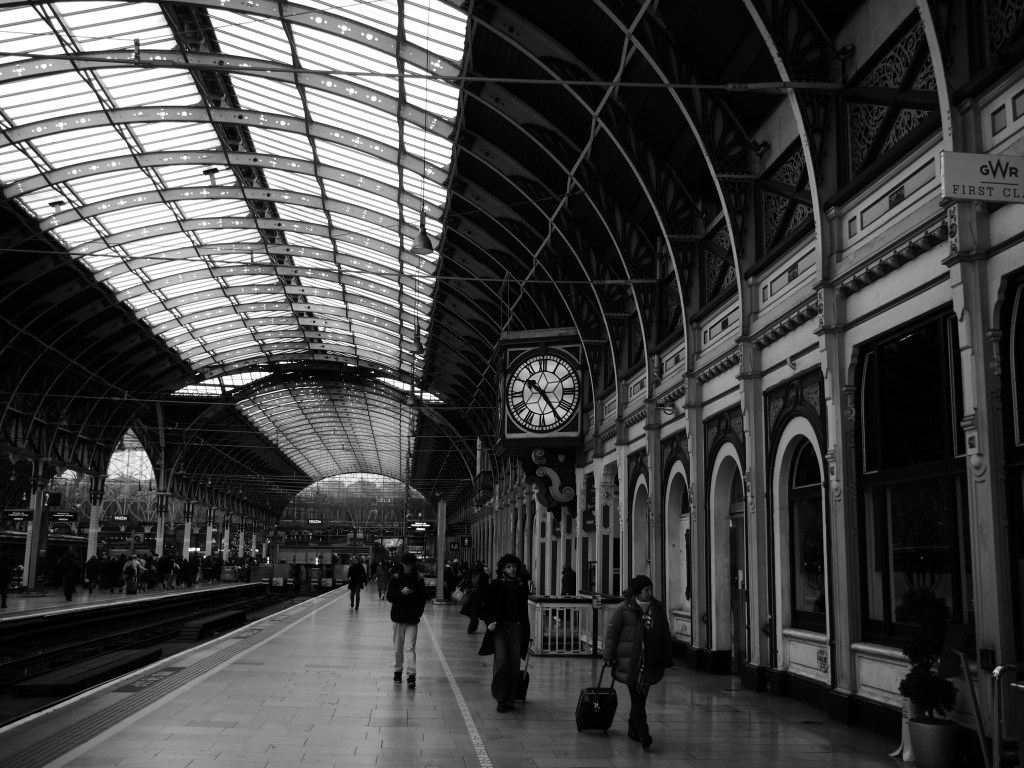
* Paddington Station is massive and interesting. Major modern mixed-use and office development surrounding Paddington Station and Paddington Basin.
* Some attractive publicly accessible greenspaces (i.e. Paddington Basin, Talbot, and Norfolk Square Garden).
* Large number of office jobs surrounding Paddington Station making this a very vibrant district even with a population density of btwn 25-30K residents per square mile.
* While there are only 2 metro stations serving the district Paddington Station connects with 5 metro lines providing excellent access across London.
* Tons of food & beverage businesses but limited number of live music venues, museums, and art galleries. Solid retail amenities as well including a modest shopping mall located in Paddington Station.
* Good diversity of architecture including more modest Georgian Brick rowhouses, Regal Terrace Housing, modest mew rowhouses, and modern office and mixed-use buildings.
URBAN WEAKNESSES:
- Tree Canopy is pretty limited.
- Bike lanes are pretty limited and what do existin are in small segments.
- Green space are pretty limited although residents can walk to Hyde Park pretty easily and Regent Park is about a 1 mile walk.
- Hyde Park lacks the theaters, live music venues, and museums of the Westend of London.
 Evaluating our Urban Communities [with a focus on America]