Historic Spitalfields, or at least the earliest connection to its current name, was the St Mary Spital, a priory/ hospital (a lodging for travelers run by a religious order) erected on the east side of the Bishopsgate thoroughfare in 1197. Spitalfields consisted mainly of fields and nursery gardens until its development in the late 17th century. The infamous and still active Spitalfields Market was established in 1638 by Charles 1. Development came to Spitalfields in the late 17th century with the arrival of French Huguenots fleeing religious oppression in France. The Huguenots came with expertise in the silk industry quickly establishing a vibrant industry in the neighborhood. Shortly after Spitalfields became an independent parish in 1729 located just outside the City of London. By the Victorian era, the silk industry entered a long period of decline and the old Huguenot merchant dwellings degenerated into multi-occupied slums. Spitalfields became a by-word for urban deprivation and hosted several of the Jack the Ripper murders. But life in Spitalfields continued on and welcomed new immigrants including large numbers as Eastern European Jews in the 1800s who specialized in furniture making and tailoring and repopulated many of the large Huguenot houses. By the mid 20th century mainly Bangladeshi immigrants moved into the neighborhood also picking up work in the local textile industry and made Brick Lane the curry capital of London. Spitalfields continued to attract large numbers of immigrants throughout the 20th century and by 1981 at least 60% of households were of minority ethnic origin.
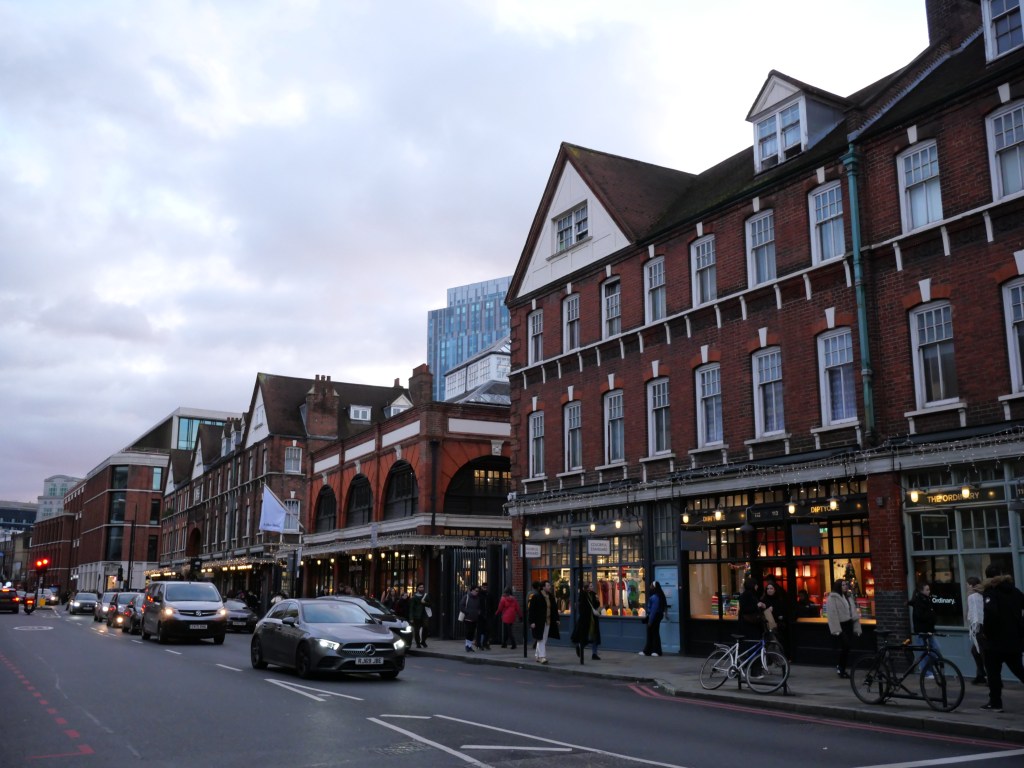
Spitalfields’s regeneration was really seeded in the 1970s with a local campaign to save the housing stock of old merchant terraces west of Brick Lane from demolition. Many have been conserved by the Spitalfields Historic Buildings Trust. Spitalfields continued to gentrify into the early 21st century welcoming several new large office blocks built near Bishopsgate, Aldgate, and Spitalfields Market and a reemergence of the strength of its historic markets (i.e. Spitalfields, Petticoat Lane) complimented with newer markets and modern makers & creators. Spitalfields has become the top destination in East London, attracting thousands of visitors every day, but still retains much of its historic charm of busy markets, gritty streets, and narrow lanes filled with layers and layers of history. Most of the newer apartments and office towers have remained on the edges of the district, not taking too much away from its charm and historic scale.
Click here to view my Spitalfields Album on Flickr
URBAN STRENGTHS:
* Dense district for London standards at about 42K people per square mile.
* Very active mixed-use district which draws large numbers of tourist and Londoners from outside the neighborhood.
* Several great markets located here starting with the historic Spitalfields Market. The Truman Brewery Markets is a weekly outdoor market place. Petticoat Lane is historic market going back to the 1650s spanning Middlesex Street, Wentworth Street, and all of the lanes in between. Backyard Market is a newer community-driven platform that provides a dedicated space for emerging artists and entrepreneurs.
* Commercial street is really interesting and includings mostly intact 18th & 19th century brick East End commercial bldgs.
* Princelet St is a very gritty narrow commercial street/Brick Lane. Very interesting. Lots of Indian/Bangladeshi restaurants. Lots of interesting and gritty streets that come off of this.
* Lots of cool and intimate mixed-use alleys (i.e. Artillery Psge, Widegate St
Some really cool landmarks including: Christ Church Spitalfields.
* Great graffit art along Grey Eagle St.
* While there are no subways stops within Spitalfields, there are plenty of stops on all sides of the district connecting the neighborhood well to the rest of London.
URBAN WEAKNESSES:
- A real hodgepodge of architectural styles. Not a terrible thing as most buildings have good urban form (even the uglier mid-century bldgs).
- A bit too gritty for some. Spitalfields market can get incredibly congested which isn’t everyone’s pace.
- A tree canopy is pretty much non existent.
- Several nice smaller plazas spread throughout (Aldgate plaza, Bishop Square, Elder Gardens) but really no medium to large sized parks.
- Bike shares are plentiful but dedicated bike lanes are very limited.”
 Evaluating our Urban Communities [with a focus on America]