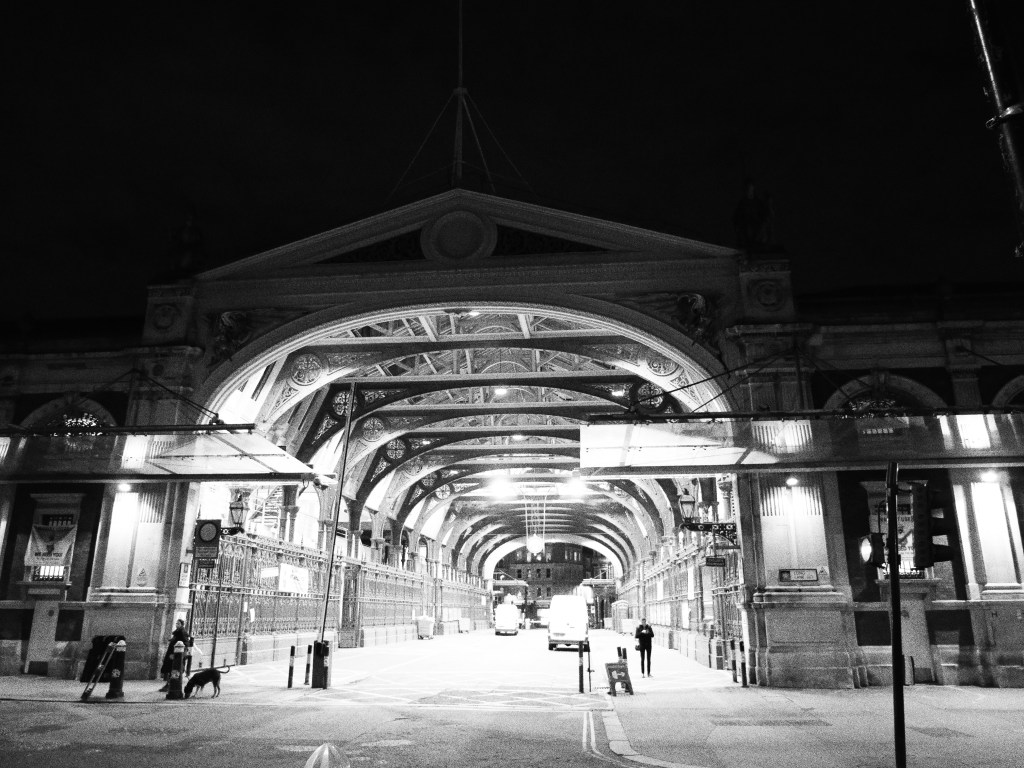
Farringdon is located in the London Borough of Islington located just north of the City of London with Smithfield Market being its southern border. The Smithfield Market dates back to 1133 and has been continually operating ever since, even escaping destruction from the London Fire of 1666. However, the City of London has sealed the fate of this storied market with plans to close it in 2028. The Farrington neighborhood grew up north from the Smithfield Market after the Great Fire along the Great North Road, which traces the modern day streets of St John & Islington High Streets. The Great Fire of London prompted the expansion of London beyond the traditional City of London boundaries north of the Roman Walls. By the early 1810s Farringdon was fully developed. However much of the northern half of Farrington was considered a slum in the first half of the 19th century and featured frequently in Charles Dicken’s Oliver Twist and David Copperfield novels.
The Smithfield market was reconstructed in the 1860s in a stunning new Victorian era building. This era also included the construction of a road over the River Fleet which served as the northeastern terminus of the world’s first underground subway, the Metropolitan Railway, Several urban renewal projects in this time period also helped lift Farrington out of poverty and into a more “respectable” working class neighborhood specializing in printing, brewing, and watchmaking. However after WWII Farrington experienced another period of decline. The neighborhood slowly emerged out of several decades of decline by the 1980s as Farringdon became a desirable place for artists desiring cheap loft space. By the late 1990s, gentrification was in full swing and Farrington became a desirable area for white collar works. In the early 2020s transit improvements to Farringdon station and the creation of the Elizabeth line have further spurred development and increased real estate values.
From an urban perspective Farrington is an attractive highly walkable mixed-use district with excellent public transit and access to central London with decent bike infrastructure and comfortable human scale design. Major amenities include Smithfield Market, Exmouth Market, the St. John’s Biz District, and several attractive urban parks. Given its medium density of around 15K residents per square mile (very low for a Central European City) I’d like to see more intensive development especially around Farringdon Metro Station. There is new construction here but its mostly 4-5 stories and I believe this area should have more residential high-rises to take advantage of its TOD access and Farringdon’s Central London location.
Click here to view my Farringdon Album on Flickr
URBAN STRENGTHS:
* Excellent pedestrian scaled biz district on Exmouth Market. Also nice biz district on St. John’s St.
* Leather Lane is a very interesting compact biz district. More on the gritty side but has markets sometimes. Parts of it have been pedestrianized. Hatton garden is only a block over from Leather lane and is a historic jewelry district.
* Good biz district along Clerkenwell Rd and Farringdon but wider streets than St. John’s St so not as intimate.
* Nice mix of more historic Eastend Central London 18th & 19th century architecture on narrow medieval streets mixed with more spacious modern styles.
* St. Peter’s Italian Catholic Church is a very interesting 19th century church tucked into the urban fabric. S]
* Three subway stations (i.e. Chancery Lane Station, Farringdon & Barbican) serve the neighborhood which includes 4 different subway lines.
* Not a terribly touristy area. Seems very livable.
* Very mixed use and amenity rich district.
URBAN WEAKNESSES:
- Better park spaces than most Central London neighborhoods (i.e. St. James’ Garden, Spa Fields & Chaterhouse Square, St. John’s Garden) but still kinda limited. Tree canopy is so so.
- Decent bike lane infrastructure but still some gaps in the two main lanes along Clerkenwell & Farringdon.
- So so density for a central European neighborhood at around 15K-20K people per square mile.

 Evaluating our Urban Communities [with a focus on America]