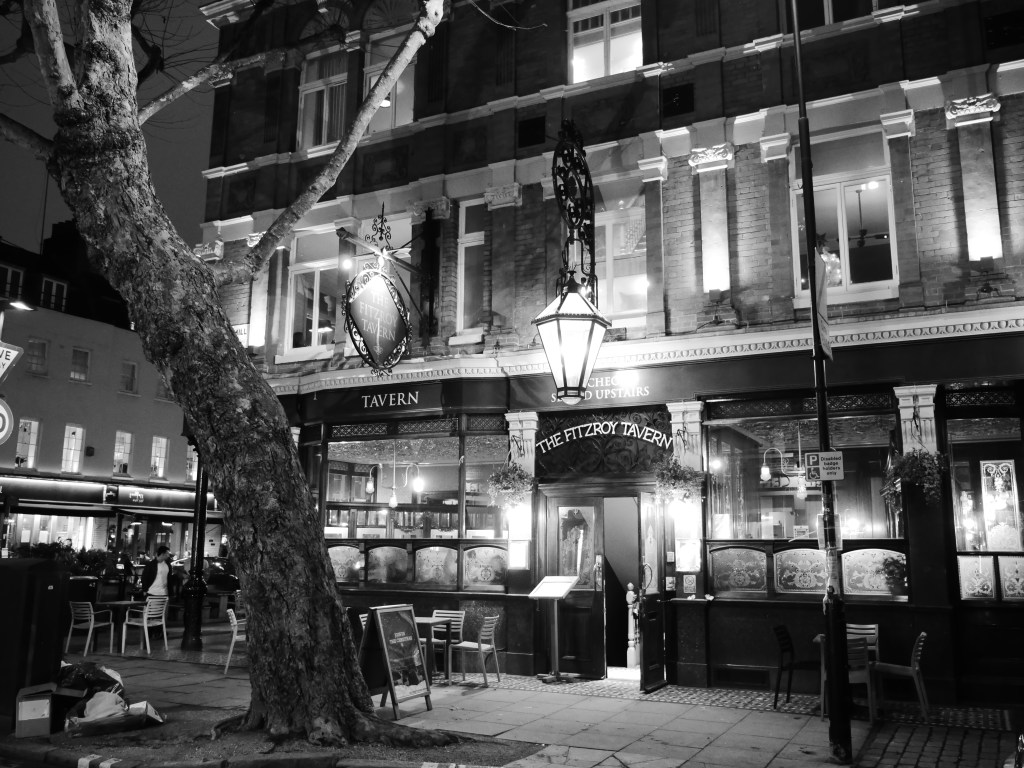
Development came to the Fitzrovia neighborhood starting along Oxford Road and Oxford Circle where more regal mid to late 18th century architecture was built for the noble classes. But the bulk of Fitzrovia’s development occurred during the late 18th and early century lined with middle class Georgian Terrace Housing lacking the more elegant square garden housing widespread in neighboring Bloomsbury and Soho (with the exception of Fitzroy Square). The name “Fitzrovia” came into use in the late 1930s among an artistic, bohemian circle that gathered at Fitzroy Tavern. The neighborhood was a cheaper alternative to surrounding West End neighborhoods. The neighborhood was home to writers such as Virginia Woolf and George Bernard Shaw. Fitzrovia became even more disinvested in the 60s & 70s and had a good amount of vacancy in this era. But this did not last as reinvestment came to the area starting in the 90s moving it more inline economically with surrounding Central London Districts. Yet Fitzrovia has managed to maintain a good amount of economic diversity as many buildings have been maintained as low-moderate income housing association. Fitzrovia’s most prominent feature is the BT Tower on Cleveland Street which towers over the rest of the neighborhood. Fitzrovia also has a large daytime population (around 50K) and historically was a known for its fashion and advertising industries concentrated along Charlotte St.
From an urbanist perspective Fitzrovia’s is a very comfortable and walkable district with several small scaled business district, lots of mixed-use areas and convenient access to the West End, Oxford Circle and Central London thanks to its excellent subway connectivity. Outside of the Oxford Corridor Fitzrovia lacks the tourist buzz of many Central London Districts yet still manages to maintain a very vibrant restaurant, bar, and cultural scene. The two biggest issues I have with Fitzrovia is a lack of connected bike lanes and the stroad like Euston Rd forming its northern border. The population should also be higher (currently at around 25K souls per square mile) as it is a center city European neighborhood that is in high demand.
Click here to view my Fitzrovia Album on Flickr
URBAN STRENGTHS:
- Oxford Street is a major shopping district filled with several department stores. One of London’s most famous streets.
- Tottenham Cour, Mortimer/Goodge St and Great Portland are all solid medium sized biz districts. Charlotte St/Rathbone is very active more intimate commercial street.
- Great mix-use fabric and most blocks in Fitzrovia including plenty of universities and colleges. Jane Jacobs would love this district. About 50K people work in this small district.
- Major TOD nodes with lots of modern office along
- Mix of historic and infill. Generally at 3-7 stories.
- BT tower should have a great view of the city.
- Other than Oxford Street, Fitzrovia is not overwhelmingly touristy.
- Great subway access including 7 metro stops served by 7 transit lines.
- While parks within Fitzrovia are small and limited, the expansive Regent’s Park is located just to the northwest of the neighborhood.
- Great night life here including tons of restaurants, bars, & cafes, plenty of live music venues and several cinemas and performing arts venues. Also a great array of museums and art galleries.
- Decent urban density at around 25K people per square mile.
URBAN STRENGTHS:
* Some well designed and vibrant urban squares and parks but just not enough of them. These include Crabtree Fields, Pearson Square, Whitfield Gardens, the Warren Park. Fitzroy Square Garden is an excellent park surrounding by elegant surrounding terrace housing but the park is unfortunately private.
* Tree canopy is also not surprisingly, limited.
* Some dedicated bike lane segments but not a great network.
* Euston Rd is a busy 6 lane arterial framing the northern edge of Fitzrovia.

 Evaluating our Urban Communities [with a focus on America]