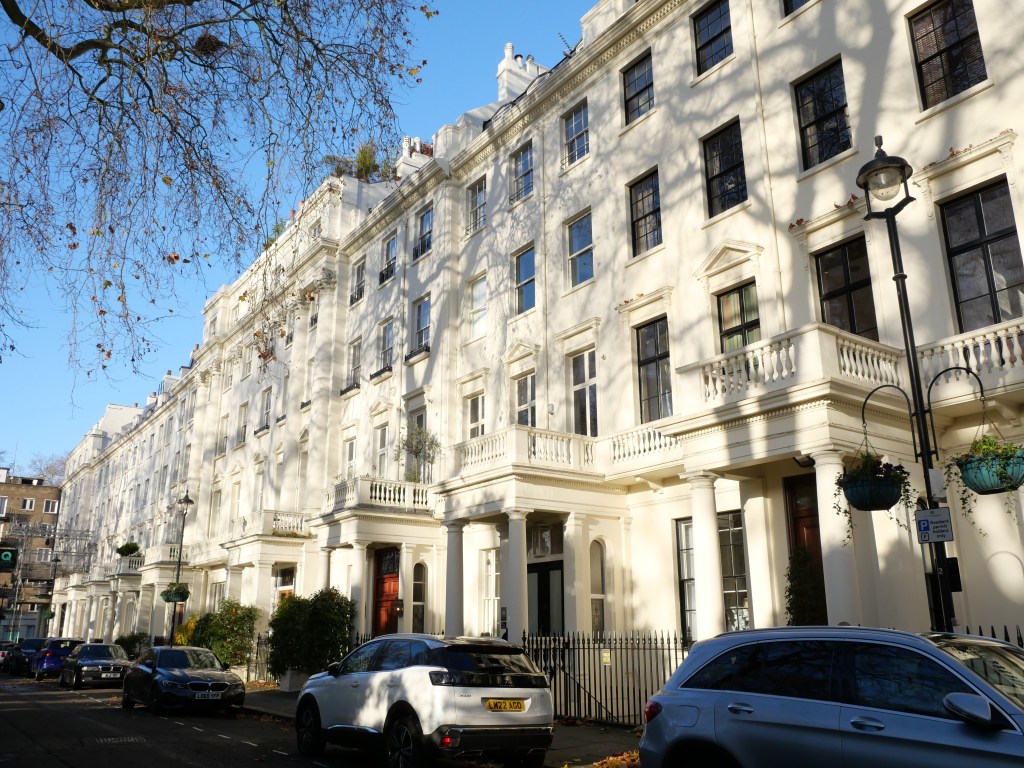
The Paddington Estate was developed at a somewhat slower pace than that of Marylebone on the other side of the Edgware Road. Development really started to come to Paddington Estate in the early 1800s, after the Tyburn Gallows were removed with Connaught Square being one of the first terrace/park housing developed. This was on land owned by the Bishop of London and originally known as the Paddington Estate. It took about 60 years for the neighborhood to fill in with high end stuccoed housing. Interestingly the area north of Hyde Park Estate (where Paddington Station and Basin are located) filled in by the 1830s even though its further from Central London due to the rapid rise of industry and accompanying worker housing. At the turn of the century, Paddington Estates was next to one of London’s most populated slums surrounding Paddington Stations leading to a period of slow decline for the Hyde Park Estates. In the post War Era many of the large stucco terraces had either become damaged in the war or had become subdivided into smaller apartments. In an effort to restore the neighborhood many of these historic complexes were redeveloped as high density flats with underground parking (i.e. Hyde Park Estate and Hyde Park Square) and filled up with higher income residents. By the 1960s Hyde Park Estate’s revitalization was in full swing with the 70s using conservation as a tool for redevelopment instead of urban renewal policies. Thanks to this much of the historic stucco terraces were saved in the neighborhood.
Modern day Hyde Park Estate is a very affluent area and home to several embassies and celebrities. While the post War urban renewal era created new high rise buildings out of character with the historic urban form of the neighborhood, this was not a mortal wound to the urbanity of the district. With a solid urban density of around 35K residents per square mile, a couple walkable commercial districts, decent mixed-use blocks, solid retail, cultural & park amenities, and convenient access to Paddington Station and the Marble Arch & Lancaster Station, this is a quality urban district situated just outside of London’s West end. The biggest issues is that there is very limited Social Housing here and the beautiful Squares are off limits to the public. Bike infrastructure could also be expanded significantly.
Click here to view my Hyde Park Estate Album on Flickr
URBAN STRENGTHS:
* Craven/Praed Rd is the main Biz District
* Westbourne Terrace and Sussex Gardens has gorgeous historic terraces and gardens. Several interesting Mews in the Paddington District.
* Paddington Station is massive and interesting
* Some attractive publically accessible greenspaces (i.e. Paddington Basin, Talbot, and Nolfolk Square Garden).
* Largest number of office jobs surrounding Paddington Station making this a very vibrant district even with a more average population density of btwn 25-30K residents per square mile.
* While there are only 2 metro stations serving the district Paddington Station connections with 5 metro lines providing excellent access across London.
* Tons of food & beverage businesses but limited number of live music venues, museums, and art galleries. Solid retail amenities as well including a modest shopping mall located in Paddington Station.
* Good diversity of architecture incluing more modest Georgain Brick rowhouses, Regal Terrace Housing, modest New rowhouses, and modern office and mixed-use buildings.
URBAN WEAKNESSES:
* Bike lanes are pretty limited and what do existin are in small segments.
* Tree Canopy is pretty limited.
* Green space are pretty limited although residents can walk to Hyde Park pretty easily and Regent Park is about a 1 mile walk.
* Hyde Park lacks the theaters, live music venues, and museums of the Westend of London.


